

CCSD code G5100: Bypass of duodenum billing guide
CCSD code G5100 bills a bypass that leaves the duodenum in place CCSD code G5100...

Last Updated: Oct 16, 2026
S0172 is the HCPCS Level II code for chlorambucil, oral, 2 mg. One unit equals a single 2 mg tablet of chlorambucil, an oral alkylating chemotherapy drug sold as Leukeran.
The code reports the drug supply on its own. Chlorambucil is swallowed, so there is no injection or infusion service to bill alongside it. The Medicare wastage modifiers JW and JZ do not apply either. S0172 sits in the S-series of temporary national codes, which Medicaid programs and commercial payers use rather than Medicare.
Let Pabau's smart automation suggest the right codes, reduce claim denials, and keep your practice compliant—effortlessly.
Automate repetitive tasks and focus on what matters most—your patients.
Reduce coding errors and ensure compliance with the latest regulations.
Clean claims, fewer denials, and faster reimbursements.
Powerful insights and reporting to help your practice thrive.
HIPAA compliant SOC 2 certified GDPR-compliant Trusted by 4,000+ clinics worldwide

HCPCS code S0172 covers chlorambucil taken by mouth, at one unit per 2 mg. The drug is only made as a 2 mg tablet, so one tablet is one unit.
S0172 reports a drug supply only. Chlorambucil is swallowed, so no injection or infusion administration code belongs on the same claim.
The JW and JZ wastage modifiers do not apply. Both report discarded drug from single-dose containers under the Medicare Part B drug benefit, and an S-code is not a Medicare code.
Chlorambucil has no injectable form, so it fails the second criterion of Medicare’s oral anticancer drug benefit. For Medicare patients it sits in Part D.
Sequence the leukemia or lymphoma diagnosis first, then add Z79.630 for long-term use of an alkylating agent.
HCPCS code S0172 is the Healthcare Common Procedure Coding System Level II code for chlorambucil, oral, 2 mg. One unit equals a single 2 mg tablet of chlorambucil, an oral alkylating chemotherapy drug sold under the brand name Leukeran.
The code reports a drug supply, not a service. Nothing is injected, infused or administered under S0172, so no administration code belongs on the same claim line. Billers who treat it as an injection code end up defending a claim the record cannot support.
S0172 sits in the S-series, a set of temporary national codes created for Medicaid programs and private payers. CMS maintains the code set, but traditional Medicare does not pay S-codes. That single fact decides where an S0172 claim can be sent.
The code has carried a CMS effective date of January 1, 2002 and remains in use. Its official descriptor is maintained through the HCPCS Level II code system, which covers drugs, biologicals and supplies that CPT does not describe.
The table below captures the billing attributes that decide how an S0172 line is built. Verify the descriptor and status against the current CMS HCPCS Alpha-Numeric file each year, because S-codes are reviewed and revised annually.
S0172 covers chlorambucil supplied in oral form. Chlorambucil is a nitrogen mustard alkylating agent that damages tumor DNA, and the FDA approved it in 1957 under the brand name Leukeran. The US product is a 2 mg film-coated tablet, and that single strength is the only one on the market.
That one-strength market is what makes the unit basis unusually forgiving. On most drug codes the unit and the dose form differ, so a biller has to convert. Here the tablet and the unit are the same object.
The FDA-labeled uses all sit in the blood cancers:
The label states plainly that chlorambucil is not curative in these disorders. Record what the prescriber expects the course to achieve, rather than leaving a reviewer to infer the treatment goal.
Several nearby products do not belong on an S0172 claim:
Other oral chemotherapy drugs sit outside the alkylating class and carry their own supply codes. Oral mercaptopurine bills as S0108, at one unit per 50 mg. Oral antiemetics follow the same pattern, and ondansetron taken by mouth bills as S0119 at 4 mg per unit.
Most state Medicaid programs require the 11-digit NDC of the dispensed product alongside the HCPCS code. The NDC goes in the qualifier field as N4 followed by the digits, then the unit qualifier, which is UN for tablets. Read it off the package that was dispensed.
S-series HCPCS codes are not part of Medicare’s standard fee schedule. CMS created them as temporary codes for Medicaid programs and private insurers, so a claim sent to traditional Medicare under S0172 will be denied.
Medicare’s oral anticancer drug benefit does not rescue it either. Part B pays for a cancer drug taken by mouth only when the same active ingredient is also covered in injectable form. Chlorambucil has no injectable version, so it fails that criterion and moves to the Part D pharmacy benefit.
Other oral cancer drugs land in the same place. HCPCS code S0170 covers anastrozole, oral, 1 mg, and Medicare patients fill it through a Part D pharmacy claim. The S-code itself is left for Medicaid and commercial payers that accept it.
The pharmacy-versus-medical split settles most S0172 questions before they start. Chlorambucil is a self-administered tablet, so the majority of plans pay for it at the pharmacy counter. S0172 exists for the cases where a payer wants the drug reported on a professional or institutional claim instead.
Medicaid is the primary payer for S0172, and the rules are state-administered. Coverage criteria, claim forms and NDC requirements differ from one program to the next. The requirements that recur across most programs are these:
Teams new to billing dispensed drugs should adopt one standing procedure. Record the NDC and the milligram strength at the moment the drug is supplied. Reconstructing both from a prescription note days later is where the errors start.
Every S0172 claim needs a supporting ICD-10-CM diagnosis code to establish medical necessity. Because chlorambucil treats blood cancers, the supporting diagnoses cluster in the neoplasm chapter. Our ICD-10-CM code index lists those chapters in full.
Sequence the malignancy that drove the prescription first, then add Z79.630 as a secondary code. Leading with the drug-therapy code tells the payer that a medicine is being taken and nothing about why.
No. Chlorambucil under S0172 is swallowed, so there is no injection or infusion service to report. CPT 96372 covers subcutaneous and intramuscular injections, and CPT 96413 covers intravenous chemotherapy infusion. Neither has any application to a tablet.
The mix-up has a traceable source. The neighboring code S0171 read injection, bumetanide, 0.5 mg before it was deleted and crosswalked to J1939. A charge master still carrying that entry sits one digit away from S0172, and the injection wording travels across with it.
Retired oncology S-codes follow the same path. HCPCS code S0115 covered bortezomib, 3.5 mg, and the reference product now bills under J9041 at 35 units per vial. A charge master audit should catch both entries at once.
Drug wastage modifiers are the other misapplication. JW and JZ report discarded and non-discarded amounts from single-dose containers under the Medicare Part B drug benefit. A tablet is not a single-dose vial, and an S-code is not a Medicare code. Neither modifier belongs on an S0172 line.
An evaluation and management visit is a separate question. Where the prescriber performs and documents a separately identifiable assessment on the same day, the E/M service is reported on its own terms.
S0172 claims that reach a human reviewer are most often denied for thin documentation. The electronic claim carries the data elements below, and the clinical record has to support each one.
Chlorambucil also appears on the NIOSH list of hazardous drugs as an antineoplastic. Practices that hold and dispense it on site need the handling controls that go with that status, and the record should show they were followed.
Store S0172 in the charge master with the 2 mg unit basis in the item description. Flag the line as supply only, with no administration code. The flag stops a biller reaching for CPT 96372 out of habit when the encounter is coded.
S0172 does not work in isolation. Knowing the adjacent codes prevents miscoding when a payer rejects the S-code, or when a patient moves to a different alkylating agent.
The J8999 pairing matters most in day-to-day work. A payer that does not recognize S-codes may still cover chlorambucil under the unlisted oral chemotherapy code. Carry the drug name, strength and NDC in the claim narrative. Check the payer’s drug policy before concluding the claim has nowhere to go.
Denials on S0172 cluster around a short, predictable list. Most are workflow problems rather than clinical ones, so they can be designed out once. The checklist below splits the claim line into what to include and what to leave off.
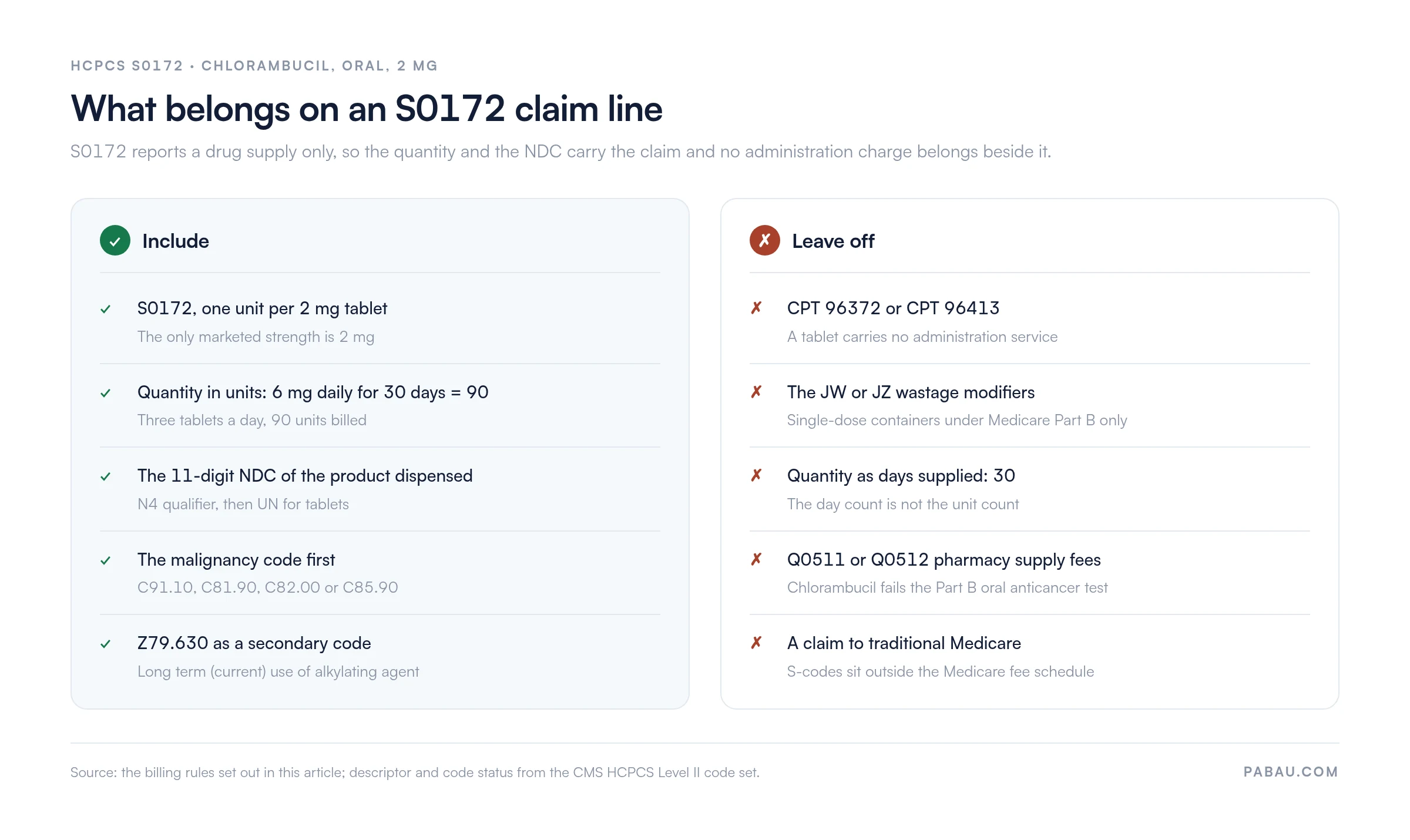
Systematic denial management starts by tracking which remittance codes land on rejected S0172 lines. CO-96 points at a non-covered code, CO-16 at missing claim information such as the NDC, and CO-151 at the quantity billed. Sorting denials by that signal shows whether the cause is the charge master, a training issue or a payer policy change. Feeding the answer back into the practice’s revenue cycle management routine is what stops the same denial recurring.
Managed care plans commonly require prior authorization before an oral chemotherapy drug is dispensed. Submit the request before the fill, because retroactive approval is rarely granted.
Before appealing an S0172 denial for a non-covered code, check whether the payer wants J8999 instead. Refiling under the unlisted oral chemotherapy code, with the drug name, strength and NDC in the narrative, often pays faster than a full appeal.
Drug billing has more moving parts than procedure billing. The NDC has to travel from the package to the record to the claim without re-entry. The quantity has to be derived from milligrams rather than counted in days. The diagnosis that justified the prescription has to be sequenced first.
Practices stitching that chain together by hand repeat the work on every fill. Practice management software like Pabau, with claims management built in, takes the repetition out. Pabau stores each HCPCS code with its unit basis and its NDC. The billing detail then flows from the encounter record to the claim in one step.
For oncology and hematology teams supplying oral chemotherapy, that means fewer quantity corrections and a shorter route from prescription to paid claim.
Integrated billing also supports the HIPAA requirements that govern electronic claims, from correct code set use to audit-ready records. The superbill for each encounter should already hold S0172, the unit count, the NDC, the rendering provider NPI and the diagnosis. A biller can then post it without rebuilding the record.

Practice management software like Pabau stores each HCPCS code with its unit basis and NDC, and keeps supply-only codes clear of administration charges. See how the claims workflow handles oral chemotherapy billing.

HCPCS code S0172 is a drug supply code with one sharp edge. It reports chlorambucil tablets and nothing else. An administration code, an infusion code or a wastage modifier on the same claim marks the line as miscoded.
Set the charge master up once with the 2 mg unit basis and a supply-only flag. Record the NDC and the milligram dose as the drug is dispensed, then sequence the malignancy ahead of Z79.630.
Oncology and hematology practices supply oral chemotherapy week in, week out. Practice management software like Pabau keeps the code, the unit basis and the NDC together from the record to the claim.
To see how it handles drug billing end to end, book a demo.

Billing another oral drug in the same S-code range? HCPCS code S0169 covers oral calcitriol, its 0.25 microgram unit basis and the payer rules that go with it.
Looking at drug-code denials across the whole practice? Revenue cycle management explained shows how to structure the workflow that catches quantity and NDC errors before submission.
Need the documentation side tightened up? Medical billing compliance sets out the record-keeping that supports drug claims through an audit.
HCPCS code S0172 is the HCPCS Level II code for chlorambucil, oral, 2 mg. One unit equals a single 2 mg tablet of chlorambucil, an oral alkylating chemotherapy drug sold as Leukeran. It is an S-series temporary national code used by Medicaid and commercial payers rather than Medicare.
No. S0172 covers chlorambucil taken by mouth, supplied as a 2 mg tablet. There is no approved injectable form of chlorambucil in the United States. The confusion usually comes from S0171, a deleted injection code for bumetanide that sat one digit away and was crosswalked to J1939.
No. An oral drug carries no administration service, so CPT 96372 for an injection and CPT 96413 for a chemotherapy infusion have no application. Billing either one alongside S0172 invites a denial and a review of the practice’s other drug lines.
One unit is 2 mg of oral chlorambucil. The drug is only marketed as a 2 mg tablet, so one tablet is one unit. A 6 mg daily dose over 30 days comes to 90 units. Billing the 30 days instead of the 90 units is the usual quantity error.
C91.10 for chronic lymphocytic leukemia is the most common pairing, followed by the Hodgkin and non-Hodgkin lymphoma codes C81.90, C82.00 and C85.90. Add Z79.630 for long-term use of an alkylating agent as a secondary code, and sequence the malignancy first.



