

CCSD code G5100: Bypass of duodenum billing guide
CCSD code G5100 bills a bypass that leaves the duodenum in place CCSD code G5100...

Last Updated: Oct 16, 2026
J8510 is the HCPCS Level II code for busulfan; oral, 2 mg. Each billed unit equals 2 mg of the tablet dispensed, so the unit count comes from the pharmacy record rather than the prescription.
Three errors account for most J8510 denials. Coders miscalculate units, omit the NDC on Medicaid claims, or apply waste-modifier logic built for single-dose injectable vials to a multi-tablet oral drug.
Let Pabau's smart automation suggest the right codes, reduce claim denials, and keep your practice compliant—effortlessly.
Automate repetitive tasks and focus on what matters most—your patients.
Reduce coding errors and ensure compliance with the latest regulations.
Clean claims, fewer denials, and faster reimbursements.
Powerful insights and reporting to help your practice thrive.
HIPAA compliant SOC 2 certified GDPR-compliant Trusted by 4,000+ clinics worldwide

J8510 describes busulfan (Myleran) oral 2 mg, and each billed unit equals 2 mg dispensed
Medicare Part B covers J8510 under oral anti-cancer parity when the IV form would also be covered. Medical necessity must be documented per the MAC’s LCD
Reimbursement follows ASP methodology and changes quarterly, so verify the current CMS ASP file before submitting
Medicaid requires NDC reporting on J8510 claims. Medicare Part B does not mandate it, though some MACs request it
Pabau’s claims management software supports J-code billing workflows and tracks claim status end to end
HCPCS code J8510 is the Healthcare Common Procedure Coding System Level II code for busulfan, administered orally, billed in 2 mg increments. CMS maintains J8510 in the oral anti-cancer drug J-code range, and the code is active and billable. Both the short and long descriptors read “Busulfan; oral, 2 mg.”
Not every oral chemotherapy drug sits in the J-code range. Chlorambucil, another oral alkylating agent, bills under S0172, a temporary S-series code that Medicare does not pay.
Oral chemotherapy codes sit between pharmacy benefit management and Part B drug policy, which is where J8510 gets misrouted. Coders unfamiliar with oral anti-cancer parity sometimes send busulfan to Part D, and the denial then takes weeks to unwind.
Busulfan is a bifunctional alkylating chemotherapy agent that cross-links DNA strands and disrupts replication in rapidly dividing cells. The FDA has approved oral busulfan for two indications. It is used for palliative treatment of chronic myelogenous leukemia (CML), and for conditioning before hematopoietic stem cell transplantation (HSCT), usually alongside cyclophosphamide.
Busulfan carries an FDA Black Box Warning for severe, life-threatening myelosuppression. This guide covers billing only and is not dosing or clinical guidance.
The distinction between oral busulfan (J8510) and injectable busulfan (J0594) matters at the claim level. Submitting J8510 for an IV dose, or J0594 for a tablet, triggers a route-mismatch denial. Confirm the route of administration against the pharmacy dispensing record before you pick the code.
Medicare Part B covers J8510 under the oral anti-cancer treatment parity provision. That provision requires Part B to cover an oral anti-cancer drug at the same level as its intravenous equivalent. It applies where both formulations are medically accepted for the same indication.
Injectable busulfan (J0594) is covered under Part B, so oral busulfan qualifies for parity coverage on the same FDA-approved indications. Coverage is not automatic on every claim. Three conditions must be satisfied, and the third one changes by contractor.
Reimbursement is based on Average Sales Price (ASP) plus a percentage add-on, consistent with CMS Part B drug payment policy. ASP rates are updated quarterly by CMS. Citing a rate from a prior quarter on a current claim frequently leads to audit flags. Pull the current ASP file from CMS’s physician fee schedule search each quarter, and put that pull on the billing calendar.
Because ASP rates change quarterly, the table below shows the structure of J8510 fee schedule data rather than a fixed dollar figure. Always verify the current allowed amount against the live CMS ASP quarterly file before submitting claims.
Tracking electronic remittance advice (ERA) for J8510 claims is the fastest way to catch ASP underpayments before they pile up. Practice management software like Pabau tracks each J-code claim from submission to payment posting, with claims management built into the same patient record.
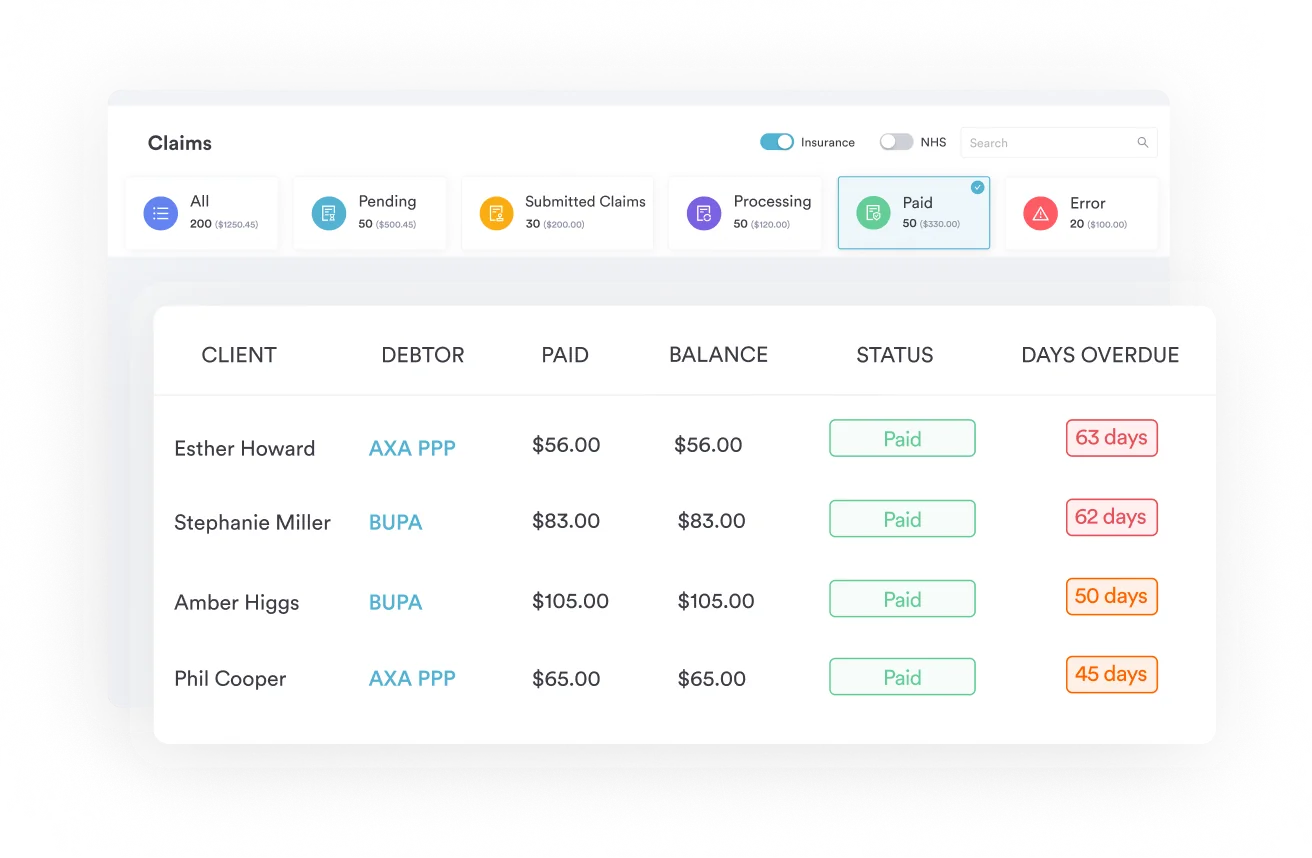
A paid J8510 claim turns on four things. Those are the unit count, the diagnosis, the NDC where the payer wants one, and the place of service. The seven steps below follow an oral chemotherapy dispense in a practice setting.
Route, units, and the payer’s NDC rule are where the claim is won or lost, so check them in that order.
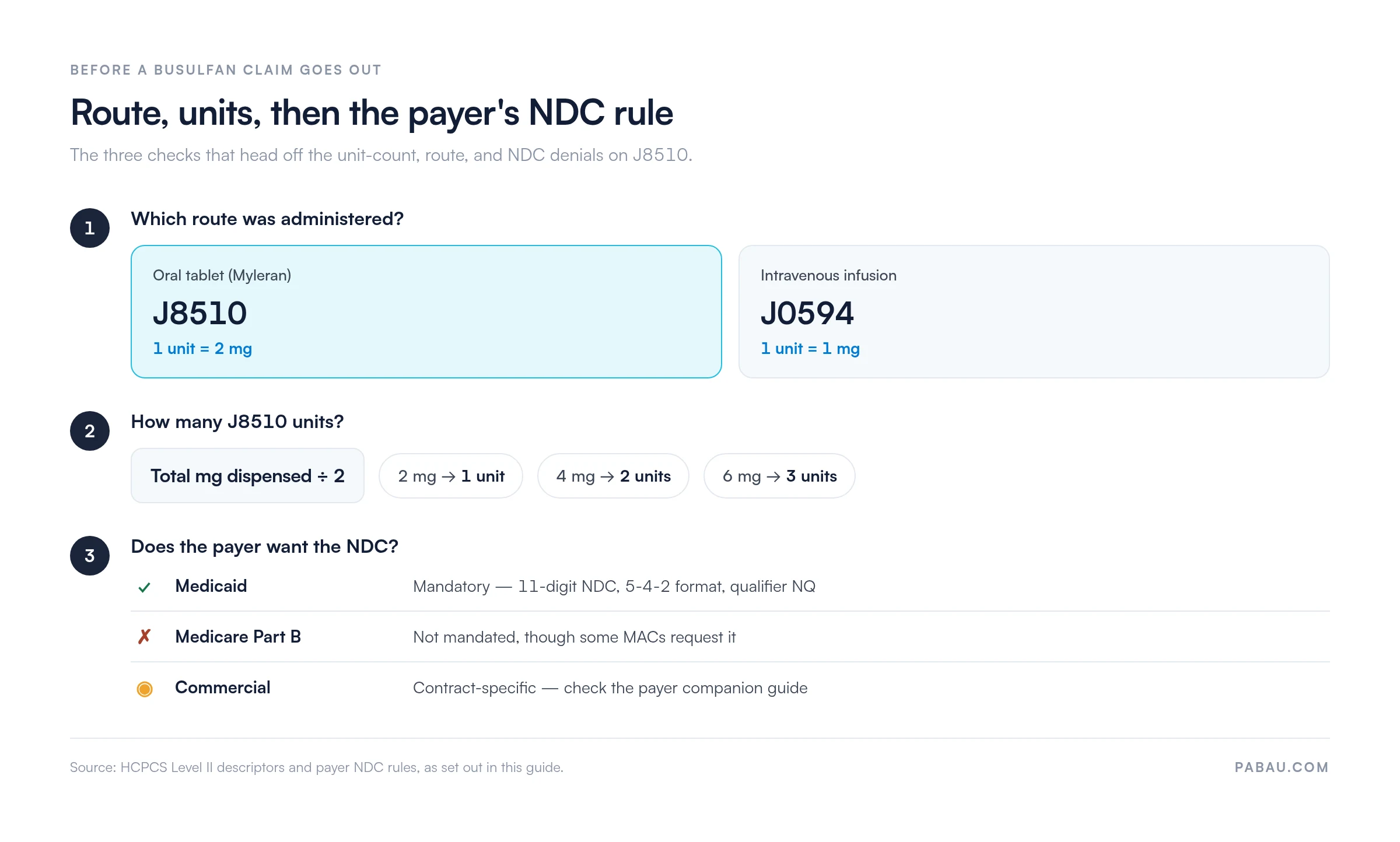
Audit your J8510 units against pharmacy dispensing logs monthly. Billing 1 unit for a 4 mg dose is the most common error on busulfan claims. It is also the easiest one to catch in a pre-submission scrub. Build a unit-calculation lookup into your charge entry workflow: Total mg dispensed divided by 2 equals units billed.
CMS built its JW and JZ modifier policy around single-dose vials with measurable waste. Oral busulfan is dispensed in multi-tablet bottles, so that logic does not transfer cleanly.
Whether waste-reporting modifiers apply to a tablet depends on current CMS guidance and, in some cases, on MAC policy. Confirm the requirement with your MAC before you append one.
Every J8510 claim requires at least one ICD-10-CM diagnosis code that supports medical necessity for busulfan. The diagnosis must align with an FDA-approved indication and, where a MAC LCD exists, must appear on the covered diagnosis list. Using an off-label or unsupported ICD-10 code is the second most frequent cause of J8510 denials after incorrect units.
Confirm each code against your MAC’s LCD coverage list before submission. Some local determinations specify remission status qualifiers or require the transplant status code as a secondary. Our ICD-10-CM code index is the place to check a neighboring diagnosis before you commit to one. Document the clinical rationale in the patient record to support the selected code.
NDC (National Drug Code) reporting rules differ between Medicare and Medicaid, and mixing them up is a frequent source of J8510 claim errors.
To report the NDC for busulfan oral correctly on an 837P claim, use the 11-digit NDC in the 5-4-2 format. Leading zeros must be included. The unit of measure is typically “UN”, meaning each tablet.
Cross-reference the dispensed package’s label for the exact NDC, since different manufacturers and package sizes carry different NDC numbers. Using an NDC from a prior dispense that no longer matches the current package will cause a validation mismatch.
A J8510 claim is only as strong as the record behind it. Payers ask for documentation when parity coverage is reviewed, and the request usually arrives months after the dispense.
Hold these records for the retention period your state and payer contracts require. An audit that lands two years later is answered from the chart, not from memory.
Busulfan billing staff frequently need to reference sibling codes when crosswalking between routes of administration or when billing combination conditioning regimens. The table below covers the most commonly referenced codes in an oncology billing workflow that includes J8510.
The AAPC’s HCPCS code lookup is a useful free reference for confirming descriptors and checking code-specific billing notes. For HCPCS Level II structure and maintenance, the CMS HCPCS overview is the definitive source.
If a conditioning regimen sends you to the cyclophosphamide side of the claim, our guide to J9070 covers the replacement codes in detail.
Five errors account for most avoidable J8510 denials. Oncology coders juggle weight-based dosing cycles, multi-drug regimens, and parity coverage conditions at once, which is where they creep in.
Flag J8510 as a high-attention code in your denial workflow. Unit calculation and parity coverage give it two failure points, and both are caught in a pre-submission scrub.
Most oncology billing teams run J8510 through three disconnected places. The dose lives in the pharmacy log, the diagnosis lives in the chart, and the unit count gets typed into the claim by hand.
Pabau keeps the dispense record, the diagnosis, and the claim on one patient record. The charge line pulls the dispensed milligrams straight from the record, so the unit count is calculated rather than retyped.
Claim status and ERA postings land in the same place, with denial reasons attached to the claim they came from. A parity review is then answered from the chart that produced the claim.
The result is fewer unit-count corrections, faster parity appeals, and a shorter list of J-code claims nobody has chased. Every Pabau subscription includes the billing tools, so nothing here sits behind a higher tier.

Pabau’s claims management tools give oncology billing teams visibility across every step, from J-code submission to payment reconciliation. See how Pabau handles oral chemotherapy billing workflows.

J8510 is a small code with an exacting set of rules. The unit math is trivial, but it only works if the number on the claim comes from the dispensing record rather than the prescription.
Build the three checks into a pre-submission scrub and the denial pattern changes within a quarter. Leave them to the coder’s memory and busulfan claims will keep coming back, one parity review at a time.
Book a demo to see how Pabau tracks a J8510 claim from the dispensing record through to the ERA.

Want to see what happens to a J8510 claim after you hit submit? How a medical claims clearinghouse works explains the electronic validation steps between submission and adjudication.
Need your charge capture to feed the claim cleanly? Superbill guide for medical practices covers the fields to structure so unit counts and diagnoses travel together.
Working a J8510 denial queue? Denial management in healthcare sets out how to triage, rework, and resubmit without losing the appeal window.
Want fewer drug claims coming back at all? What makes a clean claim lists the checks that get a claim paid on first submission.
Reporting on where the money stalls between dispense and payment? Revenue cycle management explained shows which stages to measure first.
HCPCS code J8510 reports busulfan (Myleran) administered orally, in 2 mg increments. Practices use it to bill Medicare Part B and other payers for oral busulfan dispensed for chronic myelogenous leukemia or HSCT conditioning.
Divide the total milligrams of busulfan dispensed by 2. Each J8510 unit equals 2 mg, so a 4 mg dose = 2 units, and a 6 mg dose = 3 units. Always confirm against the pharmacy dispensing record before billing.
Yes, Medicare Part B may cover oral busulfan under the oral anti-cancer parity provision. Parity applies when the IV formulation (J0594) would also be covered and the claim meets the MAC’s LCD medical necessity criteria. Coverage is not automatic. The diagnosis must be an FDA-approved indication, and the documentation must satisfy the applicable local coverage determination.
Modifier GY applies when billing a non-covered indication with an ABN on file. Modifier GA is required when an Advance Beneficiary Notice has been signed. CMS designed the JW and JZ modifiers for single-dose injectable vials. Whether they apply to oral busulfan tablets is uncertain, so verify MAC guidance before using them on J8510 claims.
Medicare Part B reimburses J8510 based on Average Sales Price (ASP) plus a statutory add-on percentage. The exact rate changes quarterly. Retrieve the current allowed amount from the CMS ASP quarterly pricing file before submitting claims, since a prior quarter’s rate is an audit risk.
The most common pairings are C92.10 (chronic myeloid leukemia, BCR/ABL-positive, not in remission), C92.11 (in remission), and C92.12 (in relapse). Z79.899 (long-term medication use) is often added as a secondary. Confirm each code against the applicable MAC LCD before submission.
NDC reporting is mandatory on Medicaid J8510 claims. Submit the 11-digit NDC in the 5-4-2 format with the unit quantity and unit of measure. Medicare Part B does not mandate NDC reporting for J8510, though some MACs request it. Always check state Medicaid and MAC billing instructions for the current requirement.



