CPT Code 62284: Injection procedure for myelography
CPT Code 62284: official descriptor and procedure overview The American Medical ...

Last Updated: Oct 19, 2026
L0980 is the HCPCS Level II code for peroneal straps, prefabricated, off-the-shelf, pair. One unit covers a pair of straps, and the code sits among accessories for spinal orthotics rather than the orthoses themselves.
CMS assigns it coverage code C, carrier judgment, so the DME MAC decides medical necessity claim by claim. No LCD sets criteria for it, so KX does not apply.
Let Pabau's smart automation suggest the right codes, reduce claim denials, and keep your practice compliant—effortlessly.
Automate repetitive tasks and focus on what matters most—your patients.
Reduce coding errors and ensure compliance with the latest regulations.
Clean claims, fewer denials, and faster reimbursements.
Powerful insights and reporting to help your practice thrive.
HIPAA compliant SOC 2 certified GDPR-compliant Trusted by 4,000+ clinics worldwide

L0980 is the HCPCS Level II code for peroneal straps, prefabricated, off-the-shelf, pair. It is an accessory code, not a spinal orthosis.
One unit of L0980 is one pair of straps, so a single pair is billed as one unit rather than two.
CMS assigns L0980 coverage code C, carrier judgment, so the DME MAC decides medical necessity one claim at a time.
L0980 sits outside the L0450 to L0651 range of the Spinal Orthoses LCD, so the KX modifier does not apply.
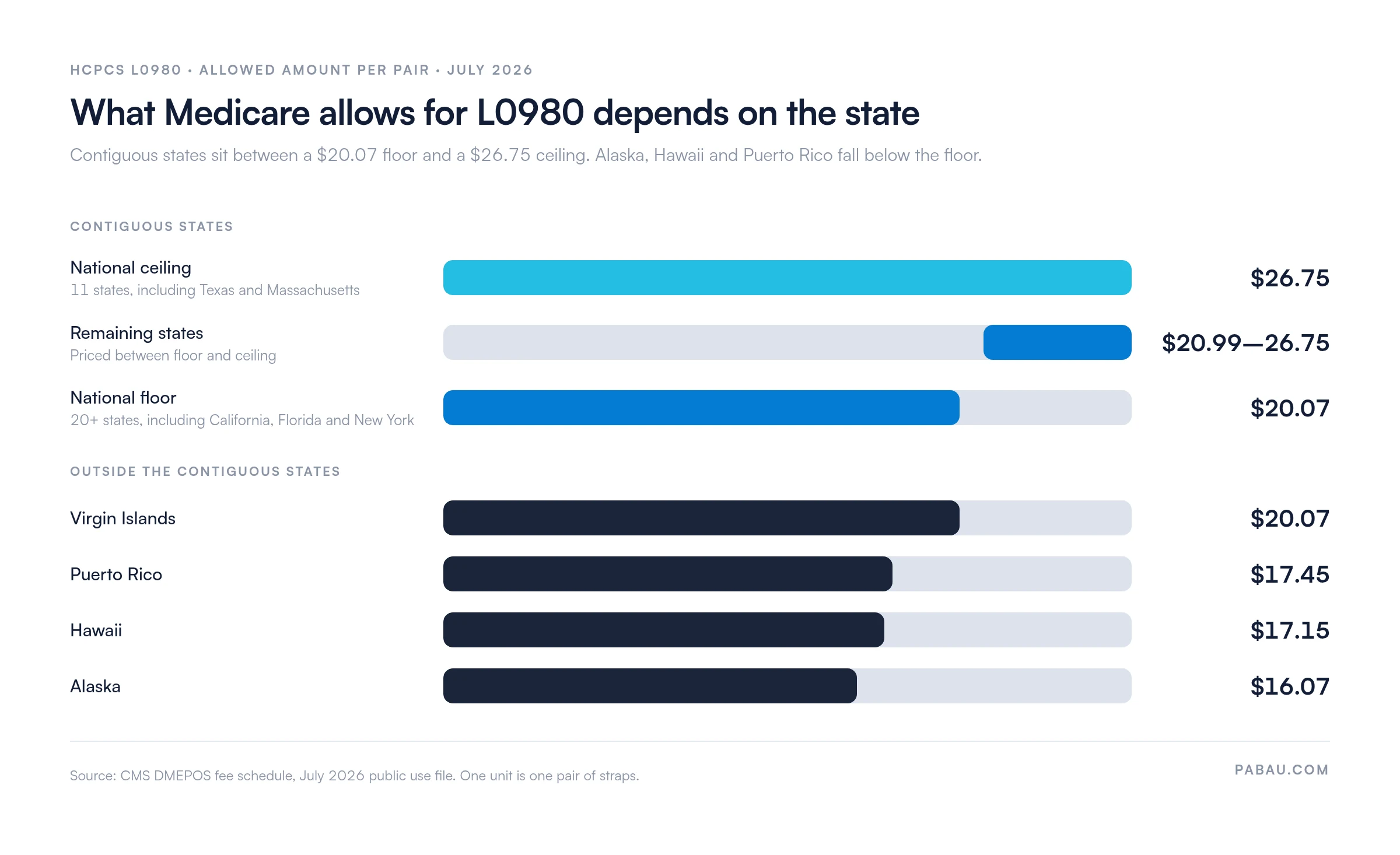
The July 2026 DMEPOS fee schedule sets a national ceiling of $26.75 and a national floor of $20.07 for L0980.
HCPCS code L0980 is the Level II code for peroneal straps, prefabricated, off-the-shelf, pair. That phrase is the complete official descriptor. CMS publishes it in the quarterly HCPCS Level II file with a short description of “Peroneal straps pair pre ots”.
The code describes a pair of straps only. Its descriptor says nothing about panels, sagittal control or spinal levels, so it never covers a back brace. A lumbar-sacral orthosis with rigid anterior and posterior panels is a different code, such as L0648.
L-series codes are one section of the HCPCS Level II code set, covering orthotic and prosthetic items billed as durable medical equipment. One of the four regional DME Medicare Administrative Contractors adjudicates an L0980 claim, not the Part B carrier. CMS assigns the code jurisdiction D and payment category PO, prosthetics and orthotics.
Two CMS files supply every value below. They are the October 2026 HCPCS Level II release and the July 2026 DMEPOS fee schedule public use file.
Each part of the descriptor sets a billing rule. Read them one at a time before you match a product to the code.
The code also sits in an unexpected place. The L0970 to L0999 block holds accessories for spinal orthotics, next to corset codes and a protective body sock. A strap named for the lower leg is filed among trunk accessories.
That placement is why the product itself should settle the code. Check the specific model in the PDAC coding verification database before you bill. Keep the verification, or your own written evidence that the product meets the descriptor, with the order.
CMS prices L0980 through the DMEPOS fee schedule, not the physician fee schedule. The July 2026 file sets a national ceiling and floor for the contiguous states, then a separate allowed amount for every state and territory.
The allowed amount follows state lines rather than supplier type. More than 20 states, including California, Florida and New York, sit at the $20.07 floor. The rest fall between $20.99 and the $26.75 ceiling. Alaska, Hawaii and Puerto Rico sit below the contiguous floor, as the chart below shows.
These are allowed amounts, not payments. Medicare pays 80 percent of the allowed amount after the beneficiary meets the Part B deductible. State Medicaid programs set their own rates, so never carry a Medicare figure across to a Medicaid claim.
CMS attaches a warning to the file itself. Inclusion or exclusion of a fee schedule amount does not imply coverage, so a priced code is still not a covered one.
CMS assigns L0980 coverage code C in the HCPCS Level II file, and coverage code C means carrier judgment. No national or local coverage determination sets criteria for this code. The DME MAC weighs medical necessity one claim at a time.
The spinal orthoses policy does not reach it. LCD L33790, Spinal Orthoses: TLSO and LSO, covers the range L0450 to L0651. Policy Article A52500 stops at L0651 as well, so neither document lists L0980.
The statute behind the braces benefit still frames the decision. An orthosis has to be a rigid or semi-rigid device that supports a weak or deformed body part, or restricts motion in an injured one.
A pair of straps does not meet that definition on its own. Expect the DME MAC to read the claim alongside the orthosis the straps are used with. The record should name that device and explain why the straps are needed.
Prior authorization is not a factor here. L0980 does not appear on the CMS Required Prior Authorization List, which covers a short set of higher-cost orthoses such as L0648.
The modifier set for L0980 is short. Several modifiers that billing teams attach to orthotic claims out of habit do not belong on this code.
With no LCD criteria to meet, the paperwork is what carries an L0980 claim. The DME MAC requests records on audit, and a missing document at that point becomes an overpayment.
Because coverage sits with carrier judgment, the claim line alone does not prove medical necessity. The record behind it does, so work through this list before the claim goes out:
Records usually have to be produced within 45 days of a request. Keep the signed order, the clinical notes and the delivery record in one retrievable place.
Six mistakes turn up again and again on L0980 claims. Each one is visible before the claim leaves the building.
L0980 belongs to the L0970 to L0999 block of accessories for spinal orthotics. Four of those codes are corsets, and the rest are single accessories.
Unit of service is the difference to watch. L0980 counts a pair, L0982 counts a set of four, and L0984 counts each sock. Match the quantity on the claim to the unit the descriptor names.
An L0980 claim is small, but it leans on paperwork for a second device. The order for the straps, the note on the base orthosis and the delivery record often sit in different places.
Practice management software like Pabau keeps the order, the clinical note and the delivery confirmation on one patient record. Claims then go out from that same record, using Pabau’s practice claims management tools.
Custom forms capture the pieces an orthotic accessory claim needs, including the written order details and the signed ABN. A records request then becomes a lookup instead of a search across drives.

Pabau keeps the written order, the clinical note and the delivery record on one patient file, then submits the claim from it. Your team answers a records request without hunting through drives.

L0980 is a low-value accessory code with a narrow descriptor. Bill it as a pair of prefabricated straps, one unit per pair, and never as a brace.
The work that protects the claim happens before billing. Verify the product against the descriptor, tie the straps to the orthosis they serve, and leave KX off the line.
Pabau keeps that record and the claim in one place for orthotic and DME suppliers. Book a demo to see how an accessory claim leaves the same patient file that holds its written order.

Need a framework for managing claim denials across codes? Denial management in healthcare covers how to build a systematic denial tracking and resolution process.
Want to understand the broader claim submission workflow? Revenue cycle management basics explains how claim submission, payment posting, and denial resolution connect end to end.
Looking for guidance on clean claim standards? Medical billing compliance requirements outlines the documentation standards that keep DMEPOS claims audit-ready.
Billing the accessory next to L0980? HCPCS code L0984 covers the protective body sock, billed each rather than by the pair.
Supplying the corset the straps sit alongside? HCPCS code L0976 explains how the lumbar-sacral full corset is coded and priced.
L0980 is the HCPCS Level II code for peroneal straps, prefabricated, off-the-shelf, pair. It is an accessory code in the L0970 to L0999 range, not a spinal orthosis.
One. The L0980 descriptor already counts the pair, so a single pair of straps is one unit of service.
No. KX attests that an LCD’s criteria are met. L0980 sits outside the range covered by the Spinal Orthoses LCD, and no other LCD sets criteria for it.
The July 2026 DMEPOS fee schedule sets a national ceiling of $26.75 and a floor of $20.07 in the contiguous states. Check your own state’s allowed amount before quoting a price.
No. L0980 covers a pair of straps. A lumbar-sacral orthosis with rigid panels is billed under a code such as L0648.