CPT Code 62284: Injection procedure for myelography
CPT Code 62284: official descriptor and procedure overview The American Medical ...

Last Updated: Oct 19, 2026
S0080 is the HCPCS Level II code for injection, pentamidine isethionate, 300 mg. CMS deleted it effective December 31, 2025, so it is valid only for dates of service through that day.
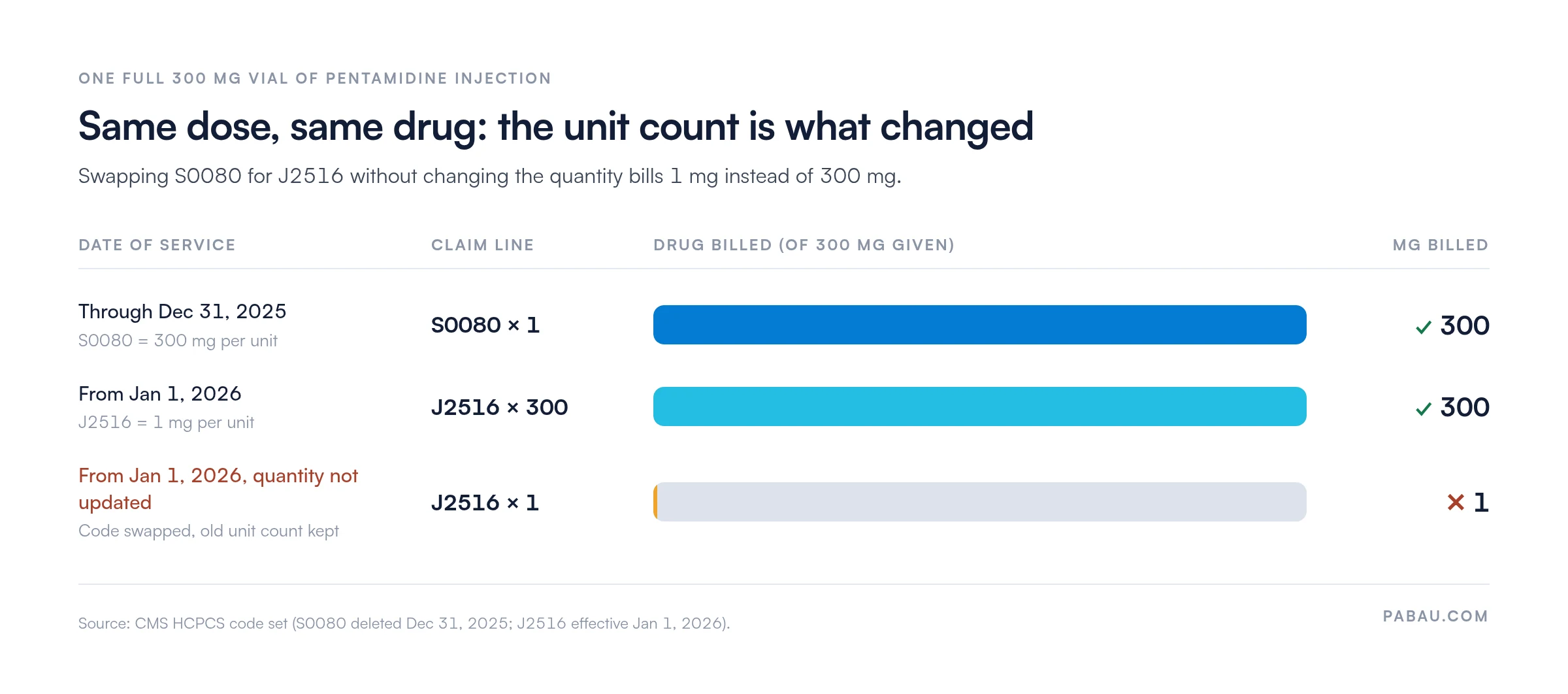
From January 1, 2026, pentamidine injection is billed as J2516, which counts one unit per 1 mg. A full 300 mg vial that was one unit of S0080 is now 300 units of J2516.
Let Pabau's smart automation suggest the right codes, reduce claim denials, and keep your practice compliant—effortlessly.
Automate repetitive tasks and focus on what matters most—your patients.
Reduce coding errors and ensure compliance with the latest regulations.
Clean claims, fewer denials, and faster reimbursements.
Powerful insights and reporting to help your practice thrive.
HIPAA compliant SOC 2 certified GDPR-compliant Trusted by 4,000+ clinics worldwide

HCPCS Code S0080 describes injection, pentamidine isethionate, 300 mg, and one unit equals one 300 mg dose.
CMS deleted S0080 effective December 31, 2025, so it is valid only for dates of service through that day.
From January 1, 2026, pentamidine injection is billed as J2516, which counts one unit per 1 mg.
A full 300 mg vial that was one unit of S0080 is now 300 units of J2516.
Practice management software like Pabau keeps the updated drug code on each charge, so old S0080 lines stop reaching payers.
HCPCS Code S0080 is the Level II HCPCS code that describes injection, pentamidine isethionate, 300 mg. It sits in the S0012-S0197 range of non-Medicare drug codes. Medicaid programs and commercial payers used those codes for drugs that had no specific J-code.
CMS deleted S0080 effective December 31, 2025. Its replacement, J2516, took effect on January 1, 2026, according to the CMS HCPCS code set. The drug is the same, but the billing unit changed from 300 mg to 1 mg.
Pentamidine isethionate is an antimicrobial drug used to treat pneumonia caused by Pneumocystis in immunocompromised patients. The injectable product is sold as Pentam 300, a lyophilized powder in a 300 mg vial.
The Pentam 300 prescribing information sets the dose at 4 mg/kg once a day for 14 to 21 days. It is given by intramuscular or intravenous route only.
The label warns of severe hypotension, hypoglycemia, acute pancreatitis, and cardiac arrhythmias. Patients are monitored closely during and after each dose. Coders record the drug, dose, and units exactly as documented. Whether the dose was clinically appropriate stays with the prescriber.
Inhaled pentamidine is a separate product with its own codes. It is billed as J2545 or J7676, never as S0080 or J2516.
The date of service decides which code goes on the claim. Doses given through December 31, 2025, are reported with S0080. Doses given from January 1, 2026, are reported with J2516.
A claim for a 2026 date of service that still carries S0080 is invalid. Payers reject it the same way they reject any code that was not active on that date.
The unit change is where most 2026 errors start. A charge master that simply swaps the code and keeps a quantity of one bills 1 mg of drug instead of 300 mg. The comparison below shows the same vial billed three ways.
On Medicare claims, single-dose vial drugs also carry the JW or JZ modifier. JW reports the discarded amount on its own line, and JZ confirms none was discarded. For the 240 mg example, 60 units of J2516 would go on a JW line.
Pull every pentamidine charge with a 2026 date of service and check the quantity field. A J2516 line billed at one unit points to a charge master that swapped the code but kept the old unit count.
S0080 still matters for 2025 dates of service. Corrected claims, late claims, and appeals for those dates use the code that was valid when the drug was given.
Medicare Part B never recognized S-codes, so S0080 was never a Medicare code. Medicaid and commercial acceptance depended on each state program and payer contract.
Before J2516 existed, pentamidine injection had no specific J-code. Medicare claims for 2025 and earlier generally used J3490, the unclassified drug code, with the drug name and dose in the claim notes.
Other anti-infective S-codes never got a J-code replacement. S0021 for cefoperazone injection is still active, and Medicare contractors commonly want J3490 with the NDC instead.
Rates for S0080 were never published by CMS. Each state Medicaid agency and each payer contract set its own amount per 300 mg unit.
The same record supports an S0080 claim for 2025 and a J2516 claim for 2026. Payers auditing drug claims look for a clear chain from the order to the administration record.
Missing unit math is a common reason for drug claim denials. A compliant superbill that records the mg given and the mg wasted lets billers calculate units without going back to the chart.
A pentamidine claim often needs an administration code alongside the drug code. The table below lists the codes coders meet most often around S0080.
Rejections after January 1 often carry CO-181, which marks a code that was invalid on the date of service. Checking rejections against common denial codes helps billers spot that pattern quickly.
CMS publishes additions and deletions in the CMS quarterly HCPCS update files. Checking them each quarter catches the next deleted S-code before it reaches a claim.
An earlier deleted S-code shows the pattern. CMS discontinued S0039 on March 31, 2025, and sulfamethoxazole and trimethoprim injection now bills as J2865 per milligram of trimethoprim. CMS deleted S0077 effective July 1, 2023, and clindamycin phosphate injection now bills as J0736 or J0737 per 300 mg.
In many practices, the drug code sits in a charge master that staff rarely open between annual code releases. When S0080 was deleted, that list kept printing it until denials arrived.
Practice management software like Pabau stores the code and default quantity on each treatment and drug line. Update pentamidine once to J2516 at 1 mg per unit, and every new invoice picks it up. Pabau’s built-in claims management then sends the claim and tracks the payer response in the patient record.
The result is fewer invalid-code rejections after each annual release. When a denial does arrive, the charge, the code, and the payer response sit in one place.

Pabau stores the code and unit on each drug line, raises the invoice against the patient’s insurer, and tracks what comes back. One update covers every future charge.

S0080 is now a historical code, but it still decides how 2025 pentamidine claims are corrected and appealed. For any dose given from January 1, 2026, the answer is J2516.
The code swap is the easy part. The unit change from 300 mg to 1 mg is what turns a routine claim into an underpayment. Fix the default quantity at the same time.
Book a demo to see how Pabau keeps drug codes and units current on every claim you send.

Billing the inhaled form of the same drug? HCPCS code J2545 covers non-compounded pentamidine inhalation solution given through DME.
Working with a compounded inhalation product? HCPCS code J7676 explains how compounded pentamidine is billed.
Billing another non-Medicare drug code? HCPCS code S0081 covers piperacillin sodium injection and the S-code versus J-code decision.
Seeing invalid-code rejections after January 1? Denial management in healthcare covers how to group denials by cause and work them down.
Want fewer rejections on drug claims? Submitting a clean claim covers the formatting and documentation that prevent common rejections.
HCPCS Code S0080 is the Level II HCPCS code for injection, pentamidine isethionate, 300 mg. It is a non-Medicare S-code that Medicaid programs and commercial payers used for pentamidine injection. One unit equals 300 mg.
No. CMS deleted S0080 effective December 31, 2025. It remains correct only for corrected claims, late claims, and appeals for doses given on or before that date.
J2516, injection, pentamidine isethionate, 1 mg, took effect on January 1, 2026. Use it for pentamidine injection given on or after that date.
Multiply the S0080 units by 300, or bill the mg given directly. One full 300 mg vial was one unit of S0080 and is 300 units of J2516.
No. Medicare Part B does not recognize S-codes, so S0080 was never billed to traditional Medicare. Medicare claims for pentamidine injection before 2026 generally used J3490, and 2026 claims use J2516.
Record the drug, the dose in mg, the units billed, and any amount wasted from the vial. Add the route, the date and time given, and the ordering and administering providers. Include the diagnosis that supports medical necessity and the NDC where the payer requires it.