CPT Code 62284: Injection procedure for myelography
CPT Code 62284: official descriptor and procedure overview The American Medical ...

Last Updated: Oct 19, 2026
J7676 is the HCPCS Level II code for pentamidine isethionate, inhalation solution, compounded product, administered through dme, unit dose form, per 300 mg.
Let Pabau's smart automation suggest the right codes, reduce claim denials, and keep your practice compliant—effortlessly.
Automate repetitive tasks and focus on what matters most—your patients.
Reduce coding errors and ensure compliance with the latest regulations.
Clean claims, fewer denials, and faster reimbursements.
Powerful insights and reporting to help your practice thrive.
HIPAA compliant SOC 2 certified GDPR-compliant Trusted by 4,000+ clinics worldwide

HCPCS Code J7676 covers compounded pentamidine isethionate inhalation solution, per 300 mg unit dose, delivered through a DME nebulizer.
J2545 covers the FDA-approved non-compounded version of the same drug, so the pharmacy’s product decides which code you file.
Medicare Part B covers J7676 under the DMEPOS fee schedule, at rates that vary by locality and change every January.
A signed physician order and a diagnosis supporting PCP risk carry medical necessity, since CMS retired the Certificate of Medical Necessity in 2023.
Pabau’s claims management software supports HCPCS Level II J code entry, claim generation, and documentation tracking for compounded inhalation drugs.
HCPCS Code J7676 describes pentamidine isethionate, inhalation solution, compounded product, administered through DME, unit dose form, per 300 mg. It sits within the HCPCS Level II J-code range, which CMS maintains annually as the classification system for drugs and biologicals not covered by CPT. The short descriptor used on claims is “Pentamidine comp unit dose.”
The key word here is compounded. J7676 applies only to pharmacy-compounded pentamidine prepared specifically for inhalation. The nebulizer is the delivery device, classified as DME, which places this code in the DME billing pathway rather than the physician drug-administration pathway.
Pentamidine inhalation is used primarily for Pneumocystis jirovecii pneumonia (PCP) prophylaxis in immunocompromised patients. The standard prophylaxis regimen is 300 mg through a nebulizer once every four weeks, which maps directly to J7676’s unit-of-service definition.
The patient population includes adults with HIV/AIDS, solid organ transplant recipients on immunosuppressant therapy, and patients with hematologic malignancies receiving chemotherapy. Pentamidine inhalation is typically prescribed when first-line PCP prophylaxis with trimethoprim-sulfamethoxazole is contraindicated or not tolerated.
The clinical indication drives coding accuracy. The ICD-10 diagnosis code submitted with J7676 must substantiate medical necessity. A claim filed with an unrelated or insufficiently specific diagnosis is a common denial trigger.
J7676 is billed by the DME supplier, not the prescribing physician. This is the billing detail that trips up practices most often. The physician writes the order and documents medical necessity. The licensed DME supplier or pharmacy that prepares and dispenses the compounded solution submits the claim. Practices that also operate as DME suppliers must hold the appropriate DMEPOS supplier number to bill this code.
The unit of service is per 300 mg, so one standard monthly PCP prophylaxis treatment equals one unit. Never report partial units, and never aggregate several months of doses onto a single claim line. Adjudication systems flag units that deviate from expected dispensing patterns.
Before submitting, confirm the pharmacy prepared a compounded solution rather than dispensing the FDA-approved NebuPent brand. Dispensing the branded product and billing J7676 constitutes upcoding. Dispensing a compounded product and billing J2545 is equally incorrect. The compounded versus FDA-approved distinction is the most consequential code-selection decision in pentamidine billing, so record the compound label details on the claim documentation.
Medicare Part B covers J7676 when a qualified DME supplier submits the claim. The claim must also meet the medical necessity criteria set by the relevant Durable Medical Equipment Medicare Administrative Contractor (DME MAC). The diagnosis alone does not guarantee coverage. The documentation package has to show that the patient cannot tolerate first-line prophylaxis, and that the prescribing physician assessed and recorded PCP risk.
Reimbursement is set through the DMEPOS fee schedule, not the Physician Fee Schedule. Rates vary by locality and are updated annually by CMS. Use the DMEPOS fee schedule to confirm the current allowed amount for your MAC jurisdiction before quoting patients on cost-sharing. Amounts change each January, so never cite a dollar figure in patient-facing materials without checking the current year’s file.
Medicare applies the 20% Part B coinsurance after the deductible for most DMEPOS drug claims. Secondary coverage, Medicaid, or supplemental insurance may pick up the remainder. Read the remittance advice line by line, because the remark codes there explain every partial payment. Our guide to denial codes decodes the ones that surface most often on DME drug claims.
Every J7676 claim requires a supporting ICD-10-CM diagnosis code that establishes medical necessity for PCP prophylaxis. The diagnosis must reflect the underlying condition creating the immunocompromised state, not the prophylactic treatment itself. CMS and the DME MACs cross-reference submitted diagnosis codes against Local Coverage Determinations (LCDs) to confirm coverage eligibility.
Verify each code against the current CMS ICD-10-CM tabular list before submitting. Codes change annually, so a code valid in a prior year may be retired or may now require additional specificity. Auditing ICD-10 pairing accuracy once a quarter catches those shifts before a payer does.
Modifier selection for J7676 depends on the DME billing context and payer requirements. DME suppliers must apply modifiers that identify the type of equipment and the supplier’s role in furnishing it. Missing or incorrect modifiers are among the top reasons DMEPOS claims are returned unprocessable by DME MACs.
Most single-agent J7676 claims use the KO modifier. Confirm modifier requirements with the AAPC HCPCS code reference and verify against the DME MAC’s Local Coverage Article before filing. Payer-specific modifier rules vary, and some commercial plans do not follow Medicare’s modifier logic.
Thorough documentation is the billing team’s primary defense against audits and post-payment recoveries. For J7676, the DME supplier holds the complete documentation package and makes it available on request. Inadequate documentation is a leading cause of J7676 claim recoupment during DME MAC post-payment reviews.
Build these requirements into your intake workflow so records are complete before the claim is filed, rather than assembled after a denial arrives. Practices that manage documentation proactively see far fewer post-submission audit findings. Retain every patient record tied to a J7676 claim for the period your state law specifies, which is typically six years at minimum.
Document the specific reason pentamidine inhalation was selected over TMP-SMX in its own clinical note entry, rather than inside a general visit note. Reviewers need to find the intolerance or contraindication rationale within seconds. A dedicated medication change note is far easier to retrieve during a DME MAC audit than a buried paragraph in a longer progress note.
J2545 covers pentamidine isethionate, inhalation solution, FDA-approved final product, non-compounded, administered through DME. J7676 covers the compounded version of the same drug by the same route. The two codes describe clinically equivalent treatments, and they are billed under entirely different regulatory and coverage frameworks.
Some commercial payers and managed Medicaid plans require the branded product as a condition of coverage, even where the prescribing physician ordered a compounded one. Verify payer-specific coding preferences during prior authorization review. Filing J7676 where the plan requires J2545 produces a denial that no modifier can correct. A fresh claim carrying the right code has to go out instead. The three checks below settle the choice before anything is filed.
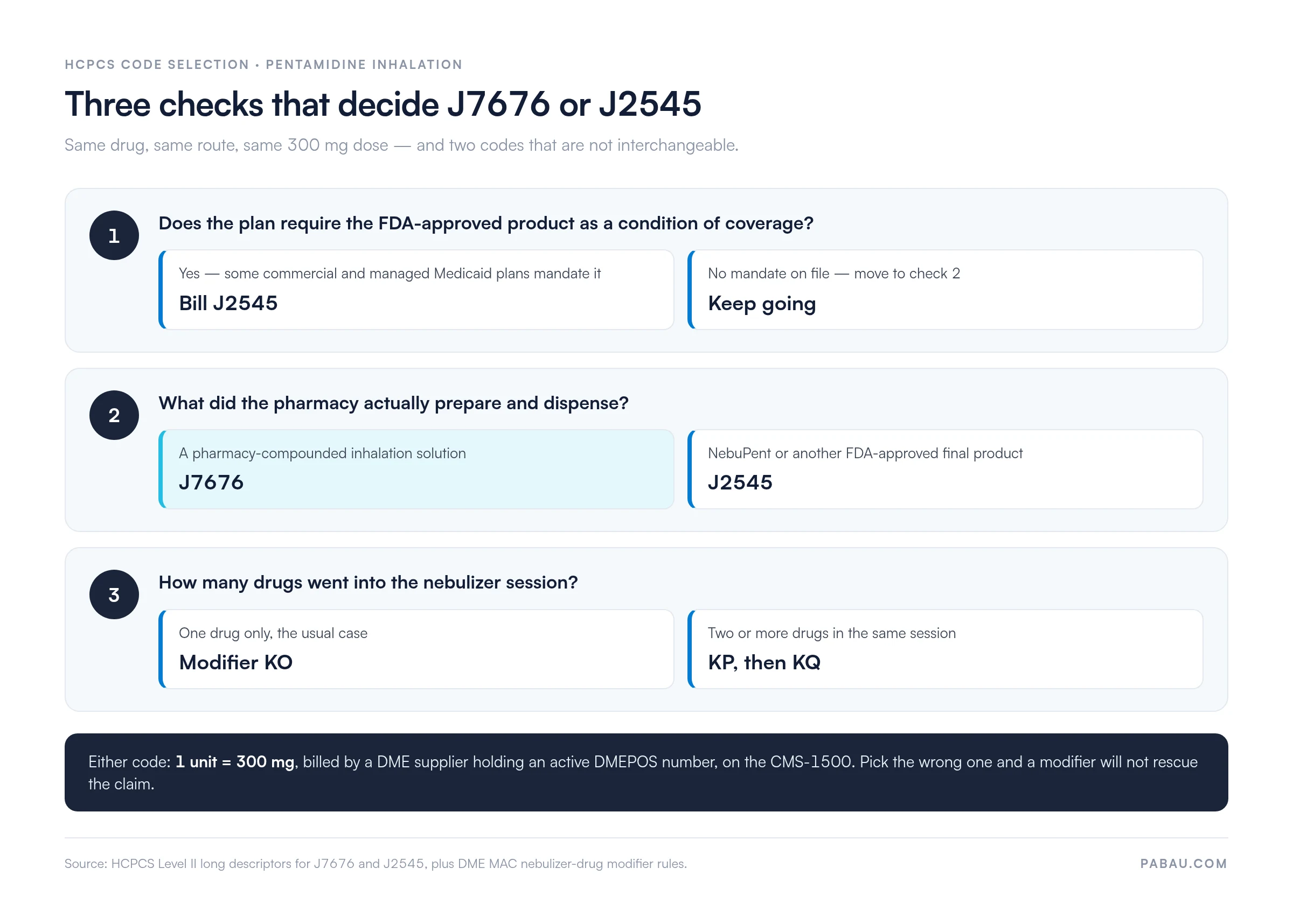
Code selection gets easier once you can see where J7676 sits in the HCPCS inhalation drug family. The codes below share the DME delivery pathway. They differ by drug, by formulation, or by whether the item billed is the drug or the device.
Not every code in the inhalation drug family is nebulized. J7665 covers mannitol administered through an inhaler, and it is counted per 5 mg capsule rather than per 300 mg unit dose.
Practices that bill HCPCS Level II J codes move faster when code entry, documentation, and claim submission live in one system. Tracking compound dispensing records, modifier selections, and ICD-10 pairings across separate spreadsheets is where DME drug claims come apart. The compound label sits in the pharmacy’s file, the order sits in the chart, and the biller reconstructs both from memory.
Practice management software like Pabau keeps that package together. Its claims management software supports HCPCS Level II J code entry alongside the clinical records that substantiate medical necessity. Teams can attach the physician order, the compound pharmacy label, and the diagnosis documentation to the patient record before the claim goes out. A DME MAC review request then becomes a lookup rather than a scramble.
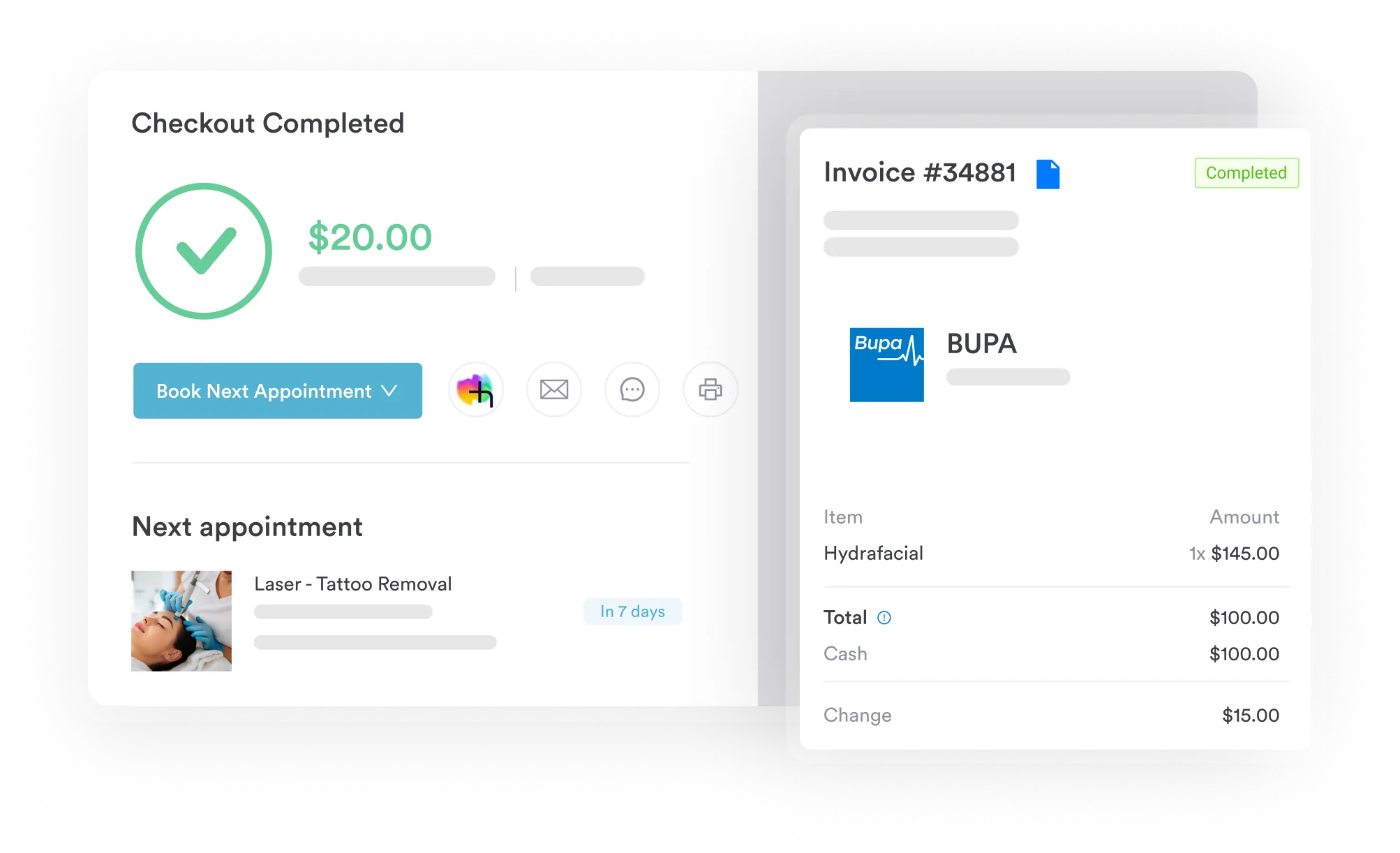
Practices running PCP prophylaxis programs can use Pabau to track the monthly dispensing cycle and flag patients approaching their next scheduled dose. The supporting ICD-10 codes stay linked to each patient’s active problem list. Recurring J7676 billing then runs off the schedule instead of off whoever remembers it.

Pabau’s claims management software supports HCPCS Level II J code entry, documentation tracking, and electronic claim submission. Your billing team spends less time chasing denials and more time on patient care.

HCPCS Code J7676 is a narrow code with an expensive failure mode. Get the compounded versus FDA-approved distinction wrong and the claim is headed for denial, whatever else the file contains. Check the plan’s coverage policy and the pharmacy’s actual product before the code is chosen, not after the remittance advice arrives.
The documentation package, the modifier, and the ICD-10 pairing all reward deliberate attention. None of them survive being templated across patients, because each episode turns on its own clinical facts. The practices that bill this code cleanly are the ones that assemble the file first and submit second.
Pabau keeps the order, the compound label and the diagnosis together behind every claim. If your practice bills J7676 or similar HCPCS drug codes, book a demo to see the documentation ride along with the claim.

Need a foundation in HCPCS billing concepts? Medical billing fundamentals covers how HCPCS codes fit into the broader claims lifecycle.
Want to reduce DME claim denials? Denial management in healthcare outlines the workflow for identifying, correcting, and preventing recurring claim rejections.
Preparing for a billing compliance review? Medical billing compliance breaks down audit readiness for outpatient drug and DME claims.
HCPCS Code J7676 is a Level II HCPCS billing code for pentamidine isethionate, inhalation solution, compounded product. It is administered through durable medical equipment (DME) in unit dose form, per 300 mg. Licensed DME suppliers use it to bill Medicare and other payers for the pharmacy-compounded formulation of inhaled pentamidine. It is most commonly prescribed for Pneumocystis pneumonia prophylaxis in immunocompromised patients.
Yes, Medicare Part B covers J7676 when a qualified DMEPOS supplier submits the claim. It must also meet the medical necessity criteria set by the applicable DME MAC. Coverage requires a valid physician order, supporting ICD-10 diagnosis codes, and documentation of clinical necessity. Reimbursement rates are locality-based and published in the annual DMEPOS fee schedule. Verify current amounts there before estimating patient cost-sharing.
Prior authorization requirements for J7676 vary by payer and DME MAC jurisdiction. Medicare does not universally require prior auth for J7676, but individual DME MACs may impose prior authorization criteria through Local Coverage Determinations. Most commercial plans and managed Medicaid programs require prior authorization for compounded drug products, so check each payer’s policy before dispensing.
Required documentation includes a signed physician order specifying pentamidine 300 mg through a nebulizer. You also need a supporting ICD-10 diagnosis confirming the immunocompromised state, documentation of intolerance to first-line PCP prophylaxis, and the compounding pharmacy label. CMS no longer requires a Certificate of Medical Necessity, having discontinued CMN and DIF forms for dates of service on or after January 1, 2023. Retain all records for the period your state law specifies, typically six years at minimum.