CPT code 21011: Excision of soft tissue tumor of the face
CPT code 21011: Official descriptor and procedure overview CPT code 21011, as pu...

Last Updated: Oct 8, 2026
S0081 is the HCPCS Level II code for injection, piperacillin sodium, 500 mg.
No CMS fee schedule rate exists for S-codes, so each state Medicaid agency and each payer contract sets its own reimbursement. Confirm the code sits on that payer's schedule before the drug is given.
Let Pabau's smart automation suggest the right codes, reduce claim denials, and keep your practice compliant—effortlessly.
Automate repetitive tasks and focus on what matters most—your patients.
Reduce coding errors and ensure compliance with the latest regulations.
Clean claims, fewer denials, and faster reimbursements.
Powerful insights and reporting to help your practice thrive.
HIPAA compliant SOC 2 certified GDPR-compliant Trusted by 4,000+ clinics worldwide

HCPCS Code S0081 describes injection, piperacillin sodium, 500 mg, and one unit equals one 500 mg dose.
Medicare Part B does not cover S0081, so the claim goes to Medicaid or a commercial payer.
When Medicare is the primary payer, the drug is billed as J3490 or a specific J-code instead.
Documentation must show the drug name, the dose in mg, the units given, the route, and medical necessity.
Practice management software like Pabau can keep S-codes and J-codes on the claims that accept them.
HCPCS Code S0081 is the Level II HCPCS code that describes injection, piperacillin sodium, 500 mg. It belongs to the S-series of codes. The Centers for Medicare and Medicaid Services (CMS) maintains that series for Medicaid programs and private commercial payers. S-codes are explicitly excluded from Medicare Part B reimbursement.
The code’s billing unit is per 500 mg. If a patient receives a 1,000 mg dose in a single encounter, the claim should report two units of S0081. Understanding the per-unit structure is essential before configuring claims management software or submitting a charge to any payer.
Piperacillin sodium is a broad-spectrum, extended-spectrum penicillin-type antibiotic in the beta-lactam class. It works by inhibiting bacterial cell wall synthesis and is active against a wide range of gram-positive and gram-negative organisms, including Pseudomonas aeruginosa.
In clinical practice, piperacillin sodium treats serious infections of the respiratory tract, urinary tract, skin, and soft tissue. It is also used for intra-abdominal and gynecological infections.
Many protocols pair piperacillin with tazobactam, a beta-lactamase inhibitor. S0081 describes piperacillin sodium alone, at the 500 mg per-unit quantity.
Coders should note that clinical indications for piperacillin sodium are established by prescribing clinicians and governed by FDA labeling. The coding role is to capture the drug identity and units accurately on the claim, not to make clinical decisions about appropriateness.
HCPCS S-codes operate outside the Medicare fee schedule entirely. S0081 piperacillin sodium claims go to Medicaid managed care plans and commercial insurers, never to traditional Medicare. A claim sent to Part B anyway is denied on payer-policy grounds.
Medicare Part B does not cover S-codes. CMS maintains the S-series for Medicaid and commercial payer use, so no S0081 claim should ever be filed to traditional Medicare. Medicare Advantage is a separate question. Those plans are run by private insurers, and each one decides for itself whether to accept S-codes.
Medicaid coverage for S0081 varies by state. Each state agency sets its own drug codes, fee schedules, and billing rules, so confirm acceptance with that program before submitting. There is no central rate to fall back on, the way the Physician Fee Schedule covers Medicare codes.
Reimbursement for S0081 piperacillin sodium is not uniform across payers. Before billing, confirm three points with each one.
Payer contracts and state Medicaid fee schedules are updated annually, and rates can change without direct notice to providers.
Checking eligibility and benefits before the infusion date is what prevents a non-covered claim later. A payer that leaves S0081 off its fee schedule will not change that position once the drug has been given. Reading the remittance advice from each payer afterwards shows whether S0081 denials cluster around one plan.
Check each state Medicaid portal directly before submitting S0081 for the first time. Some states require the NPI of both the administering practitioner and the ordering provider on drug injection claims, even for outpatient infusion. Missing one NPI is a common clean-claim failure on S-code submissions.
Accurate documentation is the foundation of a clean S0081 claim. Payers auditing drug injection claims look for a consistent chain from prescriber order through administration record. Every element below belongs in the medical record before the claim is submitted.
Incomplete documentation is a leading cause of S0081 claim denials. Creating a compliant superbill that captures all required drug injection fields before the claim leaves the practice reduces back-and-forth with payers.
If a claim is denied for documentation reasons, the path to resolution almost always requires a corrected claim with a complete medication administration record attached.
Grouping S0081 denials by reason code shows which root cause is at work. Missing chart fields point back to documentation, and a payer that never accepted S-codes points back to coverage. Each needs a different fix.
No antibiotic injection claim stands entirely on its own. Depending on the care setting and payer, coders may also need an administration CPT code alongside S0081. The table below lists the most relevant related codes.
The distinction decides which payers will accept the claim. J-codes are also HCPCS Level II drug codes, but CMS maintains them for Medicare billing.
S-codes were created by the BlueCross BlueShield Association for Medicaid and commercial payer use. The association is still active and still helps maintain the S-code set, while CMS keeps those codes outside the Medicare fee schedule.
If the patient has Medicare Part B as primary, bill the drug as J3490, the unclassified drug code. Use a specific J-code instead where one exists for this drug and dose. If the primary payer is Medicaid or a commercial plan, S0081 is correct once that payer’s fee schedule includes it. The chart below sets out that decision.
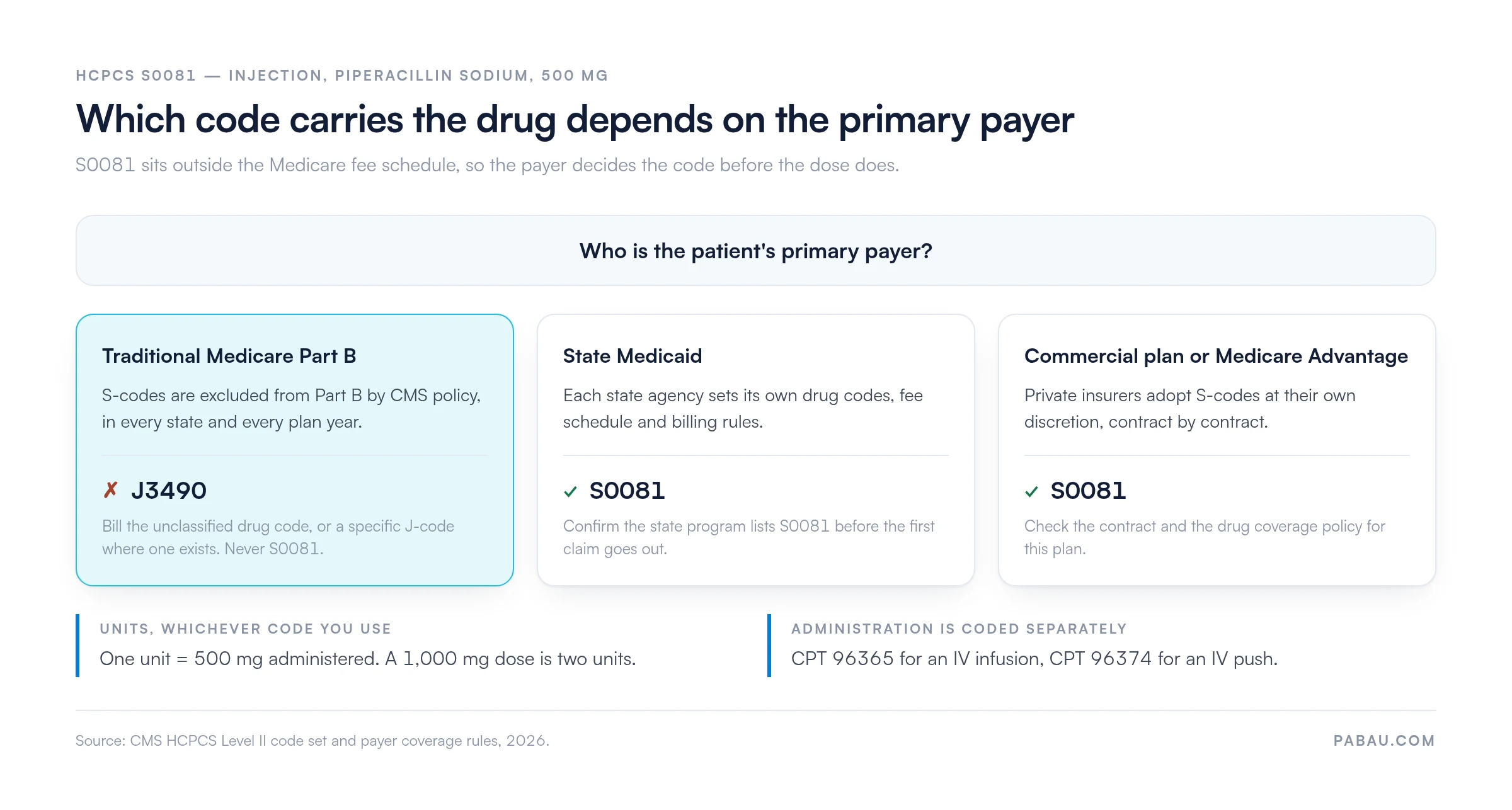
For practices treating a mixed payer population, routing piperacillin claims to the correct code by payer type prevents systematic denials. Before going live with an S-code workflow, check that the clearinghouse maps S-codes to non-Medicare payers on the electronic claim file.
The AAPC HCPCS code reference and CMS fee schedule lookup are the two primary sources for confirming whether S0081 remains active in the current year. S-codes are updated in the annual HCPCS Level II release. A code that was active in a prior year may be deleted, revised, or merged in a subsequent year without broad notification to providers.
Code history also matters at audit. Payers reviewing claims from prior periods apply the descriptor in force at the date of service, not the current year’s wording. A practice that has given piperacillin across several plan years should keep those older descriptors on file.
Verify S0081’s active status each January against the CMS HCPCS code set overview page. Do not treat internal charge master records as the authoritative source for annual code status.
When a code changes, charge masters, superbills, and any contract addenda naming specific HCPCS codes have to be updated before the effective date. Watch the remittances for medical billing denial codes such as CO-96 and CO-181. CO-96 marks a non-covered charge, and CO-181 marks a procedure code that was invalid on the date of service.
Set a recurring calendar reminder for the first week of January to verify active HCPCS S-code status. CMS publishes the updated HCPCS Level II code set each fall with an effective date of January 1. Catching deleted or revised codes before they appear on claims saves denial-correction work in Q1.
In most practices the payer rule lives in someone’s head. A biller remembers that piperacillin goes out as S0081 for Medicaid patients and J3490 for Medicare ones. The mapping holds until that person is on vacation.
Pabau’s claims management tools keep the rule with the charge. Each treatment and drug line carries its own code, so the invoice can be raised against the patient’s insurer with the right code attached. Claim responses land back in the same record as the treatment note.
The outcome is a shorter correction cycle. When a denial arrives, the chart, the code, and the payer’s response are in one place. The rebill takes minutes instead of an afternoon of chasing paperwork.

Pabau’s claims management tools code each drug line, raise the invoice against the patient’s insurer, and track what comes back. Your billers stop rebuilding the payer rule from memory.

S0081 is a simple code to bill correctly, as long as the payer question is settled first. Check the plan, confirm the code sits on that fee schedule, then count units at one per 500 mg administered.
The practices that get caught out are usually the ones whose charge master maps piperacillin to a single code for every patient. Splitting that mapping by payer type takes an afternoon, and it removes a denial pattern that would otherwise repeat on every Medicare claim.
The annual code release is the other date worth a calendar entry, since a deleted or revised S-code shows up first as a denial. Book a demo to see how Pabau keeps S-codes and J-codes on the right claims for every payer you bill.

Need to understand how denials on drug injection claims are classified? Submitting a clean claim covers the documentation and formatting requirements that prevent the most common HCPCS drug code rejections.
Billing the same drug to several payer types? Medical billing compliance requirements explains what billing teams need to document and monitor across multiple payer types.
Managing infusion billing across multiple payers? Creating a compliant superbill walks through the fields that drug injection claims require before submission.
Checking coverage before the drug is given? Insurance eligibility verification sets out how to confirm a plan’s benefits ahead of the appointment.
Seeing the same drug code rejected twice? Denial management in healthcare covers how to group denials by cause and work them down.
HCPCS Code S0081 is the Level II HCPCS code for injection, piperacillin sodium, 500 mg. It is a non-Medicare code used by Medicaid programs and commercial payers to reimburse providers for administering piperacillin sodium in outpatient clinical settings. One unit equals one 500 mg dose administered.
No. Medicare Part B does not cover S-codes, including S0081. S-codes are maintained by CMS for Medicaid and commercial payer use only. Submitting S0081 to traditional Medicare Part B will result in an automatic denial.
State Medicaid programs and many commercial payers accept S0081, though acceptance varies by state and contract. Medicare Advantage plans may or may not cover it depending on their specific plan policies. Always verify S0081 coverage with the patient’s specific payer before administering the drug.
The billing unit for S0081 is per 500 mg administered. If a patient receives 1,000 mg in a single encounter, report two units of S0081. The number of units billed must match the administration record in the patient’s chart exactly.
J-codes are HCPCS Level II drug codes covered by Medicare Part B and generally accepted by Medicaid and commercial payers. S-codes are excluded from Medicare Part B but may be accepted by Medicaid and commercial payers. When a patient has Medicare as primary, use J3490 (unclassified drug) or the applicable specific J-code rather than S0081.
Required documentation includes the drug name (piperacillin sodium), the dose in mg, and the number of 500 mg units administered. The record must also show the route (IV or IM) and the date and time of administration. Name the ordering prescriber with their NPI, and the provider who administered the injection. Add an ICD-10 diagnosis code establishing medical necessity, plus lot number and expiry where payers require it.