CPT code 51797: Intra-abdominal voiding pressure add-on
What CPT code 51797 covers CPT code 51797 is the add-on code for intra-abdominal...

Last Updated: Oct 19, 2026
J2545 is the HCPCS Level II code for pentamidine isethionate, inhalation solution, fda-approved final product, non-compounded, administered through dme, unit dose form, per 300 mg.
Get either one wrong and a routine monthly prophylaxis dose comes back unpaid.
Let Pabau's smart automation suggest the right codes, reduce claim denials, and keep your practice compliant—effortlessly.
Automate repetitive tasks and focus on what matters most—your patients.
Reduce coding errors and ensure compliance with the latest regulations.
Clean claims, fewer denials, and faster reimbursements.
Powerful insights and reporting to help your practice thrive.
HIPAA compliant SOC 2 certified GDPR-compliant Trusted by 4,000+ clinics worldwide

HCPCS code J2545 covers FDA-approved, non-compounded pentamidine isethionate inhalation solution given through DME, at one unit per 300 mg dose.
Medicare Part B pays J2545 through the DME MAC on the DMEPOS fee schedule, and the KD modifier is required.
Compounded pentamidine belongs on J7676 and the injectable form on J2516, so check the product before you pick a code.
Pair J2545 only with a diagnosis the record supports, such as B59, Z21, or B20 for PCP prophylaxis.
Practice management software like Pabau pre-fills the claim from the client record and checks required fields before it goes out.
J2545 is a HCPCS Level II J-code maintained by the Centers for Medicare and Medicaid Services (CMS).
The official descriptor reads: Pentamidine isethionate, inhalation solution, FDA-approved final product, non-compounded, administered through DME, unit dose form, per 300 mg.
Read that as three billing rules rather than one sentence. “FDA-approved final product, non-compounded” rules out compounded product. “Administered through DME” sets the fee schedule and triggers the KD modifier. “Per 300 mg” fixes the unit of service, so one 300 mg dose equals one unit.
Inhaled pentamidine prevents Pneumocystis jirovecii pneumonia, usually shortened to PCP.
Most patients on it are living with HIV and cannot tolerate trimethoprim-sulfamethoxazole. Some immunocompromised patients receive it as second-line PCP treatment, though J2545 claims are mostly prophylaxis.
NebuPent, the brand of pentamidine isethionate 300 mg inhalation solution, is given once a month through a DME nebulizer. That rhythm matters at the claim level. More than one unit inside a 30-day window invites review, so the record has to explain why.
The documented indication decides which ICD-10-CM code is valid. So confirm the diagnosis in the chart before anyone starts building the claim.
Medicare Part B covers J2545 when the product is FDA-approved and non-compounded, given through a DME nebulizer on a valid physician order.
The DME Medicare Administrative Contractor adjudicates the claim, not the Part B MAC you use for office work. Routing it to the wrong contractor costs you weeks, and the filing clock keeps running.
Medicare prices J2545 on the DMEPOS fee schedule, and allowables vary by locality. Because rates update annually, pull the current figure from the CMS DMEPOS fee schedule or your own DME MAC’s lookup. Commercial rates follow the contract instead, so never assume a payer matches Medicare.
Track the allowable by payer, not by code. One stored rate applied across every plan leads to undercollection the moment a contract is renegotiated.
KD is the modifier J2545 needs under Medicare, and leaving it off is the most common reason these claims fail. It tells the payer the drug was infused through DME. The table below covers what to use, and what to leave alone.
Key rule: KD belongs on every Medicare J2545 line delivered through DME. Make it a required field in the claim template, so a rushed submission cannot drop it.
Five steps stand between the prescription and the payment. Each one has a single point where J2545 claims tend to stall.
Timing surprises a lot of new billers. Medicare holds a clean electronic claim for 14 days before it can pay, and 29 days for a paper claim. Chasing anything sooner wastes a phone call, so save the status check for day 30.
Every J2545 claim needs an ICD-10-CM code showing why the patient needs the drug. Four codes cover the large majority of these claims. Only use the one your documentation supports.
Do not stretch a diagnosis to fit the drug. A code that misses the documented indication is a compliance problem, not a shortcut. When the same pairing keeps getting rejected, read the remittance reason first, then fix the chart or the code.
Thin documentation is the second biggest source of J2545 denials, right after modifier errors. Pull these together before the claim leaves.
Store that file against the claim rather than in a separate folder. When a DME MAC requests records, the reviewer should find the order, the note, and the administration record in one place.
Medicare generally does not require prior authorization for J2545 when it is coded and documented properly. Commercial payers are less predictable. Their rules shift by plan, benefit year, and state, so tell patients their plan “may require” approval rather than promising either way.
Run insurance eligibility verification before the dose is administered, never after. Turnaround times vary widely, so build a five-business-day buffer into the schedule for commercial patients.
Re-run eligibility at every J2545 encounter, not just at the start of care. Commercial plan rules change at renewal, and a patient whose plan covered pentamidine without prior authorization can suddenly need it mid-treatment.
The patient’s benefit decides the model, not your preference. When Part B covers the drug, the practice or DME supplier buys it and bills J2545. When a Part D pharmacy benefit covers it, the pharmacy bills and you stay out of it.
The classic audit trigger is a Part B claim for a dose that a pharmacy already dispensed under the Part D benefit. Check the pathway per patient, and check it again each January. A plan switch can quietly change who bills the monthly dose.
Pentamidine carries more than one HCPCS code. Route and product decide which one belongs on the claim, as the panel below sets out.
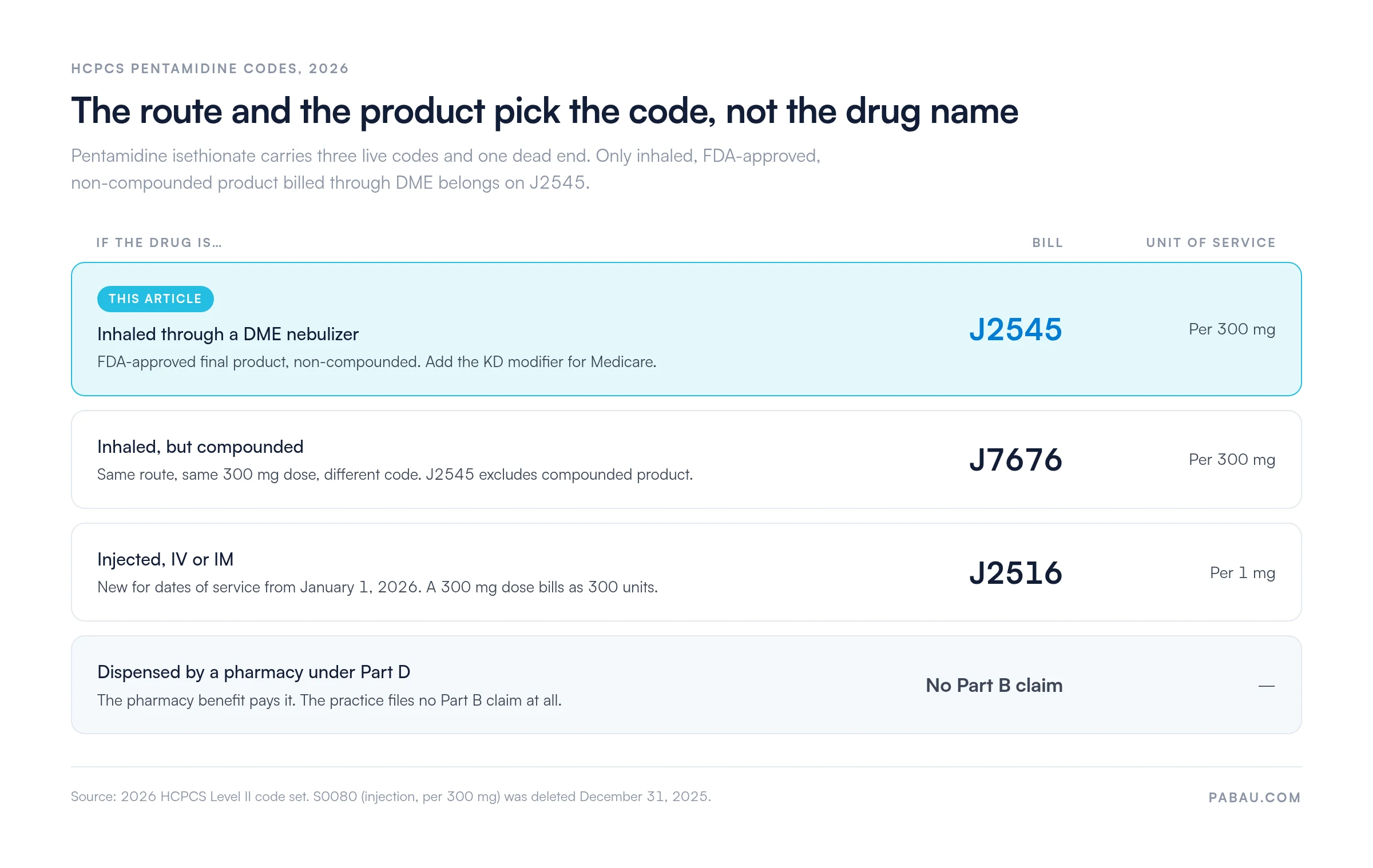
Two of those trip people up. J7676 is the compounded twin of J2545, same route and same 300 mg unit. J2516 is priced per 1 mg, so a 300 mg injection bills as 300 units rather than one.
The nebulizer and the NDC follow their own rules, and both sit on the claim beside the drug.
On paper, the shaded portion of box 24A takes the N4 qualifier, the 11-digit NDC, and a two-letter unit-of-measure code.
Box 24J is the rendering provider NPI field, so an NDC placed there will not be read. Verify descriptor language against the AAPC HCPCS lookup before you build the claim, since J-code text changes with the annual update. The annual update can also delete a code outright, as it did with L1800, and payers reject a deleted code without review.
These six account for most returned J2545 claims. Each has a fix you can build into the workflow once and forget.
Review your denial codes in medical billing reports monthly to catch J2545 patterns early. One reason code repeating across several patients usually points at a template problem rather than a coding one.
Before you submit, run the 60-second check. KD present, units matching the milligrams given, and the ICD-10 code matched to the chart. Then confirm the signed order is on file, the benefit pathway is known, and prior authorization is cleared where the plan wants it.
Most J2545 rework starts with re-keying. Someone opens the record, reads the order, then retypes the same codes into a claim form in a second system. Every hop is another chance to drop the KD modifier or the diagnosis.
Practice management software like Pabau builds the claim from the record instead. Its claims management software pre-fills the CMS-1500 from the visit and seeds the ICD-10 slots from the client’s recorded problem list.
Searchable ICD-10-CM and CPT/HCPCS libraries sit behind the form, so your coder can confirm J2545 without opening a browser tab.
The claim then stays put until the required fields are complete, so a half-built submission cannot leave. From there Pabau files it through your clearinghouse.
In the US that adds real-time eligibility checks, claim status tracking, and ERA remittance posting in the same screen. Your team spends its time on the doses that need a person, not on retyping the ones that don’t.
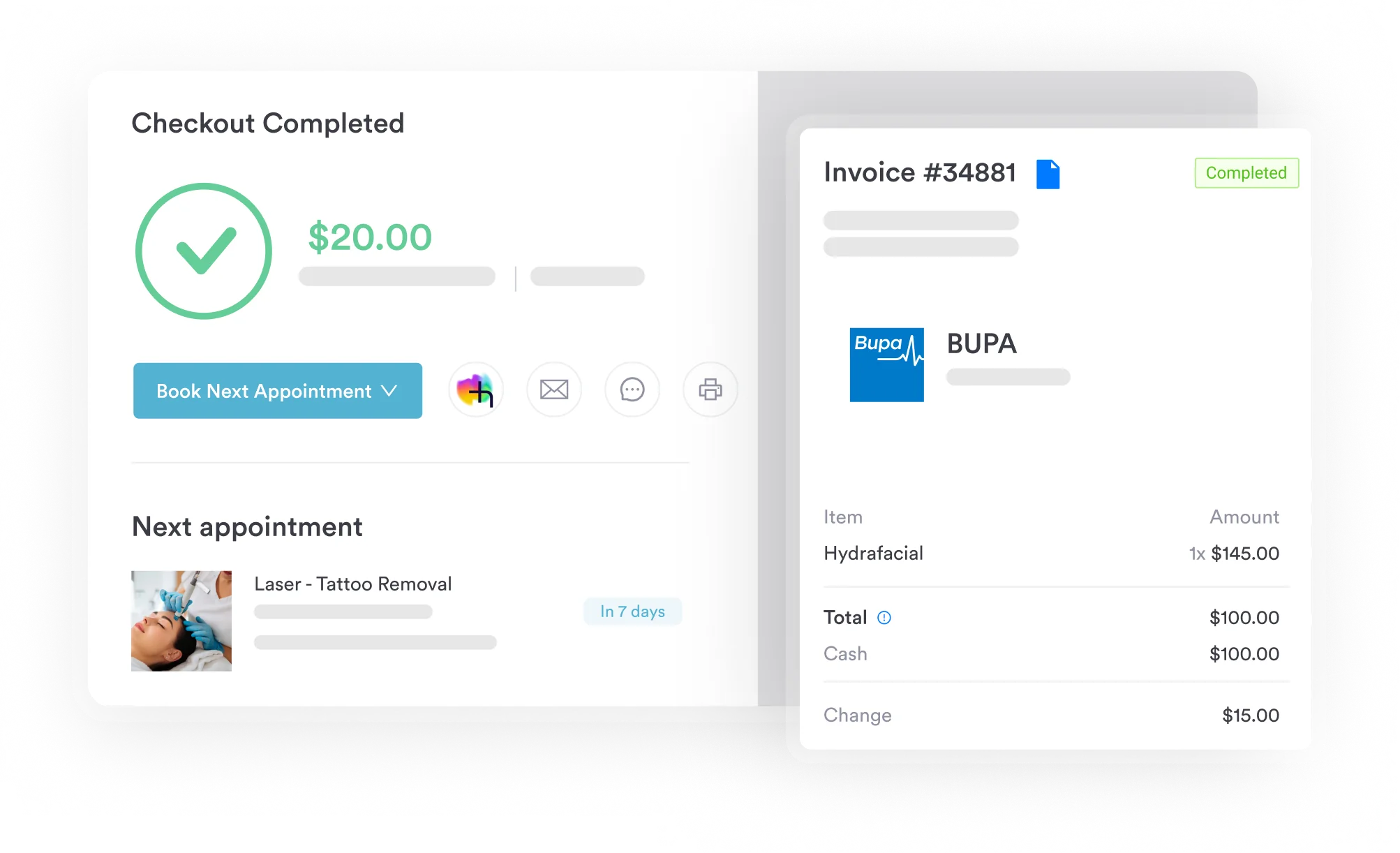

Pabau builds the claim from the client record, checks that the required fields are complete, and submits it to your clearinghouse. Fewer retyped lines mean fewer claims coming back.

J2545 rewards teams that check the product before they check the code. Inhaled and FDA-approved goes on J2545. Compounded goes on J7676, and the injectable form goes on J2516. That single habit prevents more denials than any appeal will ever recover.
The rest is routine once it is built in. KD on every Medicare line, one unit per 300 mg dose, a diagnosis the chart supports, and the claim addressed to the DME MAC. Put those four in the template and the monthly dose stops being a billing event at all.
If your team rebuilds pentamidine claims by hand each month, book a demo to see how Pabau prepares and submits them.

Want every claim to pass on the first attempt? Clean claim best practices sets out each element a payer checks before it approves a medical claim.
Not sure why a remittance says what it says? Electronic remittance advice explained shows how ERA data exposes the rejections that keep repeating.
Need the drug and the visit on one document? What a superbill is walks through the fields that have to be right before a claim is built from it.
Denials piling up faster than you can appeal? Denial management in healthcare covers how to triage, rework, and prevent the ones that keep coming back.
Shopping for a system that handles drug codes? Best medical billing software in the US compares the platforms billing teams use for HCPCS work.
No. CMS discontinued certificates of medical necessity and DME information forms for dates of service from January 1, 2023. Sending one now gets the whole claim rejected. Keep the signed physician order and the supporting clinical record instead.
Whoever furnished the drug bills it, and only one party bills per dose. If the practice buys and administers the pentamidine, the practice bills. If a DME supplier furnishes it, the supplier bills under its own supplier number.
Bill only the doses you gave. J2545 pays per 300 mg dose administered, not per month scheduled, so a missed month is simply not billed. Record why it was missed, because a broken pattern tends to prompt questions later.
A Medicare redetermination has to be filed within 120 days of receiving the remittance advice. That is the first appeal level, and it goes back to the DME MAC. Attach the order, the administration record, and the diagnosis support.