CPT Code 62284: Injection procedure for myelography
CPT Code 62284: official descriptor and procedure overview The American Medical ...

Last Updated: Oct 19, 2026
Q4141 is the HCPCS Level II code for alloskin ac, per square centimeter (add-on, list separately in addition to primary procedure).
In plain terms, Q4141 reports the AlloSkin AC graft itself, while the work of applying it goes on a separate CPT line. The rule that matters most is the unit count. One unit equals one square centimeter of product placed on the wound, never one package. Since January 1, 2026, Medicare has paid every skin substitute the same flat rate per square centimeter. As a result, a miscounted area changes the payment or triggers a denial. Below, you'll find the unit math, what the record needs to show, and the denials worth heading off.
Let Pabau's smart automation suggest the right codes, reduce claim denials, and keep your practice compliant—effortlessly.
Automate repetitive tasks and focus on what matters most—your patients.
Reduce coding errors and ensure compliance with the latest regulations.
Clean claims, fewer denials, and faster reimbursements.
Powerful insights and reporting to help your practice thrive.
HIPAA compliant SOC 2 certified GDPR-compliant Trusted by 4,000+ clinics worldwide

HCPCS code Q4141 reports the AlloSkin AC skin substitute per square centimeter applied, not per package or per application.
Since January 1, 2026, Medicare pays every skin substitute one flat rate of about $127.14 per square centimeter, so the unit count sets the payment.
The most common denial is a wrong unit count. Bill the area of product applied in cm², not the units pulled from stock.
No Medicare LCD currently governs skin substitutes for diabetic foot or venous leg ulcers. Those claims are assessed one at a time against the record.
Practice management software like Pabau pre-fills claims from the patient record, offers a code lookup library, and flags missing required fields before submission.
HCPCS code Q4141 is the Level II code for AlloSkin AC, billed per square centimeter of product applied. It’s an add-on code, so you report it alongside the primary application procedure.
The code sits in the Q4100 series maintained by the Centers for Medicare and Medicaid Services (CMS). In that series, each code stands for one named product.
Descriptors in this series change more often than most HCPCS categories. So check the live CMS quarterly update before you bill, because a stale descriptor can lead to a denial.
Here are the reference details in one place.
Q4141 pays for the AlloSkin AC product itself, counted in square centimeters placed at the visit. The application goes on its own claim line.
For that, you use a CPT skin substitute application code from the 15271-15278 series, such as 15271. The right code depends on the wound’s size and location.
Here’s where the line falls:
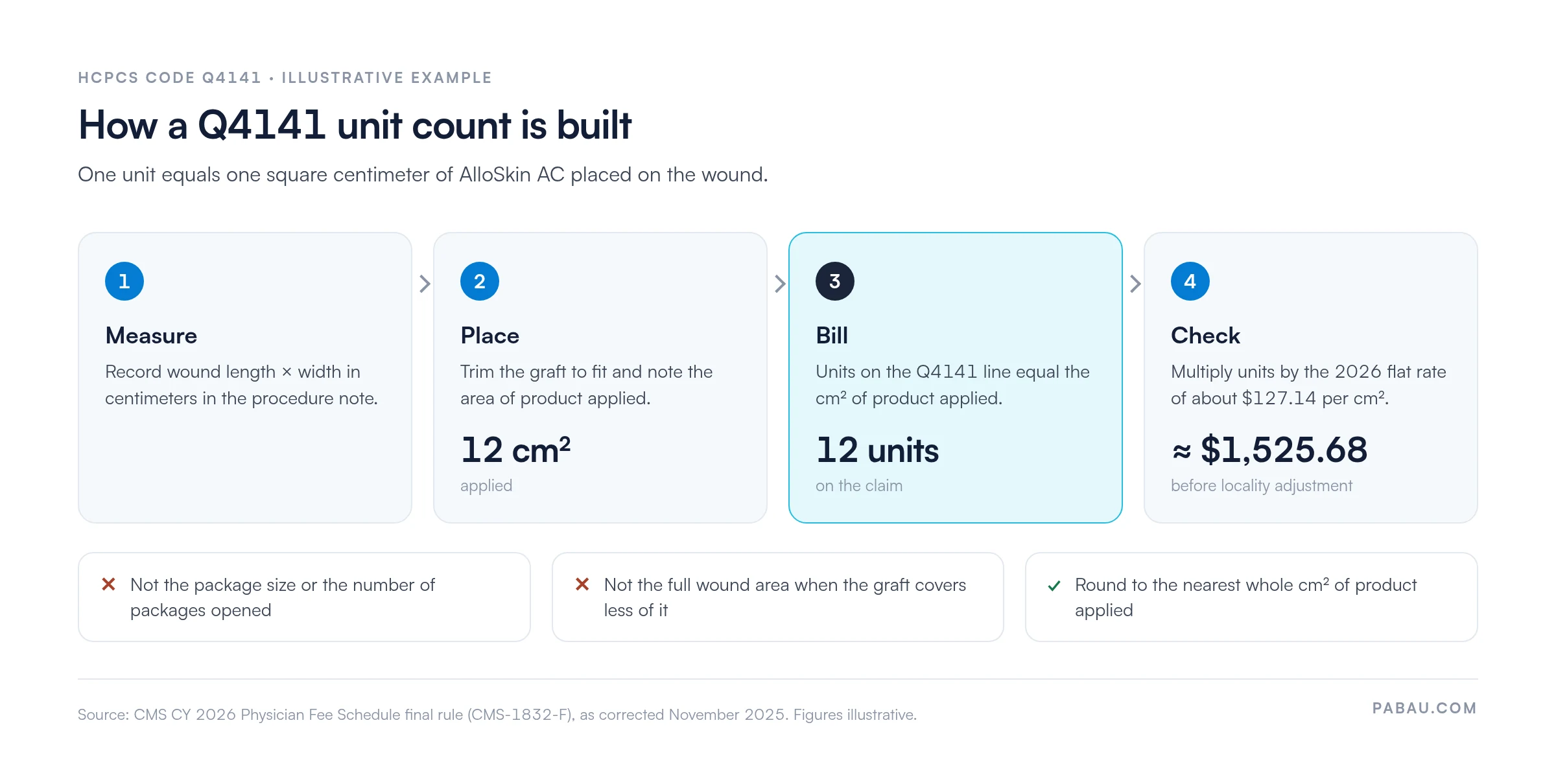
The quantity on a Q4141 claim equals the area of product applied, measured in cm². It never equals the number of packages opened. This is the biggest source of Q4141 errors, and it catches billers who are used to billing units dispensed.
Follow this sequence at every application visit:
Run on a single 12 cm² application, the math looks like this.
Modifiers sometimes come into play, too. The 59 modifier (Distinct Procedural Service) may be needed when the application happens on the same date as another significant procedure.
Place of service also affects the allowed amount for the application procedure. Confirm modifier requirements in your MAC’s billing articles before you submit.
Each Q4141 claim needs at least one ICD-10-CM code that shows why the graft was medically necessary. Which codes a payer accepts depends on its policy for that wound type. Without a supporting diagnosis, the claim is denied, however strong the procedure note is.
The table below lists the ICD-10-CM categories used most often on skin substitute claims. Confirm the codes your payer accepts before you bill.
Always use the most specific code available. A category-level code, such as E11 without the complication subcode, is a common precision error. Some MACs treat it as too vague and deny the claim.
Every Q4xxx code in the CMS HCPCS file maps to exactly one product, so Q4141 maps to AlloSkin AC and Q4127 maps to Talymed. Billing Q4130 or Q4145 for an AlloSkin AC application is a coding error, even when the wounds look alike.
The rule runs in both directions. A Truskin application belongs on Q4167, so putting it on Q4141 reports the wrong product.
The comparison below covers the codes most often confused with Q4141.
So pick the code from the product label, then confirm it in the current CMS file or the AAPC Codify HCPCS lookup. If the mapping still looks unclear, the manufacturer’s billing team can confirm it.
Medicare Part B can cover Q4141, but how it judges coverage depends on the wound. CMS withdrew the finalized skin substitute LCDs for diabetic foot ulcers (DFUs) and venous leg ulcers (VLUs) on December 24, 2025. That was before their January 1, 2026 start date, and CMS hadn’t reissued them as of 2026.
For those two indications, your MAC assesses coverage claim by claim, based on the medical record. For other wound types, check your MAC’s current policies and billing articles.
Payment changed on January 1, 2026. Under the CY 2026 Physician Fee Schedule final rule (CMS-1832-F), CMS reclassified skin substitutes as incident-to supplies. That covers the Q41xx and A2xxx code families across the 361 HCT/P, 510(k), and PMA product groups, Q4141 included.
The old product-specific, ASP-based payment no longer sets the rate. Because every product now pays the same per cm², your unit count drives the whole product payment.
The flat rate has applied since January 1, 2026, with no injunction or delay. A court dismissed the CAMPs Initiative v. HHS challenge in March 2026, but on jurisdictional grounds rather than the merits.
That ruling is under appeal, filed in May 2026, and a second, provider-led class action is also pending. For now the rule stands, so watch both cases.
Until CMS reissues skin substitute LCDs for DFUs and VLUs, write every one of those notes as if a reviewer will read it. Show wound duration, failed standard care, and the area applied. Then check the CMS Medicare Coverage Database each quarter for new policies.
Medicare generally doesn’t require prior authorization for Q4141, though MAC policies can change. Commercial payers and Medicaid plans almost always do, before the first application. Many also ask for re-authorization after a set number of applications.
Most payers look for the same evidence before they approve Q4141:
Run an insurance eligibility check before the first wound care visit. It confirms the primary payer, any prior authorization policy, and the patient’s cost-sharing. For Medicaid patients, criteria and approved product lists vary by state and can differ a lot from Medicare.
Weak documentation is the leading reason Q4141 claims are overturned on audit. A claim can pass every edit and still fail a MAC records request. That happens when the chart lacks wound measurements, proof of failed treatment, or a signed procedure note.
Here’s what the record needs to show:
Q4141 denials come from a short list of repeatable mistakes. Because they start at charge entry, that’s also where they’re cheapest to fix.
The CARC and RARC codes on your remittance tell you which problem you’re fixing. CO-4 means the procedure code is inconsistent with the modifier used, or a required modifier is missing.
CO-97, by contrast, means the benefit is included in the payment for another service. Each one calls for a different appeal, and our guide to common denial codes breaks down the rest.
A Q4141 claim passes through three sets of hands. The clinician measures and applies the graft, a biller builds the charge, and the payer checks both against the record. Quantity errors usually creep in at the handoff, when an area from the note gets retyped into a charge screen.
Before you submit, run through this checklist:
After submission, keep a running total of applications and area per wound. Some payers cap applications per episode, and a running count shows when you’re getting close. When the remittance arrives, multiply your units by the rate. If the result doesn’t match the allowed amount, check the unit count first.
A superbill helps here, too. Give it a wound measurement field next to the HCPCS code, so the area and the code travel together and nobody retypes them.
Practice management software like Pabau shortens that handoff between the note and the claim. Its pre-filled claims management pulls the service’s HCPCS code onto the charge line from the patient record. Diagnosis slots are seeded from the recorded problem list, so billers aren’t starting from a blank form.
A built-in lookup library covers ICD-10-CM and HCPCS codes when your team needs to check one. The claim also can’t be sent until required fields, like membership numbers and authorization codes, are complete.
Meanwhile, the unit count still comes from your clinician’s measurement, so keep the checklist above in your routine.
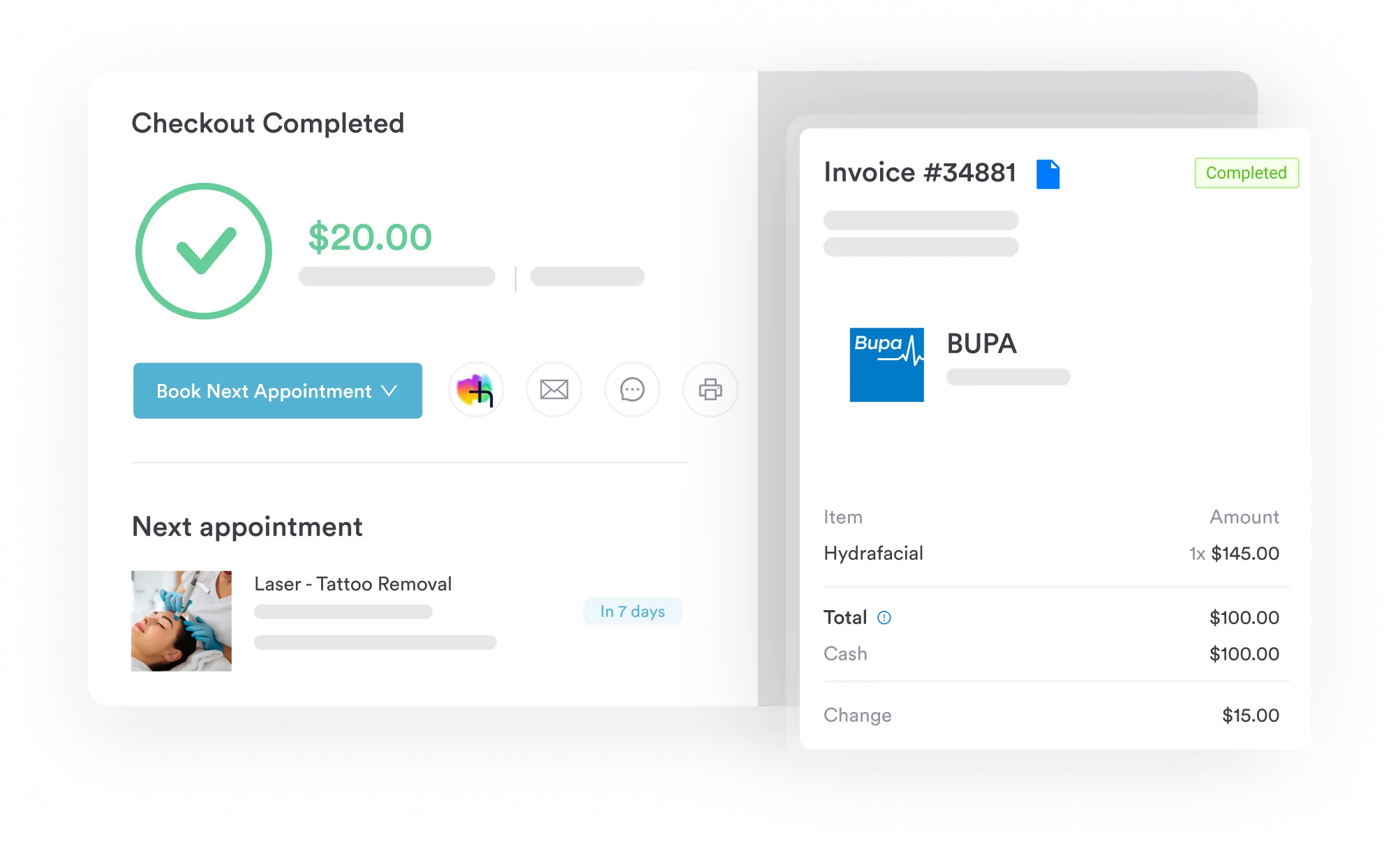

Pabau pre-fills claims from the patient record and checks that required fields are complete before submission. Your billers spend less time fixing avoidable rejections.

Q4141 leaves little room for guesswork. The descriptor names the product, the unit is a square centimeter, and since 2026 the rate is the same for every graft. That leaves two places a claim can go wrong: the unit count and the record behind it.
So the fix starts before billing. Record the applied area in the procedure note, match the units to it, and check payer rules before the first application. For DFU and VLU claims reviewed on their own merits, that note is the evidence Medicare reads.
If your team still retypes wound areas from notes into a billing screen, pre-filled claims can take that step away. Book a demo to walk through a skin substitute claim with our team.

Want every skin substitute claim to go out right the first time? Clean claims explains what payers check and how to pass on the first submission.
Need a better form for wound care visits? Superbills walks through the fields a superbill needs, including space for codes and quantities.
Need to understand how denials are categorized? Denial management in healthcare explains CARC and RARC codes, appeal timelines, and how to track denial patterns.
Want to verify eligibility before the appointment? Insurance eligibility verification covers eligibility checks and how to fit them into your wound care scheduling.
Looking for a wider view of how medical billing works? Revenue cycle management walks through the billing lifecycle from patient registration to payment posting.
It means Q4141 is never billed on its own. You report it in addition to the primary procedure, which is the skin substitute application.
You bill a code from the 15271-15278 application series, chosen by wound size and location. Codes 15271-15274 cover the trunk, arms, and legs. Codes 15275-15278 cover the face, scalp, eyelids, mouth, neck, ears, orbits, genitalia, hands, feet, and multiple digits. The application code follows wound surface area, while Q4141 units follow product area.
Medicare Part B can cover Q4141 when the record supports medical necessity. No MAC LCD currently governs skin substitutes for diabetic foot or venous leg ulcers. CMS withdrew those LCDs on December 24, 2025, and hadn’t reissued them as of 2026. So those claims are assessed one at a time instead.
Medicare pays about $127.14 per square centimeter, the same flat rate as every other skin substitute. The figure is adjusted by locality. So a 12 cm² application comes to roughly $1,525 before that adjustment.
Medicare usually doesn’t require it, though MAC policies can change. Most commercial payers and many Medicaid plans do, before the first application. Check with each payer before you schedule the procedure.