

CCSD code G5100: Bypass of duodenum billing guide
CCSD code G5100 bills a bypass that leaves the duodenum in place CCSD code G5100...

Last Updated: Oct 16, 2026
Q4122 is the HCPCS Level II code for dermacell, dermacell awm or dermacell awm porous, per square centimeter (add-on, list separately in addition to primary procedure).
The biggest change for 2026 is how Medicare prices it. The code moved off ASP-based biological payment and onto the physician fee schedule as an incident-to supply. It also covers ICD-10 pairing, place of service, documentation, prior authorization, and the related skin substitute Q-codes.
Let Pabau's smart automation suggest the right codes, reduce claim denials, and keep your practice compliant—effortlessly.
Automate repetitive tasks and focus on what matters most—your patients.
Reduce coding errors and ensure compliance with the latest regulations.
Clean claims, fewer denials, and faster reimbursements.
Powerful insights and reporting to help your practice thrive.
HIPAA compliant SOC 2 certified GDPR-compliant Trusted by 4,000+ clinics worldwide

HCPCS code Q4122 describes DermACELL, DermACELL AWM, and DermACELL AWM Porous, an acellular dermal matrix billed per square centimeter of product applied.
For 2026, CMS pays Q4122 as an incident-to supply rather than an ASP-priced biological, at 3.81 practice expense RVUs per square centimeter.
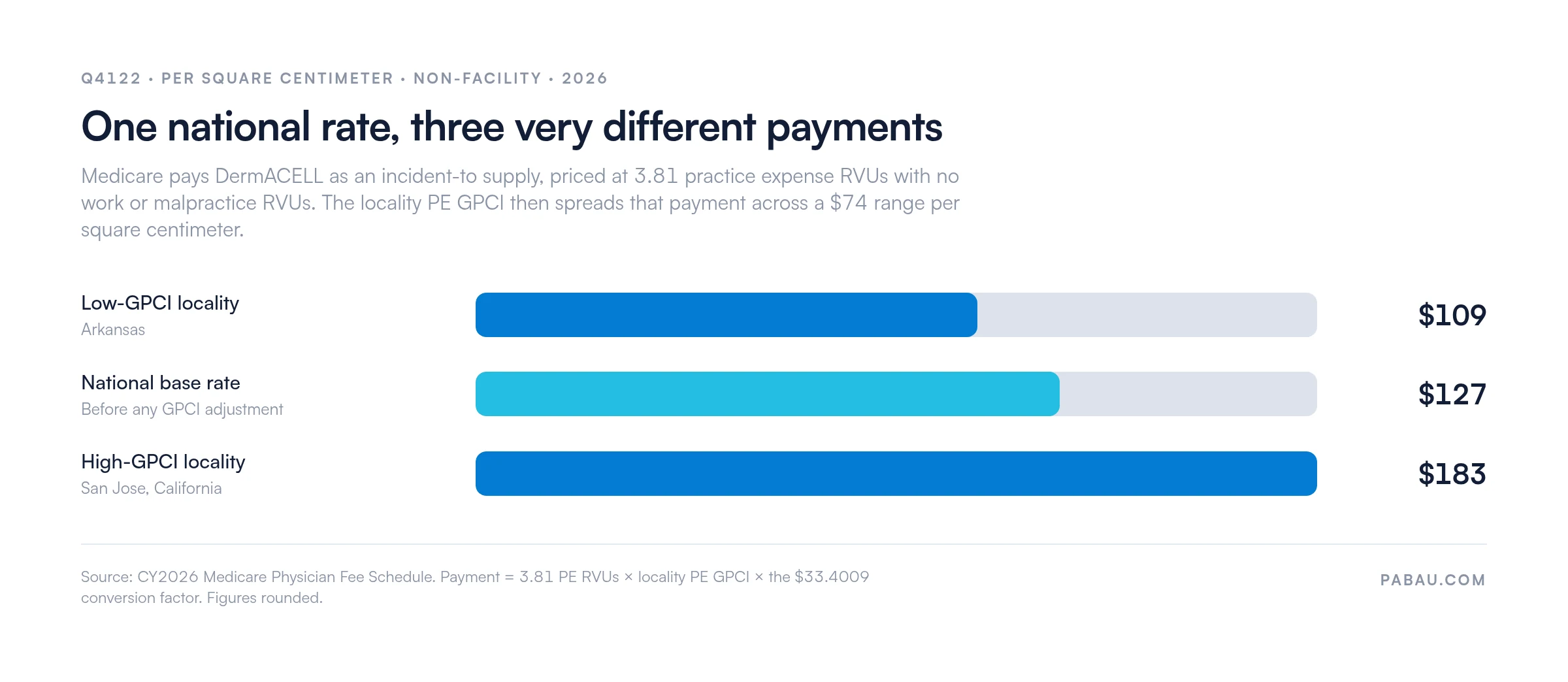
Locality GPCI adjustment moves that payment from roughly $109 to about $183 per square centimeter, so the national figure is only a planning number.
Every Medicare claim line for Q4122 carries either JW for discarded product or JZ for none, and Q7 through Q9 do not apply.
Practice management software like Pabau tracks HCPCS codes, claim submissions, and payer responses across every location your wound care team bills from.
HCPCS code Q4122 is a Level II HCPCS Q-code maintained by the Centers for Medicare and Medicaid Services (CMS). Q-codes are temporary codes assigned to non-physician services and products not covered by the standard CPT code set. Q4122 covers three product variants manufactured by LifeNet Health, all billed at the same rate per square centimeter of product applied.
All three products are acellular dermal matrices, meaning the cellular components have been removed while preserving the extracellular matrix scaffold that supports tissue regeneration. The variants differ in porosity and intended clinical use.
All three variants bill under the same HCPCS code Q4122. Billing staff do not need to select a different code based on which variant was applied. The operative or clinical note should still record which specific product was used, because auditors ask.
Medicare pays Q4122 under the CMS Physician Fee Schedule as an incident-to supply, at 3.81 practice expense RVUs per square centimeter. No work RVUs and no malpractice RVUs attach to the code. Multiply those 3.81 RVUs by your locality’s practice expense GPCI and by the 2026 conversion factor of $33.4009 to get the allowed amount.
That works out to roughly $127 per square centimeter before any geographic adjustment. Actual payment runs from about $109 in a low-GPCI locality such as Arkansas to about $183 in San Jose. Treat the national figure as a planning number, not the amount your MAC will pay.
Place of service matters as much as locality. Q4122 carries a facility NA indicator, so the physician is paid for the product only in non-facility settings. Apply it in a hospital outpatient department and the product is paid to the hospital under OPPS instead.
Rates change with each annual rule, so confirm the current figure for your locality before you set a charge. The CMS list of CPT/HCPCS codes also tells you whether Q4122 sits on your MAC’s covered code list for the current year.
Q4122 billing follows quantity rules tied to the physical product applied. Incorrect unit calculations are the most common source of claim errors for skin substitute Q-codes. Your claims management software should enforce these rules before the claim leaves the practice.
Modifier selection for Q4122 affects Medicare compliance and audit risk directly. Waste reporting is the part that trips practices up, because one of two modifiers belongs on every claim line. Q7, Q8, and Q9 do not apply here. Those report Class A, B, and C findings on routine foot care claims, not on skin substitutes.
JW/JZ modifier rule: CMS mandated waste reporting for Medicare Part B drugs and biologics. MACs apply the same requirement to skin substitute products, Q4122 included. Every Q4122 claim line must carry either JW or JZ. Verify current applicability with your own MAC, since requirements vary by jurisdiction. Building MAC-level modifier guidance into your medical billing compliance checks keeps this from becoming a recurring denial.
Q4122 must be billed with a covered ICD-10 diagnosis code that establishes medical necessity. Your MAC’s Local Coverage Determination (LCD) for skin substitute products lists the approved codes. The table below reflects categories accepted across most MACs, though a jurisdiction-specific LCD may restrict or expand the list. Our ICD-10-CM code index covers these diagnosis families in more detail.
Always verify covered diagnoses against your MAC’s current LCD before submitting. The AAPC’s HCPCS code lookup provides crosswalk references, but the MAC LCD is the controlling document for coverage decisions.
The place of service (POS) code decides who gets paid for the product, not just how much. Because Q4122 carries a facility NA indicator, a physician claim submitted with a facility POS returns no separate product payment. Selecting the wrong POS code therefore produces either a technical denial or a write-off nobody expected.
Inadequate documentation is the leading cause of Q4122 denials on post-payment audit. Skin substitute products carry a high unit cost, so MACs scrutinize DermACELL claims closely. The note has to establish medical necessity, confirm the product used, and justify the quantity billed.
A documentation checklist applied at the point of care prevents the omissions behind most denials. Keep the records complete, retrievable, and defensible, because the audit usually arrives long after the encounter.
Medicare does not typically require prior authorization for Q4122 when the claim meets LCD coverage criteria. Commercial payers are a different matter. Many require prior authorization for skin substitute products, and missing it is one of the most expensive mistakes in wound care billing.
Q4122 is one of dozens of Q-codes assigned to specific skin substitute products. When the product applied is not DermACELL or one of its variants, a different Q-code applies. Selecting the wrong code for the product actually used is an error auditors flag consistently.
The table below lists commonly used neighboring codes, so billing staff can find the correct Q-code when a different product is on hand. Watch the billing unit column in particular, since Q4114 is priced per cc rather than per square centimeter.
Other skin substitutes sit outside the table above. Oasis Ultra tri-layer wound matrix, for example, bills under Q4124, also priced per square centimeter.
When your practice stocks multiple skin substitute products, build a quick-reference card mapping each product name to its HCPCS Q-code and its billing unit. Attach it to the charging station or the EHR order entry screen. One mis-coded claim on a high-unit skin substitute can cost a four-figure underpayment or overpayment.
CMS finalized payment policy changes for skin substitutes that took effect in 2026, and they reach further than most annual updates. Billing built on pre-2026 rules produces systematic errors, so the changes below belong in your charge capture setup and your coder training.
Skin substitute policy is still moving, so confirm 2026 details through official CMS channels or your compliance team before filing under the new rules. The reclassification also changes what a reasonable charge looks like, which is worth revisiting with your fee schedule owner.
Most wound care practices find a Q4122 unit error after the remittance comes back. The product size sits in the operative note and the billed quantity sits in the claim. Nobody compares the two until a denial forces it.
Pabau keeps the clinical note and the claim in the same patient record. Your coder sees the documented product size next to the units on the claim line. JW or JZ gets set before submission rather than after an audit letter.
That shortens the rework cycle on your highest-value claim lines. When a Q4122 claim is questioned, the wound measurements, product lot, and prior treatment history are already on the record. Your team builds the appeal from one chart.

Pabau supports HCPCS code tracking, claims submission, and documentation workflows for wound care and skin practices. See how it works.

Q4122 rewards precision in three places. Bill the square centimeters you applied, put JW or JZ on every line, and hold documentation your MAC’s LCD accepts. That test applies on the day of application, not on the day of the audit.
The 2026 reclassification adds a fourth. Check what the code now pays in your own locality before the product is ordered. The national figure and your allowed amount can differ by more than $50 per square centimeter. On a 20 sq cm application, that difference decides whether the case is profitable.
Book a demo to see how Pabau tracks HCPCS units, modifiers, and payer responses across a wound care caseload.

Applying Apligraf instead of DermACELL? HCPCS code Q4101 covers the unit rules, modifiers, and coverage criteria for that product.
Billing GRAFTJACKET on the same wound care caseload? HCPCS code Q4107 sets out how that acellular dermal matrix is coded and documented.
Need to reconcile what a payer actually paid on a Q-code line? Electronic remittance advice explains how ERA files match payments back to submitted HCPCS charges.
Chasing authorizations before the product goes on? The prior authorization process walks through what commercial payers ask for and how long each step takes.
HCPCS code Q4122 is a Level II HCPCS Q-code for DermACELL, DermACELL AWM, and DermACELL AWM Porous. These are acellular dermal matrix skin substitutes manufactured by LifeNet Health. It is billed per square centimeter of product applied in wound care and surgical settings.
Q4122 is billed per square centimeter of DermACELL product actually applied to the patient. If 15 sq cm of product is applied, bill 15 units of Q4122. Units reflect the product applied, not the wound size, and both measurements must be documented in the clinical record.
Medicare prices Q4122 at 3.81 practice expense RVUs per square centimeter for 2026, with no work or malpractice RVUs. That is roughly $127 before geographic adjustment. Actual payment runs from about $109 in low-GPCI localities to about $183 in San Jose, and only non-facility claims are paid to the physician.
Medicare Part B does not typically require prior authorization for Q4122, but the claim must meet all LCD medical necessity criteria at submission. Commercial payers and Medicare Advantage plans often do require prior authorization, so always verify with the specific payer before applying the product.
Every Q4122 Medicare claim line must carry either the JW modifier, for product wasted or discarded, or the JZ modifier, for no waste at all. One or the other is required on every claim. The Q7, Q8, and Q9 modifiers do not apply to Q4122, because they report Class A, B, and C findings on routine foot care claims.
All three are acellular dermal matrix products made by LifeNet Health and all bill under Q4122. DermACELL is the standard formulation. DermACELL AWM (Advanced Wound Matrix) is designed for chronic wounds like diabetic foot ulcers and venous ulcers. DermACELL AWM Porous has a microporous structure for wounds with heavy exudate. The clinical note should specify which variant was used, even though the billing code is the same.
Common ICD-10 codes paired with Q4122 include E11.621 (type 2 diabetes with foot ulcer) and E10.621 (type 1 diabetes with foot ulcer). Others include I83.009 (varicose veins with ulcer), the L89.xx pressure ulcer series, L97.xxx non-pressure chronic ulcers, and burn codes in the T20-T32 range. Always verify against your MAC’s current LCD, as approved diagnoses vary by jurisdiction.



