CCSD code H4430: Examination of rectum under anaesthetic
CCSD code H4430 pays for the examination alone CCSD code H4430 is the UK private...

Last Updated: Oct 20, 2026
Q4103 is the HCPCS Level II code for oasis burn matrix, per square centimeter (add-on, list separately in addition to primary procedure).
The code identifies one specific skin substitute product and the quantity of it applied to the wound. That add-on wording is not decorative. Q4103 reports a supply, so it only belongs on a claim next to the application procedure code it goes with.
The product itself is Oasis Burn Matrix. Do not confuse it with Oasis Wound Matrix, which bills under Q4102. The two descriptors differ by a single word in the middle of the string. That similarity is the most common source of Q4103 coding errors.
The descriptor is the safest way to confirm you have the right code. Verify it against the AAPC HCPCS Level II code database before you build Q4103 into a charge template. CMS can update Q-code descriptors quarterly without a formal rulemaking cycle.
Let Pabau's smart automation suggest the right codes, reduce claim denials, and keep your practice compliant—effortlessly.
Automate repetitive tasks and focus on what matters most—your patients.
Reduce coding errors and ensure compliance with the latest regulations.
Clean claims, fewer denials, and faster reimbursements.
Powerful insights and reporting to help your practice thrive.
HIPAA compliant SOC 2 certified GDPR-compliant Trusted by 4,000+ clinics worldwide

HCPCS code Q4103 is Oasis Burn Matrix, billed per square centimeter of product applied to the wound
Q4103 is an add-on code, so it must be listed separately alongside the primary skin substitute application procedure
Oasis Wound Matrix is a different product that bills under Q4102, and swapping the two codes is an auditable error
From January 1, 2026, Medicare pays non-biologic skin substitutes as incident-to supplies at a single rate per square centimeter
Practice management software like Pabau pairs Q4103 with its primary code, checks modifiers, and cuts denials
Q4103 covers Oasis Burn Matrix, a natural extracellular matrix derived from two layers of porcine small intestinal submucosa. Despite the name, its cleared indications reach well beyond burns.
The product is indicated for partial- and full-thickness wounds, second-degree burns, and a broad set of chronic wounds. Wound care teams encounter this code most often in outpatient hospital departments and physician offices.
Billing Q4103 per square centimeter means the units must reflect the area of product applied. Billing the wound size instead of the product size is a common and auditable error.
Document the exact cm² of product used in the procedure note before submitting the claim. Recording that measurement in the room is more reliable than reconstructing it from the packaging later.
Q4102 and Q4103 both describe an Oasis product, both bill per square centimeter, and both are add-on codes. What separates them on a claim is which product the clinician applied.
Match the code to the product label and lot number recorded in the procedure note. Never pick the code from the wound type. Oasis Burn Matrix is cleared for diabetic, venous, and pressure wounds as well as burns. A diabetic foot ulcer dressed with Burn Matrix still bills under Q4103.
A third Oasis product sits on the same shelf. Oasis Ultra Tri-Layer Matrix bills under Q4124, so read the full package label before you pick between the Oasis codes.
Medicare Part B covers HCPCS code Q4103 subject to the applicable Local Coverage Determination (LCD) issued by the Medicare Administrative Contractor (MAC) for your jurisdiction. Because LCDs are jurisdiction-specific, coverage criteria for Q4103 can differ meaningfully between contractors such as Novitas Solutions and CGS Administrators.
Confirming the active LCD in your MAC region is a prerequisite for billing, not an optional step. Verifying the patient’s eligibility at or before the point of service reduces the risk of retroactive denials.
LCDs governing skin substitute Q-codes generally expect a wound that has failed a documented course of standard care. Most also limit the number of applications per wound per episode. Verify both against the LCD active in your jurisdiction on the date of service, since CMS revises these periodically.
The medical record has to carry every element the LCD asks for before Medicare will pay for Q4103. The list below is what a MAC reviewer expects to find when a Q4103 line is pulled for audit.
Keep a record of every skin substitute application, including a photograph of the product packaging. A photo of the label settles a Q4102 or Q4103 question that a typed product name cannot.
Prior authorization requirements vary by payer and by plan. Medicare fee-for-service does not universally require prior authorization for Q4103. Medicare Advantage plans and commercial payers often do impose their own rules. Several treat skin substitutes as a high-cost category with a standing review requirement.
Verify the requirement with each individual payer before the procedure rather than after it. An application performed without an approved authorization is rarely recoverable on appeal, because the product has already been used.
Medicare changed how it pays for skin substitutes on January 1, 2026. Products not licensed as biologics under Section 351 of the Public Health Service Act are now treated as incident-to supplies. CMS pays for them separately during a covered application procedure. That applies in non-facility settings under the Physician Fee Schedule and in hospital outpatient settings under OPPS.
For CY2026, CMS finalized a single initial rate of $127.14 per square centimeter, before geographic adjustment. That one rate applies across all three FDA regulatory groupings CMS now recognizes. The groupings are 361 HCT/Ps, 510(k)-cleared devices, and premarket approval products. CMS has said it intends to pay the groups at different rates in later years.
Oasis Burn Matrix is FDA-cleared rather than licensed as a biologic, so it sits inside the group CMS moved onto the single rate. Confirm the current amount against the CMS Physician Fee Schedule lookup tool for your locality before billing. Never carry a prior-year figure into a current claim.
Capturing the product area on the charge sheet at the point of care beats calculating it later. That habit cuts the unit billing errors behind underpayments and recoupment requests.
Submitting Q4103 correctly requires the right combination of primary procedure code, place-of-service code, modifiers, diagnosis codes, and units. Each element is independently validated by the payer’s claim processing system. A single mismatch stops the claim. The panel below shows how those elements sit across the two claim lines.
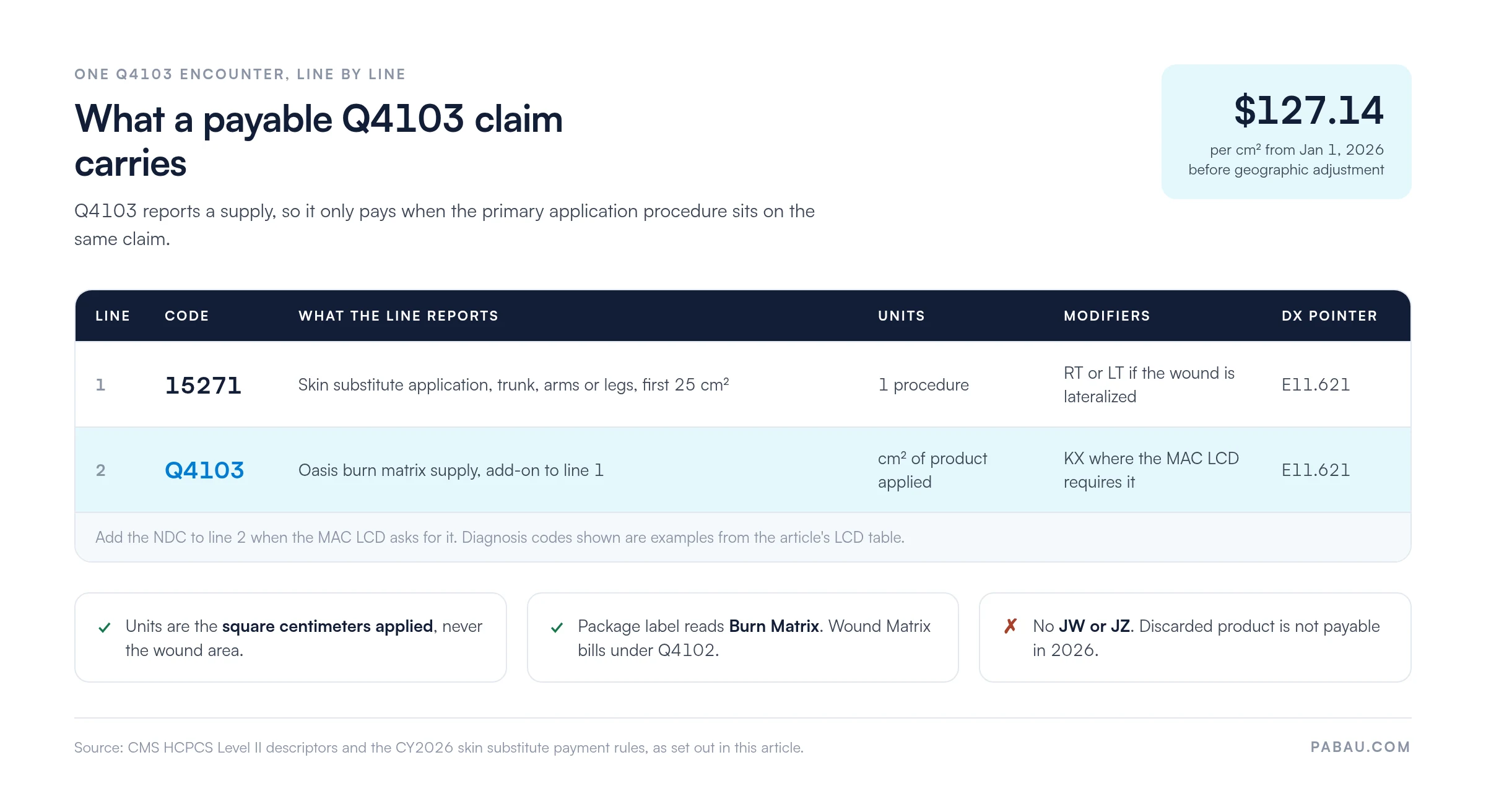
Practices that run these checks inside wound care billing software can pre-populate modifier and diagnosis rules for skin substitute codes. Errors then surface before the claim leaves the system.
Modifier requirements for Q4103 depend on the place of service, the LCD attestation your MAC expects, and whether the wound is lateralized. Always verify modifier rules with the applicable MAC LCD and payer policy, since these differ by jurisdiction.
The JW row is worth a second look if your team built its skin substitute rules before 2026. Wastage on a non-biologic skin substitute is no longer payable, so a JW line will not recover the cost of an unused portion. It only invites a denial.
Q4103 is never billed in isolation. The encounter always involves a procedure code for the application itself, plus one or more ICD-10-CM diagnosis codes that establish medical necessity. On the trunk, arms, or legs that application code is usually 15271.
The table below lists the codes most commonly paired with Q4103. Confirm each one is covered under the active MAC LCD before you submit.
Always use the most specific ICD-10-CM code available rather than an unspecified one. MAC auditors flag claims where a skin substitute Q-code is paired with a non-specific diagnosis while a more specific code sits documented in the record.
When the documented wound type does not match a row in the table above, work from the wider ICD-10-CM code index before you submit.
Run a four-point audit on every Q4103 claim before it goes out. Confirm the package label says Burn Matrix and not Wound Matrix. Confirm the claim carries a primary application CPT code. Confirm the cm² billed matches the cm² documented in the procedure note. Confirm the ICD-10-CM code sits on the LCD’s covered-diagnosis list and the KX modifier is present if your MAC requires it.
Q4103 claims fail at a higher rate than many other HCPCS codes. The requirements are granular, and the audit risk for skin substitutes is elevated. Nine error patterns account for most of the rejections, and each one is caught by a check the biller can run before submission.
In many wound care practices the facts that decide a Q4103 claim are captured in the treatment room and re-keyed later. Someone reads the product label, someone measures the graft, and someone else builds the claim from a note written hours earlier.
Each handoff is a chance for Burn Matrix to become Wound Matrix, or for the applied area to become the wound area.
Practice management software like Pabau closes that distance. The product name, lot number, and applied square centimeters go into the clinical note at the point of care. The claims side of the platform then carries those same values straight onto the claim.
Modifier and diagnosis rules for skin substitute codes sit on the charge itself. A missing KX or an unsupported ICD-10-CM code surfaces before submission, not in a remittance advice.
The outcome your billing team feels is a shorter denial queue and fewer claims reworked from memory. The outcome your finance lead feels is a wound care service line that gets paid on the first pass.

Pabau’s claims management software pre-validates modifier rules and links diagnosis codes to skin substitute Q-codes. Wound care and dermatology practices track reimbursement by procedure, so Q4103 claims go out complete the first time.

Q4103 is one of the easier skin substitute codes to get wrong, and the reasons have little to do with clinical judgment. The descriptor names Oasis burn matrix, not wound matrix.
The code is an add-on, so it never travels alone on a claim. And from January 2026 the payment basis is an incident-to supply rate rather than a product-specific fee, with no allowance for wastage.
Get those three points right at the point of care, not at claim submission. That is what separates a clean Q4103 claim from a recoupment letter. Record the product label, the applied area, and the primary procedure in the same note, on the same visit.
Book a demo to see how Pabau handles skin substitute code validation, modifier rules, and diagnosis-code crosschecks in a live clinical environment.

Need a structured approach to managing claim denials? Denial management in healthcare covers the full workflow for identifying, appealing, and preventing claim rejections across your practice.
Want to understand how medical billing fits into your broader revenue cycle? Revenue cycle management explains the end-to-end financial workflow from patient registration through final payment.
Building audit-ready records for skin substitute claims? Medical billing compliance sets out the documentation and coding standards a payer review expects to find.
Want fewer Q4103 lines coming back for rework? What makes a clean claim walks through the fields payers validate before a claim is accepted on the first pass.
Need to itemize a wound care visit for the patient or a secondary payer? The superbill explained shows which codes, units, and diagnoses belong on the document.
HCPCS code Q4103 covers Oasis Burn Matrix, billed per square centimeter of product applied. Its official descriptor is Oasis burn matrix, per square centimeter (add-on, list separately in addition to primary procedure). The product is cleared for partial- and full-thickness wounds, second-degree burns, diabetic ulcers, venous ulcers, and pressure injuries.
No. Oasis Wound Matrix bills under Q4102, not Q4103. Q4103 is Oasis Burn Matrix. The two descriptors differ by a single word. Match the code to the package label and lot number recorded in the procedure note, not to the wound type.
No. Q4103 is an add-on code, so it must be listed separately in addition to a primary procedure. The claim needs the CPT skin substitute application code for the body site treated, such as 15271 or 15273, on the same date of service.
Yes. Medicare Part B covers Q4103 subject to the Local Coverage Determination (LCD) issued by the Medicare Administrative Contractor (MAC) for your jurisdiction. Coverage criteria vary by MAC region, so confirm the active LCD before billing.
The modifier most often required is KX, which affirms that the LCD coverage criteria are documented in the medical record. RT and LT apply to lateralized wounds, and 59 identifies a distinct procedural service. GW covers a hospice patient whose wound is unrelated to the terminal condition. Do not append JW or JZ, because CMS says those modifiers do not apply to skin substitutes billed as incident-to supplies.
The ICD-10-CM code must match the wound type and appear on the MAC LCD’s covered-diagnosis list. Common choices include E11.621 for a type 2 diabetic foot ulcer and the I83.0xx series for venous leg ulcers. Pressure injuries use the L89.xxx series, and second-degree burns use T20-T25. Always verify the specific code is covered under the active LCD before submitting.
From January 1, 2026, Medicare pays non-biologic skin substitutes as incident-to supplies at a single initial rate of $127.14 per square centimeter, before geographic adjustment. Discarded product is not payable, so bill only the square centimeters applied. Check the current amount in the CMS Physician Fee Schedule lookup tool for your locality before billing.
Q4103 identifies Oasis Burn Matrix specifically, while the other codes in the Q4101 to Q4440 range cover different skin substitute products. Its nearest neighbor is Q4102 for Oasis Wound Matrix. Q4100 is the not-otherwise-specified code and should only be used when no product-specific code exists, which is not the case here.