CPT Code 62284: Injection procedure for myelography
CPT Code 62284: official descriptor and procedure overview The American Medical ...

Last Updated: Oct 19, 2026
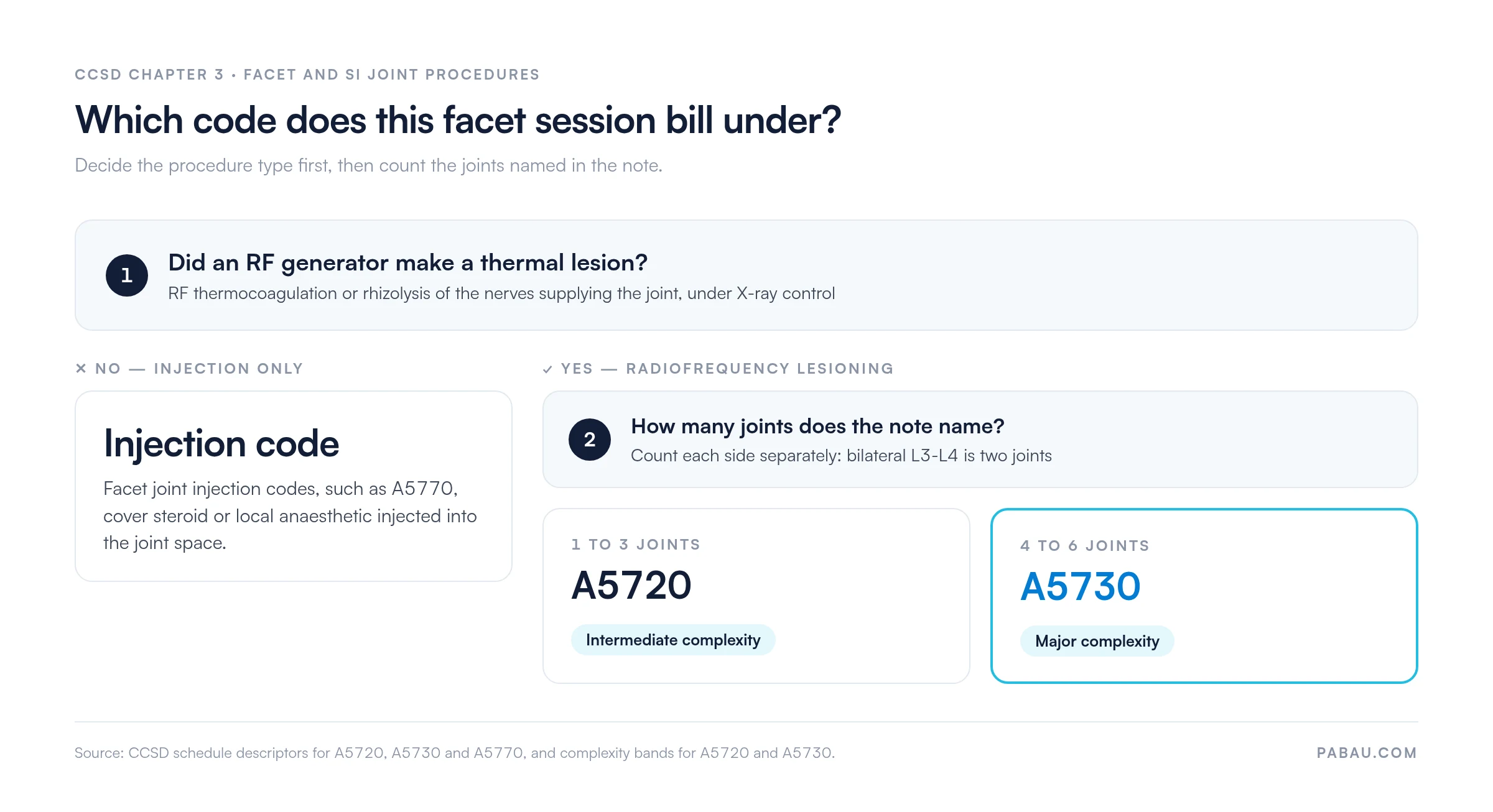
A5730 is the CCSD code for facet or sacroiliac joint radiofrequency (RF) thermocoagulation, including rhizolysis, under X-ray control. It applies when 4 to 6 joints are treated in one session, with the nerves supplying each joint lesioned by RF heat.
The joint count decides the code. A session treating 1 to 3 joints is billed as A5720. A facet joint injection without RF lesioning uses an injection code such as A5770. Major UK private medical insurers expect pre-authorisation before the procedure goes ahead.
Let Pabau's smart automation suggest the right codes, reduce claim denials, and keep your practice compliant—effortlessly.
Automate repetitive tasks and focus on what matters most—your patients.
Reduce coding errors and ensure compliance with the latest regulations.
Clean claims, fewer denials, and faster reimbursements.
Powerful insights and reporting to help your practice thrive.
HIPAA compliant SOC 2 certified GDPR-compliant Trusted by 4,000+ clinics worldwide

CCSD code A5730 covers RF thermocoagulation (rhizolysis) of 4 to 6 facet or sacroiliac joints under fluoroscopic guidance in a single session.
A5730 has one sibling code, A5720, which covers the same procedure for up to 3 joints. Picking the wrong one for the joint count is a leading cause of claim denial.
Bupa, AXA Health, and most major UK private medical insurers (PMIs) require pre-authorisation before A5730 is performed. A written diagnostic block and a failed conservative treatment trial are the standard rules for approval.
Claims management software like Pabau supports CCSD code entry, pre-auth reference linking, and insurer submission for private practices billing A5730.
CCSD code A5730 is the billable procedure code for facet or sacroiliac joint radiofrequency (RF) thermocoagulation including rhizolysis, performed under X-ray control. It applies when 4 to 6 joints are treated in a single session. The code sits in Chapter 3 (spine, spinal cord and peripheral nerves) of the CCSD schedule, under paraspinal injections at major complexity. UK private medical insurers use Clinical Coding and Schedule Development (CCSD) codes to name and pay for private procedures.
The official descriptor has three defining elements that must all be present to justify this code:
The code applies to both facet joints (zygapophyseal joints) and the sacroiliac joint. A5730 is one of the CCSD codes used for private billing only. NHS-funded spinal radiofrequency procedures are paid under the NHS tariff instead.
Radiofrequency thermocoagulation is an interventional pain procedure that uses heat generated by a high-frequency electric current to ablate the small nerves supplying the target joints. Your procedure note has to reflect each stage below to support an A5730 claim.
The typical procedural sequence:
The procedure is also known as radiofrequency ablation (RFA), medial branch neurotomy, or facet rhizolysis. All of these terms describe the same process covered by CCSD code A5730 when 4 to 6 joints are treated.
Radiofrequency lesioning of a named peripheral nerve, such as an occipital or suprascapular nerve, is coded A7300 instead. That code covers a permanent lesion made with radiofrequency, a cryoprobe or phenol, and image guidance is optional.
Private medical insurers require clear clinical reasons before approving A5730. The following are the standard rules insurers use to approve interventional pain procedures in private practice:
Guidance from the Faculty of Pain Medicine (Royal College of Anaesthetists) and NICE supports RF ablation for confirmed facet joint pain after positive diagnostic blocks. Neither body guarantees a long-term cure rate. Efficacy varies by patient and should not be presented as guaranteed to insurers or patients.
A5720 is the only sibling code in this CCSD radiofrequency thermocoagulation family. The two codes describe the same procedure and differ only in the number of joints treated in the session. Using the wrong one is a common cause of A5730 claim denial.
The table below shows the two-code structure as it appears in published CCSD-based fee schedules. A5720 sits in the intermediate complexity band and A5730 in the major band, so the two codes attract different fees.
The procedure note must state the exact number of joints (and name each level) treated. If the note says “multiple levels” without a count, the insurer cannot confirm whether A5720 or A5730 applies. The claim is then likely to be rejected or queried for more information.
Count and document joints before the procedure note is finalised, not after. A note that says ‘bilateral L3-L4 and L4-L5 facet RF’ covers four joint levels and supports A5730. A note that says ‘multilevel facet RF’ supports nothing without clarification.
A5770 covers facet joint injection (often a corticosteroid or local anaesthetic injection into the joint space). A5730 covers radiofrequency thermocoagulation (nerve ablation). These are two different procedures. Submitting A5730 when A5770 was performed, or the reverse, is an upcoding or downcoding error that leads to claim rejection.
A diagnostic medial branch block (often coded separately) is a prerequisite for RF ablation, not a replacement for it. Older insurer schedules listed that block as CCSD code A5750, covering 1 to 2 levels under X-ray control. The two procedures are distinct clinical events and must not be billed under the same code.
Both distinctions reduce to a two-step check. Confirm the procedure type first, then count the joints named in the note.
The procedure note is the primary document that insurers review when assessing an A5730 claim. Incomplete or vague notes are the second most common cause of rejection after incorrect sibling code selection. A complete note is often what separates a clean claim from a request for further information.
A compliant A5730 procedure note must include:
The procedure note should be completed the same day as the procedure. Later notes carry less weight as evidence and may be queried by insurers during audits.
CCSD code A5730 is subject to pre-authorisation from all major UK private medical insurers. This is a higher-scrutiny procedure, and performing it without written pre-auth approval means the insurer is entitled to decline the claim entirely. Check Bupa’s own coding guidance and AXA Health’s procedure code chapters for each insurer’s own requirements.
The standard pre-authorisation checklist for A5730 across major UK PMIs:
Pre-auth requirements are subject to annual policy updates from both Bupa and AXA Health. Always verify current criteria with your provider relations contact before submitting. Confirm the fee schedule in your insurer agreement before billing, because CCSD fee rates vary by insurer contract.
Most A5730 denials trace back to a handful of fixable causes. Here they are, with the fix for each:
Yes, in some cases. A separate anaesthesia or sedation code may be billable, but imaging and a same-session diagnostic block normally are not. The general bundling principles are:
When in doubt about bundling, contact your insurer’s provider relations team before submitting. Unbundling errors can trigger audits and retrospective clawbacks.
Keep a bundling log for A5730 sessions: note the date, joint count, whether sedation was used, and any codes billed alongside A5730. If the insurer queries the claim, this log provides an immediate audit trail without digging through multiple records.
Practice management software like Pabau supports CCSD code billing for UK private practices, including the A5730 workflow from pre-auth through insurer submission. Keeping the note, the pre-auth reference and the claim in one system means each claim leaves with the evidence the insurer asks for. Pabau’s claims management software allows practices to record the CCSD code, attach the pre-auth reference, and link the procedure note to the claim before submission.
A step-by-step workflow for A5730 in Pabau:
Connecting clinical documentation to billing at the point of care cuts later corrections and the time your team spends chasing denied claims.

Pabau connects clinical documentation, CCSD code selection, and insurer submission workflows for UK private practices. See how it handles A5730 and other interventional pain codes.

Most A5730 claims are won or lost in the treatment room. When the note names every joint treated and the total falls between 4 and 6, the insurer has little left to query.
The trade-off is a few extra minutes per note against the time it takes to answer a queried claim. Build the joint count, RF parameters and pre-auth reference into your procedure note template, so no session depends on memory.
Book a demo to see how Pabau keeps procedure notes, pre-auth references and CCSD claims for interventional pain work in one place.

Need a reference for Bupa CCSD procedure codes? Bupa CCSD codes guide covers the procedure code structure used by Bupa for UK private healthcare billing.
Checking how a CCSD code links to a fee? Bupa procedure codes and fee schedule explains how Bupa codes connect to fee schedules, pre-authorisation and claims.
Injected the facet joints instead of lesioning them? CCSD code A5770 billing guide covers the facet joint injection code most often confused with A5730.
Billing other Chapter 3 nerve procedures? CCSD code A6600 billing guide covers release of a deeply placed peripheral nerve entrapment.
CCSD code A5730 covers radiofrequency thermocoagulation (rhizolysis) of 4 to 6 facet or sacroiliac joints under X-ray control. All three elements must be present. The procedure must use RF thermocoagulation rather than a steroid injection, run under fluoroscopic guidance, and treat 4 to 6 joints in one session.
The most common reason is the wrong code for the joint count, such as A5730 billed when the note records only 3 joints. Other frequent causes are a missing pre-authorisation reference and a procedure note that does not name each joint level. Missing proof of fluoroscopy and a missing positive diagnostic block, where the insurer requires one, also lead to denials.
Yes. For CCSD coding purposes, rhizolysis, radiofrequency thermocoagulation, RF ablation (RFA), and medial branch neurotomy all describe the same mechanism. That process is thermal ablation of the nerve supply to the target joint, covered by the A5720 and A5730 code pair. The correct sibling code is determined by joint count, not by which term the clinician uses in the procedure note.
Radiofrequency thermocoagulation (A5730) uses an RF generator to ablate the medial branch nerve via heat. A facet joint injection (A5770) delivers a chemical injectate (often corticosteroid or local anaesthetic) into the joint space. They are billed under different CCSD codes, serve different clinical purposes, and should never be submitted interchangeably. Billing A5770 when RF thermocoagulation was performed is a coding error.