A4180 is the CCSD code for subdural haemorrhage – tap. It covers percutaneous needle or trocar aspiration of blood or fluid from the subdural space, including transfontanellar taps in infants.
Formal burr hole drainage and craniotomy evacuation carry separate codes. The access method recorded in the operative note therefore decides whether A4180 applies.
Related Information
Group
2 Brain, cranium and other intracranial organs
Category
Meninges
Complexity
Minor
Billable
No
Code also known as
subdural tap, subdural aspiration, subdural puncture, transfontanellar tap
Save time. Improve accuracy. Get paid faster.
Automate coding with Pabau
Let Pabau's smart automation suggest the right codes, reduce claim denials, and keep your practice compliant—effortlessly.
Automate repetitive tasks and focus on what matters most—your patients.
Improve accuracy
Reduce coding errors and ensure compliance with the latest regulations.
Get paid faster
Clean claims, fewer denials, and faster reimbursements.
Grow with confidence
Powerful insights and reporting to help your practice thrive.
HIPAA compliant•SOC 2 certified•GDPR-compliant•Trusted by 4,000+ clinics worldwide
Key takeaways
CCSD Code A4180 covers a subdural haemorrhage tap, which is percutaneous aspiration of a subdural collection rather than burr hole drainage or craniotomy.
The same code applies to adults, infants and neonates, including taps through the anterior fontanelle, though paediatric claims need extra documentation.
UK private medical insurers (PMIs) generally require pre-authorisation for A4180, and emergency taps fall under retrospective notification rules that vary by insurer.
Practice management software like Pabau keeps membership numbers and authorisation codes on the claim and sends it to Healthcode with the invoice attached.
CCSD Code A4180: definition and clinical scope
CCSD Code A4180 carries the official descriptor “Subdural haemorrhage – tap.” It covers one clinical act: percutaneous needle or trocar aspiration of a subdural collection. The code sits in Chapter 2 (brain, cranium and other intracranial organs) of the CCSD Schedule of Procedures, the same chapter that covers procedures such as ventriculovascular anastomosis. The Clinical Coding and Schedule Development Group maintains that schedule for UK private healthcare billing.
Three facts define its scope for billing purposes. First, A4180 covers only the aspiration itself. Second, it does not extend to formal burr hole craniostomy or craniotomy, which carry separate codes. Third, it applies no matter the patient’s age, so paediatric and neonatal cases fall under the same code, though their documentation needs differ.
Clinical overview: what is a subdural haemorrhage tap?
A subdural tap is a neurosurgical procedure that relieves a subdural collection by needle aspiration of blood, serous fluid or mixed haematoma. As a result, it is less invasive than burr hole drainage, and far less invasive than craniotomy.
Surgeons use it when they can reach the collection without formal skull entry. In neonates and young infants that means the open anterior fontanelle, and in selected adults a small percutaneous approach.
Step-by-step: how a subdural tap is performed
Patient positioning and imaging review: The consultant neurosurgeon reviews pre-procedure imaging (CT or MRI) to confirm the location, extent, and consistency of the subdural collection, then positions the patient supine.
Approach selection: In neonates and infants, the anterior fontanelle provides direct transfontanellar access. In older patients, the surgeon introduces a percutaneous needle at a pre-planned site along the subdural collection, typically without a formal scalp incision.
Needle or trocar insertion: Under aseptic technique, the surgeon advances a spinal needle or purpose-designed subdural tap needle into the subdural space. Resistance changes then signal entry into the collection.
Aspiration: The surgeon withdraws fluid by gentle syringe aspiration and the team records volume, colour, and consistency. They may also send specimens for biochemistry, culture, or cytology.
Removal and closure: The surgeon withdraws the needle. A transfontanellar approach needs no sutures, so a simple dressing covers the puncture site, and the team documents post-procedure neurological observations.
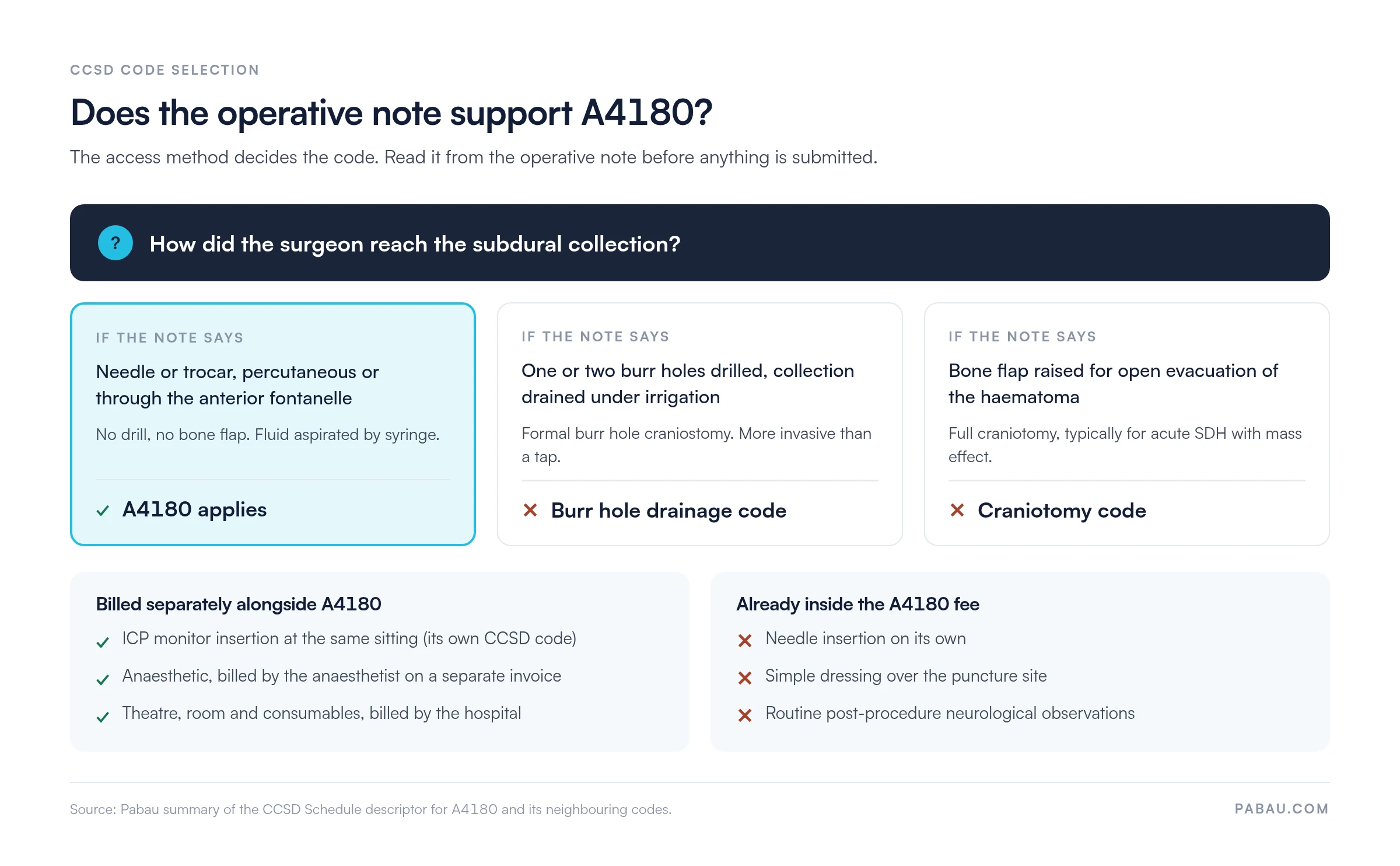
For billing, the access method is the deciding fact. So, if the surgeon created a formal burr hole to reach the collection, A4180 is not the correct code. Therefore, confirm the percutaneous approach in the operative note before you submit.
What A4180 includes and excludes
The table below maps what A4180 covers against the common exclusions that need a separate or alternative CCSD code. For this reason, settling scope before submission prevents the most frequent denial reason for this procedure: the wrong code for the access method used.
Element
Included under A4180
Not included (separate code required)
Access method
Percutaneous needle/trocar aspiration; transfontanellar approach in infants
Formal burr hole craniostomy; craniotomy flap
Fluid type
Subdural blood, serous fluid, or mixed haematoma
Epidural or extradural collections (different anatomical compartment)
Patient age
Neonates, infants, and adults
N/A (age is not a code-selection criterion)
ICP monitoring
Not included. Bill it separately if the surgeon inserts it at the same sitting.
Not included. The anaesthetist bills their own codes.
Anaesthetic time codes (billed by anaesthetist, not surgeon)
Neighbouring CCSD codes: tap, burr hole or craniotomy
A4180 sits alongside several other Chapter 2 procedures on cranial structures, including excision of a lesion of a cranial nerve. The table below sets out where it diverges from the closest neighbouring codes.
CCSD Code
Descriptor
Key distinction from A4180
When it applies
A4180
Subdural haemorrhage – tap
Baseline: percutaneous aspiration only
Fluid accessible without formal skull entry
Burr hole drainage code
Evacuation of chronic subdural haematoma via burr hole(s)
Formal burr hole craniostomy required; more invasive than a tap
Surgeon drills one or two burr holes to drain a chronic SDH under irrigation
Craniotomy code
Craniotomy for evacuation of subdural haematoma
Full cranial flap; highest complexity and reimbursement
Acute SDH with mass effect requiring open evacuation
ICP monitor code
Insertion of intracranial pressure monitor
Separate procedure code; can co-bill with A4180 if inserted at same sitting
ICP monitoring required alongside or after subdural tap
A useful rule of thumb follows from the table. If the operation note says “needle” or “fontanelle approach” with no mention of a drill or bone flap, A4180 is almost certainly correct. But if it mentions “burr hole,” “craniostomy” or “craniotomy,” a different code applies instead, such as the code for craniotomy postoperative haemorrhage. The diagram below sets out that decision, alongside what co-bills with A4180.
The access method in the operative note settles the code, and only three co-billed services sit outside the A4180 fee. Summary based on the CCSD Schedule descriptors.
When the note is unclear, query the operating surgeon before submission rather than after a denial.
Pro Tip
Flag any operative note that uses both ‘tap’ and ‘burr hole’ language in the same document. This ambiguity typically means the surgeon attempted a tap and converted to a burr hole approach during the procedure. Query the surgeon to clarify which procedure was the definitive intervention before selecting the CCSD code.
Documentation requirements for A4180 claims
Private medical insurers audit neurosurgery claims more often than lower-acuity procedures. So, sending a complete documentation set with the first claim lowers the chance of a request for further information, which can add weeks to payment. Most major UK PMIs always expect the following for subdural haemorrhage tap claims.
Operative/procedure note: Must state the access method, such as percutaneous needle or fontanelle approach. It also records the volume and character of fluid aspirated, any specimens sent and the post-procedure neurological status. The note must be attributable to the named consultant neurosurgeon.
Pre-procedure imaging report: CT or MRI report confirming subdural collection, its location, estimated volume, and any midline shift or mass effect. Imaging date must precede the procedure date.
Consent documentation: A signed informed consent form, disclosing the procedure’s nature and the possibility of conversion to a more invasive approach. For neonates, also include parental consent documentation.
Anaesthetic record: Include it if the anaesthetist gave a general or sedation anaesthetic. This record supports both the surgeon’s claim and any separate anaesthetic billing.
Post-procedure assessment note: Brief record of neurological observations and outcome at the time of procedure completion. Insurers use this to validate that the tap achieved its clinical purpose.
Referral letter (where applicable): Insurers including Bupa want evidence of a GP or recognised specialist referral before they authorise a neurosurgery admission.
For neonatal and paediatric cases, also add a weight and gestational age record and a paediatric neurosurgery assessment note. That is because insurers treat paediatric claims as a distinct audit category and expect extra clinical justification. So, keeping one checklist per claim type means the team catches a missing gestational age record before submission, not at audit.
Pre-authorisation: what UK insurers require for CCSD Code A4180
Insurer
Pre-auth required?
Emergency provision
Evidence typically required
Bupa
Yes, for all neurosurgery
Retrospective notification within 24 hours for acute emergency procedures
Co-billing with A4180: anaesthetic, assistant, and facility codes
CCSD Code A4180 covers the operating surgeon’s fee only. Several additional codes may legitimately accompany it, as long as each reflects a distinct service the team delivered and documented.
Anaesthetic code: Where the anaesthetist gives a general anaesthetic or intravenous sedation, they bill their own CCSD anaesthetic time code independently. Submit the surgeon’s A4180 claim and the anaesthetist’s claim as separate invoices, since insurers expect them to cross-reference by procedure date and institution.
Assistant surgeon code: Some insurers recognise an assistant surgeon code for neurosurgery procedures. Check with the specific insurer whether A4180 qualifies. Identify the assistant by name and GMC number on the claim.
Hospital facility charge: The hospital bills private room, theatre, and consumables costs, not the surgeon. Even so, confirm with the facility that their charges align with the procedure date and A4180 code before submitting the consultant invoice.
ICP monitor insertion: An intracranial pressure (ICP) monitor inserted at the same sitting as the subdural tap carries its own CCSD code. Both codes can be billed if both procedures were genuinely performed and documented. Confirm with the insurer whether a simultaneous procedure discount applies.
Unbundling risk arises when a claim bills parts of the A4180 fee again separately. Needle insertion alone, a simple dressing and routine post-procedure neurological observations are part of the procedure, so they never get their own code. Claims management software that shows every claim by insurer and date makes it easier to match the surgeon, anaesthetist and hospital invoices.
Pabau sends insurer claims to Healthcode with the invoice attached, so the A4180 claim and its authorisation code go out together.
Common reasons A4180 claims are denied
Denial patterns for subdural haemorrhage tap claims in UK private healthcare fall into four categories, and each one is preventable with the right process before submission.
Missing or retrospective pre-authorisation: This is the most frequent denial reason. For elective cases, failure to get authorisation before the procedure results in an automatic denial at most PMIs. Likewise, for emergency cases, failure to notify within the insurer’s set window has the same outcome. So, build a same-day notification protocol for emergency neurosurgery admissions, and assign responsibility to a named team member.
Wrong code applied: A burr hole drainage code on a percutaneous tap leads to denial or a clarification request. So does A4180 on a procedure where the surgeon created a burr hole. Confirm the access method in the operative note before coding.
Insufficient operative documentation: Insurers expect the operative note to state the approach, fluid volume aspirated, and post-procedure neurological status. Insurers typically return a note that records only “subdural tap performed” without clinical detail, and ask for further information.
Bundling errors: If a claim bills separately for elements already included in A4180 (routine post-procedure observations, needle use, simple dressing), that triggers a bundling query. Only genuinely distinct services justify separate codes: anaesthetic, ICP monitor insertion, or assistant surgeon.
Late submission: UK private insurers impose claim submission time limits, typically 3 to 6 months from the date of service. Because neurosurgery cases often involve complex documentation that takes time to compile, track submission deadlines alongside documentation completion in your billing workflow.
Tying the operative documentation to the claim before submission matters most for codes like A4180, because the documentation bar is higher in neurosurgery. As a result, reworking a denied claim takes more clinical time than it does for lower-complexity procedures. The denial codes in medical billing guide maps the CARC and RARC codes behind these outcomes, and denial management in healthcare covers the wider process for catching them before they reach a payer.
Coding tips for A4180 claims
These tips target the points where A4180 claims most often fail at audit. Each one is a small process change that saves a longer query later.
Verify code currency before every submission: The CCSD updates the Schedule regularly, so before billing A4180, confirm it remains the current descriptor in the edition in force at the time of service. Outdated editions may carry different descriptors or renumbered codes, so always check it against the CCSD’s official schedule.
Use precise operative note language: Ask the neurosurgeon to write “percutaneous subdural aspiration” or “subdural tap via fontanelle,” not a generic term like “drainage.” The exact words in the note are what the insurer’s medical reviewer will assess.
Separate neonatal from adult documentation: Most PMIs review paediatric claims under stricter criteria, so ensure the neonate’s gestational age, weight, and parental consent are part of the documentation set before billing. Flag these cases for an extra documentation check before submission.
Query the surgeon before submission, not after denial: If the note is unclear about access method, ask the surgeon to clarify within 48 hours. That is because getting clarification after a denial introduces delay, and some insurers have strict timelines for appeals that start from the denial date.
Track insurer-specific pre-auth status centrally: Different PMIs have different pre-auth reference numbers, formats, and expiry windows. A centralised tracker, whether in practice management software or a dedicated billing system, prevents submissions that reference expired or incorrect authorisation numbers.
Pro Tip
Build a one-page CCSD A4180 reference card for your billing team. List the access method (percutaneous only), the documentation checklist, insurer pre-auth contacts and the submission deadline. Review it at each CCSD Schedule update to keep it current.
How Pabau supports UK private neurosurgery billing
Today, many private neurosurgery teams track A4180 claims across spreadsheets, insurer portals and email. So, staff retype membership numbers and authorisation codes for each insurer, and a missing one only shows up when the claim bounces.
Conclusion
Book a demo to see how Pabau gets complete CCSD claims to Healthcode, with authorisation codes checked before they leave.
Continue your research
Managing CCSD codes across multiple insurers?Bupa CCSD codes guide covers the full Bupa procedure tariff, pre-auth requirements, and billing rules for UK private healthcare teams.
Billing a biopsy in the same chapter?CCSD Code A0400 explains brain biopsy billing for UK insurers, including documentation and pre-authorisation.
Coding surgery on the meninges?CCSD Code A3810 covers excision of a lesion of the meninges of the brain, another complex Chapter 2 procedure.
Choosing billing software for a UK practice?Best medical billing software in the UK compares the systems UK private practices use to submit and track insurer claims.
Frequently asked questions
What does CCSD Code A4180 cover?
CCSD Code A4180 covers subdural haemorrhage – tap, which is percutaneous aspiration of a subdural collection by a consultant neurosurgeon. It applies to needle or trocar aspiration without a burr hole or craniotomy. Adult, paediatric and neonatal transfontanellar taps all fall under it.
Can A4180 be billed alongside an anaesthetic code?
Yes. The anaesthetist bills their own CCSD anaesthetic time code independently, and A4180 covers the surgeon’s fee only. The two invoices go in separately and must cross-reference by procedure date and institution. An assistant surgeon code may also apply if the insurer recognises it for this procedure.
What documentation is required to support an A4180 claim?
The minimum set is the operative note, the pre-procedure imaging report, the signed consent form, and the anaesthetic record where one exists. The operative note should state the percutaneous access, fluid volume aspirated and post-procedure neurological status. Paediatric cases also need parental consent and a weight and gestational age record.
Where can I verify the current A4180 descriptor and fee?
The current descriptor and fee are published in the CCSD Schedule of Procedures on the CCSD’s official website. Insurers such as Bupa, AXA Health, Aviva and Vitality may apply their own fee tables. Check each insurer’s current provider portal before invoicing.