CCSD code H4430: Examination of rectum under anaesthetic
CCSD code H4430 pays for the examination alone CCSD code H4430 is the UK private...

Last Updated: Oct 20, 2026
22852 is the CPT code for removal of posterior segmental instrumentation, such as pedicle screws, rods, and hooks fixed at multiple vertebral levels. It is reported once per operative session, however many levels the surgeon clears.
It is most often confused with CPT 22830, which covers exploration of a spinal fusion with no hardware removed. The operative report should name each implant removed, the levels involved, and the clinical reason for removal.
Let Pabau's smart automation suggest the right codes, reduce claim denials, and keep your practice compliant—effortlessly.
Automate repetitive tasks and focus on what matters most—your patients.
Reduce coding errors and ensure compliance with the latest regulations.
Clean claims, fewer denials, and faster reimbursements.
Powerful insights and reporting to help your practice thrive.
HIPAA compliant SOC 2 certified GDPR-compliant Trusted by 4,000+ clinics worldwide

CPT Code 22852 reports removal of posterior segmental instrumentation (pedicle screws, rods, hooks) as a single unit, however many spinal levels are involved.
22852 is not reported per level. CPT Assistant (May 2006) confirms one unit per operative session, and per-level billing is a common denial trigger.
Use 22830 when the surgeon explores the fusion without removing hardware, and 22852 when hardware is physically taken out.
Modifier 22 applies when removal is significantly harder than typical, such as broken or embedded pedicle screws that need extra dissection.
The diagnosis must match the documented reason for removal, for example T84.216A for hardware breakage and T84.63XA for an implant infection.
CPT Code 22852 reports removal of posterior segmental instrumentation, such as pedicle screws, rods, and hooks, as one unit per operative session. It sits in the Spinal Instrumentation range (22840-22855) of the Musculoskeletal System section. The table below sums up the fields coders check most often.
Removal of posterior segmental instrumentation refers to the surgical extraction of implants that were anchored to the posterior spinal column at multiple contiguous vertebral levels. Posterior segmental instrumentation includes pedicle screws, laminar hooks, transverse process hooks, sublaminar wires, connecting rods, and cross-link connectors. These are the components placed during procedures coded with CPT 22842-22848 (posterior segmental instrumentation) or related fusion codes.
Surgeons remove this hardware for several clinical reasons:
The surgeon reopens the posterior wound, dissects down to the instrumentation, and extracts each component in turn. All posterior segmental hardware removed in one operative session is reported as a single unit of CPT Code 22852.
CPT 22852 reports only the removal of posterior segmental implants. Anterior instrumentation removal uses CPT 22855, and posterior non-segmental removal (for example, Harrington rod systems) uses CPT 22850. If the surgeon explores a prior fusion without removing hardware, that service is CPT 22830, a separate code.
CPT 22830 is exploration of a spinal fusion, and CPT 22852 is removal of posterior segmental instrumentation. The deciding question is whether hardware is physically taken out during the procedure. Once it is, the type of instrumentation decides between 22852, 22850, and 22855, as the diagram below shows.
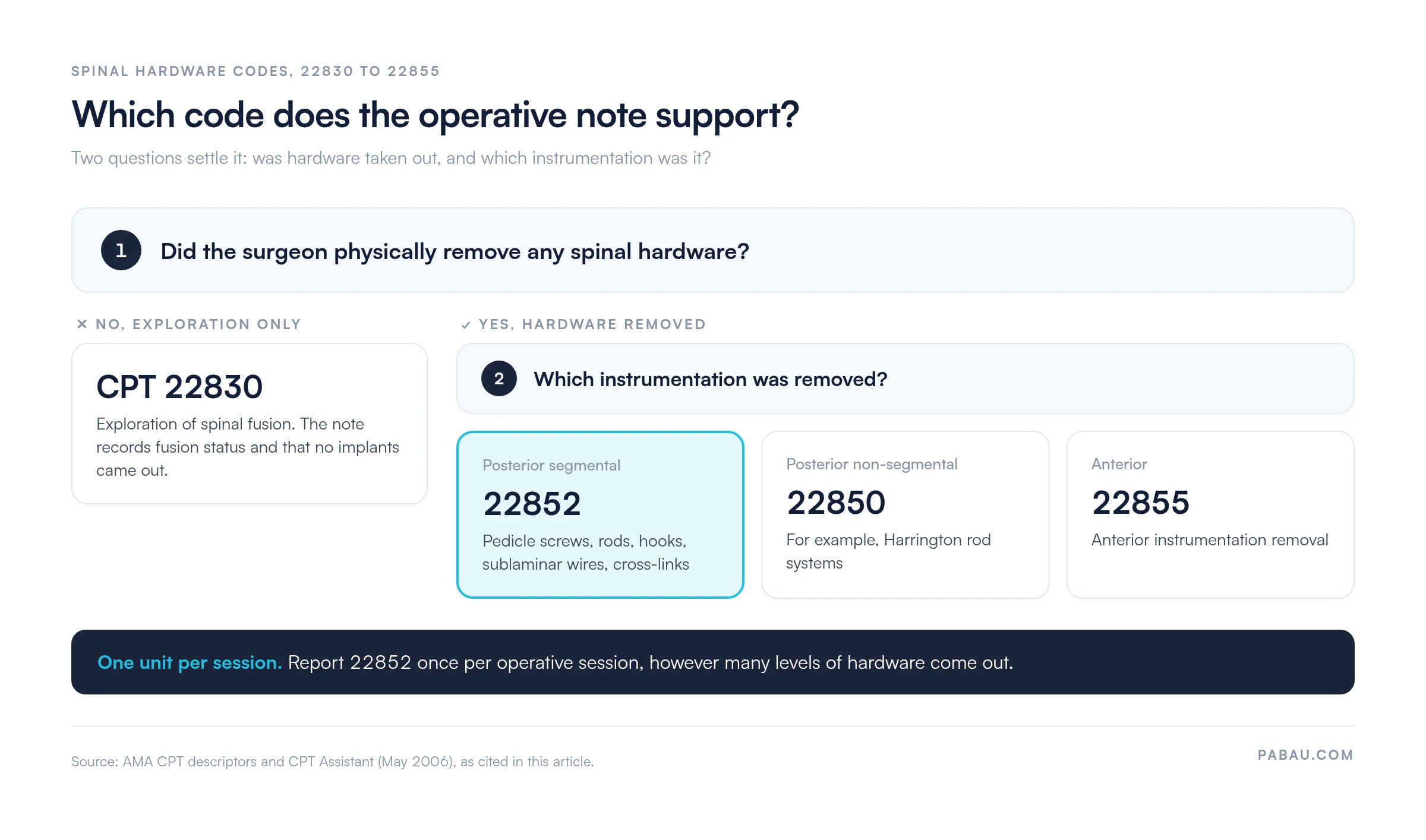
The American Medical Association (AMA) publishes CPT Assistant as the authoritative source for code interpretation. The May 2006 issue confirms that CPT 22852 should not be reported per level. Billing one unit per level is a frequent denial trigger for orthopedic billing teams.
The 22840-22855 range covers placement, reinsertion, and removal of spinal instrumentation across anterior, posterior segmental, posterior non-segmental, and pelvic fixation approaches. Knowing where the removal codes sit prevents crosswalk errors when one case combines placement and removal in different spinal regions. Our library of CPT codes has separate pages for several codes in this range, including 22840 and 22842.
When the removal approach or construct type is not described by any removal code in this range, the unlisted spine code 22899 applies instead. That claim needs the operative report and a medical necessity letter naming the closest removal code.
Many CPT Code 22852 denials trace back to an operative report that lacks the detail payers need to confirm medical necessity. The note has to support both the procedure performed and the clinical reason for it.
An operative report that supports CPT 22852 must include all of the following:
The diagnosis code linked to CPT Code 22852 must establish why hardware removal was medically necessary. Mismatch between the diagnosis and the documented removal indication is a frequent denial cause. The ICD-10-CM codes below are the most commonly paired; verify against the CDC/NCHS ICD-10-CM web tool for current-year validity before submitting.
Before submitting CPT Code 22852, cross-reference the operative note against the ICD-10 diagnosis code. If the note documents infection at the implant site but the claim carries T84.216A (mechanical breakdown), expect a mismatch denial. A one-page documentation checklist at pre-billing review catches these before submission.
The right modifier on CPT Code 22852 decides whether the claim pays on first submission or goes to manual review. The table below covers the four modifiers used most on spinal hardware removal claims and the documentation each one needs.
Prior authorization requirements for CPT Code 22852 vary by payer and plan type. Medicare generally does not require prior authorization for this code when an appropriate diagnosis supports it, but commercial payers often do. Build the authorization request into scheduling, before the case goes on the calendar.
Most commercial payers require the following before approving a claim for spinal hardware removal:
When a payer issues an authorization number, carry it onto the 837P electronic claim. A missing authorization number is one of the easiest denials to prevent on this code family.
Medicare pays CPT Code 22852 under the Medicare Physician Fee Schedule (MPFS), which is built on the resource-based relative value scale (RBRVS). Rates differ between facility settings (hospital or ASC) and non-facility settings, and they vary by geographic locality. The CMS Physician Fee Schedule lookup tool is the authoritative source for your local rate. The table below shows how the payment is built rather than quoting a figure.
Check the current-year rate in the CMS tool before you quote a patient estimate or model revenue. Tracking the electronic remittance advice (ERA) on each 22852 claim shows payer-specific payment patterns. It also flags underpayments while there is still time to appeal.
Denials on CPT Code 22852 cluster around a small set of preventable errors. Each one below is cheaper to catch at pre-billing review than to work after the payer rejects the claim. For the wider process, see our guide to denial management in healthcare.
CPT Code 22852 can be billed alongside concurrent spinal procedures in some scenarios. National Correct Coding Initiative (NCCI) edits and payer policies decide whether the removal is separately payable or bundled. In general, it is separately reportable when it adds significant surgical work beyond the primary procedure.
Key scenarios and their typical treatment:
Each separately billed service needs its own documentation in the operative report. Review the NCCI procedure-to-procedure edits every quarter, because bundling rules change with each update. The superbill for a session with concurrent spinal procedures should list each procedure with its own CPT code, modifier rationale, and note reference.
Flag every 22852 claim that also has a placement or fusion code on the same date of service for a manual review before submission. Run those claims through the current NCCI edits table to confirm separate reportability.
On a 22852 case, the operative note, the authorization number, and the diagnosis code often sit in different systems. Someone pulls them together by hand before the claim goes out. One missing authorization number or mismatched T84 code sends it back.
Practice management software like Pabau keeps the patient record, the treatment notes, and the claim in one place. Its software that tracks claims works with Claim.MD, our integrated US clearinghouse. You check eligibility in real time and submit 837P claims electronically to thousands of US payers.
When the ERA comes back, it lands against the same claim. Your team spots an underpaid or denied 22852 without cross-checking a spreadsheet, while there is still time to appeal.

Pabau integrates with Claim.MD to submit CPT 22852 claims electronically, verify eligibility in real time, and surface denial reasons before the appeal deadline. See how orthopedic and surgical practices manage the full billing cycle in one place.

Get the unit count right first. One unit of 22852 per session, whatever the number of levels, removes the most common reason these claims come back.
Then let the operative note do the coding work. A note that names each implant, the levels, and the reason for removal settles the choice between 22852, 22830, and 22850. It settles the T84 diagnosis code too. The trade-off is surgeon time, which costs less than working a denial and resubmitting.
Book a demo to see how Pabau carries spinal procedure claims from eligibility check to ERA in one workflow.

Need a clearinghouse for US surgical claims? Claim.MD clearinghouse overview explains how Pabau routes CPT claims to thousands of US payers for real-time eligibility and ERA processing.
Removing non-segmental hardware instead? CPT code 22850 covers removal of posterior non-segmental instrumentation, such as Harrington rods.
Want to reduce denials across all billing codes? Denial codes in medical billing covers the most common CARC denial reasons and how to address them before resubmission.
Tracking payments on spinal claims? Electronic remittance advice explained shows how to read an ERA and spot underpayments early.
Enrolling a new surgeon with commercial payers? Getting credentialed with insurance companies outlines the payer enrollment steps that unlock direct claim submission for orthopedic practices.
CPT Code 22852 is the code for removal of posterior segmental instrumentation from the spine. That covers pedicle screws, connecting rods, laminar hooks, sublaminar wires, and cross-link connectors placed during a prior fusion or stabilization procedure. It is reported once per operative session, however many spinal levels are involved.
No. CPT Assistant (May 2006) states that CPT 22852 is not reported per level. Billing one unit per vertebral level is a common denial trigger. Report one unit per operative session regardless of how many levels of instrumentation were removed.
Modifier 22 (increased procedural services) applies when hardware removal takes significantly more work than typical. Examples include broken pedicle screws embedded in bone, severe peri-implant fibrosis, or piecemeal screw removal with specialized instruments. The operative report must describe the added complexity and estimate the extra operative time.
Medicare payment for CPT 22852 varies by geographic locality and differs between facility and non-facility settings. Use the CMS Physician Fee Schedule lookup tool for the current-year rate in your locality. Treat published national averages as a guide only, not a basis for contract negotiations or revenue projections.