CCSD Code H5230: Haemorrhoid sclerosing injection
CCSD Code H5230: definition and clinical scope CCSD Code H5230 is the Clinical C...

Last Updated: Oct 21, 2026
82105 is the CPT code for alpha-fetoprotein (AFP); serum. It reports total AFP measured in a serum specimen. Physicians order it to monitor liver cancer and germ cell tumors, and as part of maternal serum screening in pregnancy.
AFP measured in amniotic fluid is reported with 82106, and the AFP-L3 panel with 82107. Medicare covers 82105 for tumor monitoring under National Coverage Determination (NCD) 190.25 and pays it under the Clinical Laboratory Fee Schedule.
Let Pabau's smart automation suggest the right codes, reduce claim denials, and keep your practice compliant—effortlessly.
Automate repetitive tasks and focus on what matters most—your patients.
Reduce coding errors and ensure compliance with the latest regulations.
Clean claims, fewer denials, and faster reimbursements.
Powerful insights and reporting to help your practice thrive.
HIPAA compliant SOC 2 certified GDPR-compliant Trusted by 4,000+ clinics worldwide

CPT code 82105 reports total AFP measured in serum. Amniotic fluid AFP uses 82106, and the AFP-L3 panel with total AFP uses 82107.
CMS NCD 190.25 limits Medicare coverage to monitoring AFP-producing tumors such as hepatocellular carcinoma, and average-risk screening is non-covered.
Missing or unsupported ICD-10 codes are the leading denial reason, so code the specific indication the ordering physician documented.
Practice management software like Pabau submits 82105 claims through Claim.MD, checks eligibility in real time, and tracks each claim through to the ERA.
CPT Code 82105 is the AMA’s code for “Alpha-fetoprotein (AFP); serum.” It sits in the Chemistry subsection (82009-84999) of the Pathology and Laboratory chapter. The test measures the concentration of AFP in a blood specimen, using immunoassay, enzyme immunoassay, or electrochemiluminescence in a CLIA-certified laboratory.
AFP is a glycoprotein produced mainly by fetal liver cells and yolk sac tissue. In adults, raised serum AFP serves as a tumor marker. Two clinical contexts drive most 82105 orders:
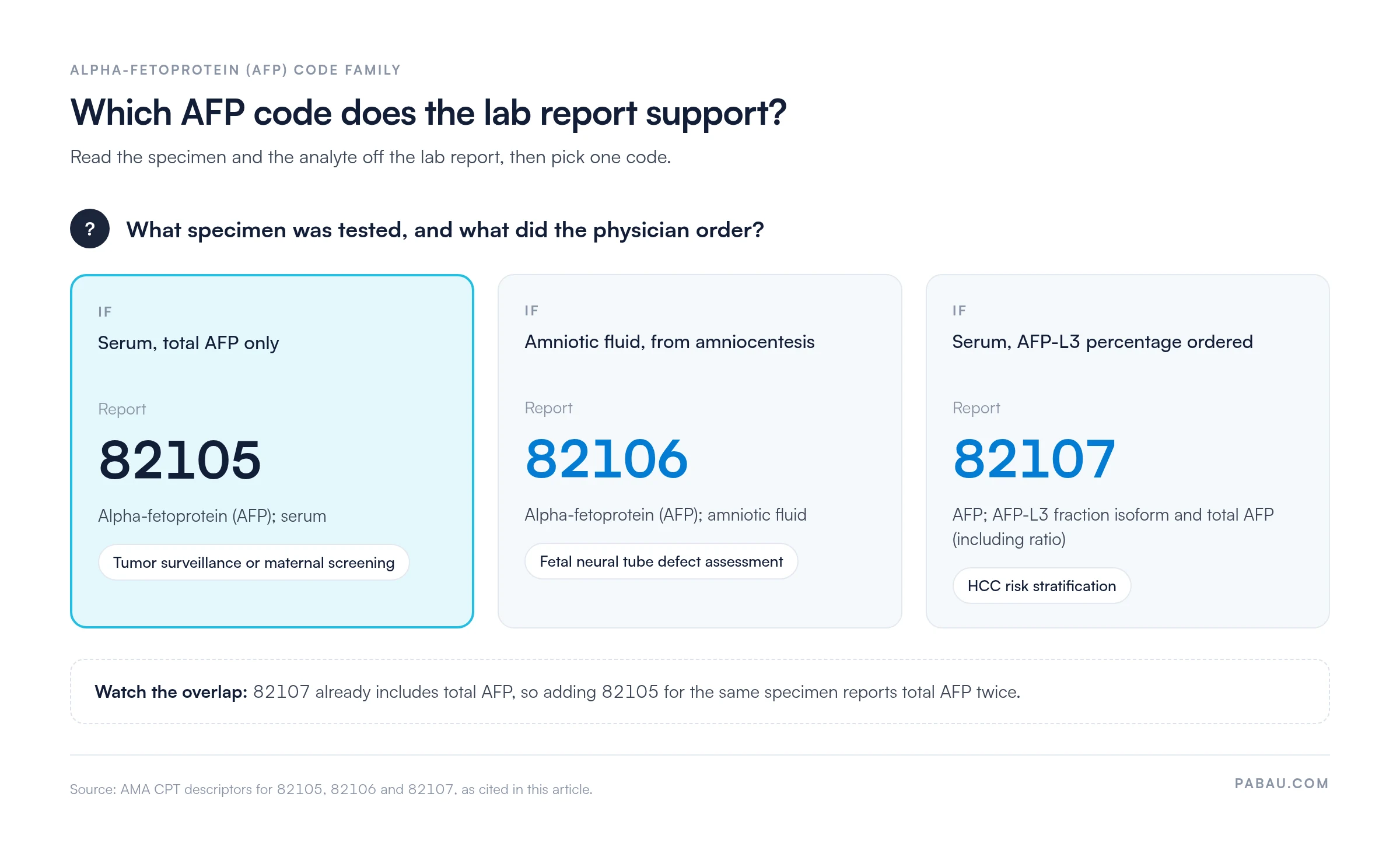
The most common coding error for AFP testing is picking the wrong code in the 82105-82107 family. Each code covers a distinct specimen or analyte, and payers deny a claim when the code doesn’t match the lab report. In short, 82105 is serum total AFP and 82106 is amniotic fluid AFP. The third code, 82107, is the AFP-L3 panel, which reports the L3 fraction, total AFP and their ratio.
82105 and 82107 are both serum tests, which causes most of the confusion. The difference is scope. 82105 reports total AFP on its own, while 82107 already includes total AFP alongside the L3 fraction and the ratio. So when the physician orders AFP-L3, report 82107 rather than adding 82105 for the same specimen. The diagram below maps each lab report scenario to its code.
A valid 82105 claim needs documentation that ties the lab result to a clinical indication. Missing documentation is a frequent denial trigger, second only to unsupported ICD-10 codes. The record must capture each of the following elements:
Prenatal screening claims need more. Many MACs require evidence of gestational age at the time of draw and the screening protocol used, such as a triple or quad screen. Follow-up AFP testing after an abnormal maternal screen is typically reported with O28.1. Keeping orders, requisitions and results together in the patient record protects the laboratory in an audit.
Flag orders that specify only ‘AFP’ without noting specimen type. Train front-desk and ordering staff to write ‘serum AFP’ in full on requisitions. The lab can then tell it apart from amniotic fluid orders before collection.
Payers accept only diagnosis codes that establish a clinical reason for measuring serum AFP. The CDC/NCHS ICD-10-CM tool provides the official code descriptions used in the table below. Always verify covered codes against the MAC LCD for your jurisdiction, as covered lists vary.
The CMS ICD-10 codes page publishes annual update files that reflect any changes to the covered diagnosis code lists. Coders should confirm that the ICD-10 code reflects the physician’s current documented indication, not a historical diagnosis carried forward from a prior visit.
CMS National Coverage Determination 190.25 is the primary Medicare policy governing alpha-fetoprotein testing. NCD 190.25 covers AFP serum testing ordered to monitor patients with known or suspected AFP-producing tumors, including hepatocellular carcinoma and germ cell tumors. Average-risk screening in patients without a documented clinical indication is explicitly non-covered under the NCD.
In practice, an AFP order with no documented tumor history or active oncology indication should not go to Medicare as a covered service. Where coverage is doubtful, the lab can issue an Advance Beneficiary Notice (ABN) before the draw, so the patient can accept financial responsibility.
CPT Code 82105 is paid under the Medicare Clinical Laboratory Fee Schedule (CLFS), not the Physician Fee Schedule. The CLFS pays a single national rate, while the Physician Fee Schedule applies geographic adjustments. Rates change every year, so confirm the figures below against the CMS CLFS file before submitting claims.
Commercial payers set their own contract rates, which may sit above or below the CLFS rate. Payers with CLFS-based contracts typically pay at or near 100% of the CLFS rate, while others negotiate separately. Electronic submission to Medicare and most commercial payers uses the 837 electronic claim file. Reconcile each 82105 payment against the electronic remittance advice (ERA) to catch underpayments early.
Oncology practices and reference laboratories often order AFP alongside other tumor marker assays on the same date of service. CPT Code 82105 can generally be billed with the following codes when the clinical record documents a distinct indication for each marker:
When a GI surveillance order pairs AFP with CEA, report CPT 82378 on its own line. Each code needs its own supporting diagnosis, because neither one includes the other.
Panel billing requires a documented clinical indication for each code in the panel. Bundling multiple tumor markers without distinct per-test documentation is a common audit finding. On a denied same-day claim, the ERA usually carries a claim adjustment reason code (CARC). It shows which code was treated as bundled or not separately payable.
Most 82105 denials are preventable with the right pre-submission checks. The medical billing denial codes that appear most often on AFP claims fall into five categories:
A denial management workflow for lab claims starts before submission. Check the ICD-10 code, the specimen type and the MAC frequency limit against the order before the claim goes out. Claims management software then handles submission and tracking, so each denial comes back with a reason code your team can act on. A clean claim on the first pass is the single highest-leverage way to cut 82105 denials.
Run a monthly query on 82105 denials segmented by denial reason code. If frequency-limit denials outnumber ICD-10 denials, the root cause is likely a scheduling issue in the EHR, not a coding error. Correct it at the ordering workflow level.
Many practices still key an AFP order into one system and the claim into another. Each re-key is another chance for the specimen type or the diagnosis code to drift from what the physician documented.
Practice management software like Pabau keeps the signed order, the lab result and the claim on the same patient record. Through its Claim.MD integration, Pabau submits the CMS-1500 claim electronically, runs a real-time eligibility check, and tracks the claim’s status.
When the payer responds, the ERA comes back into Pabau. Your team can reconcile the payment against the CLFS rate or work the denial straight away, while coding decisions stay with your coders.

Pabau’s Claim.MD integration submits CMS-1500 claims, checks eligibility in real time, and tracks each claim to the ERA. See how it fits your lab billing workflow.

Two checks settle most 82105 claims before they go out. Confirm the specimen was serum and the order asked for total AFP, not the AFP-L3 panel. Then match the ICD-10 code to the indication the physician documented, not the lab’s reason for testing.
For Medicare patients, NCD 190.25 draws the line at tumor monitoring. Average-risk screening needs an ABN before the draw, not an appeal afterward. That costs a little more work at the order stage and saves far more time chasing denials later.
Book a demo to see how Pabau submits and tracks your lab claims, so your team spends less time working denials.

Need a framework for managing lab claim denials? Denial management in healthcare walks through systematic approaches to tracking, appealing, and preventing recurring claim denials.
How does electronic remittance advice work for lab payments? Electronic remittance advice (ERA) explains how 835 transaction sets communicate payment decisions and CARC reason codes back to the billing team.
Looking for the broader billing compliance context? Medical billing compliance covers documentation retention, audit risk management, and the regulatory framework labs need to maintain.
Want fewer AFP claims coming back? Clean claims in medical billing covers the checks that get a lab claim paid on the first submission.
CPT code 82105 covers the measurement of alpha-fetoprotein (AFP) in a serum specimen, by immunoassay or an equivalent method in a CLIA-certified laboratory. It applies to oncology use, such as hepatocellular carcinoma and germ cell tumor surveillance, and to maternal serum prenatal screening. It does not cover AFP in amniotic fluid (82106) or the AFP-L3 panel (82107).
CPT 82105 is paid under the Medicare Clinical Laboratory Fee Schedule (CLFS). The 2025 national rate is approximately $20-25, so verify the exact figure in the CMS CLFS file before submitting. Commercial payer rates are negotiated separately and may differ. Unlike the Physician Fee Schedule, the CLFS rate carries no geographic adjustment.
Yes, Medicare covers AFP serum testing under NCD 190.25 when ordered to monitor known or suspected AFP-producing tumors, including hepatocellular carcinoma and germ cell tumors. Coverage does not extend to routine screening in average-risk patients without a documented clinical indication.
You need a signed physician order specifying serum AFP and a lab report confirming the serum specimen. The claim also needs a current ICD-10 code that matches the indication in the physician’s notes, plus current CLIA certification for the lab. For prenatal claims, many MACs also require the gestational age at the time of draw.