CPT Code 62284: Injection procedure for myelography
CPT Code 62284: official descriptor and procedure overview The American Medical ...

Last Updated: Oct 19, 2026
P9055 is the HCPCS Level II code for platelets, leukocytes reduced, CMV-negative, apheresis/pheresis, each unit.
It applies to single-donor apheresis platelets that are both leukoreduced and CMV-negative, billed per unit issued. When the same platelet unit is also irradiated, the correct code is P9053. P9058 shares the leukoreduced, CMV-negative, and irradiated attributes, but it describes red blood cells, so it never replaces P9055 on a platelet claim.
Let Pabau's smart automation suggest the right codes, reduce claim denials, and keep your practice compliant—effortlessly.
Automate repetitive tasks and focus on what matters most—your patients.
Reduce coding errors and ensure compliance with the latest regulations.
Clean claims, fewer denials, and faster reimbursements.
Powerful insights and reporting to help your practice thrive.
HIPAA compliant SOC 2 certified GDPR-compliant Trusted by 4,000+ clinics worldwide

HCPCS code P9055 covers apheresis platelets that are both leukoreduced and CMV-negative, and the blood bank record must confirm both attributes.
P9055 is billed per unit issued, and the units on the claim must match the blood bank issuance log.
An irradiated unit of the same platelet product is billed as P9053. P9058 is a red blood cell code and never belongs on a platelet claim.
Practice management software like Pabau keeps the order, blood bank records, and invoice in one patient record, so a challenged claim is easier to support.
HCPCS code P9055 describes leukoreduced, CMV-negative platelets collected by apheresis, billed for each unit issued. It sits in the P9010-P9100 range of HCPCS Level II blood product codes, which the Centers for Medicare and Medicaid Services (CMS) maintains. Codes in this range are reported as separate supply lines rather than bundled into a procedure code.
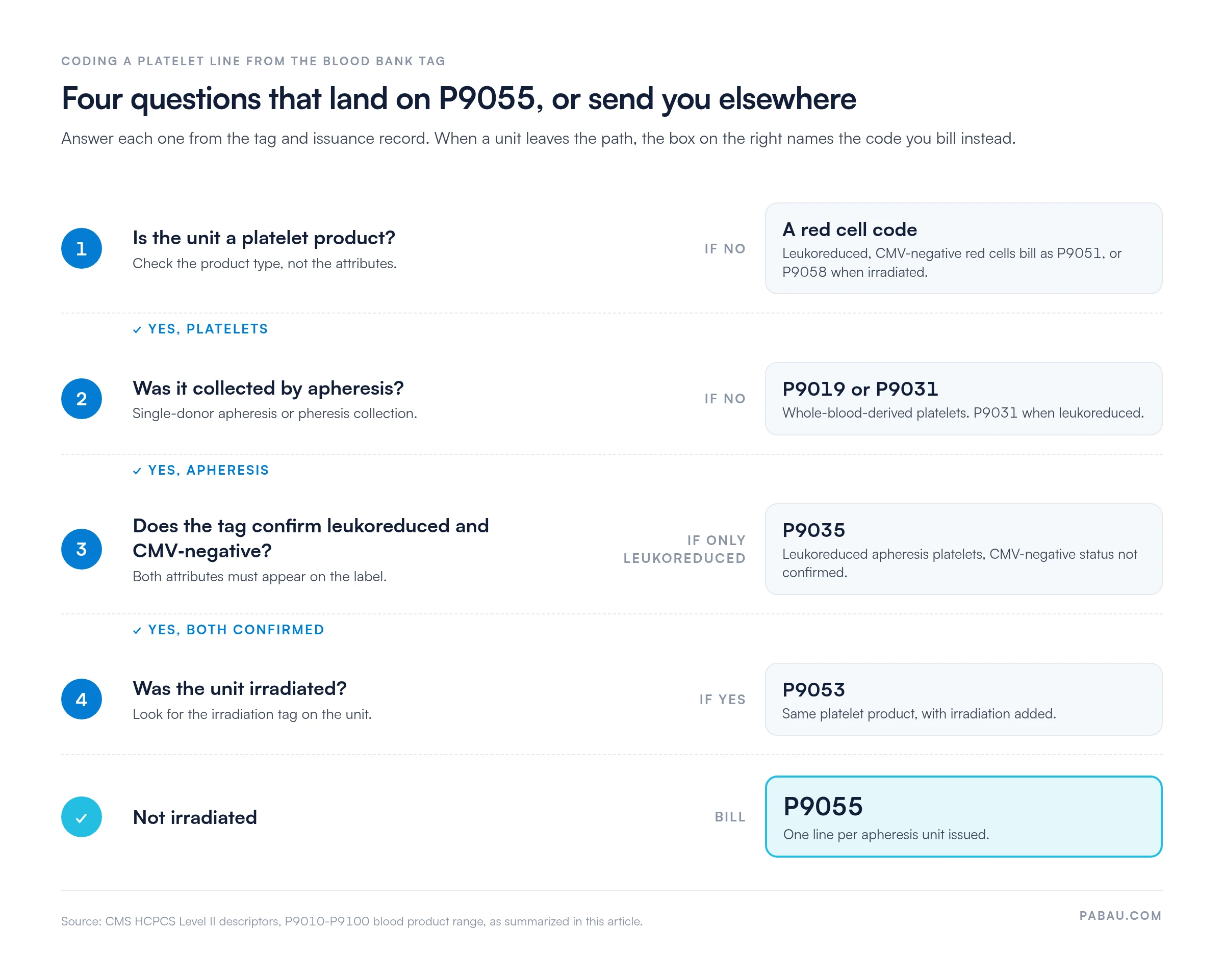
The descriptor requires both leukoreduction and CMV-negative status. A leukoreduced apheresis platelet unit without confirmed CMV-negative status is billed as P9035 instead. An apheresis platelet unit labeled pathogen reduced is billed as P9073 instead. Check both attributes on the blood bank label and issuance record before you code the line.
Leukoreduced, CMV-negative apheresis platelets are ordered for patients at high risk of transfusion-transmitted cytomegalovirus infection. Coders who know these indications can check that the medical necessity documentation supports the code.
The physician order must name the product the patient needs. An order for platelets that omits the leukoreduced, CMV-negative specification gives an auditor no support for P9055. Confirm the order language before billing.
P9055 pays for the platelet product itself, billed per issued unit. The transfusion procedure, other platelet preparations, and red cell products all carry their own codes.
When platelets and the transfusion fall in the same encounter, report P9055 for the product. The transfusion code, usually 36430, goes on a separate line. The transfusion code is reported once per session, however many units the patient receives.
Reconcile the P9055 units on the claim against the blood bank issuance log before submission. Report the count in the units field, one unit per apheresis collection. A billed count that exceeds the units issued invites an overpayment finding on audit.
HCPCS codes P9051 through P9058 look alike, but they mix platelet, whole blood, and red cell products. Only P9053 and P9055 describe apheresis platelets that are both leukoreduced and CMV-negative. The AAPC HCPCS code reference lists the full range. Product type, CMV-negative status, irradiation, and processing method separate the codes.
The key split is P9055 vs P9053, and irradiation decides it. When a transplant patient needs irradiated apheresis platelets and the tag confirms irradiation, the correct code is P9053. P9055 covers the same platelet product without irradiation.
P9058 is easy to mistake for a platelet sibling. It shares the leukoreduced, CMV-negative, and irradiated attributes with P9053, but it describes red blood cells. P9054, P9056, and P9057 are whole blood or red cell codes too, so none of them belongs on a platelet claim. Four questions about the unit settle which code applies.
Billing P9055 accurately means matching the blood bank issuance record to the claim at the unit level. The six steps below take a unit from the physician order to a submitted claim line.
Revenue code selection depends on who paid for the platelets. When the hospital purchases the unit, report P9055 under revenue code 0384. When a community blood bank supplies the unit free of charge, the hospital reports its processing and storage charge under 0390 or 0392. Confirm the pairing with your Medicare Administrative Contractor before submission.
Most P9055 claims need no modifier. The CMS JW and JZ discarded-drug policy applies to single-dose drug containers, and P-series blood codes are not on its code list. Some payers set their own modifier rules for blood products, so check the payer policy before you append one.
Medicare pays hospital outpatient claims for P9055 under the Outpatient Prospective Payment System (OPPS). Blood products carry OPPS status indicator R, so P9055 is paid separately at the rate set for its APC. That rate changes with each annual OPPS final rule.
How to find the current rate: Check CMS OPPS Addendum B for the calendar year of service. It lists the status indicator and national payment rate for each HCPCS code, including P9055. The facility wage index then adjusts the amount paid. CMS publishes each quarterly update on its OPPS addenda page.
Medicare Advantage plans negotiate blood product rates separately with each facility, and commercial contracts vary widely. Check each payer fee schedule or your remittance history to set the expected reimbursement for P9055.
Complete documentation is the strongest defense against a P9055 denial. Payers audit blood product claims for both medical necessity and descriptor accuracy. Collect the records below before the claim goes out.
The ICD-10-CM code paired with P9055 must show why the leukoreduced, CMV-negative specification is medically necessary. The pairings below are commonly accepted, but the list is not exhaustive and the payer makes the final call.
Some payers treat leukoreduction as equivalent to CMV-negative status for coverage purposes. Do not rely on this equivalence without a payer-specific policy document to support it. When the blood bank label confirms CMV-negative status, bill P9055. When it confirms only leukoreduction, the apheresis code is P9035, so review the payer coverage policy before billing.
Blood product claims are denied when the code, the order, and the blood bank record disagree. Most P9055 denials trace back to the six causes below. Our guide to common denial codes explains the CARC codes on blood product remittances.

The CARC code on the remittance advice names the denial reason, and each reason has its own fix. Missing records need document retrieval. A wrong P-series selection needs a corrected claim, and a medical necessity dispute needs an appeal.
Many blood product denials start in the paperwork. The order, the blood bank tag, and the claim line often sit in separate systems, so a mismatch stays hidden until the remittance arrives. Treating documentation capture and code checks as one workflow catches that mismatch before submission.
Practice management software like Pabau keeps the physician order, the blood bank documentation, and the invoice together in the patient record. When a payer challenges a P9055 line, your team pulls the supporting records from one place. For US payers, Pabau’s claims management and tracking pre-fills claims from data already on the record, then submits them through Claim.MD.
Automated workflows in Pabau can remind staff to finish required steps, such as attaching the blood bank label, before an invoice is closed. Incomplete P9055 documentation then gets fixed before submission rather than through an appeal. The retained transfusion records stay in the same HIPAA-compliant patient record, ready for a payer audit.


Pabau keeps physician orders, blood bank records, and invoices in one patient record, so your team can support every P9055 claim line. See how it works.

Treat the blood bank tag as the source of truth for every P9055 line. If the tag and the physician order disagree, correct the order before the claim goes out. The tag is what an auditor compares the claim against.
Two checks carry most of the risk. Match the units field to the issuance log, and confirm irradiation status before choosing between P9055 and P9053. Running both on every platelet line turns most audit requests into a records pull instead of an appeal.
To keep orders, blood bank records, and invoices together for every transfusion claim, book a demo with our team.

Need a structured approach to managing claim rejections? Denial management in healthcare walks through how to build a systematic denial resolution process for blood product and supply codes.
Want to understand how clean claims reduce rework? What makes a clean claim explains the submission requirements that prevent adjudication delays on blood product billing.
Choosing a billing platform for blood product claims? Best medical billing software in the US compares platforms that support HCPCS Level II code entry and claim management.
Need the diagnosis codes on the claim to line up? How to build a superbill shows how to capture the procedure and diagnosis codes a payer expects on each line.
Preparing for a payer audit? Medical billing compliance covers the records and controls that keep supply-code claims defensible.
HCPCS code P9055 covers apheresis-collected platelets that are both leukoreduced and CMV-negative, billed per unit issued. It covers the product supply only. The transfusion procedure (CPT 36430 or 36440), irradiated units (P9053), and whole-blood-derived platelets carry their own codes.
Medicare fee-for-service generally does not require prior authorization for blood product codes such as P9055. Medicare Advantage plans and commercial payers may apply utilization management, particularly for repeated transfusion episodes. Check the plan requirements before assuming no authorization is needed.
Revenue code 0384 (platelets) is the standard pairing for P9055 on a UB-04 claim when the hospital purchased the unit. If a community blood bank supplied it free, the processing and storage charge goes under 0390 or 0392. Confirm the pairing with your Medicare Administrative Contractor.
No. P9058 is red blood cells, leukocytes reduced, CMV-negative, irradiated, each unit. It shares three attributes with the platelet code P9053 but describes a red cell product. Leukoreduced, CMV-negative red cells are billed as P9051 when not irradiated and P9058 when irradiated.