HCPCS Code E0272: Foam rubber mattress billing guide
HCPCS Code E0272: official descriptor and code overview HCPCS Code E0272 is the ...

Last Updated: Nov 6, 2026
L2070 is the HCPCS Level II code for hip knee ankle foot orthosis, torsion control, unilateral rotation straps, pelvic band/belt, custom fabricated. It belongs to the L2040 through L2090 series of custom torsion-control HKAFOs, which anchor at the pelvis. Within that series, it's the one-leg version that controls rotation with straps instead of torsion cables.
L2070 is not a knee-ankle-foot orthosis (KAFO) code, since the KAFO range ends at L2038. Medicare's AFO/KAFO policy, LCD L33686, doesn't list it, so each claim rests on the order, the treating practitioner's notes and the fitting record.
Let Pabau's smart automation suggest the right codes, reduce claim denials, and keep your practice compliant—effortlessly.
Automate repetitive tasks and focus on what matters most—your patients.
Reduce coding errors and ensure compliance with the latest regulations.
Clean claims, fewer denials, and faster reimbursements.
Powerful insights and reporting to help your practice thrive.
HIPAA compliant SOC 2 certified GDPR-compliant Trusted by 4,000+ clinics worldwide

HCPCS code L2070 describes a custom-fabricated hip-knee-ankle-foot orthosis (HKAFO) with torsion control, a unilateral rotation strap and a pelvic band or belt.
L2070 is not a KAFO code: KAFOs run from L2000 through L2038, and L2040 through L2090 is the custom HKAFO torsion-control series.
Medicare’s AFO/KAFO policy, LCD L33686, does not list L2070, so each claim stands on what the medical record shows.
Pabau, practice software with insurance claiming built in, checks each L2070 claim for missing or invalid details before it reaches the payer.
HCPCS code L2070 is the CMS HCPCS Level II code for a custom-fabricated hip-knee-ankle-foot orthosis (HKAFO) with torsion control. The official descriptor reads: “Hip knee ankle foot orthosis (HKAFO), torsion control, unilateral rotation straps, pelvic band/belt, custom fabricated.”
A pelvic band or belt anchors the device at the hip. A rotation strap runs down one leg and controls how that limb turns during walking.
L2070 sits in the HCPCS torsion-control HKAFO series, L2040 through L2090. Every code in that series is custom fabricated, so there is no prefabricated version of this device. The series follows the knee-ankle-foot orthosis (KAFO) codes, L2000 through L2038, which have no pelvic component. Within that KAFO range, a custom brace whose knee locks in stance and releases in swing bills as L2005.
L2070 describes the complete custom-fabricated torsion-control HKAFO: the pelvic band or belt plus a rotation strap on one leg. It does not describe a KAFO, an AFO, or a version that controls rotation with torsion cables.
Three boundaries separate L2070 from its neighbors:
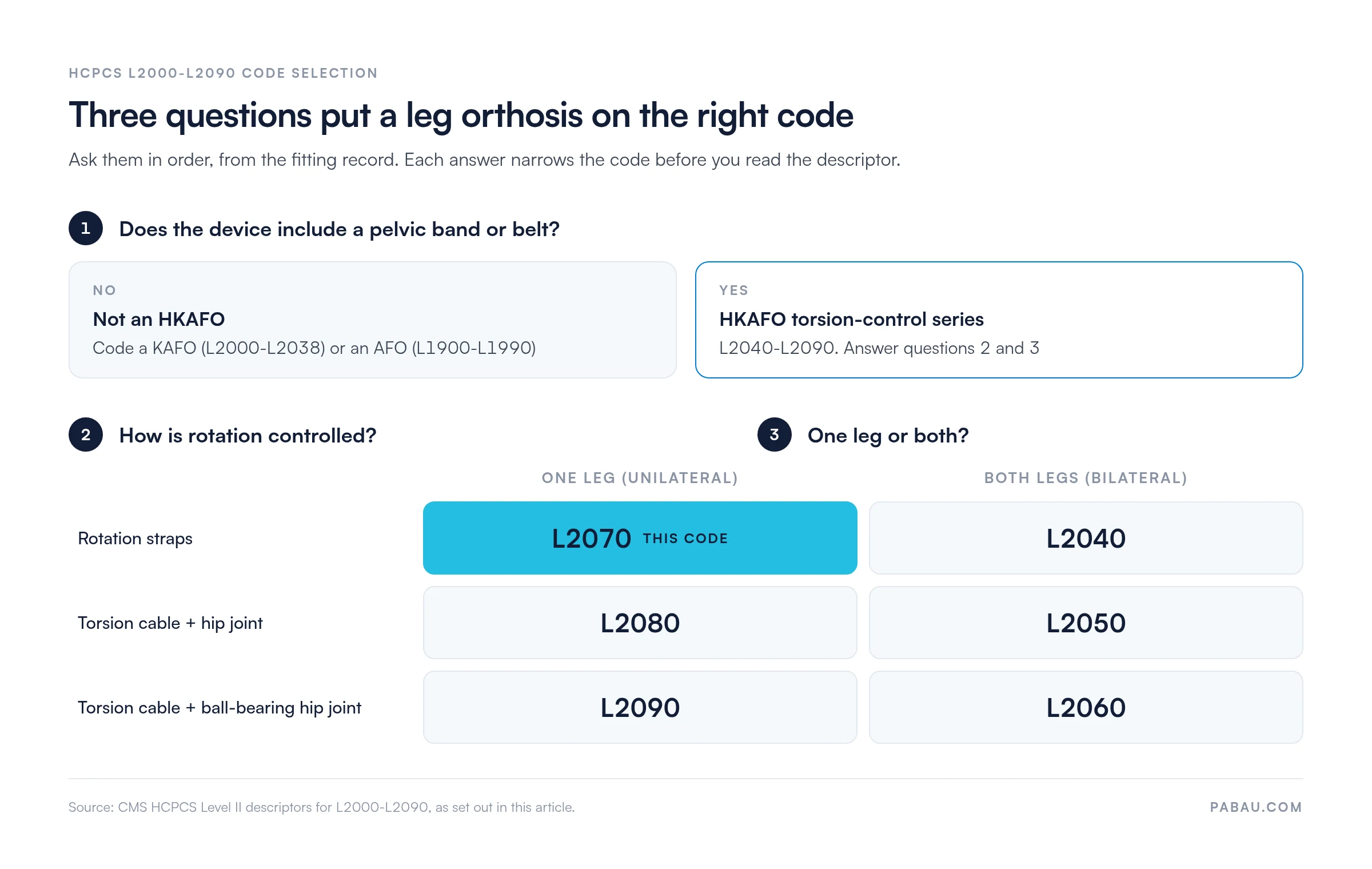
The torsion-control series splits on three features: straps or cables, the hip mechanism, and one leg or two. The table below maps the codes coders most often mix up with HCPCS code L2070.
Three questions, asked in order, settle the code. Does the device include a pelvic band or belt? If not, it isn’t an HKAFO. Does it control rotation with straps, or with a torsion cable and a hip joint?
Straps narrow it to L2070 or L2040, and the leg count decides between them. A cable on one leg with a standard hip joint is L2080. The grid below maps each answer to its code.
CMS publishes no covered-diagnosis list for L2070. The AFO/KAFO policy article (A52457) lists ICD-10 codes only for a few positioning devices and the CROW boot, and L2070 is not among its codes.
That puts the weight on the record. Torsion-control HKAFOs are typically used for rotational gait problems, such as in-toeing or out-toeing, often in children with neuromuscular conditions. Code the underlying condition as specifically as the record allows, for example a cerebral palsy code from category G80. Our searchable ICD-10-CM library helps you find the most specific code the notes support.
Link that diagnosis to the L2070 claim line, and make sure the notes name the affected side. A diagnosis alone does not establish need; the record must also describe the rotational deviation the strap controls.
Medicare covers orthoses under the Part B braces benefit, and the DME MAC for the beneficiary’s state processes L2070 claims. Local Coverage Determination L33686 covers ankle-foot and knee-ankle-foot orthoses. Its KAFO code list does not include the L2040-L2090 HKAFO series.
With no LCD setting criteria, the DME MAC judges each L2070 claim under Medicare’s general reasonable-and-necessary standard. Practices that share care, such as physical therapy and orthotics practices, should keep therapy and orthotist notes in the same file. Reviewers look for a record that shows:
Payers do not accept a diagnosis code alone as proof of need. The notes must explain what the patient cannot do without the orthosis and why L2070’s construction addresses it.
DMEPOS suppliers billing HCPCS code L2070 to Medicare should hold a complete file before the claim goes out, not only before an audit.
Medicare requires suppliers to keep ordering documentation and proof of delivery for seven years from the date of service. L2070 has no Certificate of Medical Necessity (CMN) form, so do not hold a claim waiting for one. Only enrolled Medicare DMEPOS suppliers may bill L2070 to the Medicare program.
Medicare pays L2070 as a purchased item under the prosthetics and orthotics category of the DMEPOS fee schedule, which CMS updates each year. Rates vary by state, so check the current file for the state where the device is delivered.
Commercial payer rates for HCPCS code L2070 are set by contract. Verify each payer’s rate rather than assuming Medicare’s applies.
L2070 is not among the orthoses codes CMS has named for its DMEPOS Required Prior Authorization List, including the codes added from October 28, 2026. CMS updates that list periodically, so check it before relying on this.
Commercial payers often require prior authorization for custom orthoses regardless of Medicare rules. Build a prior authorization check into order intake, and record the authorization number on the claim and in the patient file.
Check the CMS Required Prior Authorization List and the face-to-face and written-order Master List at the start of each year. Both change, and a new listing would change how HCPCS code L2070 orders must be handled.
Modifier rules for L2070 differ from AFO and KAFO claims. The KX rule in the AFO/KAFO policy article applies to the codes that policy lists, and L2070 is not one of them.
Treat every modifier as an attestation. Add one only when the record supports what it claims.
Most L2070 denials start with a coding slip or a missing document. The table below maps each one to its root cause and the corrective action that prevents it. Good denial management workflows catch most of these at the pre-claim stage rather than the appeals stage.
Billing HCPCS code L2070 takes five checks at entry, not one. Each step below stops a data entry error from turning into a denial.
Add an L2040-L2090 rule to your claim scrubber: the rotation mechanism, hip mechanism and number of legs on the fitting record must match the code. That one check catches the series miscodes before they reach the payer.
Without one system, an L2070 order travels by hand from the written order to the fitting notes to the billing screen. Each retyped field is a chance to drop a modifier or attach the wrong diagnosis.
Pabau, a practice management platform with insurance claiming built in, opens each claim pre-filled from the invoice. Its error-catching claims software checks every claim for missing or invalid details before it leaves, so a fix takes seconds instead of a resubmission.
In the US, Pabau submits CMS-1500 claims through Claim.MD, checks eligibility before the visit and stores each prior authorization as a case. That keeps the medical billing process for an L2070 order in one record, from intake to payment.
Once the payer responds, Pabau settles the payment straight from the electronic remittance advice (ERA). Check it against the DMEPOS fee schedule amount you expected. A clean claim submission process that tracks ERA responses also flags underpayments before they age past the timely filing window.

Pabau checks every claim for missing or invalid details before submission. Book a demo to see how it keeps L2070 orders, notes and claims in one record.

L2070 is a narrow code, and it rewards a careful fitting record. Once that record names the pelvic band, the straps and the one controlled leg, the code is settled before billing starts.
Because no LCD sets its criteria, an L2070 claim stands on the record alone. Build the file before the claim goes out, and settle prior authorization at intake instead of after a denial.
Pabau keeps that file, the code and the claim together, so a missing signature or modifier shows up before a reviewer finds it. Book a demo to see how the system handles HCPCS billing from order intake through ERA reconciliation.

Need a denial management framework for DMEPOS claims? Denial management in healthcare outlines the workflow steps that catch coding and documentation errors before claims reach the payer.
Want to understand how the medical billing process works end to end? What is medical billing covers the full revenue cycle from patient registration through payment posting.
Looking to reduce claim errors at the submission stage? Clean claim submission explains the elements every DMEPOS claim must have before it reaches the clearinghouse.
L2070 covers a custom-fabricated hip-knee-ankle-foot orthosis (HKAFO) with torsion control, a unilateral rotation strap and a pelvic band or belt. It controls rotation in one leg. Rotation straps on both legs code to L2040.
No. KAFO codes run from L2000 through L2038. L2070 belongs to the L2040 through L2090 series of custom torsion-control HKAFOs, which add a pelvic band or belt.
Both are unilateral HKAFOs. L2070 controls rotation with rotation straps, while L2080 uses a torsion cable with a hip joint. L2090 is the cable version with a ball-bearing hip joint.
Medicare covers orthoses under the Part B braces benefit, and DME MACs process L2070 claims. LCD L33686 does not list L2070, so each claim is judged on whether the medical record shows the device is reasonable and necessary.
Keep a standard written order, the treating practitioner’s notes showing the need, a fabrication and fitting record, and proof of delivery. Medicare requires suppliers to keep these records for seven years from the date of service.
RT or LT identifies the leg the strap controls. GA, GZ and GY apply when a denial is expected or the item is excluded. KX belongs on L2070 only when a payer policy requires it.
L2070 is not on the CMS Required Prior Authorization List for orthoses as of November 2026. Commercial payers often require it for custom orthoses, so check each plan at order intake.
A frequent reason is choosing the wrong code in the L2040 through L2090 series. Billing a bilateral device as two L2070 lines and thin notes on medical need are others. A missing standard written order or proof of delivery also triggers denials.