CCSD code H4430: Examination of rectum under anaesthetic
CCSD code H4430 pays for the examination alone CCSD code H4430 is the UK private...

Last Updated: Oct 20, 2026
L2080 is the HCPCS Level II code for hip knee ankle foot orthosis, torsion control, unilateral torsion cable, hip joint, pelvic band/belt, custom fabricated.
L2080 sits in a tightly defined segment of the L-series where the hardware on the device decides the code. A single component difference means a different billing code entirely.
Read that descriptor as a parts list. The device spans four joints, covering the hip, knee, ankle, and foot. It uses one torsion cable for rotational control, includes a hip joint, and anchors to a pelvic band or belt. It is custom fabricated for the individual patient rather than taken off a shelf.
The torsion cable is what separates L2080 from its neighbors in the series. A torsion cable stores and returns rotational force between the pelvic section and the lower limb.
That action corrects internal or external rotation through the gait cycle. Clinicians prescribe it for rotational deformity linked to conditions such as spastic cerebral palsy or an acquired neuromuscular disorder.
Let Pabau's smart automation suggest the right codes, reduce claim denials, and keep your practice compliant—effortlessly.
Automate repetitive tasks and focus on what matters most—your patients.
Reduce coding errors and ensure compliance with the latest regulations.
Clean claims, fewer denials, and faster reimbursements.
Powerful insights and reporting to help your practice thrive.
HIPAA compliant SOC 2 certified GDPR-compliant Trusted by 4,000+ clinics worldwide

HCPCS Code L2080 covers a custom-fabricated hip knee ankle foot orthosis (HKAFO) with torsion control. Its descriptor names one torsion cable, a hip joint, and a pelvic band or belt.
In this code range, unilateral and bilateral describe the torsion hardware rather than the number of legs braced. One cable is unilateral and two cables are bilateral.
L2090 is the same device with a ball bearing hip joint, so the joint type is what decides between the two codes.
L2080 is billed under the Medicare Part B DME benefit. The supplier must hold active DMEPOS accreditation or the claim is denied regardless of clinical need.
A detailed written order and supporting medical necessity records must be on file before delivery. Missing either is a leading cause of recoupment.
Practice management software like Pabau helps orthotists and DMEPOS suppliers track documentation requirements and submit clean DME claims across payers.
In this descriptor, unilateral attaches to torsion cable. It counts the torsion control hardware built into the device, not the legs the orthosis braces. L2080 carries one torsion cable, while L2050 and L2060 carry two, which is what their bilateral torsion cables wording means.
Coders who read unilateral as one leg and bilateral as two legs pick the wrong code whenever their assumption and the cable count disagree. Let the cable count drive code selection. The RT and LT modifiers are the part of the claim that states which side of the body the orthosis was furnished for.
L2080 is paid under the Medicare DMEPOS fee schedule. Allowed amounts are jurisdiction-specific and change every year, so treat the table below as structure rather than a dollar figure. Verify the current allowable in the CMS DMEPOS fee schedule for your MAC and the applicable calendar year.
The hip joint and the pelvic band or belt already appear in the descriptor. Adding them as separate line items bills twice for what L2080 pays. Custom fabrication carries its own record requirements. The supplier file should show the measurements, the model or mold, and the fitting notes behind the finished device.
L2080 is covered under Medicare Part B as durable medical equipment (DME). Coverage is not automatic. The claim has to meet CMS medical necessity criteria, and the supplier has to satisfy DMEPOS accreditation requirements before submitting.
The CMS list of CPT/HCPCS codes subject to the physician self-referral law includes L-series orthotic codes. Clinicians and suppliers billing L2080 need to watch for Stark Law exposure when the prescribing physician has a financial relationship with the supplying entity. Where such a relationship exists, confirm the arrangement meets an applicable Stark exception before billing.
Documentation is where most L2080 claims fail on audit. CMS recoupment actions on HKAFO claims consistently cite missing or insufficient medical necessity justification. Get this file in order before dispensing the device, not after.
Keep the order, the clinical records, and the delivery proof together for each L2080 claim. Capture each document at the point of care rather than reconstructing the file after a records request.
Build a pre-dispensing checklist for L2080. Require a DWO that is signed, dated, and names the components. Add the face-to-face visit note, the medical necessity statement, the fabrication records, and the delivery confirmation. Audit the file against that list before submitting. A 10-minute internal review catches what triggers a post-payment audit.
ICD-10 codes paired with L2080 must reflect the clinical condition that justifies an HKAFO with torsion control. The table below lists commonly paired diagnosis codes. Always verify against the applicable MAC LCD for your jurisdiction, because covered diagnoses vary by contractor. Incorrect pairings are a common audit trigger.
Verify each paired code against the MAC LCD for your region. Noridian, Palmetto GBA, and CGS each publish orthotic coverage policies that list supported diagnoses. Eligibility checks before delivery are the right moment to confirm the diagnosis is supported under the applicable determination.
Modifier selection for L2080 is not optional. RT or LT tells the payer which side of the body the orthosis was furnished for, and a claim without it is a predictable return. Use the table below as a reference, and always verify against the payer’s current billing manual before submitting.
RT and LT describe anatomy. The unilateral in the code descriptor describes hardware. Keeping those two apart is the difference between a clean claim and a coding correction. Catch modifier problems in the pre-submission review, rather than on a remittance advice weeks later.
Choosing the wrong L-code in the L2040 to L2090 range is one of the most frequent miscoding patterns in HKAFO billing. The range varies along three axes.
Torsion control comes either from rotation straps or from a torsion cable. The device carries either one of them or two. The hip joint is either standard or ball bearing. Match the device dispensed against all three before you pick a code. The grid below sets out how the six codes divide on those features.
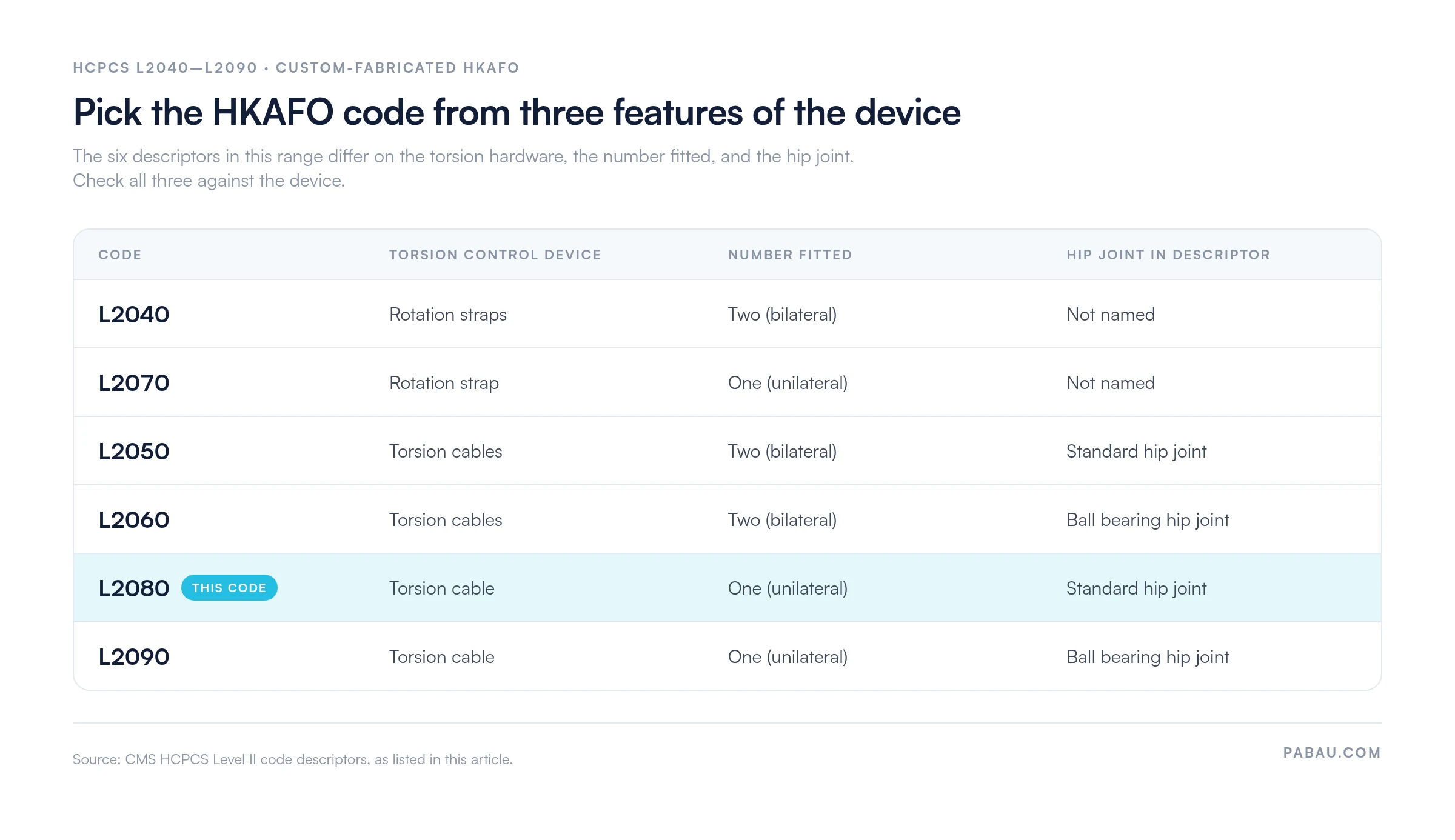
The AAPC’s HCPCS code reference gives detailed guidance on distinguishing adjacent L-series codes. When in doubt, check the manufacturer’s specification sheet against the descriptor before billing.
Billing L2090 for a device with a standard hip joint, or L2050 for a single-cable device, misstates what was delivered and creates compliance exposure.
Every descriptor in this range stops at a pelvic band or belt. A frame that extends higher and adds thoracic support belongs to the thoracic-hip-knee-ankle orthosis family instead. CMS deleted that family’s codes, L1500 through L1520, in 2012.
The most expensive errors on L2080 claims are predictable ones. They surface in post-payment audits because the pre-submission review was skipped. Each of the eight below is avoidable inside the supplier’s own file review.
Review the denial codes that map to documentation and modifier errors on DME claims. Tracking which ones repeat turns a corrections queue into a pre-submission checklist. Submitting a clean claim the first time cuts the cost of appeals and the risk of a wider audit of your HKAFO billing.
Keep the manufacturer’s specification sheet in every HKAFO claim file. Before the code is assigned, check three things against it. Confirm the torsion control type, the number of cables or straps, and whether the hip joint is standard or ball bearing. Those three answers pick the code for you, and the sheet is your evidence if a payer asks later.
DMEPOS billing produces a heavier record trail than most outpatient claim types. Physician orders, clinical evaluations, fabrication notes, proof of delivery, and modifier attestations all have to be at hand the moment a payer asks. Practices without a structured system assemble that from paper files and disconnected software, which is what audits catch.
Pabau brings the whole file into one patient record. Pabau’s claims management software lets orthotic practices and DMEPOS suppliers track L-codes, attach the supporting documentation, and follow claim status across payers. Staff can flag a claim that is missing a record before it goes out. The shortfall then surfaces in your own review instead of an ADR.
The payoff is fewer corrections and a shorter path to payment. When a records request does arrive, the order, the evaluation, the fabrication notes, and the delivery confirmation are already attached to the claim you submitted.

Pabau’s claims management software gives orthotists and DMEPOS suppliers a structured way to track documentation requirements, run eligibility checks, and submit clean claims. See how it works for your practice.

L2080 rewards suppliers who check the device before they pick the code. Confirm the cable count and the hip joint type, then assemble the file the payer will ask for. Most denials on this code come from process failures rather than clinical disagreement.
A modifier goes missing, the order does not match the device delivered, or the ICD-10 pair sits outside the MAC LCD. Each of those is fixable before submission, and none of them is fixable once an audit letter arrives.
Pabau’s claims management software helps DMEPOS suppliers build the documentation workflow that prevents those failures upstream. To see how it fits your orthotic billing process, book a demo.

Need a structured approach to clean claims? What makes a clean claim in medical billing breaks down the components that determine whether a claim pays on first submission.
Dealing with HKAFO denials after submission? Denial management in healthcare covers how to build a systematic appeals and prevention process.
Want to understand the broader DME billing framework? What is medical billing explains the end-to-end revenue cycle for DME and other claim types.
L2080 bills a custom-fabricated hip knee ankle foot orthosis (HKAFO) with torsion control. The descriptor names one torsion cable, a hip joint, and a pelvic band or belt. It is a HCPCS Level II code paid under the Medicare Part B DME benefit. It suits patients whose rotational deformity or neuromuscular condition needs full lower limb support.
No. Unilateral attaches to torsion cable, so it counts the torsion control hardware on the device rather than the legs braced. L2080 has one torsion cable, while L2050 and L2060 have two. Use the RT or LT modifier to tell the payer which side of the body the orthosis was furnished for.
The hip joint. L2080 names a standard hip joint and L2090 names a ball bearing hip joint. The rest of the two descriptors match, including the single torsion cable, the pelvic band or belt, and custom fabrication. Check the manufacturer’s specification sheet for the joint type before choosing between them.
Bill L2080 to Medicare Part B under the DMEPOS fee schedule with an RT or LT modifier for the side furnished. The billing entity needs active DMEPOS accreditation and a signed detailed written order on file before delivery. Add the KX modifier once all applicable LCD requirements have been met. Submit through your Medicare Administrative Contractor on the CMS-1500 form or the 837P transaction.
RT or LT identifies the side of the body the orthosis was furnished for, and it belongs on every claim. KX certifies that LCD medical necessity criteria have been met. GA shows a signed Advance Beneficiary Notice is on file when a Medicare denial is expected. GY applies when the item is not covered and a denial is needed for secondary payer billing.
You need a detailed written order signed by the prescribing physician and clinical records supporting the need for torsion control. Add proof of delivery signed by the beneficiary, plus the measurements and fitting notes behind the custom fabrication. Document the face-to-face encounter where the applicable MAC LCD requires one. Retain the file for at least seven years in case of audit.
Yes. L2080 is covered under Medicare Part B as durable medical equipment when the claim meets CMS medical necessity criteria. The supplier must hold DMEPOS accreditation and keep a compliant detailed written order on file. Medicare typically pays 80% of the approved amount after the deductible. Coverage rules and supported diagnoses vary by MAC jurisdiction.