

HCPCS code E0198: Water pressure pad billing guide
HCPCS code E0198 is a water pad for a standard mattress HCPCS code E0198 is the ...

Last Updated: Oct 13, 2026
Billable Code
L2040 is the HCPCS Level II code for hip knee ankle foot orthosis (HKAFO), torsion control, bilateral rotation straps, pelvic band/belt, custom fabricated. Medicare Part B covers it as a durable medical equipment benefit when the supplier holds a written order and medical necessity documentation.
The bilateral rotation straps are what set L2040 apart from the five codes beside it. Claims deny when the delivered device uses torsion cables or unilateral control instead, so the documentation has to name the strap configuration.
Let Pabau's smart automation suggest the right codes, reduce claim denials, and keep your practice compliant—effortlessly.
Automate repetitive tasks and focus on what matters most—your patients.
Reduce coding errors and ensure compliance with the latest regulations.
Clean claims, fewer denials, and faster reimbursements.
Powerful insights and reporting to help your practice thrive.
HIPAA compliant SOC 2 certified GDPR-compliant Trusted by 4,000+ clinics worldwide

HCPCS code L2040 covers a custom-fabricated HKAFO whose torsion control comes from bilateral rotation straps rather than torsion cables.
Medicare Part B covers L2040 as a DMEPOS benefit, and the supplier must hold the documentation before the claim goes out.
A physician order, a Certificate of Medical Necessity where the LCD requires one, and proof of delivery all belong in that file.
Append modifier KX when coverage criteria are documented, and use GA, GY or GZ when medical necessity is uncertain.
Pabau’s claims management software attaches L2040, appends the modifiers, and routes the claim through Claim.MD for scrubbing before submission.
HCPCS code L2040 is the HCPCS Level II code for a custom-fabricated hip-knee-ankle-foot orthosis with torsion control and bilateral rotation straps. The descriptor also names a pelvic band or belt. Support runs from the pelvis down through the hip, knee, ankle, and foot.
The bilateral rotation straps are what the code turns on. They apply rotational corrective force to both sides of the limb at once. Every other code in the L2040 to L2090 range delivers torsion control a different way, so the strap configuration decides the code.
Orthotists and DMEPOS suppliers should confirm the delivered device carries that strap system before the claim goes out. The full range sits under HCPCS Level II in the CMS HCPCS code set.
L2040 covers the complete HKAFO as one unit, bilateral rotation straps included. That unit is the custom-fabricated frame, the pelvic band or belt, the knee and ankle sections, the foot plate, and the rotation straps themselves.
Separate billing applies to several common add-ons. Replacement straps, additional locks, and soft goods such as pads and liners carry their own HCPCS codes when dispensed on their own. The initial evaluation and fitting by a certified orthotist is a professional service, billed apart from the device code.
L2040 explicitly excludes the following device configurations:
Medicare Part B reimburses L2040 as a DMEPOS item under the CMS Physician Fee Schedule and DME fee schedule. The allowed amount is set annually and varies between competitive bidding areas (CBAs) and non-competitive bidding areas. Pull the national fee schedule from the CMS DMEPOS file for the applicable calendar year. Rates change each January, so a figure quoted anywhere else may already be out of date.
Key reimbursement facts that remain consistent year to year:
Reconciling allowed amounts against the remittance advice is where L2040 payment discrepancies surface. Track the paid amount on each claim against the schedule you quoted the patient from.
Pull the current CMS DMEPOS fee schedule file at the start of each calendar year and update your charge master for L2040 and adjacent codes. The national non-CBA rate is the ceiling for non-CBA suppliers. Verify your own MAC jurisdiction rate as well, because regional adjustments move the final allowed amount.
Medicare and most commercial payers want the documentation file assembled before the device is delivered and the claim submitted. One missing element is sufficient grounds for a full denial or a post-payment audit recovery. Check the applicable DME MAC Local Coverage Determination for the jurisdiction-specific list. The elements below are the standard minimum across most LCDs.
A standardized documentation checklist keeps a missing element from reaching the claim stage. Every item should be reachable in the patient record at the moment of submission. Post-payment reviews flag HKAFO claims for thin medical necessity narratives far more often than for a wrong code.
The diagnosis codes below are among those most often used to support medical necessity for an HKAFO with bilateral rotation straps. Treat the list as illustrative. Coders confirm coverage under the specific DME MAC LCD and the payer’s own policy.
Traditional fee-for-service Part B does not universally require prior authorization for L2040, but many Medicare Advantage plans and commercial insurers do. Running insurance eligibility verification before the device is fabricated is the most effective denial-prevention step a supplier can take. Check the plan’s authorization requirements in the same pass.
Clinical criteria that most LCD policies require for coverage include:
Medi-Cal applies frequency limits to orthotic codes in this range. Suppliers billing California Medicaid beneficiaries should confirm replacement and new-device thresholds in the Medi-Cal orthotics manual first.
Modifier selection on an L2040 claim decides whether it pays, returns a documentation request, or is denied outright. Each modifier reports a specific status to the payer’s claims processing system. Once remittance posts, reconciling modifier use against the advice catches any modifier your team omits systematically.
The L2040 to L2090 range covers custom-fabricated HKAFOs that all deliver torsion control. Two decisions separate them. The first is whether the control acts on both limbs or on one. The second is whether it comes from rotation straps or from a torsion cable.
Choosing the wrong code here is a common HKAFO error, because the devices look alike in photographs. The AAPC HCPCS code lookup lists the full official descriptor for every code in the series. The matrix below sets the two decisions side by side.
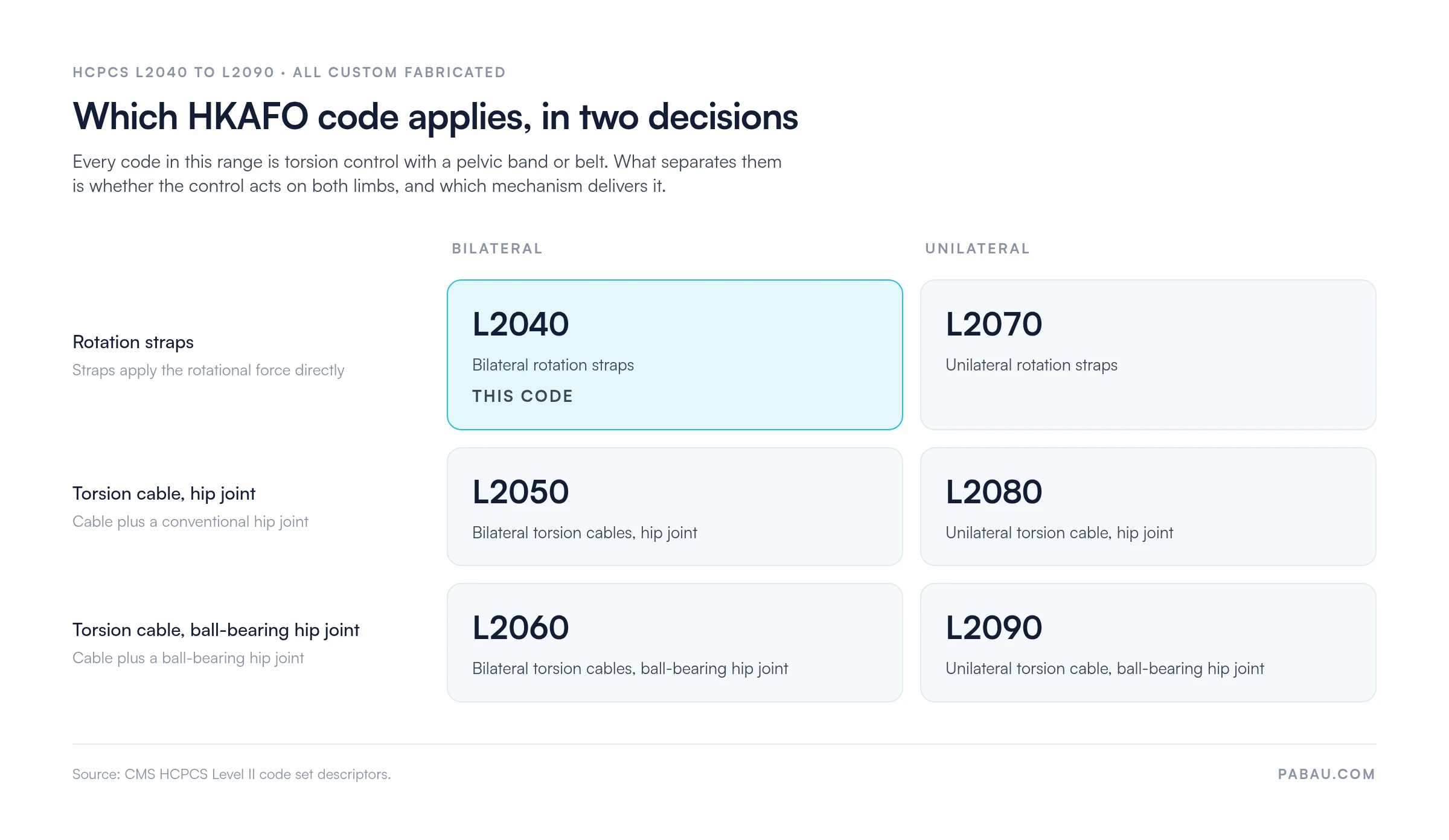
The practical selection rule is short. Match the code to the device the patient received. Bilateral rotation straps mean L2040, and the same straps on one limb mean L2070.
If torsion cables carry the control instead, the code sits in the L2050, L2060, L2080 or L2090 group. Laterality and the ball-bearing hip joint split that group further. Never code to a fee schedule preference, because the device dispensed dictates the code.
L2040 denials cluster around a predictable set of documentation and submission errors. Matching each rejection to its denial codes and back to your pre-submission checklist is the fastest way to bring the rate down. Workflows that route remittance reason codes to the intake and documentation team close the loop sooner than reviewing denials one at a time.
Run a monthly denial analysis on every L-code claim and group the denials by CARC reason code. If a missing KX accounts for more than 20% of L2040 denials, change the charge entry workflow rather than retraining the coders. A systematic error needs a systematic fix.
Entering L2040 in a billing platform takes more than dropping the code into a charge entry screen. Each step in the workflow carries a compliance checkpoint. A platform without HCPCS Level II support or modifier management adds manual steps, and manual steps raise the error rate.
A reliable billing workflow for L2040 follows these steps:
In most orthotic practices the L2040 file lives in three places at once. The order and the chart note sit in the clinical record. The modifiers go on in the billing system, and the delivery receipt waits in a folder. Someone has to reconcile all three before the claim transmits.
Practice management software like Pabau keeps that work in one record. Pabau’s claims management software handles HCPCS Level II entry, modifier selection, and diagnosis linkage in a single workflow. Claims route through Claim.MD for pre-submission scrubbing, and the remittance posts back against the patient it belongs to.
For a supplier running high volumes of orthotic claims, that closes the loop between charge entry and payment posting. A missing KX or an unlinked diagnosis surfaces before the claim leaves, rather than six weeks later on a remittance advice.

Pabau helps DMEPOS suppliers and orthotists attach L-codes, append modifiers, and submit clean claims through an integrated clearinghouse. See how billing workflows work in practice.

L2040 is a narrow code, and the bilateral rotation straps are what keeps it narrow. Before the claim transmits, four documents have to describe the device that was dispensed. They are the physician order, the CMN where one is required, the medical necessity narrative, and the proof of delivery.
Most failures on this code come down to two habits. A modifier gets left off at charge entry, or the narrative justifies an HKAFO in general and never mentions the rotation control. Both are workflow problems, and both are cheaper to fix at the front of the process than to appeal at the back.
Build the strap description into the order template and the KX modifier into the charge template. The denial rate on this code drops without anyone learning a new rule. Book a demo to see how Pabau handles HCPCS orthotic claims from charge entry through remittance.

Need a framework for reducing claim denials across your DME billing? Denial management in healthcare walks through how to categorize, track, and resolve remittance-based denials systematically.
Want to understand how clean claims reduce rework time? Clean claim submission practices covers the pre-submission checks that keep claims off the denial queue.
Looking to verify patient coverage before the device ships? Insurance eligibility verification explains how to confirm active coverage and authorization status before any DMEPOS order proceeds.
HCPCS code L2040 is the HCPCS Level II code for a custom-fabricated hip-knee-ankle-foot orthosis (HKAFO) whose torsion control comes from bilateral rotation straps. The code covers the complete four-joint orthosis as one unit. Replacement straps, additional joint locks, and professional fitting services are billed separately under their own codes.
Medicare Part B pays 80% of the allowed amount on the current CMS DMEPOS fee schedule, once the Part B deductible is met. The beneficiary covers the remaining 20%. The exact allowed amount varies by geographic area (competitive bidding areas have different rates than non-CBA areas) and is updated each January. Pull the current fee schedule file from CMS for the applicable calendar year and jurisdiction rather than relying on prior-year figures.
L2040 specifies bilateral rotation straps as the torsion control mechanism, while L2050 specifies bilateral torsion cables with a hip joint. Both are custom fabricated and both carry a pelvic band or belt. The device the patient receives decides the code. Straps mean L2040, and cables with a hip joint mean L2050.
Traditional Medicare fee-for-service Part B does not universally require prior authorization for L2040, but many Medicare Advantage plans and commercial insurers do. Always verify the payer’s authorization requirements before the device is fabricated or delivered. A claim submitted without a required PA number denies automatically, however good the documentation is.
KX is required when all coverage criteria and documentation requirements are met for Medicare claims. LT or RT indicates the side of the body when billing a unilateral device. GA applies when an Advance Beneficiary Notice is on file and medical necessity is uncertain. GY applies when the item is statutorily excluded. GZ applies when a non-medical-necessity denial is expected but no ABN was obtained. NU (new equipment) or UE (used equipment) may also apply depending on device condition and payer payment category.
Three reasons dominate. The first two are a missing or incorrect KX modifier and an absent or incomplete Certificate of Medical Necessity. The third is a medical necessity narrative that never explains why bilateral rotation control is needed. Code mismatches come next, where L2040 is billed for a cable-driven device. Missing prior authorization and an unsupportive diagnosis code round out the list.
Four groups of diagnoses commonly support medical necessity for an HKAFO with bilateral rotation straps. The first is neurodegenerative disease, such as amyotrophic lateral sclerosis (G12.21). The second is neuromuscular disorders, including muscular dystrophy (G71.00) and cerebral palsy (G80.0). The third is spinal cord injury sequelae such as paraplegia or quadriplegia (G82 series). The fourth is structural deformity needing rotational correction (M21 series). The supporting diagnosis has to appear in the documentation and on the claim, and match the physician’s rationale.



