HCPCS code V2599: Other type contact lens billing guide
What is HCPCS code V2599? HCPCS code V2599 is the Level II supply code for a con...

Last Updated: Oct 20, 2026
L1755 is the HCPCS Level II code for a custom-fabricated Legg-Perthes orthosis of the patten-bottom type. It covers a leg brace built for one child with Legg-Calvé-Perthes disease. A raised platform under the foot keeps weight off the affected hip.
Medicare pays it from the DMEPOS fee schedule, but most claims go to Medicaid or commercial plans because the patients are children. Claims pair it with an M91 diagnosis code, and the written order must be on file before the claim is submitted.
Let Pabau's smart automation suggest the right codes, reduce claim denials, and keep your practice compliant—effortlessly.
Automate repetitive tasks and focus on what matters most—your patients.
Reduce coding errors and ensure compliance with the latest regulations.
Clean claims, fewer denials, and faster reimbursements.
Powerful insights and reporting to help your practice thrive.
HIPAA compliant SOC 2 certified GDPR-compliant Trusted by 4,000+ clinics worldwide

HCPCS code L1755 bills a custom-fabricated Legg-Perthes orthosis of the patten-bottom type, a pediatric brace that keeps weight off the affected hip.
Medicare pays it from the DMEPOS fee schedule, but most claims go to Medicaid or commercial plans because the patients are children.
Valid diagnosis pairings sit in the M91 series, and a laterality-specific code is expected once imaging names the affected hip.
Every code from L1700 to L1755 is custom fabricated, so the brace design written in the fitting note decides which one you bill.
A standard written order, fabrication records, and signed proof of delivery have to be on file before the claim goes out.
HCPCS code L1755 is the Level II code for a Legg-Perthes orthosis of the patten-bottom type, custom fabricated. It bills a brace built for one child with Legg-Calvé-Perthes disease.
The code sits in the L-code series of the CMS HCPCS Level II system. Payers handle it as Durable Medical Equipment, Prosthetics, Orthotics, and Supplies, known as DMEPOS. L1755 has been in the code set since January 1, 1988, and its descriptor has not changed since.
The design is what the code describes. Billing L1755 for any other Legg-Perthes brace is a coding error, even when the diagnosis is identical.
The official descriptor reads: Legg perthes orthosis, (patten bottom type), custom fabricated. Confirm the wording against the current CMS HCPCS annual release file before each coding year.
A patten-bottom orthosis is a leg brace that ends in a raised platform, the patten, below the foot. The child stands and walks on that platform instead of the foot, so body weight bypasses the affected hip.
The opposite shoe usually carries a lift to level the legs. The goal is to protect the softened femoral head while it remodels. Some designs also hold the hip in abduction, which is why the brace is sometimes called a hip abduction brace with a patten bottom.
A custom-fabricated orthosis is built from raw materials over a model or measurements of one patient. A custom-fitted device starts as a prefabricated item and is then adjusted.
All five codes in the L1700-L1755 range are custom fabricated. Fabrication method therefore never separates them. The fitting note has to name the patten-bottom design, and the fabrication records have to show the brace was built for this child.
Legg-Calvé-Perthes disease interrupts the blood supply to the femoral head in a growing child. The bone softens, then remodels as that supply returns.
Treatment aims to keep the femoral head round through the remodeling, rather than letting it flatten under load. The condition mostly appears between ages 4 and 10, and boys are affected around four times as often as girls.
The patten-bottom design takes the affected hip out of weight-bearing while the child stays upright and mobile. That clinical aim is also the billing argument. The physician note has to name the diagnosis, the disease stage, and why off-loading the hip is the chosen treatment.
Medicare covers L1755 under the orthotics benefit when a physician documents that the brace is medically necessary. The HCPCS file lists its coverage as carrier judgment. No national coverage determination is written for Legg-Perthes orthoses.
Medicare DMEPOS claims go to one of two DME MAC contractors, based on where the beneficiary lives. Noridian handles Jurisdictions A and D, and CGS Administrators handles Jurisdictions B and C across the rest of the country. Check the Medicare Coverage Database for any policy article your contractor publishes on hip or Legg-Perthes orthoses.
Medicare is rarely the payer here. Legg-Calvé-Perthes disease is a pediatric condition, so most L1755 claims go to a state Medicaid program or a commercial plan. Confirm the policy and any approval step before the brace is fabricated.
Medicare pays L1755 from the DMEPOS fee schedule, which CMS updates every January 1. The Physician Fee Schedule does not carry orthotic L-codes, so a search there returns no rate.
Pull the current allowable from the CMS DMEPOS fee schedule files for the beneficiary’s state. Three points shape what you are paid:
Medicaid and commercial rates follow each program’s own fee schedule. Check them with the payer before quoting a figure to the family.
The crosswalk is narrow. Valid pairings sit in the M91 series, which covers juvenile osteochondrosis of the hip and pelvis. Legg-Calvé-Perthes disease itself codes to M91.1x, juvenile osteochondrosis of the head of the femur.
Check laterality on every L1755 claim. Billing M91.10 when imaging already named the affected hip invites a review. Take the side from the radiology report and the physician order, then code it.
The patten-bottom brace is built for one leg, so the side of the diagnosis should match the side of the brace. Add the RT or LT modifier where the payer asks for it.
The claim itself is a few lines. The record behind it is what gets paid, or recovered at audit. Keep these documents in the patient file:
CMS requires the written order before the claim is submitted. Some items also need an order before delivery, listed with the DMEPOS order requirements. That list changes, so check the current version.
A medical-necessity review looks for age, stage, and side in the physician’s note, not only the orthotist’s. Timing matters as well, because the payer check comes before fabrication and the order before the claim.
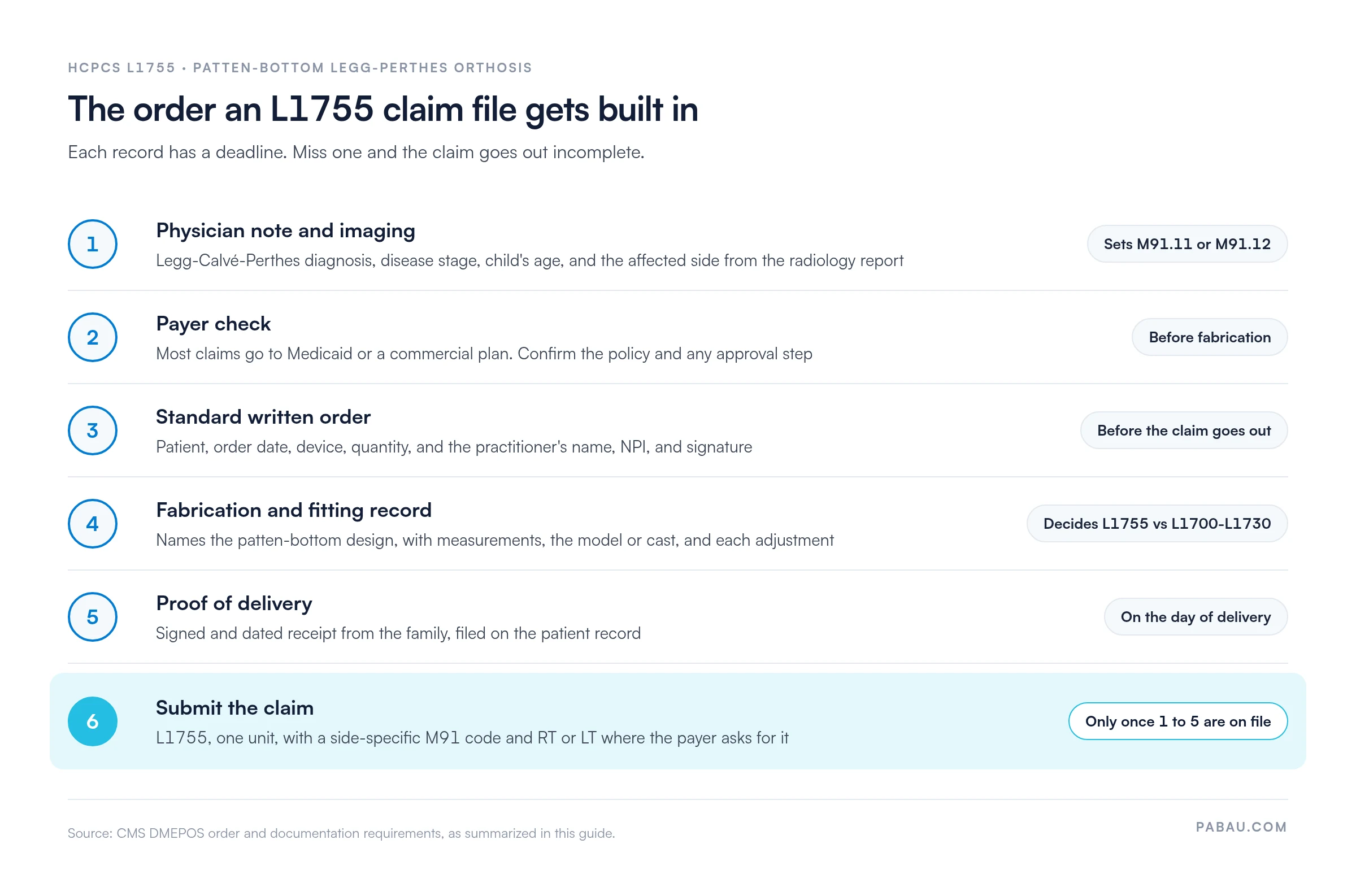
Photograph the signed delivery receipt on the day the family collects the brace. Attach it to the patient record before they leave. Receipts filed later are the ones missing when an audit request arrives.
L1755 needs few modifiers. Report the side, and add a liability modifier only when coverage is in doubt.
When a claim does deny, the remittance tells you which element failed. Reading the medical billing denial codes on the response saves a blind resubmission.
Every code in the range treats the same disease. They differ only by brace design, which makes the choice a documentation question rather than a clinical one.
All five are custom fabricated, so that phrase never tells you which code to use. Read the fitting note, find the design name, then match it. The sibling guide to HCPCS code L1730 covers the Scottish Rite brace.
A clear superbill helps when a family has to claim from an out-of-network plan themselves. It carries the code, the diagnosis, the date of service, and the charge.
Orthotic billing usually fails on assembly. The order sits in one system and the fitting note in another. The delivery receipt sits in a drawer, and the claim goes out before anyone links them.
Practice management software like Pabau keeps those records on one patient file. Clinical notes, consent, fitting documentation, and delivery confirmation live on the record the billing team works from.
Claims then go out from that record through Pabau’s claims management, and each one is tracked through to payment. Code, modifier, and diagnosis choices stay with your coders.
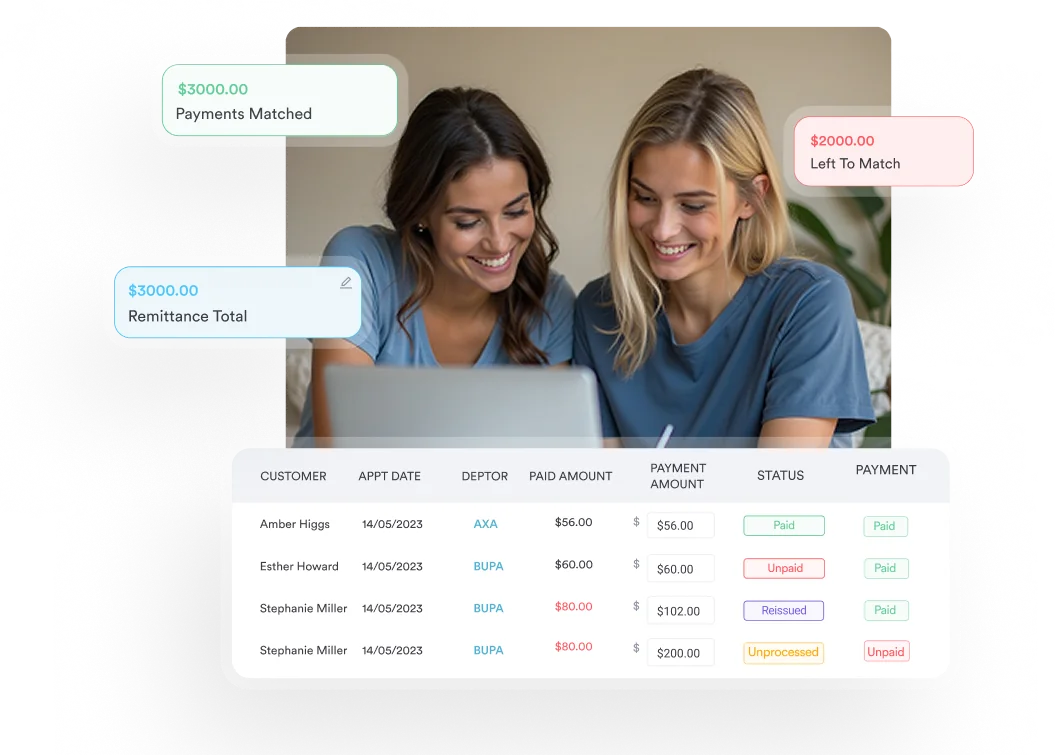

Pabau holds clinical notes, orders, fitting records, and delivery confirmations on one patient record. Your team stops rebuilding files when an audit letter arrives.

L1755 describes one brace design, pairs with one family of diagnosis codes, and asks for a file any careful supplier already builds. The code is narrow, and the claims that fail usually fail on sequence.
Get the design name into the fitting note and the side into the diagnosis. File the order and delivery receipt before billing, and most of these claims pay on first submission.
Book a demo to see how Pabau keeps orthotic documentation and claim submission on one patient record.

Need a framework for managing claim denials? Denial management in healthcare walks through root-cause categorization and appeal workflows.
Want to understand the full billing process? What is medical billing covers the workflow from claim creation to payment posting.
Protecting your practice at audit? Medical billing compliance outlines the documentation standards that protect DMEPOS suppliers.
Billing a different Legg-Perthes design? HCPCS code L1710 covers the Newington abduction brace from the same code range.
Helping a family claim out of network? What is a superbill explains the fields a plan needs to reimburse the family directly.
L1755 covers a custom-fabricated Legg-Perthes orthosis of the patten-bottom type. The brace ends in a raised platform below the foot, so a child with Legg-Calvé-Perthes disease can walk without loading the affected hip.
L1755 pairs with the M91 series, juvenile osteochondrosis of the hip and pelvis. Legg-Calvé-Perthes disease codes to M91.10, M91.11, or M91.12. Use the right or left code once imaging names the affected hip.
L1755 bills as one unit for one brace. The patten-bottom design is built for the affected leg. Record that side in the diagnosis code, and add RT or LT where the payer asks for it.
Both codes bill custom-fabricated Legg-Perthes orthoses, and only the design differs. L1730 is the Scottish Rite brace with a pelvic band and swivel bar. L1755 is the patten-bottom brace with a raised platform sole.
Most L1755 claims go to a state Medicaid program or a commercial plan, because Legg-Calvé-Perthes disease affects children. Medicare pays it from the DMEPOS fee schedule when a beneficiary qualifies. Check each payer for approval rules before fabrication.