HCPCS code V2599: Other type contact lens billing guide
What is HCPCS code V2599? HCPCS code V2599 is the Level II supply code for a con...

Last Updated: Oct 20, 2026
L1710 is the HCPCS Level II code for legg perthes orthosis, (newington type), custom fabricated.
Let Pabau's smart automation suggest the right codes, reduce claim denials, and keep your practice compliant—effortlessly.
Automate repetitive tasks and focus on what matters most—your patients.
Reduce coding errors and ensure compliance with the latest regulations.
Clean claims, fewer denials, and faster reimbursements.
Powerful insights and reporting to help your practice thrive.
HIPAA compliant SOC 2 certified GDPR-compliant Trusted by 4,000+ clinics worldwide

HCPCS Code L1710 is a Legg perthes orthosis, Newington type, custom fabricated. That is the complete official CMS descriptor.
Custom fabricated is part of the descriptor, so the record must justify why a prefabricated hip abduction orthosis would not meet the need.
L1710 is a permanent national DMEPOS code on the CMS Master List, requiring a written order and proof of delivery before claim submission.
The KX modifier is required when documentation on file supports medical necessity. GY applies when Medicare statutorily excludes the item.
Practice management software like Pabau keeps the written order, fitting notes and delivery proof on one patient record.
L1710 is a permanent national HCPCS Level II code in the DMEPOS category, which covers durable medical equipment, prosthetics, orthotics and supplies.
CMS publishes the descriptor as Legg perthes orthosis, (Newington type), custom fabricated, with no additional wording. The code also appears on the CMS Master List of items potentially subject to conditions of payment.
The Newington orthosis is a bilateral hip abduction device used to manage Legg-Calvé-Perthes disease. That childhood hip condition involves avascular necrosis of the femoral head, and containment orthoses hold the femoral head seated in the acetabulum while it remodels. The descriptor names the design and the fabrication method, and nothing more.
Custom fabricated means the orthosis is built from raw materials for one named patient. It is shaped over a model or a set of measurements taken from that patient.
It is a different fabrication level from a prefabricated device, which is made in advance and then fitted. Every code in the L1700-L1755 range is custom fabricated, so fabrication level never separates one code in this family from another.
That has a practical effect on your claim file. The clinical record has to show why a prefabricated hip abduction orthosis would not have met this patient’s need. A diagnosis alone does not carry that argument. Ask the prescriber to document the anatomy, the containment required, and the reason a stock device was ruled out.
Note also what the descriptor leaves out. It says nothing about fitting or adjustments, unlike nearby prefabricated codes such as L1690, whose descriptor states “includes fitting and adjustment”. So do not assume later adjustment work is bundled into L1710 by the descriptor.
Check how your Medicare Administrative Contractor (MAC) treats adjustment and repair of a custom fabricated orthosis before you bill it.
Medicare reimbursement for HCPCS Code L1710 is governed by the CMS DMEPOS fee schedule, which is updated annually. Rates are expressed as national limitation amounts and may vary by MAC jurisdiction and geographic adjustment factors.
Verify the current-year rate in the CMS DMEPOS fee schedule files, or in your DME MAC’s own pricing lookup, before you submit. Figures published by third-party aggregators may not reflect the current data.
Because L1710 reimbursement involves geographic pricing adjustments, a supplier in one MAC jurisdiction may receive a different payment than a supplier in another. The national limitation amount sets the ceiling. Your MAC may pay at or below that figure, depending on locality modifiers and competitive bidding status.
Medicaid matters more here than it does for most DMEPOS codes. Legg-Calvé-Perthes disease presents in childhood. So a large share of L1710 claims go to a state Medicaid program rather than to Medicare. Pull your state’s orthotic and prosthetic fee schedule, and check its prior authorization rules before you fabricate.
L1710 appears on the CMS DMEPOS Master List of items potentially subject to conditions of payment. That classification means a supplier has to meet specific pre-delivery requirements before submitting a claim. Non-compliance does not just cause a denial. It can also trigger a post-payment recoupment audit.
Required documentation to support an L1710 claim includes:
Verify eligibility before the fitting appointment, not after it. Pediatric DMEPOS coverage limits and prior authorization rules vary by payer. A custom fabricated orthosis is built for one named patient, so it cannot be redirected if coverage falls through.
Medical necessity is determined by the treating physician, not the supplier. Do not assume that a confirmed diagnosis of Legg-Calvé-Perthes disease automatically establishes medical necessity for L1710. The clinical record must specifically support the need for this type of orthosis and document the expected therapeutic benefit.
Flag L1710 claims for pre-submission review whenever the written order is received after the fitting date. CMS conditions of payment require the order to precede delivery. Orders received even one day late create an audit liability that is difficult to resolve retroactively.
Modifier selection for HCPCS Code L1710 directly affects claim processing outcomes. MAC guidance identifies several modifiers that apply to custom fabricated orthotic codes in this range. Incorrect modifier assignment is a leading cause of L1710 denial, and it is the easiest of the common errors to prevent before submission.
The KX modifier matters most on L1710 claims billed to Medicare. Appending KX attests that the documentation in the patient’s file meets every applicable coverage criterion. Submitting without KX when that documentation exists produces an avoidable denial. Submitting KX when the documentation is incomplete is a misrepresentation.
Review your MAC’s local coverage determination (LCD) or policy article for jurisdiction-specific modifier rules. Requirements differ between Jurisdiction C, run by CGS Medicare, and the other MAC regions. Tracking which modifier drove each orthotic denial is what surfaces a pattern before it spreads across a quarter of claims.
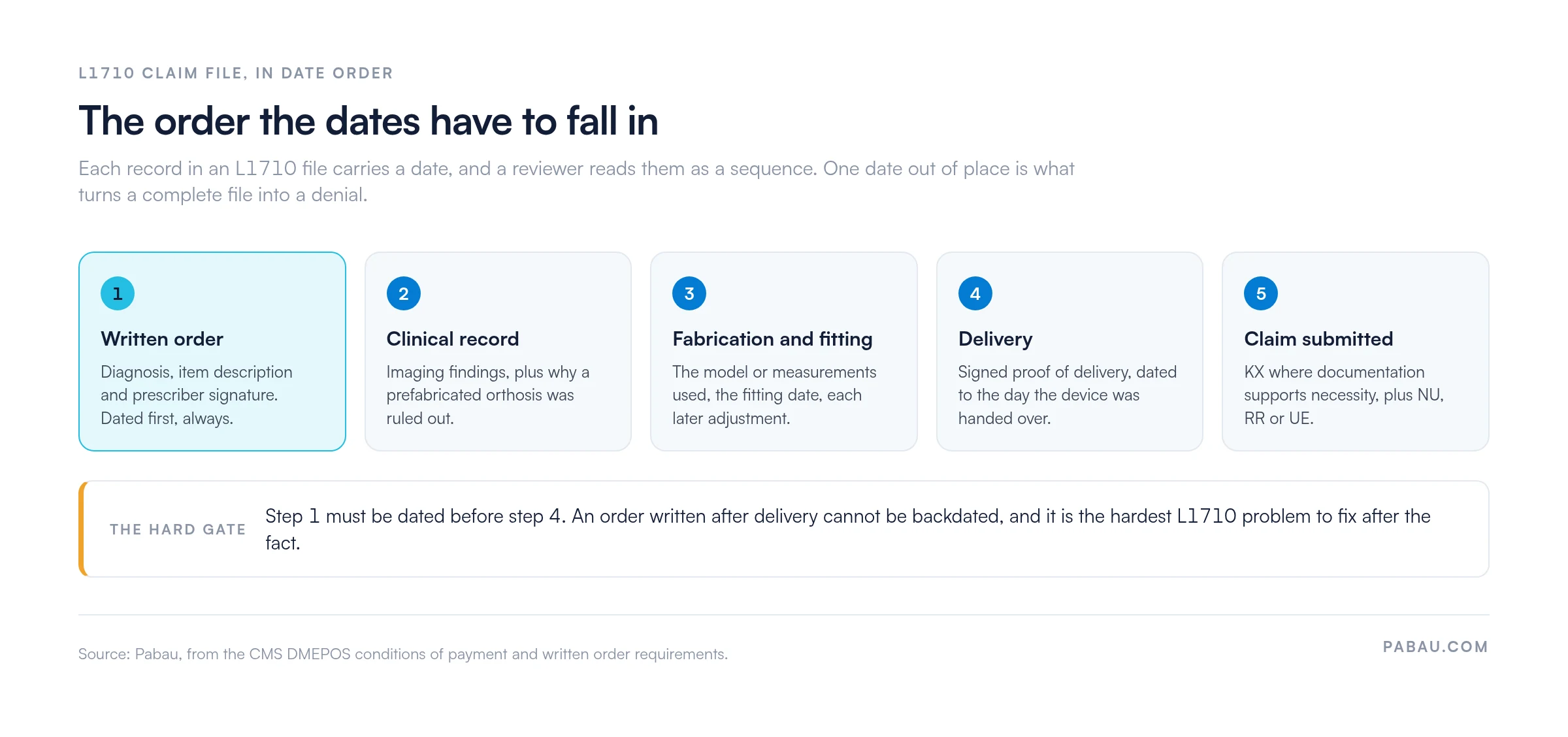
A clean L1710 claim follows a defined sequence from the physician order through to submission. Most DMEPOS denials on this code trace back to a step taken out of order rather than to the coding choice itself.
Read that sequence as a set of dates rather than a set of tasks. The chart below shows where each record has to fall, and the single point in the run that cannot be corrected afterwards.
Every data element has to be present and accurate before an L1710 claim leaves your system. That means the correct ICD-10-CM diagnosis code, the HCPCS code, the applicable modifiers, and the beneficiary’s details. An incomplete claim delays payment and invites a request for additional documentation.
HCPCS Code L1710 sits in a five-code family covering the Legg Perthes orthoses, running from L1700 through L1755. All five are custom fabricated, so the code you choose turns entirely on the device design the physician prescribed. Billing L1700 for a Toronto-type device when a Newington orthosis was supplied is a coding error regardless of diagnosis.
Two points about this range save time in an audit. Each of the five is a complete base code, so none of them is an addition code that has to ride alongside another. And there is no thigh lacer variant anywhere in L1700-L1755, despite descriptors circulating online that add that wording to L1710.
Thigh lacer language does exist in HCPCS, just not in this family. L4040 and L4045 cover replacement of a molded and a non-molded thigh lacer for a custom fabricated orthosis. Those are repair codes for lower-limb orthoses, and neither one describes a Legg Perthes device.
Confirm current code status and any National Correct Coding Initiative (NCCI) edits in the AAPC HCPCS code lookup or the CMS HCPCS overview.
The table below lists the ICD-10-CM codes most commonly paired with L1710 claims. Pairing L1710 with a code that does not reflect the documented diagnosis is a billing error, and a systematic mismatch can amount to fraud. Select the diagnosis code that most precisely matches the physician’s documented clinical findings.
ICD-10 specificity matters for DMEPOS claims. The unspecified laterality codes M91.10 and M91.20 are acceptable when the record does not say which hip is affected. Payers still prefer the most specific code available.
When bilateral involvement is documented, code each affected side separately. Then confirm whether your payer accepts bilateral orthosis billing on one claim line or requires two. Our ICD-10-CM code reference holds the individual guides for the diagnosis codes behind these claims.
Run a pre-submission check pairing your selected ICD-10-CM code against HCPCS Code L1710 using your payer’s coverage policy article. M91.x codes are the expected diagnosis grouping, but payer edits vary. A diagnosis that does not support a custom fabricated containment orthosis is a common reason for medical review referrals.
The denials on this code cluster around a handful of repeatable mistakes. Each one is preventable at the intake or fitting stage rather than at appeal.
Most orthotic suppliers assemble an L1710 claim file by hand. The order sits in one inbox and the imaging report in the patient’s chart. The fitting notes are on a paper form, and the delivery receipt is in a folder. Nobody sees the whole file until a payer asks for it. That is the worst possible moment to discover the order is dated after the fitting.
Pabau, our practice management platform, keeps those pieces on one patient record instead. The written order, the clinical note justifying custom fabrication, the fitting history and the signed delivery confirmation all attach to one timeline. Every date is there to check in seconds. Our claims software for suppliers then carries the code, modifiers and diagnosis through to the claim itself.
The outcome is a file you can hand to a reviewer without rebuilding it first. Your billing team catches a missing signature or an out-of-sequence date before submission. Fewer L1710 claims come back for additional documentation, and more of them pay on the first pass.

Pabau helps orthotic suppliers and DMEPOS practices track documentation requirements, manage written orders, and submit claims with the correct modifier combinations, all from one platform.

HCPCS Code L1710 has a short descriptor and a long list of conditions attached to it. Legg perthes orthosis, (Newington type), custom fabricated is the whole of what CMS says.
Every argument for payment therefore has to come from your documentation rather than the code wording. Get the written order dated before delivery, justify the custom fabrication, and confirm which payer covers the child in front of you.
Pabau builds those checkpoints into the workflow, so an incomplete L1710 claim stops before it reaches the payer. Book a demo to see how Pabau supports DMEPOS billing from the written order through to payment posting.

Need guidance on DMEPOS denial patterns? Denial management in healthcare covers strategies for identifying and resolving common claim rejection reasons across payer types.
Looking to understand the broader billing compliance picture? Medical billing compliance requirements outlines the regulatory framework DMEPOS suppliers must follow to avoid audit exposure.
Want to streamline your claim submission process? Revenue cycle management explains the end-to-end financial workflow from order intake through payment posting for healthcare suppliers.
Wondering what makes a claim pay on the first pass? What is a clean claim sets out the data elements a payer checks before it accepts a submission.
Building the paperwork behind each claim? Superbill documentation walks through the fields that carry codes, modifiers and diagnoses onto a submitted claim.
HCPCS Code L1710 is used to bill for a Legg perthes orthosis, (Newington type), custom fabricated. That is the full official CMS descriptor. It is a permanent national DMEPOS code. Orthotic suppliers bill it when they build and deliver this bilateral hip abduction device for a child with Legg-Calvé-Perthes disease.
No. There is no thigh lacer variant of L1710 and no thigh lacer code anywhere in the L1700-L1755 Legg Perthes range. Some online listings add that wording to L1710 in error. Thigh lacer codes do exist elsewhere in HCPCS, such as L4040 and L4045 for replacement thigh lacers on a custom fabricated orthosis.
The KX modifier is required when documentation on file supports medical necessity per the applicable payer policy. GY is used when the item is statutorily excluded from Medicare coverage. NU, RR, or UE are appended based on whether the equipment is new, rented, or used. Modifier rules may vary by MAC jurisdiction.
Required documentation includes a detailed written order from the treating physician, obtained before delivery. You also need proof of delivery with a beneficiary signature, plus clinical notes supporting the Legg-Calvé-Perthes diagnosis. Add the prescriber’s rationale for a custom fabricated device, the fabrication and fitting records, and proof of eligibility. Retain all records for a minimum of seven years.
Both codes describe a custom fabricated Legg Perthes orthosis, so the difference is the design. L1700 is the Toronto type and L1710 is the Newington type, a bilateral hip abduction device. Billing the wrong code for the device you actually supplied is a coding error regardless of diagnosis.
Yes. L1710 is listed on the CMS Master List of DMEPOS Items Potentially Subject to Conditions of Payment. This means suppliers must have a written order and proof of delivery on file before submitting a claim. Billing without meeting these conditions can result in claim denial or post-payment recoupment.
The primary ICD-10-CM codes supporting L1710 claims are M91.10 (Juvenile osteochondrosis of head of femur, unspecified leg), M91.11 (right leg), and M91.12 (left leg). Coxa plana codes M91.20-M91.22 may also apply when the orthosis is used to manage late-stage sequelae. Always select the most specific laterality code the clinical record supports.