

CCSD code G5100: Bypass of duodenum billing guide
CCSD code G5100 bills a bypass that leaves the duodenum in place CCSD code G5100...

Last Updated: Oct 16, 2026
L1690 is the HCPCS Level II code for combination, bilateral, lumbo-sacral, hip, femur orthosis providing adduction and internal rotation control, prefabricated, includes fitting and adjustment.
Claims for this code fail on paperwork far more often than on code selection. DME MACs cite missing detailed written orders, thin medical necessity narratives, and incorrect modifier assignment as the leading reasons L1690 claims are rejected.
Let Pabau's smart automation suggest the right codes, reduce claim denials, and keep your practice compliant—effortlessly.
Automate repetitive tasks and focus on what matters most—your patients.
Reduce coding errors and ensure compliance with the latest regulations.
Clean claims, fewer denials, and faster reimbursements.
Powerful insights and reporting to help your practice thrive.
HIPAA compliant SOC 2 certified GDPR-compliant Trusted by 4,000+ clinics worldwide

HCPCS Code L1690 describes a prefabricated combination bilateral lumbosacral hip femur orthosis that controls adduction and internal rotation, including fitting and adjustment.
L1690 is billed under Medicare Part B as durable medical equipment. Every claim needs a detailed written order and a documented medical necessity narrative.
Common denial triggers are a missing KX modifier when the LCD criteria are met, billing a prefabricated device as custom-fabricated, and thin physician documentation.
Practice management software like Pabau links HCPCS codes to patient records and clinical notes, which cuts manual transcription errors before submission.
HCPCS Code L1690 is a Level II Healthcare Common Procedure Coding System code maintained by the Centers for Medicare and Medicaid Services (CMS). It falls within the hip orthotics range L1600-L1690 and is classified as durable medical equipment under Medicare Part B.
The “prefabricated, includes fitting and adjustment” language carries legal weight. It separates L1690 from the custom-fabricated hip orthosis codes. It also sets the allowed amount and the documentation standard a DME MAC applies on review.
The device described by L1690 is a multi-segment external support. It spans the lumbar spine through the sacrum, wraps both hip joints, and extends down to the femur on each side. Its two defining functions are adduction control, which prevents excessive leg separation, and internal rotation control, which limits inward turning of the femur.
Those functions suit conditions that compromise neuromuscular control at the hip, particularly where bilateral involvement means both limbs need managing at once. Common scenarios include developmental hip dysplasia after reduction, acquired hip instability following neurological injury, and congenital conditions affecting femoral alignment on both sides.
Prefabricated vs. custom-fabricated distinction: L1690 covers only a prefabricated device selected from existing stock. A qualified orthotist then fits and adjusts it to the patient. A device fabricated from raw materials against a patient-specific cast or mold takes a different, custom-fabricated code. Billing a custom-fabricated device under L1690 is upcoding, and it carries serious audit and compliance risk.
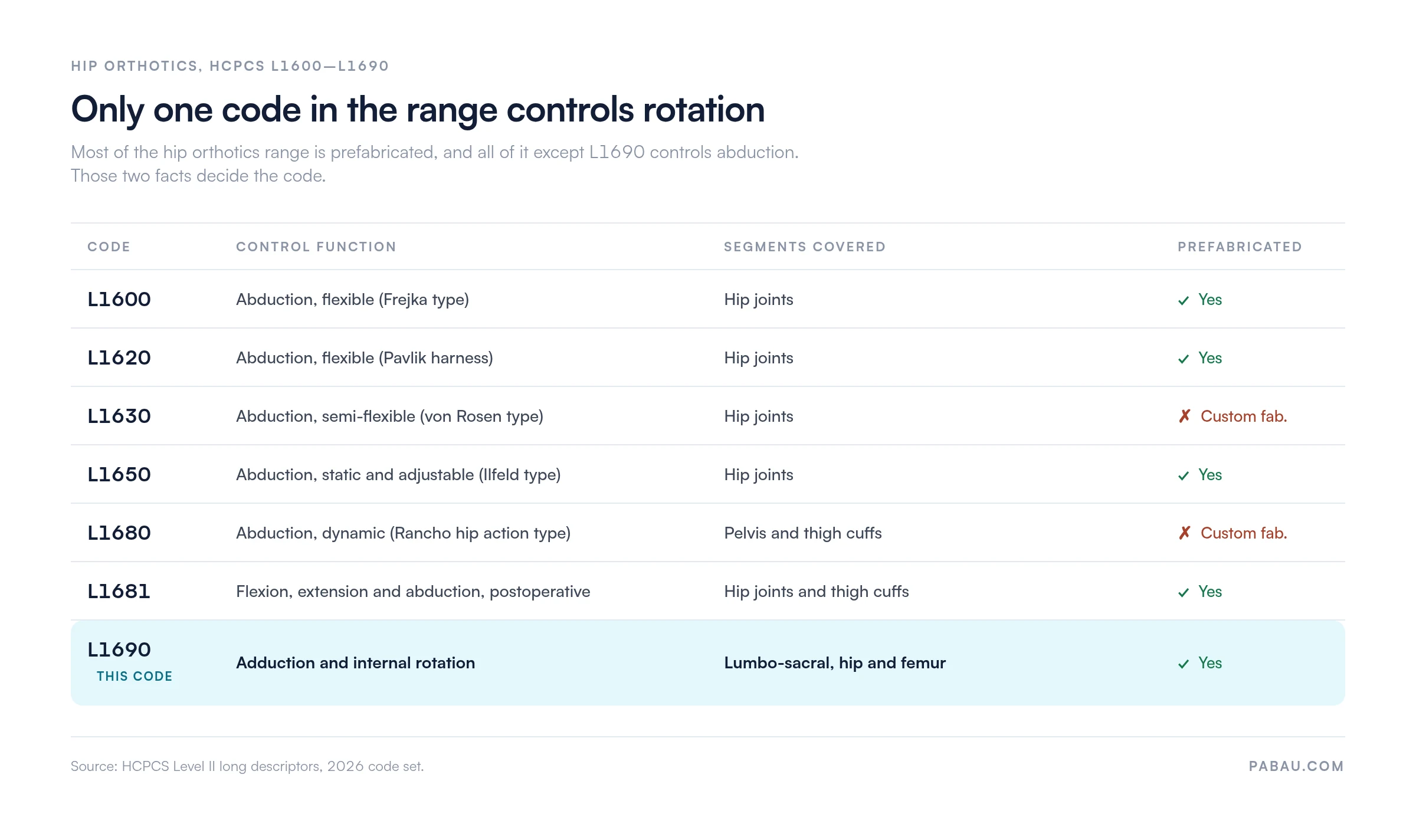
Fabrication method and control function separate L1690 from its neighbors in the range. The comparison below sets the whole range out side by side.
Medicare Part B covers L1690 as DME when the beneficiary meets the Local Coverage Determination (LCD) requirements set by the applicable DME MAC. Coverage never follows from the diagnosis alone. The supplier has to confirm that the beneficiary satisfies the general DME coverage conditions and any LCD-specific criteria before the device is dispensed.
The general conditions require that the orthosis be medically necessary, ordered by a treating physician, and appropriate for use in the patient’s home. A pre-delivery checklist that confirms each condition before the device ships is the simplest way to hold that line.
Suppliers should consult the current LCD published by their DME MAC. Jurisdictions B and C sit with CGS Administrators, while Jurisdictions A and D sit with Noridian Healthcare Solutions. Each contractor publishes its own coverage articles and LCDs, and updates them periodically without notice.
The ICD-10-CM diagnosis code on an L1690 claim has to match a covered diagnosis in the applicable DME MAC LCD or coverage article. The codes below are among those commonly paired with bilateral hip orthosis billing, but the list is not exhaustive. Always verify against the current LCD for your jurisdiction before you submit.
Laterality is where these claims most often come apart, and the ICD-10-CM code index carries the laterality-specific options within each Q65 subcategory.
Code to the highest available specificity. Unspecified laterality is a common audit finding on bilateral DME claims, and a four-character Q65 code is not billable on its own. Where the device is bilateral, the record should document bilateral pathology and the reason both limbs need covering.
HCPCS Code L1690 is reimbursed under the DMEPOS fee schedule that CMS publishes annually. Rates are geographically adjusted using locality multipliers, so the allowed amount follows the supplier’s location rather than the patient’s. Verify current rates through the CMS fee schedule search tool or the DMEPOS fee schedule files on CMS.gov.
Rates change every January 1 and can be adjusted mid-year. Any dollar figure from a third-party aggregator should be cross-referenced against the official CMS files before it goes on a claim. Four variables shape what L1690 pays.
Before dispensing an L1690 orthosis, check the DME MAC’s coverage article to confirm the patient’s diagnosis appears on the covered diagnosis list. This single step prevents the most common denial: non-covered diagnosis. Build it into your intake workflow as a mandatory pre-delivery verification.
An L1690 claim without complete supporting documentation will be denied or recouped on audit. DME MACs apply heightened scrutiny to orthotic claims, and the standard is precise. The suppliers who pass audits build the documentation checks into the ordering and dispensing workflow rather than relying on retrospective chart review.
Retain all of it for at least seven years from the date of service, in line with Medicare record retention requirements. A submission process that verifies document completeness before the claim leaves the building cuts the initial denial rate sharply.
L1690 claims go to the DME MAC for the supplier’s jurisdiction on the CMS-1500 claim form or the 837P electronic transaction. The claim carries the patient’s Medicare beneficiary information and the ordering provider’s NPI. It also carries the supplier’s NPI and PTAN, plus the HCPCS code with its modifiers and place of service.
Place of service code 12, the patient’s home, is standard for most DMEPOS orthotic claims. Confirm the place of service with your DME MAC when the device is delivered in a clinical setting. Do the same when the patient lives in a facility.
Modifier selection is the highest-risk element of L1690 billing. Incorrect or missing modifiers cause a large share of denials and are a focus of DME MAC pre-payment reviews. The CGS Medicare coding verification guidance sets out the requirements for Jurisdictions B and C.
L1690 may fall under the CMS DMEPOS prior authorization program. The list of items subject to prior authorization changes periodically, and the program has expanded over time to cover more high-expenditure DMEPOS items.
Verify the current prior authorization status of L1690 with your DME MAC and on CMS.gov before dispensing. A claim for a PA-required item without an approved PA is denied automatically, and the device has already left the shelf by then.
Choosing correctly within the hip orthotics range is what keeps reimbursement accurate and an audit defensible. The L1600-L1690 series covers unilateral and bilateral hip devices that differ by anatomical coverage, functional design, and fabrication method. It opens with L1600, the flexible Frejka type with cover, which controls abduction at the hip joints alone.
L1620 follows it in the same abduction control group, the flexible Pavlik harness used for infant hip dysplasia. Coverage ends at the hip joints, so a claim that needs lumbo-sacral or femoral support does not fit it.
Fabrication method is a weaker discriminator here than most billers assume. Five of these seven codes describe prefabricated devices, so “it came off the shelf” does not point to L1690 on its own. What does point to it is the combination of lumbo-sacral, hip and femoral coverage with adduction and internal rotation control.
L1681 is worth knowing for the same reason. It sits between L1680 and L1690 as the prefabricated postoperative abduction brace, and it absorbs claims that suppliers used to file under a neighboring code.
L1660 belongs to the same abduction control group. It describes a static, plastic hip orthosis, prefabricated with fitting and adjustment included. Its coverage stops at the hip joints, so it includes no lumbo-sacral or femoral segment. L1686 describes a prefabricated postoperative hip abduction orthosis, and its coverage also stops at the hip joint.
The NLM Clinical Table Search API publishes the full HCPCS Level II code set for free. Use it to check any descriptor in the range.
L1690 attracts scrutiny because it sits at the top of the hip orthotics range and carries a comparatively higher allowed amount. DME MACs run both pre-payment and post-payment audits on orthotic claims. The six errors below account for the majority of preventable denials and recoupments.
Building these checks into the ordering and dispensing process catches the errors before they become denied claims. A pre-submission audit checklist inside the billing workflow costs far less than retrospective correction. Pairing it with a standing denial management routine turns recurring failures into something you can measure and fix.
Run a quarterly internal audit on your L1690 claims. Pull five to ten paid and denied claims at random. Compare the supporting documentation against the LCD checklist and flag any recurring shortfalls. This takes under two hours and surfaces systematic documentation failures before a DME MAC probe audit does.
Most DME suppliers assemble an L1690 claim from three separate places. The order sits in a scanned PDF. The fitting record lives in the orthotist’s own notes. The claim itself is keyed into a billing system by hand. Every one of those handoffs is a chance for the descriptor on the claim to drift from the device that was dispensed.
Pabau is practice management software that holds the patient record, the clinical note, and the invoice on the same file. Its claims management software attaches HCPCS codes to the treatment record rather than to a spreadsheet, so nobody re-types a code at submission time.
That matters most on the checks that sink these claims. The written order, the fitting record, and the KX modifier all sit in one workflow. Your billing team sees what is missing before the claim goes out, rather than after it is denied.

Pabau connects HCPCS codes to patient records, clinical notes, and claims in a single workflow. No re-keying data between systems, and no missing paperwork at submission time.

L1690 is not a code you reach for by anatomy alone. Four attributes decide it: prefabricated construction, bilateral coverage, a span from the lumbo-sacral spine to the femur, and control of adduction with internal rotation. A device that misses any one of them belongs on a different line.
The practical move is to treat the paperwork as part of dispensing rather than a step that follows it. Write the detailed written order before delivery, record who performed the fitting, and pair the claim with a laterality-specific diagnosis. Do that consistently and the KX modifier becomes a formality rather than a denial trigger.
Book a demo to see how Pabau ties HCPCS codes, clinical notes, and claim submission together for DME and orthotic billing.

Need a primer on how medical billing works end to end? What is medical billing covers the full claims lifecycle from patient intake to payment posting.
Want to understand how clean claims reduce rework? Clean claim submission explains the technical and documentation standards that prevent front-end rejections.
Checking coverage before the device ships? Insurance eligibility verification sets out what to confirm with the payer before a patient is fitted.
HCPCS Code L1690 covers a combination bilateral lumbosacral hip femur orthosis that provides adduction and internal rotation control. It is a Level II Healthcare Common Procedure Coding System code. The device is prefabricated and the code includes fitting and adjustment. It is billed under Medicare Part B as durable medical equipment.
Commonly paired ICD-10-CM codes include Q65.1 (congenital dislocation of hip, bilateral) and Q65.4 (congenital partial dislocation of hip, bilateral). Q65.89 (other specified congenital deformities of hip) and G80.0 (spastic quadriplegic cerebral palsy) also appear. Always verify against the current DME MAC LCD for your jurisdiction before submitting a claim.
L1690 may be subject to prior authorization requirements under the CMS DMEPOS prior authorization program. The items subject to PA can change. Suppliers must verify the current L1690 status with their DME MAC and on CMS.gov before dispensing.
The KX modifier is required when all LCD coverage criteria are met. The GA modifier is used when an advance beneficiary notice is on file and the claim is expected to deny. The NU modifier indicates a new device purchase, while RR indicates rental. GZ is used when no ABN is on file and denial is anticipated.
L1690 reimbursement rates are set by the CMS DMEPOS fee schedule and vary by geographic locality. Rates are updated annually on January 1. Suppliers should verify current rates directly through the CMS DMEPOS fee schedule files on CMS.gov, as third-party aggregators may not reflect the most recent updates.
L1690 is the only code in the range covering a bilateral device that spans the lumbo-sacral, hip, and femoral regions. It is also the only one controlling adduction and internal rotation. The other codes in the range control abduction at the hip joints and stop short of the lumbo-sacral component. Fabrication method does not separate them, because most of the range is prefabricated.



