CPT Code 62284: Injection procedure for myelography
CPT Code 62284: official descriptor and procedure overview The American Medical ...

Last Updated: Oct 19, 2026
L0976 is the HCPCS Level II code for a lumbar-sacral orthosis (LSO), full corset. That short phrase is the whole official descriptor. It sets no requirement for rigid panels, sagittal control, or a posterior section reaching T-9.
CMS assigns the code coverage code C, carrier judgment, so the DME MAC decides medical necessity one claim at a time. L0976 sits outside the L0450 to L0651 range covered by the Spinal Orthoses LCD, so there is no KX attestation to make. Coding the same corset as a rigid-panel LSO can overpay one claim by more than $1,000.
Let Pabau's smart automation suggest the right codes, reduce claim denials, and keep your practice compliant—effortlessly.
Automate repetitive tasks and focus on what matters most—your patients.
Reduce coding errors and ensure compliance with the latest regulations.
Clean claims, fewer denials, and faster reimbursements.
Powerful insights and reporting to help your practice thrive.
HIPAA compliant SOC 2 certified GDPR-compliant Trusted by 4,000+ clinics worldwide

L0976 is the HCPCS Level II code for a lumbar-sacral orthosis (LSO), full corset, and that short phrase is the whole official descriptor.
The descriptor says nothing about rigid panels, sagittal control, or a posterior section reaching T-9. That language belongs to L0631.
CMS assigns L0976 coverage code C, carrier judgment, so the DME MAC decides medical necessity one claim at a time.
L0976 sits outside the L0450 to L0651 range covered by the Spinal Orthoses LCD, so the KX modifier does not apply.
The July 2026 DMEPOS fee schedule sets a national ceiling of $244.99 and a national floor of $183.75 for L0976.
HCPCS code L0976 is the Level II code for a lumbar-sacral orthosis (LSO), full corset. That phrase is the complete official descriptor. CMS publishes it in the annual HCPCS Level II file as “Lso, full corset”, with a short description of “Lso full corset”.
The code carries no other requirements. Its descriptor does not mention sagittal control, rigid anterior and posterior panels, or a posterior section running from the sacrococcygeal junction to T-9. That wording belongs to L0631, a custom-fitted LSO that Medicare prices at roughly six times the L0976 rate.
L-series codes cover orthotic devices billed as durable medical equipment. One of the four regional DME Medicare Administrative Contractors adjudicates an L0976 claim, not the Part B carrier. CMS assigns the code jurisdiction D and payment category PO, prosthetics and orthotics.
Two CMS files supply every value below. They are the July 2026 HCPCS Level II release and the July 2026 DMEPOS fee schedule public use file.
An LSO supports the lumbar and sacral spine. A TLSO covers the same ground and continues up into the thoracic spine. That difference in anatomical extent, not panel rigidity, separates L0976 from L0974.
HCPCS does not define “full corset” any further, and it does not define “corset front” either. The product itself settles which code fits. Suppliers can check a specific model in the PDAC coding verification database before they bill.
A corset is dispensed where the record shows a trunk that needs external support. LCD L33790 does not list L0976. Its four indications still describe the clinical picture a DME MAC looks for in any trunk orthosis:
Those indications cover most of what suppliers see. The list runs from lumbar instability and post-surgical stabilization through degenerative disc disease, spondylolisthesis and lumbar stenosis. A diagnosis of back pain on its own will not carry a claim. The record has to connect the condition to the functional limitation the corset addresses.
CMS prices L0976 through the DMEPOS fee schedule, not the physician fee schedule. The July 2026 file sets a national ceiling and floor for the contiguous states, then a separate allowed amount for every state and territory.
The spread across the contiguous states is about 33 percent, and it follows state lines rather than supplier type. Eight southern states sit at the ceiling. Thirteen states and the District of Columbia sit at the floor, New York, Pennsylvania, Ohio and Illinois among them.
These are allowed amounts, not payments. Medicare pays 80 percent of the allowed amount after the beneficiary meets the Part B deductible. State Medicaid programs set their own rates, so never carry a Medicare figure across to a Medicaid claim.
CMS attaches a warning to the file itself. Inclusion or exclusion of a fee schedule amount does not imply coverage, so a priced code is still not a covered one.
CMS assigns L0976 coverage code C in the HCPCS Level II file, and coverage code C means carrier judgment. No national or local coverage determination sets criteria for this code. The DME MAC weighs medical necessity one claim at a time.
That is where most published L0976 guidance goes wrong. LCD L33790, Spinal Orthoses: TLSO and LSO, covers the range L0450 to L0651. L0976 falls outside it, and Policy Article A52500 stops at L0651 as well.
Accessory codes in the L0970 to L0999 range sit outside that LCD as well. A claim for L0980 peroneal straps therefore turns on carrier judgment too.
What does apply is the statute behind that policy. Under the Medicare braces benefit, an orthosis has to be a rigid or semi-rigid device. It must support a weak or deformed body member, or restrict motion in a diseased or injured part. Items too soft to do that are statutorily noncovered.
So the practical coverage test for a full corset is construction. A corset built from inelastic material, with stays or panels that immobilize the trunk, can meet the brace definition. An elastic support garment cannot, and CMS directs those to A4467, which is denied as noncovered.
A corset that cannot immobilize the trunk goes to A9270, non-covered item or service. The material it is made from does not change that. Coding it as an L-code instead does not make it payable.
Prior authorization is not a factor here. L0976 does not appear on the CMS Required Prior Authorization List updated on July 29, 2026. Nine spinal orthosis codes do appear, L0631 among them, which is one more reason miscoding a corset upward is expensive.
The modifier set for L0976 is shorter than most billing guides suggest. Three modifiers that are routinely listed against spinal orthoses do not belong on this code at all.
Run a three-point check before a batch of L0976 claims goes out. First, confirm the dispensed product is a full corset and not a rigid-panel LSO. Second, confirm nobody has added KX out of habit. Third, confirm a signed ABN is on file wherever coverage is in doubt. Two minutes across twenty claims removes most of what this code gets denied for.
Documentation failures cost more L0976 claims than clinical disputes do. The DME MAC requests records on audit, and a missing document at that point becomes an overpayment.
It helps to picture the path the claim takes. The treating practitioner writes the order. The supplier dispenses the corset and keeps proof of delivery. The claim then goes to the DME MAC rather than the Part B carrier.
Because coverage sits with carrier judgment, the claim line alone does not prove medical necessity. The record behind it does, and the DME MAC sees that record only if it asks.
So work through this list before the claim goes out:
Records have to be produced on request, usually within 45 days. Keep the signed order, the clinical notes and the delivery record in one retrievable place. That is what makes the 45-day deadline manageable.
Most L0976 denials come from a handful of avoidable mistakes. Each one is visible before the claim leaves the building, which is what makes the list worth a second read.
Log the denial reason against the claim rather than reworking each one in isolation. After a quarter, the pattern usually points at one or two of the mistakes above. Those are the ones to fix upstream, in the dispensing and coding step.
Because no LCD covers L0976, there is no published list of covered diagnosis codes for it. The diagnosis still has to establish medical necessity, and it still has to match the treating practitioner’s notes.
The codes below are the ones that usually sit behind a lumbar-sacral corset.
Always use the most specific code the record supports. A granular code, paired with notes describing the condition and the limitation it causes, survives an audit that a vague code will not. Several families above need a fifth or sixth character before they are billable, and the ICD-10-CM code set shows which one applies.
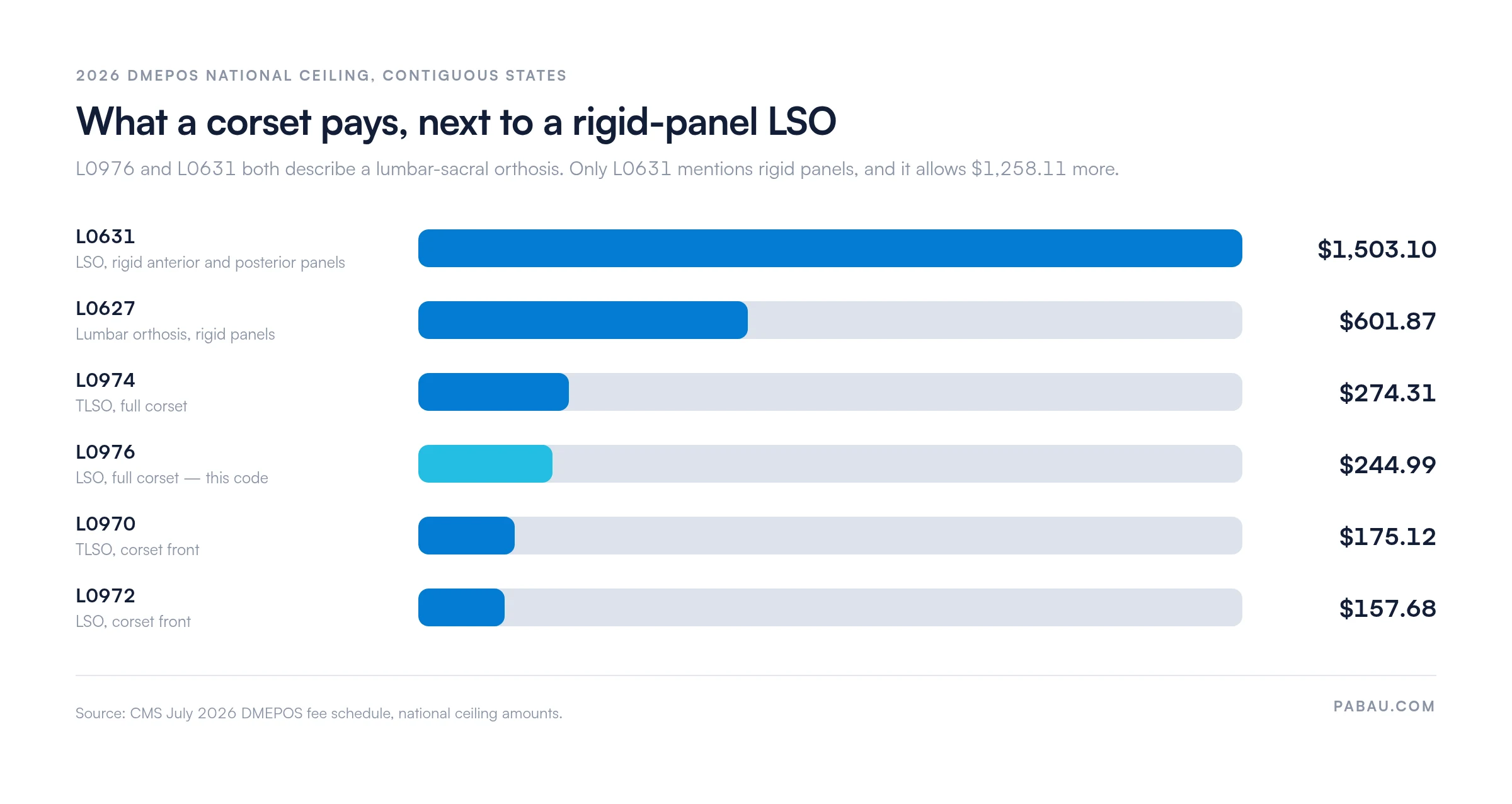
L0976 belongs to a block of four corset codes. Two of them describe a thoracic-lumbar-sacral device and two describe a lumbar-sacral one. Within each pair, the difference is corset front against full corset.
Not one of those four descriptors mentions rigidity. Choosing between them is a question of how far the device reaches up the spine. The second question is full corset or corset front.
L0976 and L0631 are the pair that costs money to confuse. In New York the two codes allow $183.75 and $1,231.38 for the same claim line.
Match the dispensed device to the descriptor before you bill, and keep the product’s coding verification with the order. Lined up across the whole group, the spread makes the point faster than a fee file does.
DME suppliers lose L0976 claims to filing problems more often than to clinical ones. The written order sits in one system and the delivery note in another. The coding verification sits in a shared drive nobody can search on audit day. Forty-five days is not long when the record is spread across three places.
Practice management software like Pabau keeps the order, the clinical note and the delivery confirmation on one patient record. Claims then go out from that same record through Pabau’s claims management software. The evidence behind a line item is one click away when a DME MAC asks.
Custom forms capture the pieces a spinal orthosis claim needs, including the written order details and the signed ABN. Pabau files them against the patient rather than in a separate drive. A records request then becomes a lookup instead of a search.
None of that replaces a coder’s judgment on L0976 against L0631. It does mean the documentation defending that choice is already filed when someone asks to see it.

Pabau keeps the written order, the clinical note and the delivery record on one patient file, then submits the claim from it. Your team answers a records request without hunting through drives.

L0976 is a three-word code with a long history of being described wrongly. Rigid panels, sagittal control and a posterior section reaching T-9 all belong to L0631, and to a fee roughly six times higher.
So the work on this code happens upstream of billing. Match the dispensed device to the descriptor, keep the coding verification with the order, and leave KX off the claim. Coverage then rests where CMS put it, on the DME MAC’s judgment and on the record you can produce.
Pabau keeps that record and the claim in one place for orthotic and DME suppliers. Book a demo to see how a spinal orthosis claim leaves the same patient file that holds its written order.

List Item #1
List Item #2
No. L0976 is priced on the DMEPOS fee schedule with a national floor and ceiling. Competitive bidding applies to other spinal orthosis codes, including the sacroiliac codes L0621 and L0623.
Twenty percent of the Medicare allowed amount, once the Part B deductible is met. In a floor state that works out at about $36.75. Quote from your own state’s allowed amount rather than the national figure.
No. Each state Medicaid program sets its own fee for L0976 and its own coverage rules. Check the state fee file before you quote a price or estimate a patient’s share.
GA where a signed ABN is on file, and GZ where one is not. GZ leaves the denial with the supplier, because the beneficiary cannot be billed for it.
Construction. L0972 is a corset front and L0976 is a full corset. Both cover the lumbar-sacral region, and neither descriptor mentions rigid panels or sagittal control.