CPT Code 62284: Injection procedure for myelography
CPT Code 62284: official descriptor and procedure overview The American Medical ...

Last Updated: Oct 19, 2026
L0984 is the HCPCS Level II code for protective body sock, prefabricated, off-the-shelf, each.
Rejections trace back to three causes. Modifier KX is missing, the physician order is incomplete, or the base orthosis code already covers the liner.
Let Pabau's smart automation suggest the right codes, reduce claim denials, and keep your practice compliant—effortlessly.
Automate repetitive tasks and focus on what matters most—your patients.
Reduce coding errors and ensure compliance with the latest regulations.
Clean claims, fewer denials, and faster reimbursements.
Powerful insights and reporting to help your practice thrive.
HIPAA compliant SOC 2 certified GDPR-compliant Trusted by 4,000+ clinics worldwide

HCPCS code L0984 is the billing code for a protective body sock, prefabricated, off-the-shelf, each. It sits in the HCPCS Level II L-code range for DME.
L0984 is billed under the Medicare Part B DME benefit. Coverage requires documented medical necessity, usually when the sock is worn under a spinal orthosis.
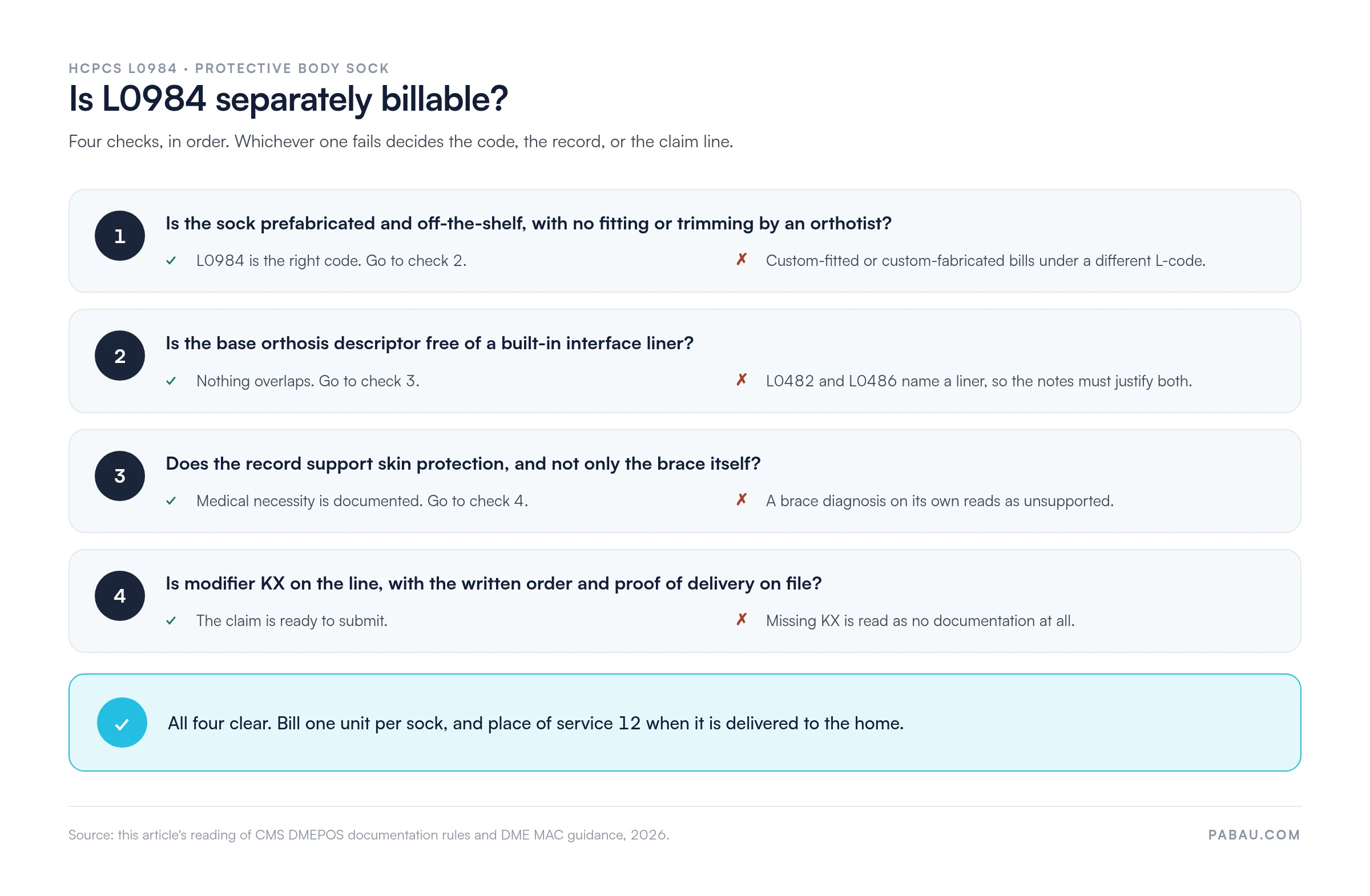
Modifier KX must appear on the claim when medical necessity documentation is on file. Missing KX is a leading denial trigger for L0984.
Practice management software like Pabau supports insurance claim tracking and reimbursement reconciliation, so billing staff always know where a submitted claim stands.
HCPCS code L0984 describes a protective body sock, prefabricated, off-the-shelf, each. It is an HCPCS Level II L-code, so it falls under the orthotic procedures and devices category. That category is maintained by the Centers for Medicare and Medicaid Services (CMS).
The “prefabricated, off-the-shelf” qualifier is not incidental. It directly determines which code applies. L0984 applies only when the body sock is a manufactured, mass-produced item.
It must need no custom fitting, trimming, or modification by a qualified orthotist. Billing a custom-fabricated or custom-fitted body sock under L0984 is a coding error with audit implications.
Medicare, Medicaid, and many commercial payers use HCPCS Level II codes like L0984 for durable medical equipment (DME) and orthotic accessories. The items are dispensed to patients outside a hospital setting.
The table below summarizes the key code attributes for L0984. These values match CMS HCPCS Level II release files and are consistent across current coding references.
A protective body sock is worn underneath a spinal orthosis, thoracolumbosacral orthosis (TLSO), lumbosacral orthosis (LSO), or body brace. Its primary function is to protect the patient’s skin from friction, pressure, and irritation caused by direct contact between the brace and the skin surface.
Patients who wear rigid or semi-rigid spinal orthoses for extended periods are particularly susceptible to skin breakdown. The body sock acts as a moisture-wicking, padded barrier that reduces this risk.
Clinically, it is indicated for patients with limited mobility, compromised skin integrity, or impaired sensation. In those patients, pressure injury from orthotic contact is hard to catch early.
The clinical context matters for billing. Medicare requires medical necessity in the patient’s record, not an assumption drawn from the orthosis prescription.
Medicare Part B covers L0984 under the DME benefit when medical necessity criteria are met. Coverage is not automatic simply because the patient has a spinal orthosis. The claim must be supported by documentation that specifically establishes why the protective body sock is medically necessary for this patient.
Coverage requirements vary by Medicare Administrative Contractor (MAC) jurisdiction. Always check the applicable Local Coverage Determination (LCD) or Coverage Article for your MAC before billing.
The criteria below represent general Medicare DME billing requirements; specific thresholds and documentation formats may differ by jurisdiction.
Verify eligibility on every L0984 claim before the sock is dispensed. Some commercial payers apply different coverage thresholds. Medicaid programs may set their own prior authorization requirements that differ from Medicare Part B.
The diagnosis on an L0984 claim has to do two jobs. It must support the base spinal orthosis, and the record behind it must show why the skin needs protecting. A low back pain code on its own does neither.
The payable diagnosis list for spinal orthoses comes from the DME MACs rather than the code book. Check LCD L33790 and its Policy Article A52500 for your jurisdiction before you settle on a code. The families below are the ones that typically sit behind a TLSO or LSO order.
Pair the orthosis diagnosis with a second code or a clinical note that names the skin risk. That second element is what a reviewer looks for when L0984 is billed alongside the brace. Our ICD-10-CM code library carries the full descriptor for each family above.
L0984 is priced on the DMEPOS fee schedule administered by CMS. Payment rates are subject to annual updates and geographic adjustments based on the payment locality.
The figures below reflect 2025/2026 fee schedule data from CMS DMEPOS files. Verify current rates in the CMS DMEPOS fee schedule files before submitting claims, because rates differ by locality.
Fee schedule rates change annually and vary by locality. Coding teams should pull the current DMEPOS file from CMS.gov each January rather than relying on prior-year figures. Using outdated rates is a common cause of underbilling or claim mismatch errors.
Download the CMS DMEPOS fee schedule file at the start of each year and cross-reference L0984 allowable rates for each of your billing localities. Rate differences between rural and urban payment areas can be significant enough to affect your pricing strategy for self-pay patients.
L0984 claims are submitted on a CMS-1500 claim form by DMEPOS-accredited suppliers, or on its electronic 837P equivalent. Suppliers that bill their own DME need a submission check that catches a missing order, modifier or delivery slip before the claim leaves the building.
Units of service for L0984 are billed per unit (each). If a patient receives two body socks, bill two units. Do not bundle multiple socks into a single unit without confirming payer policy. Some MACs set quantity limits that require prior authorization for replacement items.
Modifiers on an L0984 claim carry three signals to the payer. They show whether medical necessity is documented, who holds the equipment, and which side of the body applies. The table below covers the most commonly applied modifiers and the scenarios that require each one.
Modifier requirements can vary by MAC jurisdiction and commercial payer. Verify modifier rules against CGS Medicare’s coding verification guidance and your applicable LCD before finalizing a claim.
Poor documentation is the leading cause of L0984 claim denials on post-payment audit. Medicare’s DME documentation requirements are specific, and missing one element can trigger a full repayment demand. The six items below are what a reviewer asks for.
Keep a documentation checklist for each DME category you dispense, and file it with the claim. Treat every L0984 claim as if it will be reviewed, because DMEPOS claims are a consistent target for Recovery Audit Contractor reviews.
Several adjacent L-codes cover related orthotic accessories and spinal orthosis components. Reading them side by side is what stops an unbundling error, because the base orthosis and its accessories are billed on separate lines.
Two codes in this range are easy to grab by mistake. They sit either side of L0984 in the code book, but neither one is a spinal orthosis.
One check on the base orthosis matters more than the rest. Some rigid TLSO codes name an interface liner inside their own descriptor. L0482 and L0486 both cover a custom-fabricated rigid plastic shell with interface liner.
Where the brace already carries that liner, the record has to explain why a separate protective body sock is needed on top of it. Read the base code’s full descriptor and your MAC policy article before both items go on one claim.
The patterns below come from standard DME audit findings and DMEPOS MAC guidance on orthotic accessory billing. Each one is a technical failure rather than a clinical disagreement, which is why a checklist catches them.
Run the four checks below in order and most of those denials surface before the claim goes out.
When a denial arrives, respond with a focused appeal. Include the standard written order, the medical necessity documentation, and the LCD criteria that support coverage. A well-structured appeal resolves the majority of technical denials within one round.
Tracking denial reasons systematically helps identify patterns that warrant a process fix rather than a one-off appeal. Pabau’s denial management resources cover how to build that tracking system.
Build a pre-submission checklist for L0984 claims. Confirm the standard written order is dated before dispensing, KX is applied, and the ICD-10-CM code supports the skin-protection need. Then check that delivery confirmation is on file and the MAC quantity limit is clear. Catching these before submission costs nothing. Catching them after a denial costs time and money.
In most DME operations the four documents behind an L0984 claim live in four systems. The order is in the EMR and the clinical note is with the prescriber. The signed delivery slip sits in a folder, and the claim status sits in a payer portal. A reviewer asks for all four together.
Practice management software like Pabau holds them against one patient record instead. The order, the encounter note and the delivery document attach to the same file. The ICD-10 and HCPCS codes then carry through to the claim without retyping. Insurers and policies sit on the record too, so each invoice routes to the right payer.
Pabau’s claims software for suppliers tracks each submission through pending, submitted, processing, paid and error. Validation runs in the background on send, so a missing membership number surfaces before the payer sees it.
In the US, claims route through Claim.MD, which returns eligibility checks and posts remittances back against the invoice. When payment lands, the status update records against the right invoice.
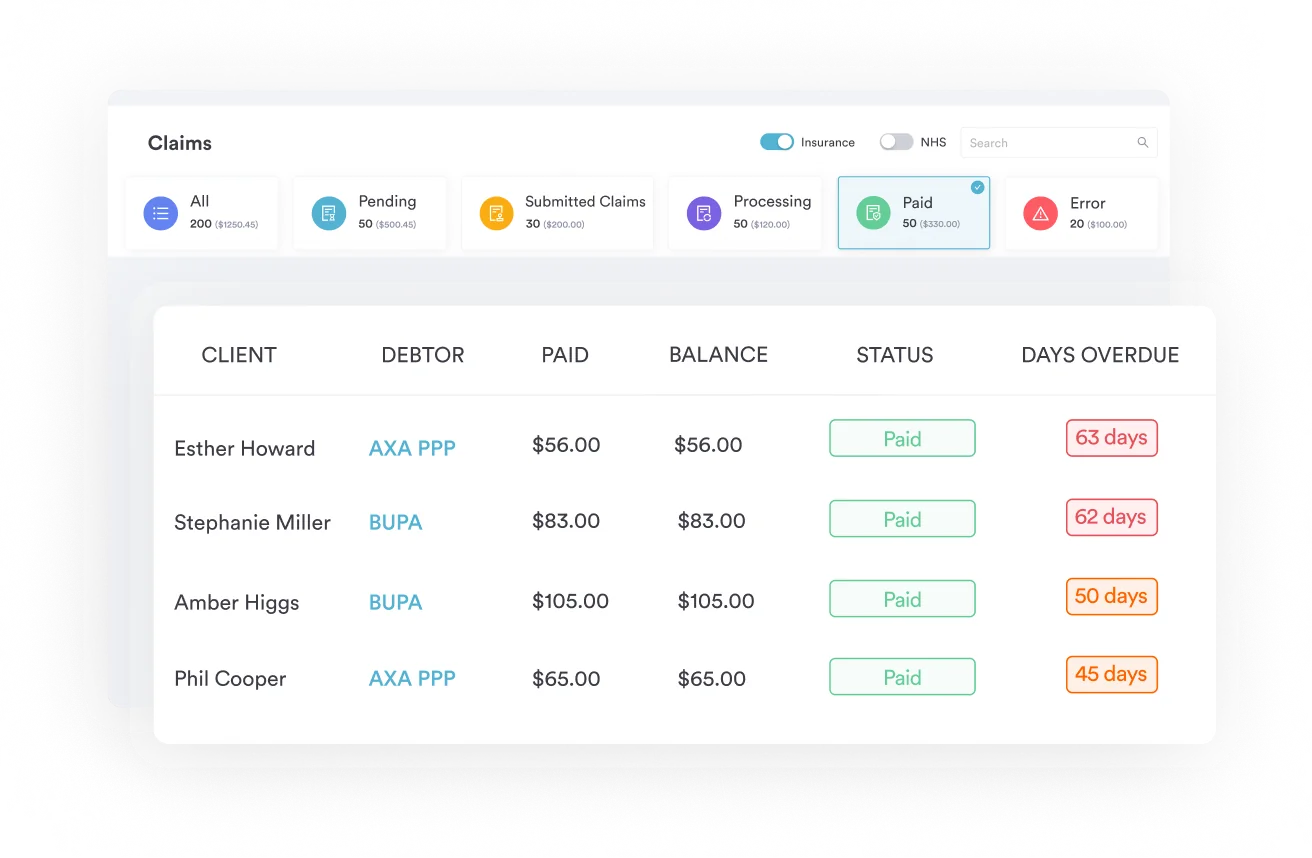

Pabau keeps the order, the delivery record and the claim on one patient file, and follows each submission through to reimbursement. See how it works for your practice.

L0984 is a short descriptor with a long denial trail, and the cause sits in the paperwork rather than the clinical decision. Get KX on the claim, hold a complete standard written order, and confirm the base orthosis code does not already include a liner. Those three habits clear most L0984 denials before they happen.
At volume, the front-end check matters more than any single code. A supplier who verifies the order, the diagnosis and the modifier before submission spends far less time appealing afterwards. That is the trade the whole L0984 workflow turns on.
If you want to see how Pabau keeps orthotic documentation and claims in one place, book a demo with the team.

Need to understand how DME billing fits into your revenue cycle? What is revenue cycle management explains the full billing lifecycle from claim submission to reimbursement reconciliation.
Want to reduce the risk of claim denials across your HCPCS codes? Denial management in healthcare walks through how to track, appeal, and prevent recurring denials.
Looking for guidance on staying compliant with DME billing requirements? Medical billing compliance covers audit-readiness practices and documentation standards for DME suppliers.
HCPCS code L0984 is the billing code for a protective body sock, prefabricated, off-the-shelf, each. It is a HCPCS Level II L-code used to bill Medicare Part B and other payers for this DME orthotic accessory. The sock is typically worn under a spinal orthosis to protect the patient’s skin.
A protective body sock is worn underneath a spinal orthosis, TLSO, or body brace to protect the patient’s skin from friction, pressure, and moisture. It is clinically indicated for patients wearing rigid or semi-rigid orthoses for extended periods, particularly those with limited mobility, compromised skin integrity, or reduced sensation.
Yes, L0984 is covered by Medicare Part B under the DME benefit when medical necessity criteria are met. Coverage requires a qualifying diagnosis, a standard written order, documentation of medical necessity, and a DMEPOS-accredited supplier. Criteria vary by MAC jurisdiction, so check LCD L33790 and its policy article before billing.
The most critical modifier for L0984 is KX, which confirms that medical necessity documentation is on file and LCD criteria are met. Other applicable modifiers include NU (new equipment), RR (rental), GA (advance beneficiary notice on file), and GY (item statutorily excluded). Apply KX on every claim where coverage criteria are satisfied.
Required documentation includes a standard written order (SWO), a supporting ICD-10-CM diagnosis, and a signed proof of delivery. The treating practitioner’s clinical notes must document the need for skin protection. CMS discontinued certificates of medical necessity from January 1, 2023, so the medical record now carries that justification.
Prefabricated off-the-shelf items such as L0984 are mass-produced and need no custom fabrication or fitting by a qualified orthotist. Custom orthoses involve individual measurement, fabrication, or significant modification, and they are billed under different, typically higher-value L-codes. Billing a custom-fitted item under an off-the-shelf code is still miscoding, and it still attracts audit attention.
Related codes in the same range include L0970 (TLSO, corset front), L0972 (LSO, corset front), L0974 (TLSO, full corset), and L0976 (LSO, full corset). L0999 covers an addition to a spinal orthosis that has no specific code. L0980 and L0982 sit beside L0984 numerically but cover peroneal straps and stocking supporter grips, not spinal orthoses.