CCSD code H4430: Examination of rectum under anaesthetic
CCSD code H4430 pays for the examination alone CCSD code H4430 is the UK private...

Last Updated: Oct 20, 2026
L0112 is the HCPCS Level II code for cranial cervical orthosis, congenital torticollis type, with or without soft interface material, adjustable range of motion joint, custom fabricated.
According to the Centers for Medicare and Medicaid Services (CMS), HCPCS Level II codes like L0112 are maintained and updated annually. Local Coverage Determinations can also tighten the criteria beyond national policy, so check your contractor's article each year.
Let Pabau's smart automation suggest the right codes, reduce claim denials, and keep your practice compliant—effortlessly.
Automate repetitive tasks and focus on what matters most—your patients.
Reduce coding errors and ensure compliance with the latest regulations.
Clean claims, fewer denials, and faster reimbursements.
Powerful insights and reporting to help your practice thrive.
HIPAA compliant SOC 2 certified GDPR-compliant Trusted by 4,000+ clinics worldwide

HCPCS Code L0112 describes a custom-fabricated cranial cervical orthosis with an adjustable range of motion joint, made for a patient with congenital torticollis
L0113 is the prefabricated torticollis orthosis code, and it is the one whose descriptor includes fitting and adjustment
Billing L0112 for a device taken off the shelf is a coding error that payers and Recovery Audit Contractors flag
Medicare and most commercial payers require a letter of medical necessity and diagnosis confirmation before reimbursing L0112
Pabau’s claims management software captures orthotic billing codes, stores documentation, and submits clean claims to payers
HCPCS Code L0112 is the Healthcare Common Procedure Coding System Level II code for a custom-fabricated cranial cervical orthosis used to treat congenital torticollis. The full official descriptor is: Cranial cervical orthosis, congenital torticollis type, with or without soft interface material, adjustable range of motion joint, custom fabricated.
Three elements in that descriptor carry billing weight. First, “custom fabricated” means the device is built for one named patient from measurements, an impression, a cast, or a model.
Second, the adjustable range of motion joint is written into the code, so a device without that joint does not belong here.
Third, “with or without soft interface material” means the presence of padding does not change the code selection.
One phrase is missing from L0112 on purpose. The words “prefabricated, includes fitting and adjustment” belong to L0113, the neighboring torticollis orthosis code. Coders who read the two descriptors side by side before selecting either one avoid the most common error on this claim.
L0112 is indicated for congenital torticollis. In that condition, asymmetric shortening or fibrosis of the sternocleidomastoid muscle tilts the infant’s head to one side and rotates it toward the opposite shoulder. It is not a general-purpose cervical collar code. Billing L0112 for adult cervical strain is a coding error that will not survive a payer audit.
The descriptor is narrower than L0113 in two ways. L0112 names congenital torticollis specifically, while L0113 covers torticollis type more broadly. L0112 also requires custom fabrication, while L0113 covers the prefabricated device. Acquired torticollis treated with an off-the-shelf orthosis therefore points to L0113, not L0112.
For a claim to be payable, the diagnosis code must map to the device’s covered indication. The two ICD-10-CM codes most commonly paired with L0112 are Q68.0 (congenital deformity of the sternocleidomastoid muscle) and M43.6 (torticollis).
Carrier-specific crosswalks may add or exclude codes, so verify the pairing against your MAC’s Local Coverage Determination before submission. Both sit in the wider set of ICD-10-CM diagnostic codes a payer will accept as proof of medical necessity.
Construction type is what separates L0112 from L0113. Both describe cranial cervical orthoses for torticollis. L0112 is custom fabricated for one patient and carries an adjustable range of motion joint. L0113 is prefabricated, and its descriptor bundles fitting and adjustment.
Billing L0112 for a stock device that was fitted at the visit misstates the construction type. A reviewer checks that first. The grid below maps the two facts that decide the code, alongside the neighboring cervical collar codes.
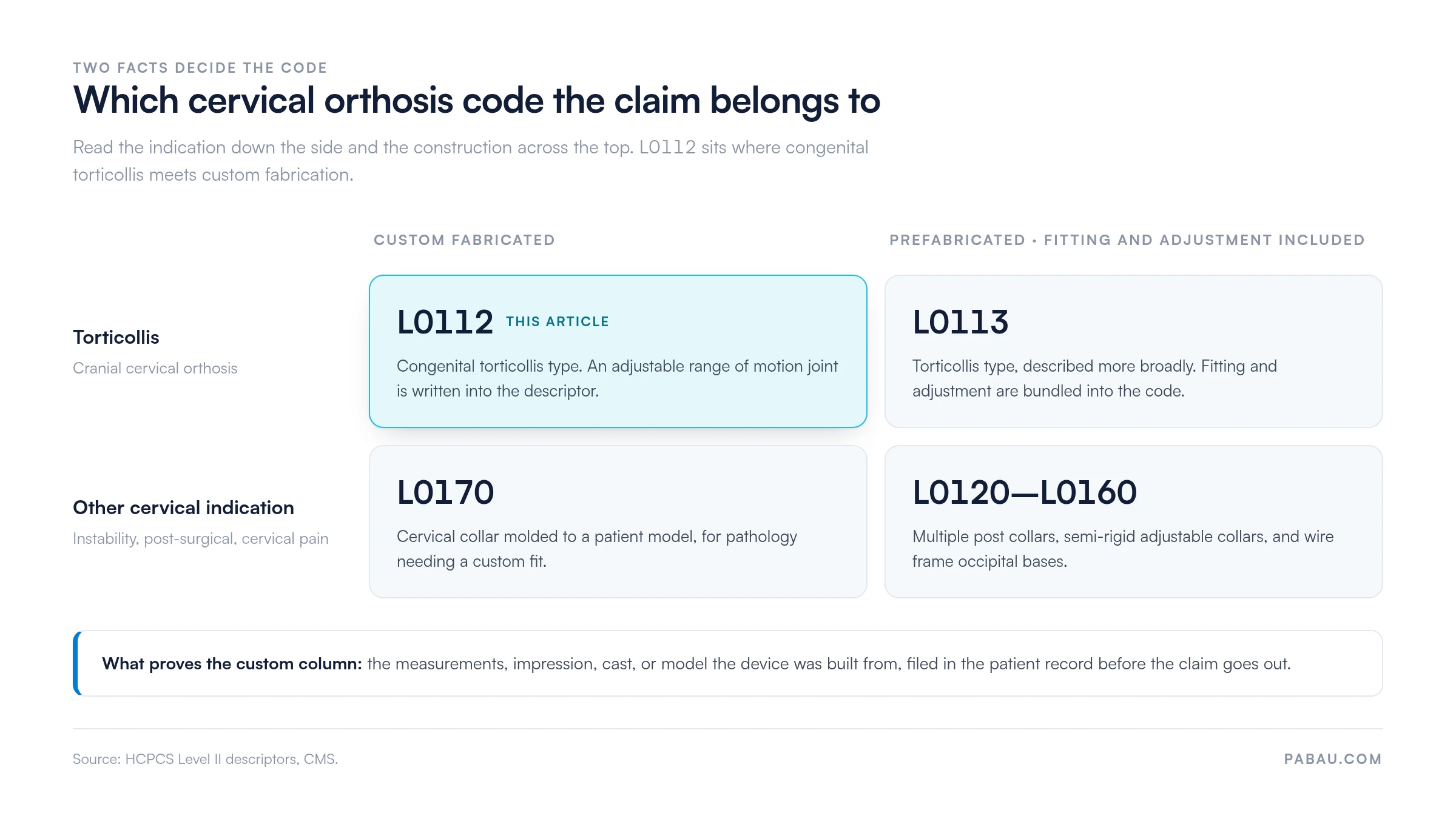
If the device was fabricated for one patient from a cast, mold, model, or set of measurements, L0112 is the correct congenital torticollis code. If it came off the shelf and was fitted at the visit, L0113 applies instead. Mixing the two categories is a known trigger for Recovery Audit Contractor (RAC) review.
L0112 is reimbursed under the DMEPOS fee schedule, not the Medicare Physician Fee Schedule. Rates are set annually by CMS and vary by Medicare Administrative Contractor (MAC) jurisdiction. The national limiting charge is the ceiling a non-participating supplier may collect from a Medicare beneficiary.
CMS releases updated DMEPOS fee schedule files each January. Confirm the current fee year file before you submit any claim, because a stale allowable produces both underbilling and write-offs.
Custom-fabricated codes generally carry a different allowable than their prefabricated counterparts, so never copy a rate across from L0113. Pull each code’s own line from the fee schedule file.
CMS also applies a Reasonable Useful Lifetime (RUL) policy to cervical orthoses. Medicare will not pay for a replacement device until the RUL period has elapsed, unless there is documented clinical justification. Device failure and a significant change in the patient’s condition are the two justifications MACs see most often. Always document the reason for replacement separately from the original claim.
Check your MAC’s Local Coverage Determination before submitting L0112. CGS Medicare and Noridian each publish jurisdiction-specific coverage articles that may set tighter medical necessity criteria than national CMS policy. Verify the LCD annually as MACs update coverage articles with each fee schedule release.
Medicare covers L0112 when medical necessity is established and the claim is submitted by an eligible billing entity. Coverage is not automatic. The MAC reviews the claim against the applicable LCD to confirm that the diagnosis, the device construction, and the supplier all meet program requirements.
Custom fabrication brings an extra supplier rule into play. Section 427 of the Benefits Improvement and Protection Act limits payment for custom-fabricated orthotics. The item must be furnished by a qualified practitioner and fabricated by a qualified practitioner or supplier. Confirm your MAC’s current position on that requirement before you dispense the device.
L0112 describes a midline device, so the RT and LT laterality modifiers do not apply to it. A brace for one knee, such as HCPCS code L1836, is the opposite case and needs RT or LT on the claim. The modifiers that do come up are the ones that tell the MAC about liability, coverage, and replacement. Append them at the line level, and confirm each one against your jurisdiction’s article before submission.
After code selection, documentation is what decides an L0112 claim. Every element below must be in the patient record before the claim is submitted. Those records also have to stay retrievable afterward, because a post-payment review asks for them months later.
Submitting a clean claim from the outset means every required field is populated. The diagnosis code must support the device, and the supporting records must be filed and accessible.
Missing records found during a Recovery Audit Contractor review lead to repayment demands that include interest. Paper-based filing makes fabrication notes and letters of medical necessity slow to retrieve. Digital record-keeping removes that delay.
L0112 is billed on a DMEPOS claim by the supplier that furnished the device, not by the ordering physician’s practice. The sequence below is the order most orthotic billing teams follow.
Most L0112 denials trace back to a handful of repeat causes. The table below pairs each one with the correction that clears it.
An L0112 claim depends on records created at three separate moments. Those are the order, the fabrication, and the delivery. Practice management software like Pabau keeps all three against the patient, so the claim is assembled from one place. Its medical claims management tools then carry the code, the diagnosis, and the supporting documents through to submission.
Orthotic billing carries a heavier documentation load than many other DMEPOS categories, because L-codes involve physical devices with proof-of-delivery requirements.
Custom-fabricated codes such as L0112 add a fabrication record on top. Capturing each document as it is created, rather than chasing it at appeal, keeps that load manageable.
Run a monthly audit of your L0112 claims to catch denial patterns early. Pull all claims submitted in the prior 30 days. Check that every denied claim has a matching LMN, a physician order dated before the device was dispensed, and a fabrication record in the chart. Most repeat denials trace to one missing document type.

Pabau’s claims management software helps orthotic and DME providers capture billing codes, store documentation, and submit clean HCPCS Level II claims.

L0112 turns on a single question about how the device was made. Confirm custom fabrication, file the record that proves it, and the rest of the claim follows a predictable path.
The trade-off worth remembering is timing. Every document this code needs is cheap to capture at the point of care. The same document is expensive to reconstruct at appeal. Build the collection into the dispensing workflow rather than the billing one.
Pabau gives orthotic and DME practices one place to document, code, and submit L0112 claims. It also tracks the denials that follow a payer policy change. To see how it handles orthotic billing, book a demo with the team.

Billing another custom-fabricated orthosis? HCPCS code L0636 applies the same custom-versus-prefabricated test to a lumbar-sacral orthosis.
Dealing with repeated denials on DMEPOS codes? Denial management in healthcare covers the most common denial reasons and how to build a systematic appeals process.
Need the compliance rules behind an L-code claim? Medical billing compliance sets out the documentation and audit standards payers apply to orthotic claims.
Want to understand how orthotic billing fits your revenue cycle? What is revenue cycle management explains the full billing lifecycle from coding to payment posting.
HCPCS Code L0112 is a Level II Healthcare Common Procedure Coding System code. It covers a custom-fabricated cranial cervical orthosis of the congenital torticollis type, with an adjustable range of motion joint. It falls within the orthotic procedures and services section (L0112-L4631) and is billed under the DMEPOS fee schedule for Medicare and Medicaid claims.
L0112 is a custom-fabricated orthosis code. The descriptor ends with the words custom fabricated, and it also requires an adjustable range of motion joint. The prefabricated torticollis orthosis is L0113, whose descriptor includes fitting and adjustment. Billing L0112 for a stock device is a coding error that may trigger a RAC audit and a repayment demand.
L0112 is custom fabricated for one patient, names congenital torticollis specifically, and requires an adjustable range of motion joint. L0113 is prefabricated, covers torticollis type more broadly, may or may not have a joint, and bundles fitting and adjustment into the code. Construction type is the first thing to confirm when choosing between them.
L0112 covers a custom-fabricated cranial cervical orthosis supplied to a patient with a documented diagnosis of congenital torticollis, typically ICD-10-CM Q68.0 or M43.6. It does not cover prefabricated devices, which are billed as L0113. It also does not cover cervical orthoses used for general adult cervical pathology, which fall under other codes in the L0120-L0174 range.
Medicare reimbursement for L0112 is determined by the annual CMS DMEPOS fee schedule and varies by MAC jurisdiction and locality code. Rates are updated each January. Custom-fabricated codes are priced separately from their prefabricated counterparts, so never carry a rate across from L0113. Confirm the current-year allowed amount from the CMS fee schedule download before submitting claims.
Required documentation includes a signed physician order and a letter of medical necessity. You also need an ICD-10-CM diagnosis code supported by the record, custom fabrication notes showing the measurements or impression used, and signed proof of delivery. Add a statement explaining why a prefabricated device would not meet the patient’s needs. The billing supplier must also hold an active DMEPOS supplier number and meet CMS quality standards.
L0112 is the only cervical orthosis code that names congenital torticollis and requires custom fabrication with an adjustable range of motion joint. L0113 is its prefabricated counterpart for torticollis generally. Codes L0120 through L0160 cover prefabricated collars for general cervical indications, and L0170 covers a custom-fabricated collar molded to a patient model.