

HCPCS code E0198: Water pressure pad billing guide
HCPCS code E0198 is a water pad for a standard mattress HCPCS code E0198 is the ...

Last Updated: Oct 13, 2026
L1836 is the HCPCS Level II code for knee orthosis, rigid, without joint(s), includes soft interface material, prefabricated, off-the-shelf.
L1836 applies only when the device meets the off-the-shelf (OTS) definition. The brace needs minimal self-adjustment by the beneficiary and no modification by a practitioner before it is dispensed. A brace that someone with expertise has to trim, bend, or mold belongs to a different code.
Coverage runs through CMS Policy Article A52465, the claim carries the KX modifier plus RT or LT, and Medicare pays under the DMEPOS fee schedule. The documentation file has to be complete before the brace is handed over, not after the denial arrives.
Let Pabau's smart automation suggest the right codes, reduce claim denials, and keep your practice compliant—effortlessly.
Automate repetitive tasks and focus on what matters most—your patients.
Reduce coding errors and ensure compliance with the latest regulations.
Clean claims, fewer denials, and faster reimbursements.
Powerful insights and reporting to help your practice thrive.
HIPAA compliant SOC 2 certified GDPR-compliant Trusted by 4,000+ clinics worldwide

HCPCS code L1836 describes a rigid, jointless, prefabricated off-the-shelf knee orthosis with soft interface material billed under Medicare Part B DMEPOS.
Coverage is governed by CMS Policy Article A52465. Medical necessity must be established per claim, not assumed from the diagnosis alone.
The KX modifier is required when the supplier attests that documentation on file supports Medicare coverage criteria for L1836.
Neighboring knee orthosis codes differ by joint type and fitting method, so L1810, L1820, L1832 and L1843 are prefabricated but custom-fitted.
Practice management software like Pabau tracks modifier requirements, submission deadlines, and denial resolution in one place.
HCPCS code L1836 carries the following official descriptor from the Centers for Medicare & Medicaid Services (CMS). Knee orthosis (KO), rigid, without joint(s), includes soft interface material, prefabricated, off-the-shelf. Every word in that descriptor has billing significance.
The “rigid, without joint(s)” language is what separates L1836 from hinged knee orthosis codes. A rigid brace holds the knee in a fixed position, with no medial or lateral hinges. Adding any hinge moves the claim to a different code family, typically L1843 or L1844.
The OTS designation means the brace comes in multiple sizes and needs no custom fitting. The beneficiary or caregiver can apply it without any practitioner modification. CMS and the HCPCS Level II coding system maintain this distinction to separate OTS devices from custom-fitted and custom-fabricated orthotics.
Medicare covers L1836 when a physician or treating practitioner orders the orthosis and the clinical record supports medical necessity under CMS Policy Article A52465. Coverage is not automatic based on diagnosis alone.
Common clinical indications accepted under A52465 include:
Non-covered indications typically include:
The treating clinician’s notes must name the specific impairment the brace addresses. A practice that bills DME alongside its own treatment services should confirm that before the claim goes out.
The policy article is the authoritative reference. CMS publishes it through the Medicare Coverage Database (A52465), and MACs including Noridian supplement it with Dear Clinician Letters addressing jurisdiction-specific questions.
Medicare pays for L1836 under the DMEPOS fee schedule, which CMS updates annually. Payment amounts vary by geographic locality through a pricing adjustment applied to the national base rate. Always verify current figures against the official CMS DMEPOS fee schedule file for the applicable year.
Verify the current allowable amount before billing each claim. Relying on a prior year’s rate without confirming the annual update is a routine source of underbilling and write-offs.
Every L1836 claim requires a complete documentation package before submission. Missing a single element is enough for Medicare or a MAC to deny the claim on the first pass.
Noridian, which handles Medicare DME claims in the western US jurisdiction, has issued Dear Clinician Letters with further guidance on knee orthosis documentation. Suppliers in that jurisdiction should read those publications alongside A52465. Checking the beneficiary’s coverage before dispensing also surfaces secondary payer coordination issues early.
Medicare requires specific modifiers on L1836 claims to indicate laterality, transaction type, and whether coverage criteria are met. Submitting without the correct modifier is a fast path to a claim rejection.
KX is the modifier that catches the most denials. When a supplier bills L1836 without KX, Medicare reads the absence as an attestation that coverage criteria are not met, and the claim denies automatically. The supporting documentation must be on file before KX is applied. Adding it retroactively without that file is a compliance violation.
Before submitting any L1836 claim, confirm your documentation file contains the physician order, medical records supporting necessity, and delivery confirmation. Apply the KX modifier only after verifying that those documents are in hand. A missing KX is the fastest of these to fix. A missing CMN or an unsigned delivery ticket means chasing the ordering provider, which adds weeks to your collection timeline.
Billing L1836 correctly requires supplier enrollment, careful claim preparation, and timely submission. The general rules of medical billing apply throughout, but DME adds a few steps of its own.
Electronic billing runs on the 837P transaction. Paper CMS-1500 submissions are permitted for suppliers below the electronic filing threshold. Electronic submission still processes faster and returns denial feedback sooner.
Practices managing DME alongside their own treatment services need one place to track modifier rules and appeal deadlines. Dedicated claims management software holds modifier requirements, denial codes, and appeal deadlines in a single workflow instead of spreadsheets and manual logs.
Selecting the wrong knee orthosis code is one of the most audited billing errors in the DMEPOS category. Two questions settle it: whether the brace has a joint, and how it was fitted to the patient.
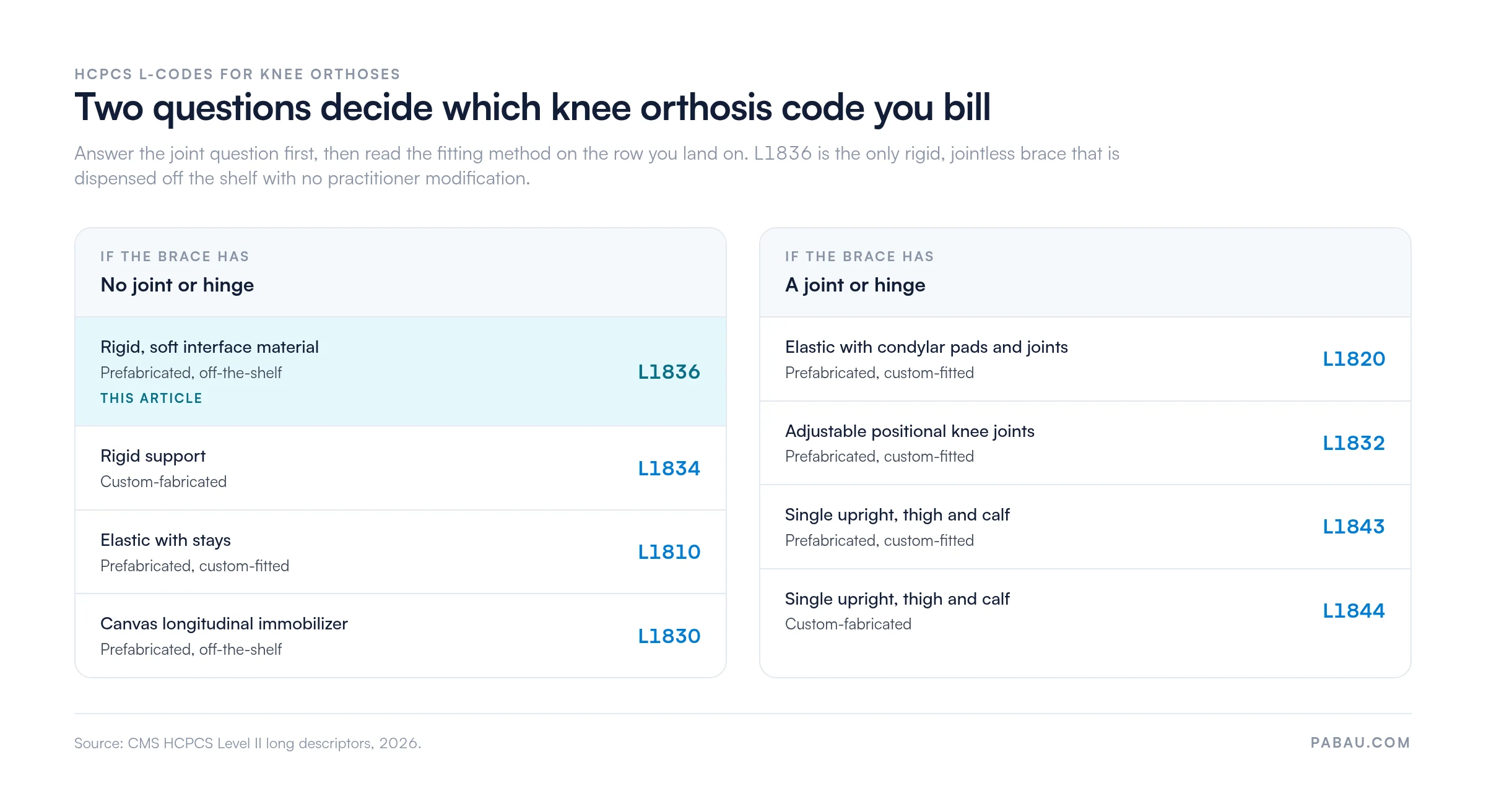
The table below carries the same codes with their abbreviated descriptors.
Two neighboring codes sit outside the table and are worth knowing. L1833 is the off-the-shelf counterpart to L1832, and L1846 covers the double upright, custom-fabricated brace that suppliers often reach for by mistake.
L1848 also sits outside the table, and coverage rules it out entirely. It describes the off-the-shelf double upright brace with an inflatable air chamber, which Medicare denies as not reasonable and necessary. For the nonambulatory contracture patient that brace targets, L1836 is the covered rigid alternative.
The most common mix-up is billing L1836 for a brace that someone with expertise had to trim, bend, or mold before handing it over. That work makes the device custom-fitted, so L1836 no longer describes it. Verify with the AAPC HCPCS code reference when the descriptor and the device do not obviously match.
A covered ICD-10-CM diagnosis code on the claim is a prerequisite for Medicare reimbursement. CMS Policy Article A52465 governs which diagnoses are covered. The table below lists commonly accepted codes, but always cross-check the current A52465 publication for your MAC jurisdiction.
Each row above is a family rather than a single code, and the claim needs the specific one. Our ICD-10-CM code library breaks the individual diagnosis codes down one by one.
No diagnosis code by itself guarantees payment. The medical record must show the clinical basis for prescribing this specific device for this specific patient. A diagnosis of knee osteoarthritis supports coverage, while a note that the patient is “at risk for injury” does not.
Most L1836 denials trace back to a small set of recurring errors. Knowing the pattern makes them preventable rather than routine. A structured denial management workflow catches these before they age into write-offs.
Map each remittance advice (RA) denial reason back to its root cause and corrective action before you resubmit. Many DME denials are preventable with a pre-submission checklist run on every L1836 claim.
Denial trends across a batch of L1836 claims usually point at a template rather than at a biller. If 30% of your KO denials cite “documentation does not support medical necessity”, the physician order form is what needs changing. Fix the form and the denial rate drops.
Run a quarterly audit of your L1836 claims. Pull every denial, group them by denial reason code, and rank them by frequency. The top three reasons account for most of your write-off risk. A 30-minute audit surfaces patterns that reviewing claims one at a time will not show. Apply the fix upstream in your workflow rather than correcting claims after the fact.
A supplier billing L1836 usually keeps the documentation file in one place and the claim in another. The physician order sits in a shared drive, the delivery ticket in a scanner folder, and the modifier rules in someone’s memory. The claim goes out, and the file is only reviewed once a denial comes back.
Practice management software like Pabau keeps the order, the delivery confirmation, and the claim on the same patient record. Claim statuses, modifier flags, and appeal deadlines sit in one queue. An incomplete file shows up before the claim is submitted, rather than three weeks later.
For a DME supplier, that means fewer first-pass denials on knee orthosis claims and a shorter path from dispensing to payment. Every Pabau subscription includes the full feature set, so claim tracking is not something you add on later.
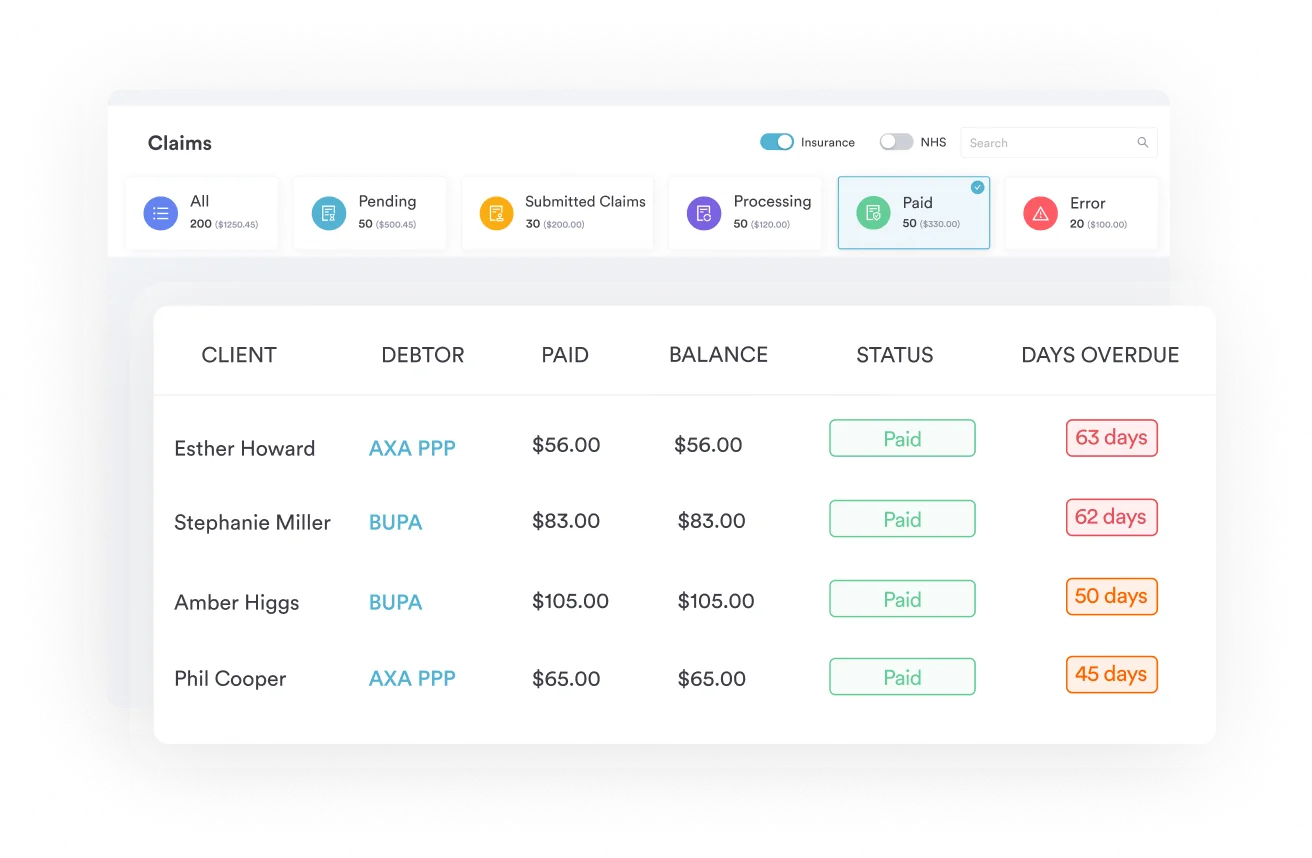

Pabau’s claims management tools help practices and suppliers track HCPCS codes, modifier requirements, and denial workflows without switching between systems. See how it works in a live demo.

The fabrication column is where L1836 claims go wrong most often. A brace that a practitioner trimmed, bent, or molded to fit stopped being off-the-shelf at that moment, whatever the packaging said.
That makes dispensing, not billing, the right place for the check. The person handing over the brace knows whether it was modified. The biller opening the file three days later has to take the paperwork’s word for it.
Suppliers running high knee orthosis volume gain the most from workflows that enforce the modifier and documentation rules at the point of billing. Book a demo to see how Pabau fits into a DME billing workflow.

Want a clean-claim checklist for DME billing? Submitting a clean claim walks through every field Medicare reviewers check before approving payment.
Managing denials across multiple payers? Denial management in healthcare covers how to categorize, appeal, and prevent the most common payer rejections.
Need to verify eligibility before dispensing? Insurance eligibility verification explains how real-time eligibility checks reduce dispensing-before-coverage errors.
HCPCS code L1836 is used to bill for a rigid knee orthosis without joints that is prefabricated and off-the-shelf, including soft interface material. DME suppliers and orthotists use it to bill Medicare Part B and commercial payers for this category of prefabricated knee brace. Typical indications include post-surgical stabilization, ligament injury, and documented knee instability.
Medicare pays for L1836 under the DMEPOS fee schedule, with rates adjusted by geographic locality. The exact allowed amount changes each January 1 with the annual fee schedule update. Always verify the current rate against the official CMS DMEPOS Fee Schedule file for your MAC jurisdiction rather than relying on a prior year’s figure.
Billing L1836 requires a signed physician order and medical records documenting the clinical necessity for the orthosis. The claim also needs a covered ICD-10-CM diagnosis code, proof the device was dispensed off-the-shelf without modification, and a signed delivery confirmation. Suppliers must also maintain DMEPOS accreditation from a CMS-approved organization.
L1836 is a rigid knee orthosis without joints. L1832 is an adjustable knee orthosis with positional joints that let the brace angle be set. If the dispensed device has any joint mechanism, L1836 is the wrong code. Confirm whether the brace has adjustable hinge components before selecting between the two codes.
Yes, Medicare Part B covers prefabricated off-the-shelf knee orthoses billed under L1836. Coverage requires documented medical necessity and a claim that meets the requirements in CMS Policy Article A52465. The KX modifier must be applied to attest that supporting documentation is on file at the time of billing.
Commonly accepted diagnoses include M17.x (knee osteoarthritis), S83.x (ligament sprain or dislocation), M23.x (internal derangement of the knee), and S82.x (fracture of the lower leg). Coverage is determined claim-by-claim under A52465. A covered diagnosis on the claim does not guarantee payment if the medical record does not support the clinical need for the device.
L1834 is a rigid knee orthosis without joints that is custom-fabricated, while L1836 covers the same device type when it is prefabricated and off-the-shelf. If a practitioner modified the brace’s structure, shape, or components before dispensing, the device is no longer OTS and L1836 is the incorrect code. Use L1834 for custom-fabricated rigid braces without joints.



