HCPCS Code L0472: Hyperextension TLSO billing guide
HCPCS code L0472: Official descriptor and device definition HCPCS code L0472 des...

Last Updated: Nov 5, 2026
K0609 is the HCPCS Level II code for replacement electrodes for use with automated external defibrillator, garment type only, each.
It covers the electrodes inside a wearable cardioverter defibrillator (WCD) garment, billed per electrode by a DMEPOS supplier. Medicare pays when the patient meets the WCD criteria in LCD L33690 and policy article A52458.
Every claim line needs the KF modifier, plus KX when the coverage criteria are met. Electrodes for a non-wearable AED bill under A9999 instead.
Let Pabau's smart automation suggest the right codes, reduce claim denials, and keep your practice compliant—effortlessly.
Automate repetitive tasks and focus on what matters most—your patients.
Reduce coding errors and ensure compliance with the latest regulations.
Clean claims, fewer denials, and faster reimbursements.
Powerful insights and reporting to help your practice thrive.
HIPAA compliant SOC 2 certified GDPR-compliant Trusted by 4,000+ clinics worldwide

K0609 bills replacement electrodes for a wearable cardioverter defibrillator (WCD), garment type only, with one unit per electrode.
Medicare covers it when the patient meets the WCD criteria in LCD L33690, with a diagnosis listed in policy article A52458.
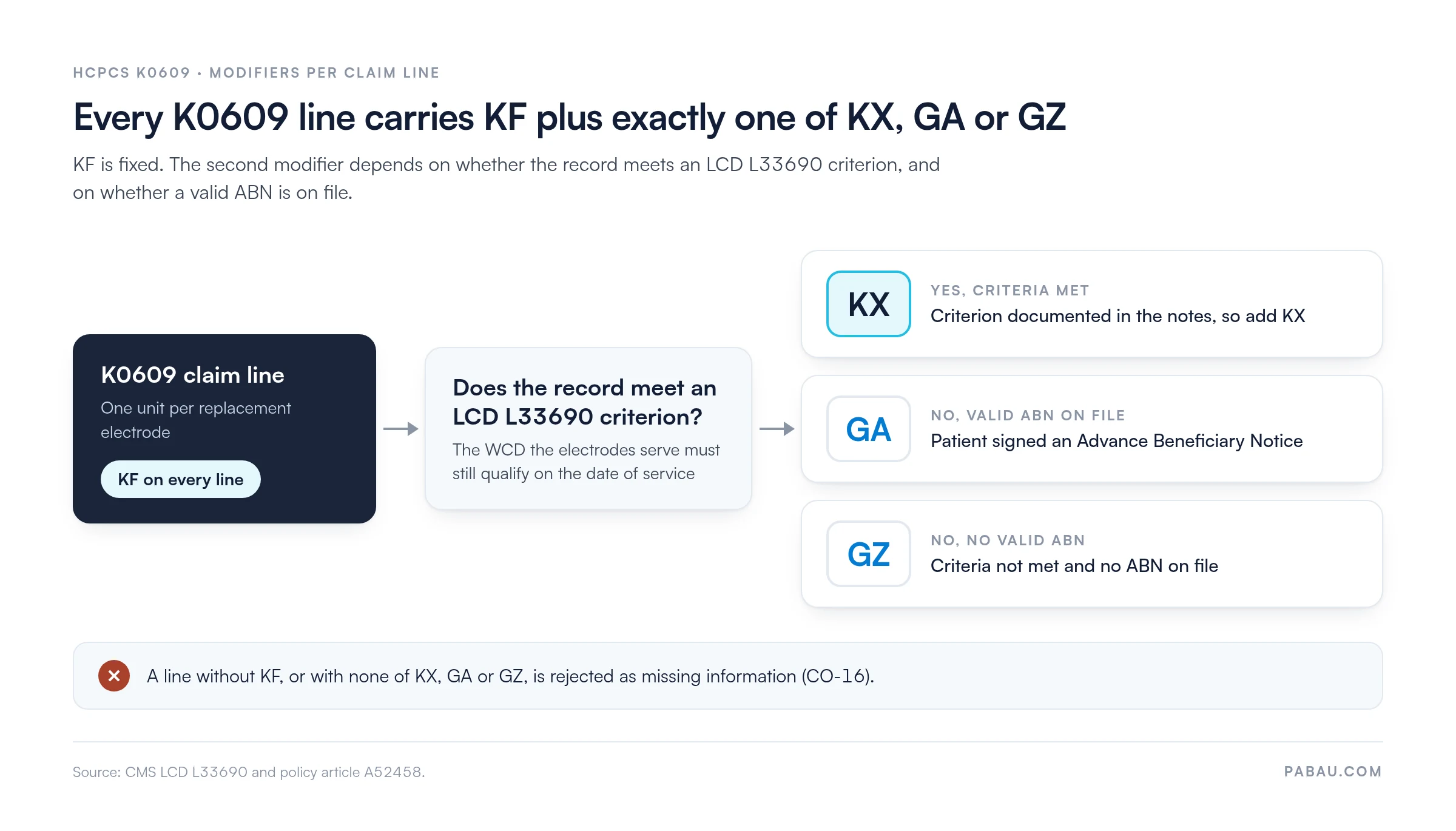
Every K0609 claim line needs the KF modifier, plus KX when coverage criteria are met, or GA or GZ when they are not.
Electrodes for a non-wearable AED (E0617) bill under A9999. The WCD battery and garment bill under K0607 and K0608.
Practice management software like Pabau keeps the order, delivery proof, and claim on one record, so an audit request is answered from one place.
HCPCS code K0609 describes replacement electrodes for a garment-type automated external defibrillator. That device is better known as a wearable cardioverter defibrillator (WCD). K0609 has carried this descriptor since July 1, 2003, and sits in the K0606 to K0609 range for wearable defibrillators and their supplies.
The table below summarizes the code’s key attributes, drawn from the CMS HCPCS Level II code set and CMS policy article A52458.
A WCD is a vest-style garment worn against the skin and connected to a battery-powered monitor. Electrodes in the garment read the heart rhythm continuously. They also deliver a shock if a life-threatening arrhythmia appears. K0609 is how a supplier bills a fresh set of those electrodes.
K0609 applies in these situations:
K0609 does not apply in these situations:
K0609 has no coverage criteria of its own. Replacement electrodes are covered when the WCD they serve is covered. That makes the K0606 criteria in LCD L33690, Automatic External Defibrillators, the test for every electrode claim.
The LCD covers a wearable defibrillator when the patient meets one of four criteria:
Ejection fraction must be measured by angiography, radionuclide scanning, or echocardiography. The LCD also expects the treating practitioner to be experienced in managing patients at risk of sudden cardiac death.
Policy article A52458 lists the diagnoses that support K0606 through K0609 in one shared group. The codes below come from that list. A listed code is not enough by itself, so the record must still meet an LCD criterion.
The list changes with each fiscal year revision, so check the current article before you bill. Run insurance eligibility verification before dispensing to confirm Part B coverage and any secondary payer.
Medicare does not use a Certificate of Medical Necessity for K0609. Instead, the record has to show three facts. The WCD is still covered, the electrodes were ordered, and they reached the patient.
Applying sound medical billing compliance at intake means collecting these documents before the electrodes ship. Chasing them after a denial takes far longer.
Pair every K0609 claim with the WCD claim it supports. Before you bill electrodes, confirm the K0606 record still shows a qualifying criterion. If the patient has stopped wearing the WCD or received an implantable defibrillator, the electrode claim loses its basis.
K0609 is billed on the CMS-1500 claim form, or the 837P electronic claim, to the DME MAC for the patient’s permanent address. Use the DMEPOS supplier’s NPI and the place of service where the patient uses the device.
Review a clean claim submission checklist before filing. It catches the formatting errors that reject a claim before adjudication.
A K0609 line therefore carries two modifiers: KF plus one of KX, GA or GZ. A52458 rejects a line that carries none of those three as missing information. Choosing the second modifier comes down to two questions, about the L33690 criteria and the ABN.
Pabau’s claims management software tracks modifier selection and claim status. Your billing team sees every outstanding K0609 claim in one view.
K0609 is one of four codes in the K0606 to K0609 range. A52458 codes every WCD replacement supply inside that range, so the right code depends on which component was replaced.
Never re-bill K0606 for a replacement supply, and never bill K0608 when only the electrodes were replaced. K0609 is also sometimes mistaken for an infusion pump code. It covers WCD electrodes only, and external insulin pumps bill under E0784.
K0609 denials follow a short list of predictable errors. The common denial codes in medical billing reference explains how CARCs work. The table below maps the codes most likely on an electrode claim.
A denial management workflow tracks each returned claim’s CARC and fixes the root cause before resubmission. Resubmitting without that fix produces a second denial on the same claim.
Audit K0609 units against delivery records every month. Electrodes bill per unit, so compare the units on each claim with the count on the signed delivery receipt. A mismatch is cheaper to fix before a DME MAC review finds it.
Medicare Advantage plans, Medicaid programs, and commercial payers set their own rules for WCD supplies. Many follow the Medicare criteria, but prior authorization, unit limits, and modifier rules vary by plan.
Before billing a non-Medicare payer for replacement electrodes, check three things:
The Medicare Required Prior Authorization List changes over time, so check it before dispensing as well. Good revenue cycle management puts these checks in the intake workflow, before the claim exists.
A K0609 claim depends on records that usually sit apart. The cardiologist’s notes hold the ejection fraction, and the supplier holds the order and delivery receipt. The billing team holds the modifiers. When a DME MAC asks for the file, someone has to rebuild it.
Pabau keeps the order, the qualifying diagnosis, the delivery record, and the claim on one patient record. Its claims management software flags a missing modifier before the claim goes out.
The result is an electrode claim that agrees with the record behind it. Every Pabau subscription includes the full feature set, so documentation, billing, and reporting stay in one system.

Pabau tracks orders, delivery records, modifier selection, and denial codes across your DMEPOS claims, so your billing team resolves K0609 rejections faster.

HCPCS code K0609 is narrow by design. It covers replacement electrodes for a wearable defibrillator, one unit per electrode, and no other part of the AED range. Most K0609 denials come from one of three errors. The KF modifier is missing, the WCD no longer meets LCD L33690, or the electrodes went out under the wrong code.
Check all three before the claim exists, and the electrode line pays alongside the device it supports. Pabau’s medical billing tools keep the order, the coverage evidence, and the claim on one record. To see how that works for DMEPOS billing, book a demo.

Need a framework for reducing claim rejections? Clean claim submission guidelines walks through the formatting and coding requirements that determine whether a claim adjudicates or returns on first pass.
Confused about denial appeal timelines? Denial management in healthcare covers CARC-based workflows and how to prioritize which returned claims to appeal first.
Building a compliance review process? Medical billing compliance outlines the documentation controls and audit triggers that apply across DMEPOS, DME MAC, and commercial payer submissions.
HCPCS code K0609 covers replacement electrodes for a garment-type automated external defibrillator, also called a wearable cardioverter defibrillator (WCD). A DMEPOS supplier bills it per electrode. Electrodes for a non-wearable AED do not use K0609 and bill under A9999 instead.
No. K0609 has described replacement electrodes for a wearable defibrillator since July 1, 2003. External ambulatory insulin pumps bill under E0784, which Medicare covers under its own external infusion pump policy.
Yes, when the WCD it supports is covered. The patient must meet one of the four criteria in LCD L33690, such as an ejection fraction of 0.35 or less after a prior MI. The diagnosis must also appear in policy article A52458.
Every K0609 claim line needs the KF modifier, because CMS classes the item as an FDA Class III device. Add KX when all LCD coverage criteria are met. Otherwise, use GA with a valid ABN, or GZ without one.
K0609 is billed per electrode, so each electrode supplied is one unit. Policy article A52458 sets no fixed replacement quantity. The record should explain why the electrodes were replaced and match the units billed.
K0606 is the complete wearable defibrillator. K0607 is a replacement battery, K0608 a replacement garment, and K0609 replacement electrodes. Bill each component under its own code, and never re-bill K0606 for a replacement supply.
You need a Standard Written Order received before the claim is submitted, plus notes showing the patient meets an LCD L33690 criterion. Add an ICD-10-CM code from A52458, a note on why the electrodes were replaced, and signed proof of delivery.