CCSD code H4430: Examination of rectum under anaesthetic
CCSD code H4430 pays for the examination alone CCSD code H4430 is the UK private...

Last Updated: Oct 20, 2026
K0608 is the HCPCS Level II code for replacement garment for use with automated external defibrillator, each.
Two modifiers decide whether the claim pays. KF attests that the wearable cardioverter defibrillator is an FDA Class III device. KX attests that coverage criteria are met and the documentation is on file. Leave either one off and the claim comes back unpaid.
Let Pabau's smart automation suggest the right codes, reduce claim denials, and keep your practice compliant—effortlessly.
Automate repetitive tasks and focus on what matters most—your patients.
Reduce coding errors and ensure compliance with the latest regulations.
Clean claims, fewer denials, and faster reimbursements.
Powerful insights and reporting to help your practice thrive.
HIPAA compliant SOC 2 certified GDPR-compliant Trusted by 4,000+ clinics worldwide

HCPCS code K0608 is the replacement garment for use with an automated external defibrillator, billed as one unit per garment.
Every K0608 claim needs the KF modifier, because the wearable defibrillator is an FDA Class III device.
KX goes on the claim line when coverage criteria under CMS Policy Article A52458 are met and documented.
K0608 is one of four wearable defibrillator codes, and picking the wrong one is a leading cause of denial.
Practice management software like Pabau tracks modifier requirements, supporting diagnoses, and claim status across payers.
K0608 sits in the K-series of HCPCS Level II, the code set CMS uses for durable medical equipment, prosthetics, orthotics, and supplies (DMEPOS). An enrolled DMEPOS supplier bills it on a CMS-1500 claim form.
The “each” unit descriptor matters. Two garments on one claim means two units, and each unit needs its own justification in the record.
Billers meet K0608 when a patient on a wearable cardioverter defibrillator (WCD) needs a fresh garment. The garment is the vest-like component holding the electrodes against the skin. It degrades with daily use and perspiration, so periodic replacement is clinically necessary.
The replacement garment is the textile vest that holds a wearable cardioverter defibrillator’s electrodes against the patient’s skin. The device itself is not implanted. It monitors cardiac rhythm continuously and delivers a shock if a life-threatening arrhythmia appears.
A WCD is usually prescribed as bridge therapy. Candidates have survived a sudden cardiac event, have a newly reduced ejection fraction, or are awaiting an implantable cardioverter-defibrillator (ICD). ZOLL Medical’s LifeVest is the WCD most US suppliers will handle.
Patients wear the garment against bare skin around the clock, including during physical activity. It absorbs sweat and takes mechanical stress. Regular replacement preserves electrode contact quality, which is what makes it clinically necessary rather than cosmetic. That distinction is what a payer questioning replacement frequency is really asking about.
Coverage for K0608 is governed by CMS Policy Article A52458, which sets the medical necessity and documentation requirements for the WCD codes. Check that your DME MAC’s Local Coverage Determination (LCD) is current before you submit, because MAC rules can narrow the national policy.
Per CMS policy, Medicare Part B covers K0608 when these conditions are satisfied:
Prior authorization requirements vary by DME MAC jurisdiction. Check with your MAC, either Noridian or CGS Administrators depending on the region, before you submit the first claim.
Per CMS Policy Article A52458, the ICD-10-CM diagnosis codes below support medical necessity for K0608. The table covers the diagnoses that come up most often. Consult the controlling policy article for the full list, which is updated with each fiscal year revision.
Verify the specific ICD-10-CM code against the current policy article before billing. A code that does not appear on the CMS-approved list draws a denial for unsupported medical necessity, whatever the patient’s clinical picture. Build that crosswalk check into order entry rather than into billing.
Missing or incomplete documentation is the most common reason K0608 claims are denied on post-payment audit. Confirm every element below is in the patient record and available for MAC review before you submit.
Organized document management at the practice level keeps these records audit-ready. Track which items have arrived, which are outstanding, and which orders are close to expiring. Capturing every required element at the point of order fulfillment costs far less than reconstructing it during an audit.
Medicare reimbursement for K0608 follows the DMEPOS fee schedule rather than the Physician Fee Schedule. Rates are set nationally and adjusted for geographic cost differences using a DMEPOS locality multiplier.
Verify current rates in the CMS DMEPOS fee schedule before billing, because they are updated annually and vary by jurisdiction.
Third-party rate aggregators often lag official CMS updates. Use the CMS DMEPOS fee schedule as the authoritative figure before you bill or quote a patient on out-of-pocket cost.
Check your DME MAC jurisdiction’s fee schedule locality file before billing K0608. Reimbursement rates differ between Noridian (Jurisdictions A and D) and CGS Administrators (Jurisdictions B and C). Using the wrong locality rate inflates your expected payment and creates problems when you reconcile remittance advice.
K0608 is billed on a CMS-1500 claim form by an enrolled DMEPOS supplier. The sequence is fixed. The order comes in, the garment is delivered, the documentation is confirmed, and the claim goes out.
Six modifiers come up on K0608 claims. Two of them belong on every line, and the rest depend on what the record supports.
KF and KX carry the most weight. A claim without KF is rejected for missing information, and a claim without KX, where criteria are met, is denied outright. The chart below shows how the two fixed modifiers combine with the one that varies.
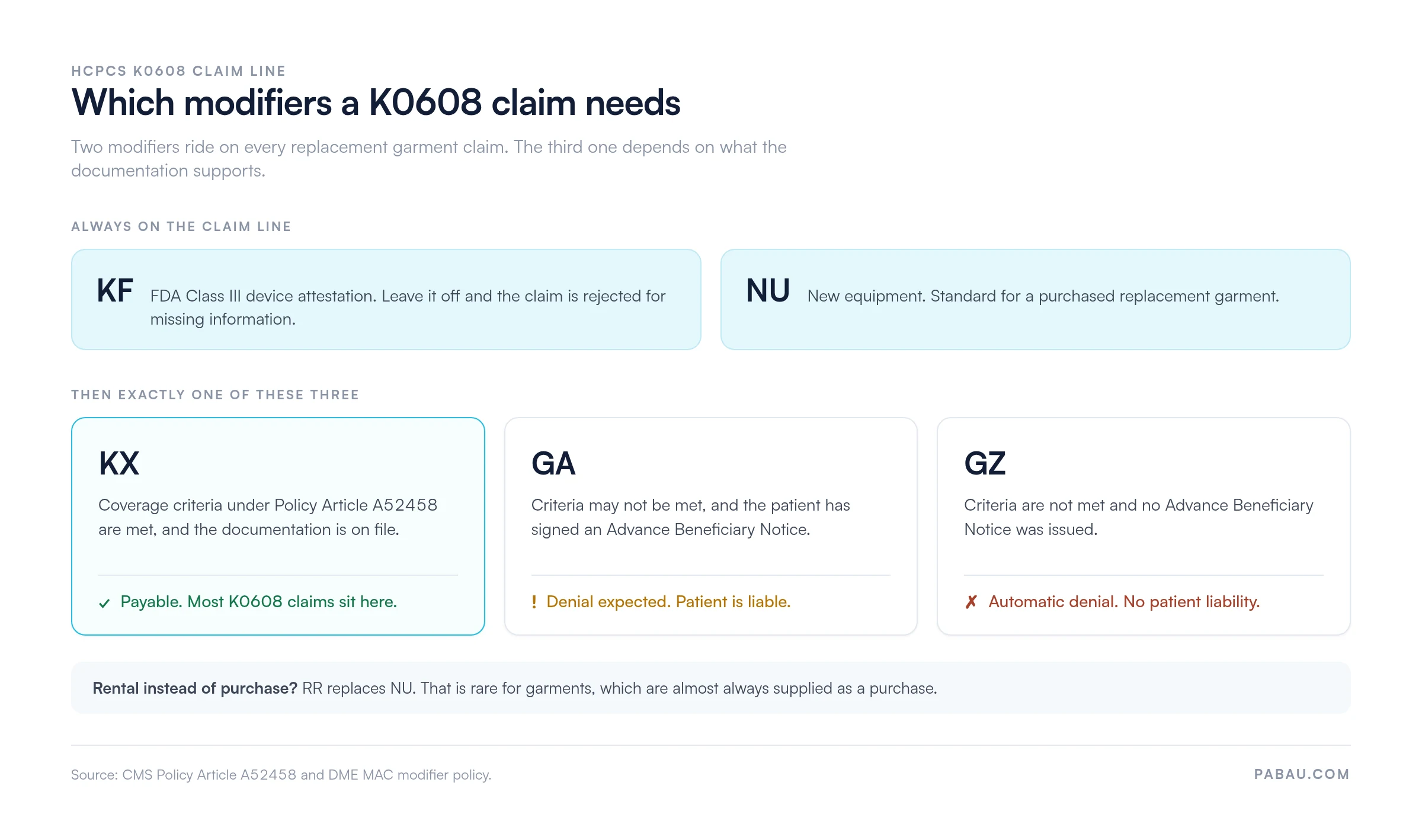
Check current AAPC HCPCS code guidance for modifier updates issued with the annual HCPCS revision cycle.
All four WCD codes sit together in CMS Policy Article A52458, and each covers a distinct component. Picking the wrong one is a significant source of denials and overpayment liability. The table below shows when each applies.
The common upcoding error is billing K0606, the complete device, when only a garment was supplied. That exposes the supplier to overpayment recovery. The mirror error is billing K0608 when electrodes were replaced, which belongs under K0609.
Accurate selection at order entry prevents both. If you are billing the base device rather than a supply, K0606 is the code that applies.
K0608 denials follow predictable patterns. Knowing them in advance is worth more than any appeal you file afterwards. These are the errors DME billing teams hit most often.
Tracking denial reason codes shows which error type dominates your K0608 rejections. When the denials cluster around one reason, the fix is structural. Update the order intake workflow rather than reworking claims one at a time.
Set a calendar reminder 30 days before each patient’s expected WCD discontinuation date. Confirm whether the device and garment supply are still covered under the original SWO, or whether a renewal order is needed. Lapsed orders are a common cause of K0608 denials that surface weeks after the garment was delivered.
A single K0608 claim’s evidence often lives in three places. The order sits in a shared drive, the delivery receipt in a folder, and the modifier rules in someone’s head. When a MAC asks for the record, somebody spends an afternoon assembling it.
Practice management software like Pabau keeps the order, the supporting diagnosis, the delivery confirmation, and the claim on one client record. Our claims software for suppliers flags a missing modifier or an unsupported diagnosis before the claim goes out. You find out at submission, not from a remittance advice three weeks later.
The payoff is the audit you do not have to prepare for. Order dates, delivery signatures, and modifier history stay attached to the patient, so answering a MAC request takes minutes instead of an afternoon.

Pabau’s claims management tools help DME suppliers track modifier requirements, supporting diagnoses, and claim status across payers. Every K0608 submission goes out complete the first time.

K0608 is a narrow code with a short list of ways to get it wrong. Nearly all of them are settled at order entry, not at submission. If the SWO is dated correctly and the diagnosis sits on the A52458 list, KF and KX are the only decisions left.
The trade-off worth remembering is timing. Front-loading those checks costs a few minutes per order, and skipping them costs a denial you appeal weeks later. Book a demo to see how Pabau keeps DME claim documentation together from order to payment.

Want the wider view of the claim’s path? Revenue cycle management covers the process from order to payment, and where DME billing fits into it.
Working a denied K0608 claim? Denial management in healthcare explains how to categorize reason codes, prioritize appeals, and stop repeat denials.
Checking Medicare coverage before you dispense? Insurance eligibility verification walks through the checks that keep a claim from failing at the enrollment level.
Preparing for a post-payment audit? Medical billing compliance sets out the record-keeping habits that hold up when a MAC asks for documentation.
K0608 bills a replacement garment for a wearable cardioverter defibrillator, one unit per garment. It is a HCPCS Level II code for durable medical equipment. Medicare Part B covers it under the DMEPOS benefit when the criteria in CMS Policy Article A52458 are met.
Required documentation includes a Standard Written Order dated before delivery, clinical notes supporting the ICD-10-CM diagnosis, and a signed proof of delivery. CMS discontinued the Certificate of Medical Necessity for dates of service on or after January 1, 2023. Apply the KF modifier on every claim, plus KX when all coverage criteria are documented.
K0606 covers the complete wearable cardioverter defibrillator. K0607 covers replacement batteries, K0608 covers the replacement garment, and K0609 covers replacement electrodes. Each code covers a discrete item, so they are never interchangeable or bundled for the same component.
Yes. K0608 is covered under Medicare Part B through the DMEPOS benefit when the patient meets the coverage criteria in CMS Policy Article A52458. The supplier must be enrolled with the patient’s DME MAC jurisdiction. The claim carries KF for the Class III device, plus KX to attest that criteria are met.
Supporting diagnoses include dilated cardiomyopathy (I42.0), ventricular tachycardia (I47.2), ventricular fibrillation (I49.01), and cardiac arrest (I46.9). CMS Policy Article A52458 carries the full list. Check it each year, because the diagnosis list moves with the annual ICD-10-CM revision.
The 2026 Medicare rate for K0608 follows the DMEPOS fee schedule and varies by geographic locality. Look up the current national allowed amount in the CMS DMEPOS fee schedule. Rates change each January 1, and third-party aggregators often lag the official CMS publication.