HCPCS code L2108: Custom tibial fracture orthosis billing guide
HCPCS code L2108: Definition and official descriptor HCPCS code L2108 is the Lev...

Last Updated: Oct 21, 2026
K0607 is the HCPCS Level II code for replacement battery for automated external defibrillator, garment type only, each.
Medicare pays it only for beneficiaries who meet the cardiac criteria in CMS Policy Article A52458, and only when an enrolled DMEPOS supplier bills it. Overall, this reference covers the code details, coverage criteria, 2026 fee schedule guidance, documentation, modifiers, and the denial patterns behind most K0607 rejections.
Let Pabau's smart automation suggest the right codes, reduce claim denials, and keep your practice compliant—effortlessly.
Automate repetitive tasks and focus on what matters most—your patients.
Reduce coding errors and ensure compliance with the latest regulations.
Clean claims, fewer denials, and faster reimbursements.
Powerful insights and reporting to help your practice thrive.
HIPAA compliant SOC 2 certified GDPR-compliant Trusted by 4,000+ clinics worldwide

Specifically, HCPCS Code K0607 covers a replacement battery for a garment-type automated external defibrillator, billed as one unit under HCPCS Level II
Notably, the garment-type qualifier matters, because K0607 is the battery for a wearable defibrillator vest rather than a wall-mounted public-access AED
In addition, Medicare coverage follows CMS Policy Article A52458, which limits payment to beneficiaries who survived ventricular fibrillation arrest or face high arrhythmia risk
Additionally, every K0607 line needs modifier KF for the FDA Class III device, plus KX to affirm that medical necessity documentation is on file
As a result, Pabau’s claims management software keeps patient records and claim status in one place, so DME billing teams can track each submission
HCPCS Code K0607 describes a replacement battery for an automated external defibrillator, garment type only, billed per unit. Specifically, it sits in the K-codes section of HCPCS Level II. The Centers for Medicare and Medicaid Services (CMS) maintains that classification for durable medical equipment and supplies. Additionally, the garment-type AED range occupies a narrow band of the wider HCPCS Level II codes set, which CMS revises each year.
K-codes cover DME items and supplies that do not fit the other HCPCS sections. Notably, only Medicare-enrolled DMEPOS suppliers may bill K0607 to Medicare. Consequently, a clinical provider who is not separately enrolled as a DMEPOS supplier cannot submit this code for reimbursement.
CMS Policy Article A52458 governs coverage for HCPCS Code K0607 and covers the full garment-type AED supply range from K0606 through K0609. Specifically, Medicare Part B pays for a replacement battery only where the beneficiary meets one of two cardiac criteria.
Screening the patient record for that cardiac history before accepting the order is the cheapest control available on this code. Additionally, Medicaid coverage for K0607 varies by state, so confirm the rules with the relevant state program before billing. Indeed, criteria and reimbursement differ widely across jurisdictions.
Incomplete documentation is the fastest path to a K0607 denial. Specifically, DME MAC auditors look first for the physician order and the medical necessity narrative. Therefore, the documents below must be in the supplier’s file before the supplier submits the claim.
Keep all records for a minimum of seven years from the date of service. Indeed, DME MAC post-payment audits often request documentation years after Medicare pays a claim, and a missing record at that stage means recoupment.
CMS updates Medicare payment rates for HCPCS Code K0607 annually as part of the DMEPOS fee schedule. Specifically, reimbursement is the lower of the supplier’s submitted charge or the applicable fee schedule amount, adjusted by geographic locality. Therefore, check the CMS DMEPOS fee schedule for the 2026 rate in your MAC jurisdiction before billing.
Medicare prices K0607 as a DME supply, so its rate reflects the purchase price of the item rather than work and practice expense RVUs. Consequently, the Physician Fee Schedule lookup tool does not price DME supply codes. In fact, searching there is one of the more common reasons a biller quotes the wrong expected payment.
Electronic remittance advice files, received after adjudication, show how the DME MAC applied that rate. Specifically, reading the adjustment codes on a K0607 remittance identifies short-pays tied to geographic locality or pricing indicators.
Run a quarterly audit of your DME fee schedule amounts against your claims management system’s reimbursement expectations. Specifically, DMEPOS rates change each January, and stale fee schedule data in your billing platform leaves underpayment alerts undetected until a payment variance review.
Modifiers decide how the DME MAC adjudicates a K0607 claim. Indeed, one missing pair of characters turns a payable line into a rejection. For reference, the AAPC HCPCS code reference lists the approved modifier set, and the coverage implications below are what a billing team needs before submission.
Every K0607 line carries KF. Specifically, A52458 treats the AED supply range as a group of FDA Class III devices. Consequently, the DME MAC rejects a line submitted without KF as missing information rather than denying it on the merits. KX, meanwhile, affirms that the medical necessity documentation is on file. In short, the two do different jobs, and one never substitutes for the other.
Only one liability modifier belongs on a line. Specifically, the chart below maps the file you are holding to the modifier that follows from it.
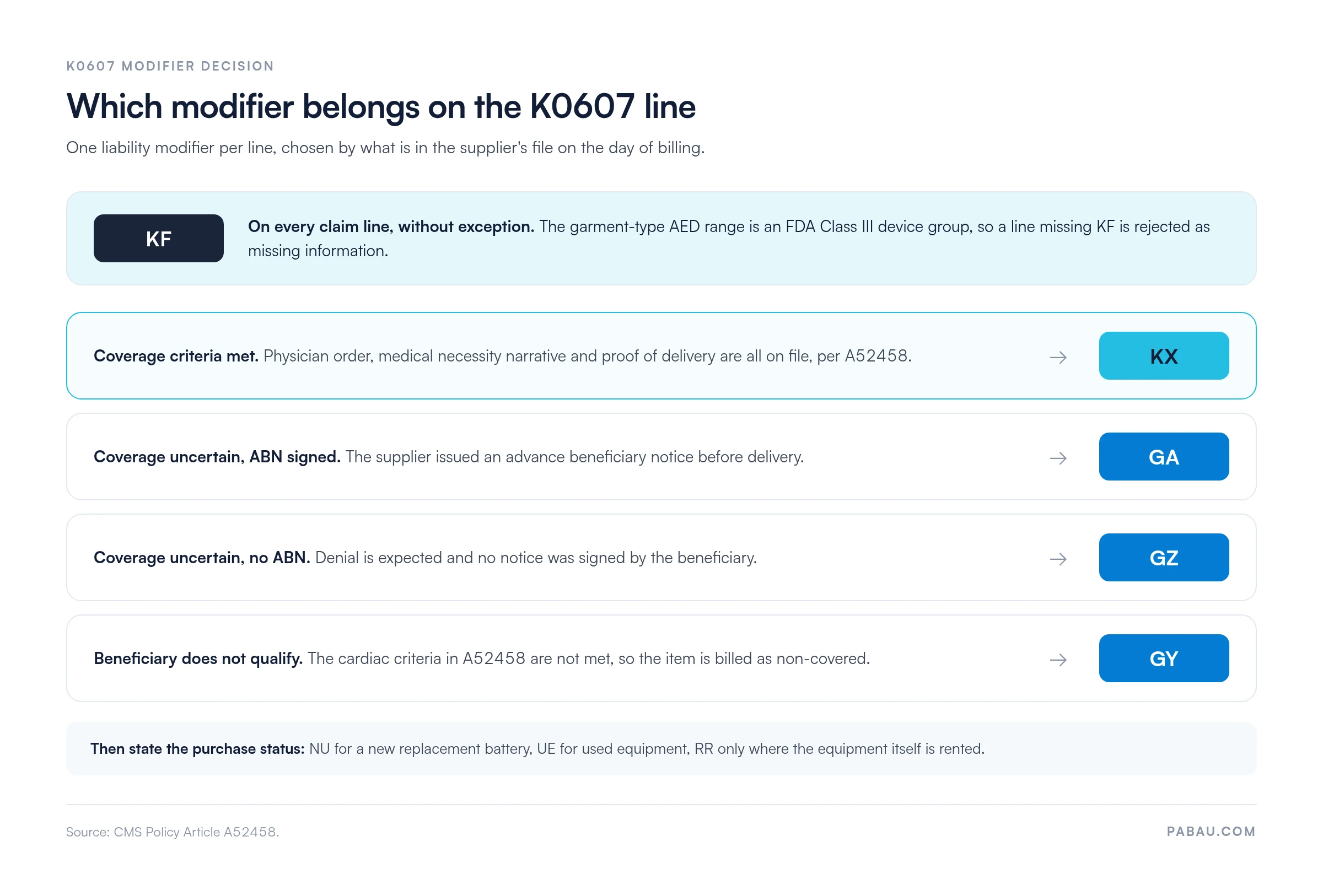
Verify the modifier set with your specific DME MAC before you build it into a claim scrubber rule. After all, local coverage determinations can add requirements beyond the national policy.
Clean K0607 claim submission follows a predictable sequence. Otherwise, a step skipped at delivery becomes a documentation failure at DME MAC review, often months after the DME MAC pays the claim.
First-pass acceptance shortens the cycle from delivery to payment and removes the administrative cost of an appeal. Overall, that is easier to sustain when claims management software holds the order, the delivery proof, and the claim status against one patient record.
K0607 denial rates run high for a single-unit supply code, because the coverage criteria are narrow and every claim needs affirmative documentation. Specifically, the table below reflects the failure patterns that denial management teams report most often on DME accounts.
Build a K0607 pre-submission checklist into your billing workflow. Confirm the physician order is signed and dated, and that the medical necessity narrative names the A52458 criteria. Then check the delivery confirmation is on file and both KF and KX sit on the line. Overall, four checkpoints clear the most common denial categories for this code.
HCPCS Code K0607 sits inside the four-code garment-type range, K0606 through K0609. Specifically, CMS Policy Article A52458 governs all four, alongside E0617 for the non-garment automated external defibrillator. Indeed, each code in the K0606 to K0609 group describes a different part of the same wearable system. Overall, the table below shows what each one actually covers.
Billers commonly swap two of these codes in practice. Specifically, K0608 is the garment, and K0609 covers the electrodes that sit inside it. Nonetheless, all four codes carry the same coverage criteria and the same KF requirement, whichever supply item the supplier bills.
In most DME operations, the pieces of a K0607 claim live in different places. For example, the physician order arrives by fax, and the medical necessity narrative sits in the referring practice’s notes. Meanwhile, someone scans the signed delivery receipt into a shared drive. So, when the DME MAC asks for the file two years later, someone rebuilds it by hand.
Practice management software like Pabau keeps the patient record, the uploaded documents, and the claim status against one profile. As a result, billing staff can see what the supplier ordered, what it delivered, and where the claim sits without leaving that record. Pabau’s claims management tools run pre-submission field checks, then submit and track the claim from the same place.
The outcome is a shorter path from a denial notice to the document that answers it. In short, an audit request stops being a search across three systems and becomes a look at one patient record.

Pabau’s claims management software keeps patient records, documents, and claim status in one place. DME billing teams can submit and track each claim from the record it came from.

The garment-type qualifier decides most K0607 questions. Specifically, the code belongs to a wearable defibrillator vest, not a wall-mounted public-access AED. Once billers settle that, the coverage criteria, the sibling codes, and the modifier set all follow from it.
Three checkpoints are worth building into the workflow. Specifically, put KF on every line, back KX with a narrative naming the A52458 criteria, and date every physician order before delivery. As a result, suppliers who hold those three rarely see a first-pass rejection on this code.
The harder part is keeping the file together for an audit that arrives long after payment. Overall, Book a demo to see how Pabau holds K0607 orders, delivery proof, and claim status against one patient record.

Need to understand how denial codes affect your DME revenue? Denial codes in medical billing explains the most common CARC and RARC codes and how to respond to each.
Want a cleaner claims workflow from intake to remittance? Revenue cycle management fundamentals covers the end-to-end process for DME and clinical billing teams.
Preparing superbills for patients with secondary insurance? Superbill documentation guide walks through what must appear on a compliant itemized billing statement.
HCPCS Code K0607 is a replacement battery for an automated external defibrillator, garment type only, billed as a single unit. Specifically, it covers the battery for a wearable defibrillator vest, not a wall-mounted public-access AED. In addition, the device itself is K0606, the replacement garment is K0608, and the replacement electrodes are K0609. Medicare pays K0607 only for beneficiaries who meet the cardiac criteria in CMS Policy Article A52458.
The Medicare reimbursement rate for K0607 varies by geographic locality, and CMS updates it annually through the DMEPOS fee schedule. Indeed, there is no single national rate, because rates differ across DME MAC jurisdictions based on CMS locality adjustments. Therefore, use the CMS DMEPOS fee schedule, published each calendar year, to find the rate that applies to your billing area for 2026. Notably, the Physician Fee Schedule lookup tool does not price DME supply codes.
To bill K0607 to Medicare, the supplier must retain a signed physician order that predates delivery. In addition, the file needs a physician narrative establishing medical necessity per A52458, face-to-face clinical notes on the patient’s cardiac history, and a signed delivery confirmation. The supplier must also issue an advance beneficiary notice if they believe Medicare may not cover the claim. Overall, all records must be available for audit on request.
Medicaid coverage for K0607 varies by state. By comparison, CMS Policy Article A52458 governs Medicare coverage nationally. Specifically, each state Medicaid program sets its own coverage criteria, prior authorization requirements, and reimbursement rates for DME supply codes. Therefore, verify K0607 coverage with the specific state program before submitting claims. Additionally, some states require additional documentation or impose different frequency limits.