CCSD code H4430: Examination of rectum under anaesthetic
CCSD code H4430 pays for the examination alone CCSD code H4430 is the UK private...

Last Updated: Oct 20, 2026
K0070 is the HCPCS Level II code for rear wheel assembly, complete, with pneumatic tire, spokes or molded, replacement only, each.
Almost every K0070 denial traces back to a missing KX attestation or a mislabeled tire type.
K0070 sits in the K-series of HCPCS Level II codes, which CMS reserves for wheelchair and mobility equipment accessories. It is billed per unit, so replacing both rear wheels means two units of K0070 on separate claim lines.
Before the code is selected, confirm that the part being replaced is a pneumatic assembly rather than a solid or foam-insert tire. That single distinction decides whether K0070 or an adjacent code applies.
Let Pabau's smart automation suggest the right codes, reduce claim denials, and keep your practice compliant—effortlessly.
Automate repetitive tasks and focus on what matters most—your patients.
Reduce coding errors and ensure compliance with the latest regulations.
Clean claims, fewer denials, and faster reimbursements.
Powerful insights and reporting to help your practice thrive.
HIPAA compliant SOC 2 certified GDPR-compliant Trusted by 4,000+ clinics worldwide

HCPCS Code K0070 covers a rear wheel assembly, complete, with a pneumatic tire, any size, billed per unit.
Medicare coverage requires a face-to-face examination, a written order from the treating practitioner, and documented medical necessity under CMS Policy Article A52504.
The KX modifier is required once coverage criteria are met, and a missing KX is the leading cause of K0070 denials.
K0071 is a front caster assembly rather than a rear wheel, so it never stands in for K0070.
Practice management software like Pabau holds the exam record, the signed order, and the claim in one system.
CMS Policy Article A52504 governs Medicare coverage for wheelchair options and accessories, including K0070. Coverage is not automatic. The beneficiary’s clinical situation must meet defined criteria, and the claim must reflect that medical necessity at the time of service.
Build coverage verification into the intake process, before the equipment ships. A K0070 claim submitted without meeting the criteria below will deny on medical necessity grounds.
Coverage requirements under CMS Policy Article A52504:
Medicare does not cover K0070 as a routine maintenance item billed at fixed intervals. The need for replacement must be clinically justified in the record, typically citing wear, damage, or structural failure that affects the patient’s safe mobility.
Missing or incomplete documentation is the second most common reason K0070 claims deny, after modifier errors. CMS and the DME MACs require specific records to support every claim, and each one has to be retrievable at audit.
In practice management software like Pabau, digital intake forms let treating practitioners record face-to-face exam findings, mobility assessments, and written orders in one place. The supplier’s billing team then works from a single audit trail when it prepares the claim.
Four modifiers apply to K0070 claims. Selecting the wrong one is the leading denial trigger for this code. Each modifier signals a different transaction type to the payer, and Medicare treats them as mutually exclusive on a given claim line.
The KX modifier must accompany NU, UE, or RR on every Medicare claim for K0070. It is not a standalone modifier, so it stacks with the transaction-type modifier. A claim submitted as K0070 NU without KX will deny for missing attestation. A claim submitted as K0070 KX alone will deny for missing transaction type.
Five combinations account for nearly every K0070 line a DME supplier submits, and three of them pay.
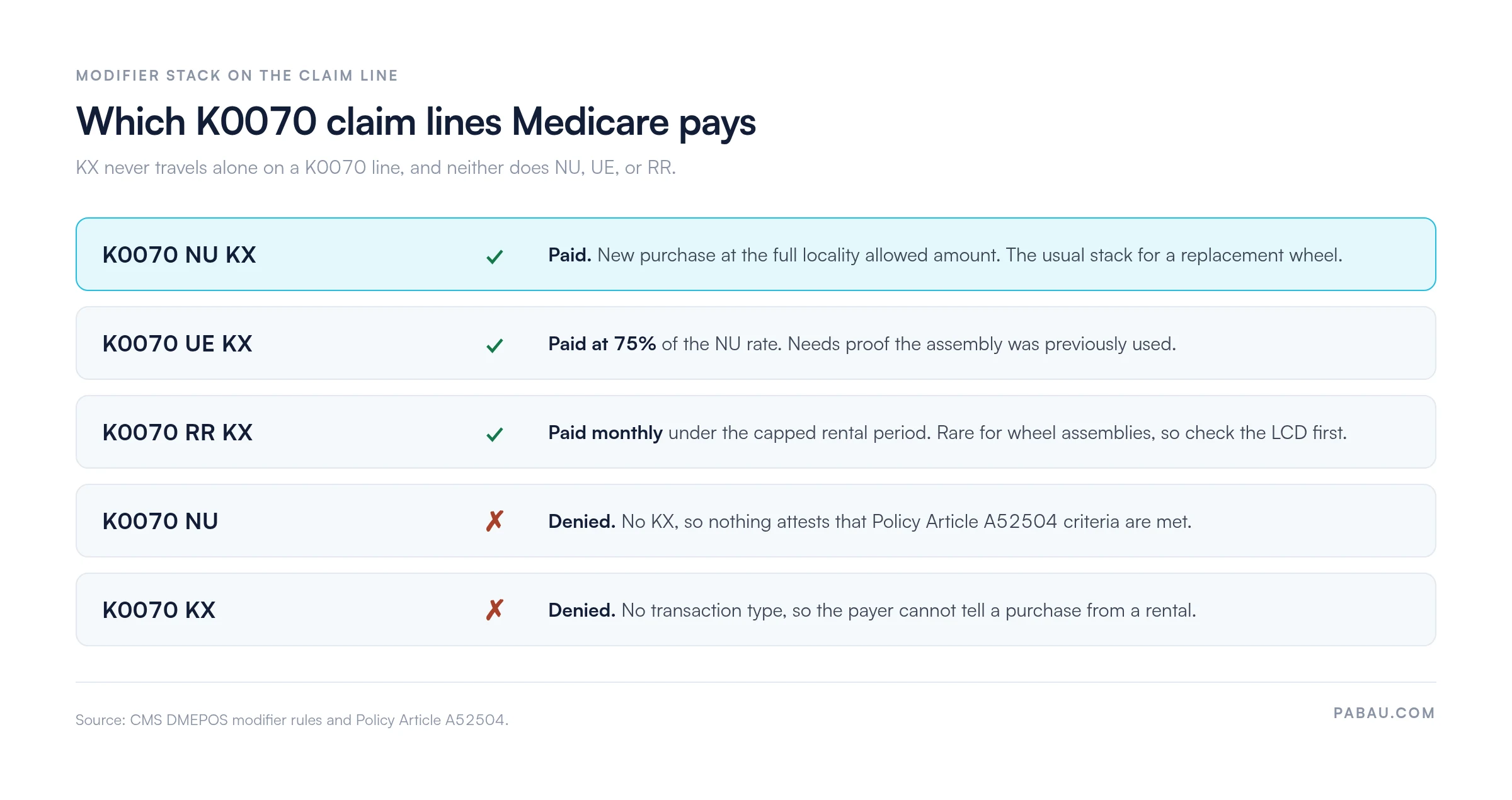
Verify that the documentation in the supplier’s file supports the KX modifier before submission. Clean claim submission for DME codes depends on the modifier set being complete and defensible at audit.
Check your modifier stack before every K0070 submission: the claim line needs both the transaction type (NU, UE, or RR) and KX together. Run a pre-submission audit on any K0070 claim missing KX. Carriers reject missing-modifier claims on first-pass edits, not during medical review, so the fix is administrative, not clinical.
K0070 is reimbursed under the DMEPOS fee schedule administered by CMS. Rates vary by locality and by modifier type. Always verify current rates through the CMS DMEPOS fee schedule for your billing locality before submission.
Geographic variation is built into the schedule. Four DME MAC jurisdictions administer the locality-based rates. Noridian Healthcare Solutions runs Jurisdictions A and D, and CGS Administrators runs Jurisdictions B and C for the rest of the country. Your billing locality sets the allowed amount, not your supplier’s head office.
PDAC, the Pricing, Data Analysis and Coding contractor operated by Palmetto GBA, works nationally on coding verification and product classification. It does not publish a regional fee schedule, so never treat a PDAC decision as a rate.
Rates are updated annually under the DMEPOS fee schedule rule published in the Federal Register. Download the current-year file from CMS and filter it by K0070 and your jurisdiction before you set an expected reimbursement.
The order of these steps matters. Skipping step 2 or step 3 produces the downstream denial that costs a billing team the most rework time.
Track K0070 outcomes alongside the other wheelchair accessory codes you bill. Reading the denial codes on each remittance surfaces patterns, such as a prescriber whose notes never support the KX attestation.
K0069, K0070, and K0071 are neighboring HCPCS codes that suppliers mix up, but they do not describe one series of rear wheels. K0069 and K0070 are both rear wheel assemblies, separated by tire type. K0071 describes a front caster assembly, the smaller wheel at the front of the chair.
The prescribing practitioner’s order should name the part and the tire type. If it says only “wheel assembly”, contact the prescriber before delivery. Ask whether the part is a rear wheel or a front caster, and whether the tire is pneumatic or solid.
Billing K0070 from an ambiguous order creates audit exposure. Per the AAPC HCPCS code reference, Medicare treats K0069, K0070, and K0071 as materially different items rather than interchangeable descriptions of one product.
Four errors generate most of the K0070 rework across DME suppliers. Each one has a fix that sits in the billing workflow rather than in the appeal.
Build a K0070-specific denial dashboard in your billing system. Filter all K0070 remittance lines by CARC code monthly. CARC 50 (non-covered service) signals a medical necessity issue; CARC 4 (service inconsistent with modifier) signals a modifier stack problem. Separating these two denial types tells you whether the fix is clinical documentation or claim editing, not a blanket appeal process.
In most DME operations the K0070 evidence lives in three places. The face-to-face exam sits with the prescribing practice. The signed order sits in a scanned folder or an inbox, and the delivery confirmation travels with the driver’s paperwork. The biller assembles it after the claim has already denied.
Pabau is practice management software that keeps the clinical record and the billing record in one system. Exam notes, mobility assessments, and signed orders are captured on digital forms and attached to the patient’s file.
Delivery confirmations and order dates stay on the same timeline, so the KX attestation can be checked before the line is submitted rather than after.
The outcome is a shorter path from documentation to a payable claim. Billing staff stop chasing records between systems, first-pass acceptance improves, and an audit request can be answered from one place instead of four.

Pabau keeps face-to-face exam records, written orders, and DME claim documentation together. Your billing team has what it needs at submission, without chasing records across separate systems.

K0070 is a simple code with an unforgiving submission process. The description leaves little room for interpretation, so the work that decides whether the line pays happens before anyone opens the claim form.
Treat the tire type and the KX attestation as intake decisions rather than billing decisions. Confirm the part at the point of order, and confirm the coverage criteria while the exam notes are still in front of you. Suppliers that move both checks upstream stop reworking claims that were never going to pay.
The trade-off is a slower intake in exchange for a faster payment cycle, and for DME that exchange is worth making. Book a demo to see how Pabau keeps DME documentation and claim records in step.

Need a foundation for DME billing compliance? What is medical billing explains the end-to-end process from patient intake to claim payment, including the DMEPOS supplier’s role.
Reducing denials across your DME claims portfolio? Revenue cycle management for healthcare practices covers denial prevention, appeals workflows, and KPI benchmarks for DME billing teams.
Worried about what an audit would find? Medical billing compliance sets out the records a payer expects to see and how long you have to keep them.
Stopping coverage denials before the item ships? Insurance eligibility verification walks through the checks that confirm active benefits at the point of intake.
Looking for best-in-class billing software for your practice? Best medical billing software in the US compares leading platforms by feature set, claim accuracy, and DMEPOS workflow support.
HCPCS Code K0070 is a Level II HCPCS code that describes a rear wheel assembly, complete, with pneumatic (air-filled) tire, any size, each. It is used to bill durable medical equipment claims for manual wheelchair rear wheel replacements under Medicare and other payers. It falls under the DMEPOS fee schedule administered by CMS and is governed by Policy Article A52504.
K0070 is reimbursed under the 2026 DMEPOS fee schedule at locality-specific rates set by CMS. The NU (new purchase) modifier yields the highest allowed amount, and UE (used equipment) is typically reimbursed at 75% of the NU rate. Actual rates vary by Medicare Administrative Contractor jurisdiction and geographic locality. Verify current rates through the CMS DMEPOS fee schedule before submitting claims, as rates are updated annually.
K0070 claims require two stacked modifiers. The first is a transaction type: NU for new purchase, UE for used purchase, or RR for rental. The second is KX, which attests that Medicare coverage criteria have been met. A typical Medicare claim line reads K0070 NU KX. Submitting K0070 with only one modifier, or with the wrong transaction type, is the leading cause of K0070 denials.
CMS requires a face-to-face examination by the treating practitioner documenting the beneficiary’s mobility limitation and clinical need. You also need a written order signed and dated before delivery that specifies the item or HCPCS Code K0070. The file must hold medical records supporting the diagnosis, a delivery confirmation with beneficiary signature, and evidence of DMEPOS supplier accreditation. All documents must be retained in the supplier file and available on audit request.
K0069 covers a rear wheel assembly with a solid tire, and K0070 covers a rear wheel assembly with a pneumatic tire. K0071 sits elsewhere on the chair. It describes a front caster assembly, complete, with a pneumatic tire, replacement only, each. The three codes are not interchangeable, and billing the wrong one for the delivered part creates upcoding or downcoding exposure. The practitioner’s order should name the part and the tire type.
Yes, Medicare Part B covers K0070 for eligible beneficiaries whose manual wheelchair is medically necessary. The clinical record must also document a mobility limitation that a cane or walker cannot address. Coverage is not routine or time-based. The replacement must be clinically justified, and the KX modifier must be appended to attest that CMS Policy Article A52504 criteria have been met. A signed written order predating delivery is also required.
K0070 is priced under the CMS DMEPOS fee schedule, which is published annually and administered by the four DME Medicare Administrative Contractors (MACs). Rates vary by locality. Download the current-year DMEPOS fee schedule file from CMS to find the allowed amount for your area. Your MAC’s own fee schedule lookup tool works too. Filter by K0070 and your billing jurisdiction before setting expected reimbursement.