CCSD code H4430: Examination of rectum under anaesthetic
CCSD code H4430 pays for the examination alone CCSD code H4430 is the UK private...

Last Updated: Oct 20, 2026
J7799 is the HCPCS Level II code for noc drugs, other than inhalation drugs, administered through dme.
It applies when a drug reaches the patient through DME and no named J-code describes it. Because the code names no drug, payers price the claim from the invoice and read the documentation instead.
Two conditions do most of the work on a J7799 claim. The drug must be delivered through DME, and it must not be an inhalation drug. Get either one wrong and the claim belongs to J3490 or J7999 instead.
Let Pabau's smart automation suggest the right codes, reduce claim denials, and keep your practice compliant—effortlessly.
Automate repetitive tasks and focus on what matters most—your patients.
Reduce coding errors and ensure compliance with the latest regulations.
Clean claims, fewer denials, and faster reimbursements.
Powerful insights and reporting to help your practice thrive.
HIPAA compliant SOC 2 certified GDPR-compliant Trusted by 4,000+ clinics worldwide

HCPCS Code J7799 describes NOC drugs other than inhalation drugs administered through durable medical equipment (DME).
Use J7799 only when no specific HCPCS J-code exists for the drug administered through DME. Inhalation drugs are excluded from the code.
Documentation must include the drug’s generic name, dosage, route, units administered, and a written order for the DME. One missing field is the leading cause of denial.
Medicare prices J7799 from the invoice rather than a fee schedule, so the drug invoice has to be retrievable on request.
Practice management software like Pabau collects the required drug fields at the point of administration, which cuts preventable J7799 denials.
HCPCS Code J7799 is a not otherwise classified (NOC) code in the HCPCS Level II J-code drug series. The Centers for Medicare and Medicaid Services (CMS) maintains it.
Its official description is: NOC drugs, other than inhalation drugs, administered through DME. The code applies when a provider administers a drug through durable medical equipment and no specific HCPCS code exists for that drug.
NOC codes exist because the HCPCS schedule cannot anticipate every drug a prescriber will order. J7799 is the placeholder for the DME drug administration category, which most often means an external infusion pump. Two conditions define its scope. The drug must reach the patient through DME, and it must not be an inhalation drug.
The table below summarizes the core technical attributes of J7799 as maintained by CMS under HCPCS Level II.
J7799 is a last-resort code. Use it only after confirming that no specific HCPCS code describes the drug being administered. Applying it when a named code exists is the most common billing error in this category, and payers deny those claims routinely.
Use J7799 when all four conditions are met:
Do not use J7799 when:
External infusion pumps are the most common DME delivery mechanism for J7799 claims. According to CMS Policy Article A52507, drugs administered through external infusion pumps fall under the DME benefit.
Where no specific J-code exists, J7799 is the code that applies. Palmetto GBA and PDAC contractor guidance reinforces the same framework for infusion pump billing.
J7799 carries no predetermined Medicare fee schedule rate. Because it is a NOC code, Medicare typically reimburses the lower of the invoice cost or the supplier’s usual charge.
Named J-codes work differently. They carry established average sales price (ASP) or average wholesale price (AWP) benchmarks.
Invoice-based pricing changes what the biller has to assemble before submission. The framework below is what governs payment on a J7799 line.
Because rates are invoice-based rather than schedule-based, practices should retain the drug invoice for every J7799 claim. Medicare contractors may request invoices during claims review. A practice that cannot produce one faces recoupment.
Medicaid coverage for J7799 is state-administered and varies widely. Some state programs reimburse NOC drug codes at invoice cost with prior authorization. Others limit coverage to named drug categories, or exclude NOC codes from the DME formulary altogether. Verify coverage with the state Medicaid office or DME MAC before submitting claims.
Commercial payers follow their own coverage policies. Key variables include:
Verifying coverage and authorization before each administration cycle is what keeps a recurring J7799 regimen from accumulating denials. A restriction found in advance is a scheduling conversation. The same restriction found afterward is an appeal.
NOC codes attract more documentation scrutiny than specific J-codes because payers cannot verify the drug from the code alone. The supporting documentation has to identify the drug the code does not name. One missing element is the most consistent cause of denial and audit findings for J7799.
Required documentation for J7799 claims generally includes:
Practices handling frequent J7799 claims should build a documentation checklist into the intake and administration workflow. Assembling records claim by claim at billing time is where fields go missing. The person completing the form is no longer the person who gave the drug.
Build a J7799 documentation packet that pre-populates the required fields: drug name, NDC, dosage, DME equipment type, medical necessity rationale, and invoice. Have staff complete the packet at the point of administration rather than at billing. That single change removes the most common reason J7799 claims are denied or delayed.
Prior authorization for J7799 is set by the payer, not by the code. Traditional Medicare Part B does not mandate it for every J7799 claim. Medicare Advantage plans and most commercial payers do. Medicaid requirements depend on state policy.
When prior authorization is required, the authorization request should include:
Tracking authorization status across a recurring NOC drug regimen is operationally demanding. Each authorization carries an expiry date. Administering past it without a renewal turns a covered treatment into a write-off, and the drug has already been given by the time anyone notices.
Billing J7799 correctly requires more than applying the code. The claim has to be structured so the payer can process it without manual review. The documentation has to make the medical necessity case on its own, without follow-up calls from the billing team.
Step-by-step billing process for J7799:
Common billing errors with J7799:
Grouping J7799 denials by reason code shows where the problem starts. A cluster of CO-189 denials means billers are reaching for the NOC code when a specific J-code exists. CO-97, payment included in the allowance for another service, points instead at bundling against the DME equipment code.
Read the reason code before acting on it. CARC 4 is widely assumed to mean the wrong code was billed, but its published definition covers an inconsistent or missing modifier. Our reference on denial reason codes lists the official wording for each one.
J7799 is one of three NOC codes in the HCPCS J-series that billers regularly confuse. The differences are narrow, and applying the wrong one is a miscoding error. The table below sets out which code applies in each scenario.
The selection logic runs in one direction, and three questions settle it. Compounding is decided first, DME delivery second, and inhalation last. The order matters more than it looks, because the first question that resolves ends the process.
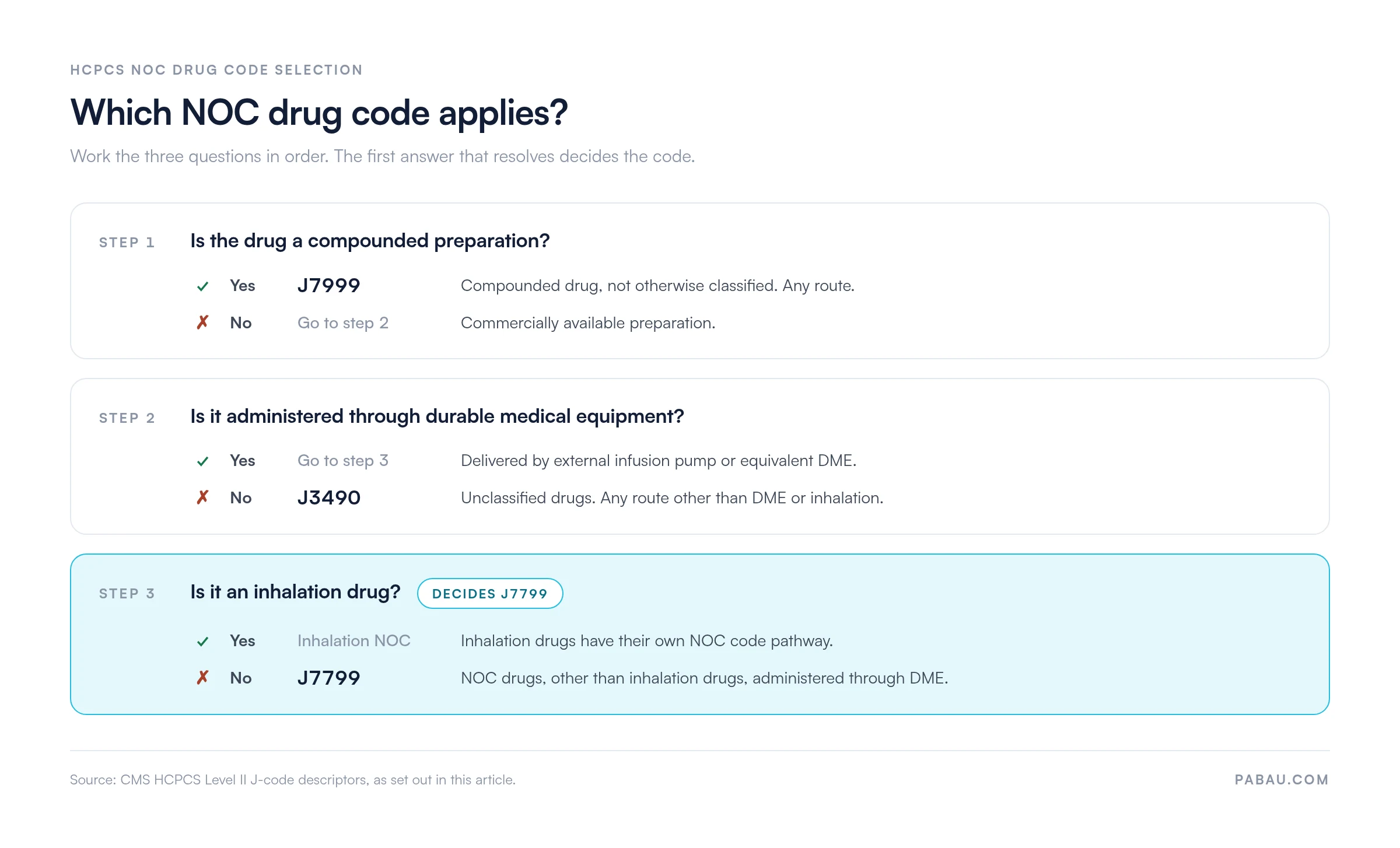
Never reach for J7799 as the default for an unclassified drug. Confirm the DME delivery requirement first, because that one condition is what separates J7799 from J3490.
J7799 billing is documentation-intensive. Assembling drug invoices, prescriber notes, DME orders, and necessity statements by hand costs the billing team time on every claim. The load compounds for practices running recurring infusion regimens, where the same packet is rebuilt every cycle.
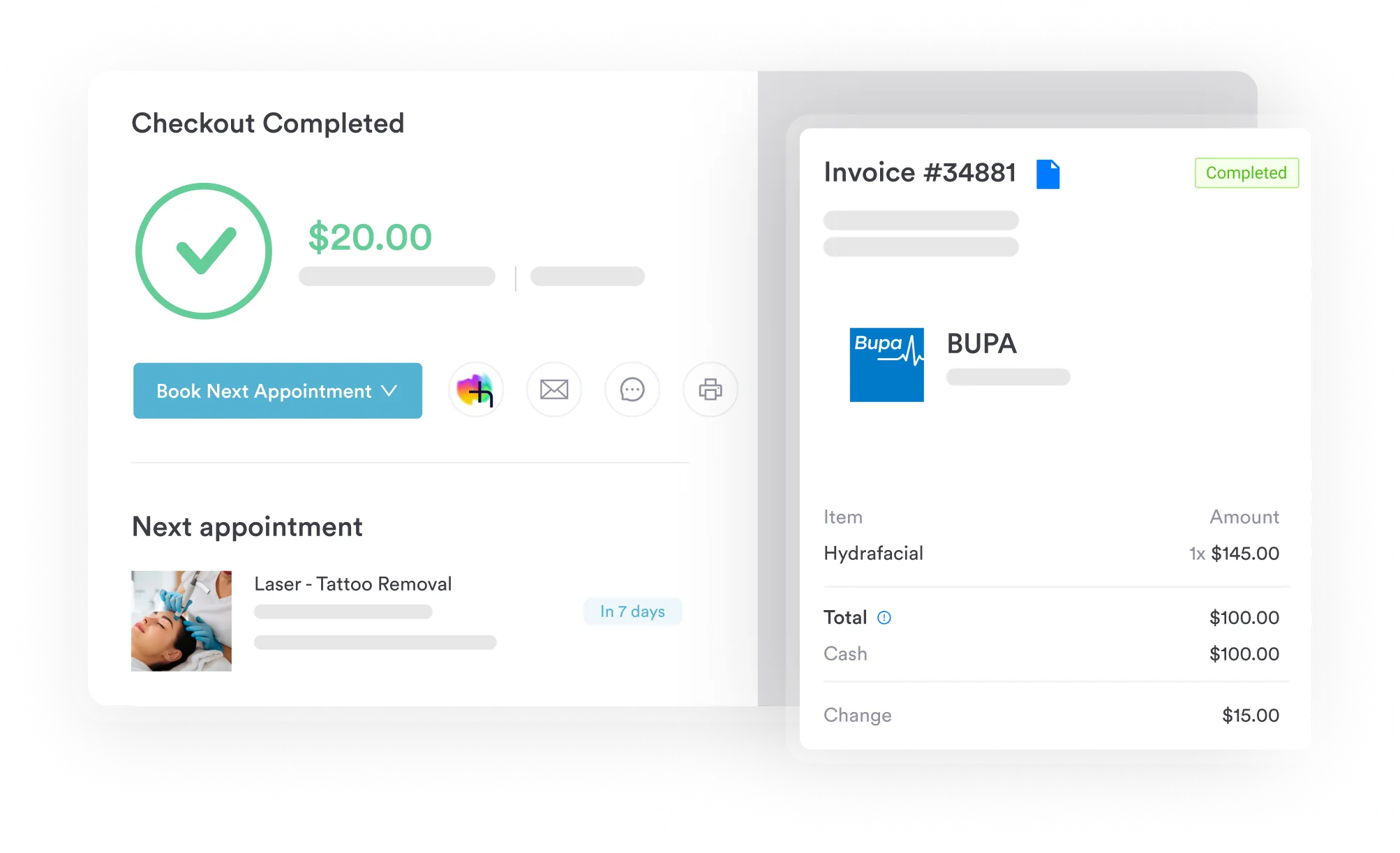
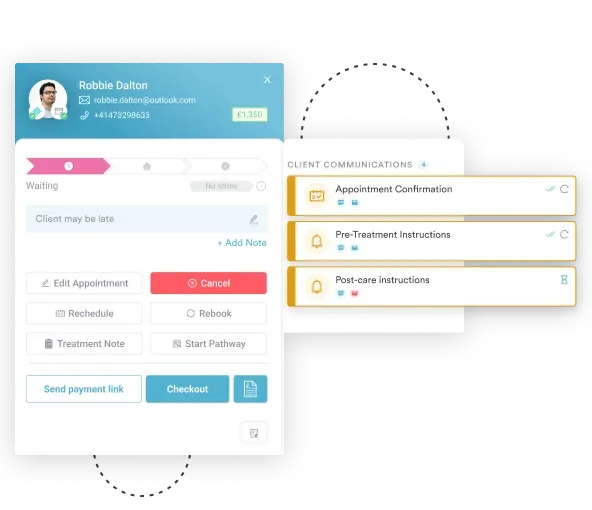
Practice management software like Pabau closes that loop. Its claims management software collects the required J7799 fields at the point of administration. Drug details, units administered, and the DME equipment used land in the record, so the billing team is not chasing invoices afterward.
Three workflow areas carry most of the J7799 billing load:
The documentation requirements for J7799 are fixed by CMS and payer policy. What varies is how efficiently a practice collects and stores them, and that is a workflow decision rather than a coding one.
Run a quarterly audit of your J7799 claims by pulling every denial reason code for the code from your billing system. If CO-189 and CO-16 together account for more than a fifth of those denials, the problem sits upstream. CO-189 means a NOC code was billed where a specific code exists, and CO-16 means the claim is missing information. Fix the intake form, not the claim.

Pabau’s claims management tools help practices capture J7799 documentation at the point of administration, track prior authorization timelines, and submit clean claims. See how it works in a personalized demo.

The J7799 decision is made at the point of administration, not in the billing system. A biller who receives the drug name, the units, the DME type and the invoice has a claim that pays. One who receives a code and a date has an appeal to write.
The trade-off worth remembering is that invoice-based pricing cuts both ways. It removes the fee schedule ceiling that caps a named J-code. It also hands the payer a standing reason to ask for paperwork on any claim you submit.
Pabau standardizes what gets captured at administration and surfaces the denial patterns worth acting on. Book a demo to see how it fits your practice’s NOC drug billing.

Seeing the same J7799 denials every quarter? Denial management in healthcare covers how to categorize denials by cause and work the appeal window.
Want to catch coverage limits before the drug is given? Insurance eligibility verification explains what to check ahead of each administration cycle.
Preparing for a payer audit of NOC claims? Medical billing compliance walks through the record-keeping a contractor expects to find.
Need to itemize a drug administration for the patient? Superbill explains which fields a claimable itemized receipt has to carry.
HCPCS Code J7799 bills not otherwise classified (NOC) drugs administered through durable medical equipment, such as an external infusion pump. Inhalation drugs are excluded. It applies only when no specific HCPCS J-code exists for the drug.
NOC stands for “not otherwise classified.” In drug billing, NOC codes are catch-all HCPCS codes used when a specific code does not exist for the drug. NOC codes require more documentation than named drug codes because the payer cannot identify the drug from the code alone.
J7799 covers non-inhalation drugs administered through DME. J3490 (unclassified drugs) is broader, and covers drugs given by any route other than DME or inhalation. If the drug goes through an infusion pump or other DME, J7799 applies. If not, J3490 usually does.
J7999 covers compounded drugs not otherwise classified, regardless of administration route. J7799 covers commercially available drugs administered through DME. If the drug is a compounded preparation, J7999 is correct. A commercially available drug given through an infusion pump takes J7799.
Prior authorization requirements for J7799 vary by payer. Traditional Medicare Part B does not mandate it for every J7799 claim. Medicare Advantage plans and most commercial payers do. State Medicaid programs set their own policies. Verify the requirement with the payer before administering the drug.
J7799 does not have a fixed Medicare fee schedule rate. Because it is a NOC code, Medicare typically reimburses the lower of the supplier’s invoice cost or usual charge. Rates also vary by locality under the DMEPOS fee schedule. Retain the drug invoice, because contractors may request it during review.
Medicaid coverage for J7799 varies significantly by state. Some state programs cover NOC drug codes through DME with prior authorization. Others restrict coverage to named drug classes, or exclude NOC codes from the DME benefit. Contact the state Medicaid agency or DME MAC before billing.