CCSD code H4430: Examination of rectum under anaesthetic
CCSD code H4430 pays for the examination alone CCSD code H4430 is the UK private...

Last Updated: Oct 20, 2026
J7199 is the HCPCS Level II code for hemophilia clotting factor, not otherwise classified.
Medicare Part B wants a quantity of 1 on the line, whatever dose the patient received. The drug name, the total IU, and the NDC belong in the claim narrative instead.
Let Pabau's smart automation suggest the right codes, reduce claim denials, and keep your practice compliant—effortlessly.
Automate repetitive tasks and focus on what matters most—your patients.
Reduce coding errors and ensure compliance with the latest regulations.
Clean claims, fewer denials, and faster reimbursements.
Powerful insights and reporting to help your practice thrive.
HIPAA compliant SOC 2 certified GDPR-compliant Trusted by 4,000+ clinics worldwide

HCPCS code J7199 covers hemophilia clotting factor products that have no dedicated HCPCS Level II code
Medicare Part B wants a quantity of 1 on a J7199 line, whatever dose the patient received
The drug name, the total IU administered, and the NDC go in the claim narrative instead of the quantity field
Some payers set their own convention, so confirm the rule before billing a state Medicaid or commercial plan
Pabau’s claims management software keeps the NDC, the documented dose, and prior authorization status on one client record
HCPCS code J7199 is a HCPCS Level II not-otherwise-classified (NOC) code. It reports hemophilia clotting factor products that have no specific, dedicated code of their own.
According to the Centers for Medicare and Medicaid Services (CMS), J7199 sits within the clotting factor code range J7177 through J7214.
The NOC classification makes this a code of last resort. Reach for it only when no specific HCPCS code exists for the exact product administered. Choosing it while a dedicated code is available counts as upcoding, and it carries fraud and abuse risk.
A clotting factor lands on J7199 when it reaches the market before CMS assigns it a dedicated HCPCS code. The same applies when an existing code has been retired. Novel recombinant factors and extended half-life agents are the usual candidates.
Jivi (antihemophilic factor recombinant, PEGylated-aucl) is the standard example. North Carolina Medicaid’s billing bulletin directed providers to J7199 when the drug launched in 2018. Jivi now has its own code, J7208, so billing it under J7199 today is an error.
Check the current CMS HCPCS file at every update cycle. A product that once needed J7199 may since have been given a code of its own.
A J7199 claim carries more supporting detail than a typical J-code claim. The payer cannot identify the product from the code, so the drug name, the NDC, and the dose all have to arrive with the line.
Work through the nine steps below in order.
Report a quantity of 1 on a J7199 line to Medicare Part B, whatever dose the patient received. The dose belongs in the claim narrative, not in the quantity field.
CMS Medicare Coverage Database article A56482 and its legacy guideline L31078 set out the rule. Palmetto GBA and Noridian repeat it in their NOC billing instructions.
The reason sits in the descriptor. J7192 reads “per IU”, so one unit has a defined size and a 2,000 IU dose converts to 2,000 units. J7199 reads “hemophilia clotting factor, not otherwise classified” and names no amount at all.
CMS publishes no HCPCS-level IU quantity for it in the ASP and NOC pricing files, so the quantity field has nothing to count. The two lines below start from the same dose.
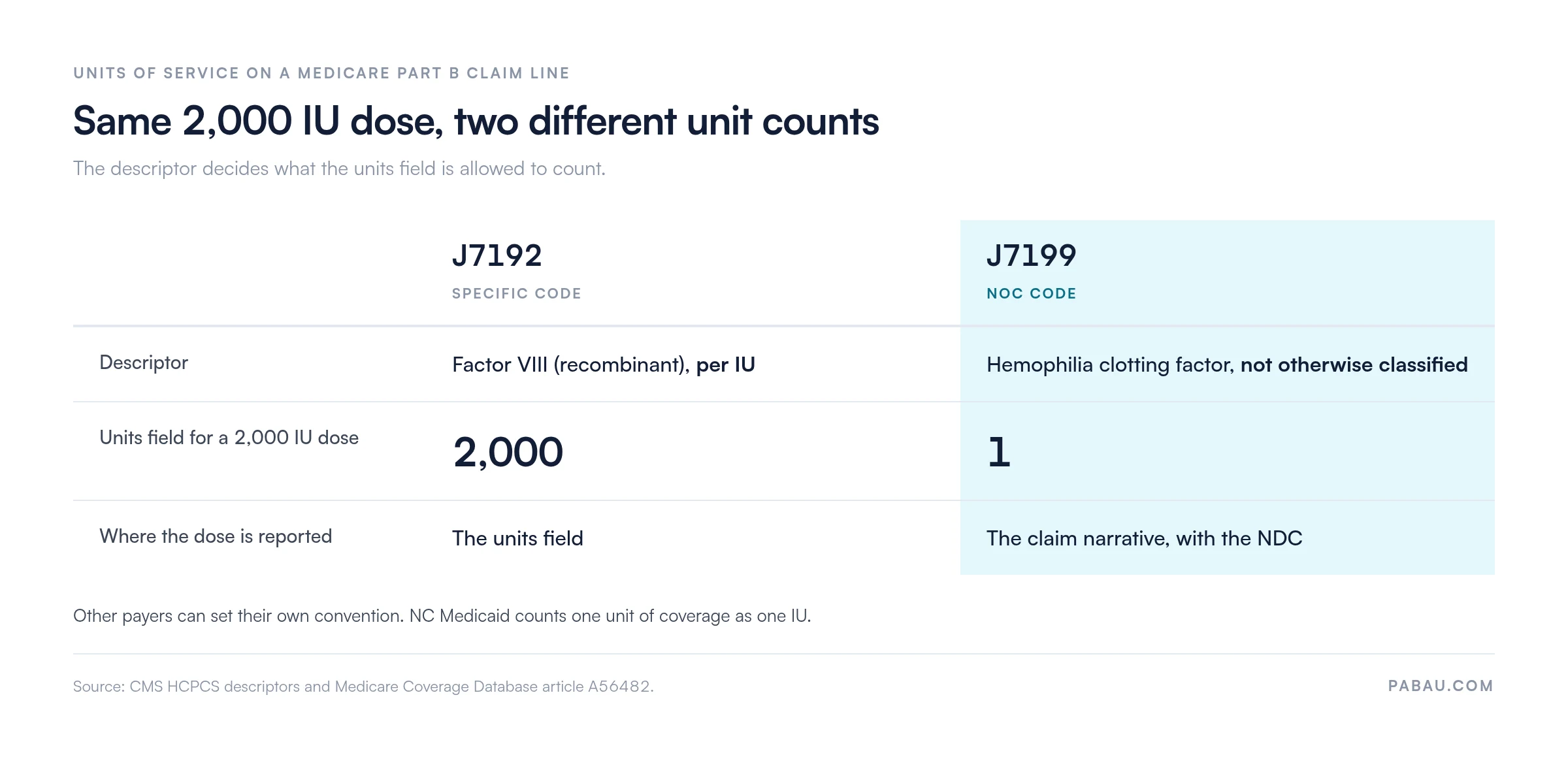
Never let the quantity field carry the dose on a Part B J7199 line. A line that reads 2,000 units invites a rejection, or a payment calculated against the wrong quantity. The narrative tells the payer how much drug the patient received.
The medical record then has to match it exactly, because payers cross-reference the documented IU against weight-based dosing for the coded hemophilia type.
The quantity of 1 rule belongs to Medicare Part B, and it is not universal. NC Medicaid’s Jivi bulletin defines one unit of coverage as one IU for its own program. That payer expects the IU count in the quantity field, and a commercial plan may follow either convention.
So check the payer’s drug billing manual for the NOC code before the first claim goes out. Then record the answer where the billing team can find it.
Every separately payable Part B drug from a single-dose container needs one of two wastage modifiers. JZ attests that no amount was discarded. JW reports the discarded amount that is eligible for payment.
Question 14 of the CMS JW and JZ modifier FAQs settles the point for NOC codes. Both modifiers apply to a drug billed under an NOC code in the physician office, even though the code names no drug.
Most clotting factor vials are reconstituted and given in full, so JZ belongs on the majority of these lines. Reach for JW only when a measured amount was left in the vial and thrown away.
The quantity field still carries a 1 either way. Spell the discarded IU out in the narrative, and ask your MAC how it wants that line built.
The National Drug Code (NDC) is mandatory on every HCPCS code J7199 claim for Medicare and most Medicaid programs. Noridian’s JF Part B billing guidance states it plainly.
Claims submitted without an NDC are denied. On an electronic claim the number sits in the Loop 2410 LIN and CTP segments of the 837 claim file, then repeats in the narrative.
The NDC must match the vial that was administered, not a generic product listing for the brand.
Record the NDC from the physical vial label before it is discarded. Build this into the nursing or infusion documentation workflow. The NDC then reaches the chart at the time of administration, rather than being reconstructed from purchase records later.
A J7199 line pays only when the diagnosis explains why a clotting factor was given. Code the underlying bleeding disorder first. Then add the bleed itself when the infusion treated an active episode.
Match the diagnosis to the product. A factor IX product billed against a hemophilia A diagnosis is a mismatch that payer edits catch. Where the patient has an inhibitor, document it. Inhibitor status is often what justifies a product with no dedicated code.
An NOC code tells the payer very little on its own, so the record has to carry the detail the code leaves out. Reviewers ask for more here than they do for codes with specific descriptors.
The list below is what a J7199 audit usually wants to see.
Medicare Part B covers hemophilia clotting factor under J7199 when the product is medically necessary. CMS Medicare Coverage Database article A56482 and Noridian JF Part B guidance both confirm it.
Coverage runs across outpatient, office, and home infusion settings. After payment, the electronic remittance advice shows what was allowed and flags any adjustment.
Medicaid coverage varies by state. Some states cover J7199 broadly, and others restrict it to specific hemophilia products or diagnoses.
North Carolina Medicaid covers antihemophilic factor recombinant agents under J7199, per the NC DHHS billing bulletin, and that program also requires prior authorization. Always read the state Medicaid billing manual before you submit.
Prior authorization rules differ by payer, so never assume one way or the other. Medicare Part B applies no blanket prior authorization requirement to hemophilia clotting factors, though individual MACs may set coverage criteria.
Most Medicaid programs and many commercial payers do require it for hemophilia factor products, including those billed under J7199. The cost of these agents drives that requirement.
A prior authorization request should carry the patient’s hemophilia type and severity, the factor inhibitor status, and the prescribing hematologist’s order.
Add the supporting factor activity levels. Then say why products with a dedicated HCPCS code were unsuitable or ineffective. Keeping this on the client record before you request authorization avoids the back-and-forth that delays an infusion.
Medicare Part B reimburses J7199 at ASP plus 6%, applied to the specific drug billed under the code. The rate is drug-specific and moves every quarter, so pull it from the current CMS ASP drug pricing file rather than a static reference.
The CMS Physician Fee Schedule lookup tool covers the administration codes that travel with the drug.
When a product does have a dedicated code, that code must be used instead. The table below shows selected codes from the J7177 to J7214 clotting factor range.
Scan it for a specific match before you reach for the NOC line.
Three brand names cause most of the mix-ups in this range. Advate bills under J7192, Eloctate under J7205, and Kovaltry under J7211.
None of the three belongs on a J7199 line. Verify the current range with the AAPC HCPCS code search or the NLM HCPCS API. CMS updates the HCPCS Level II file annually, and new dedicated codes can appear at a quarterly update.
J7199 draws a higher-than-average denial rate. Its NOC status invites documentation shortcuts, and payers reject them. Catching the pattern before submission costs far less than appealing after the fact.
When a line does come back, the remittance carries a reason code, and our guide to denial codes explains what each one is asking for.
Run a monthly audit of all J7199 claims against the current CMS HCPCS file. If a drug billed under J7199 last month has since received a dedicated code, flag those claims for review. Correct any future submissions before the next billing cycle.
Most J7199 rework traces back to five fields. Walk them at the point of submission, rather than at the end of the month when the denial report lands.
A no on any line is a claim to hold, not a claim to send.
A J7199 claim fails on details that live in three different places. The drug name and NDC sit with the nurse who opened the vial. The dose sits in the clinical note.
The prior authorization sits in an email thread or a payer portal. Billing staff then rebuild the line days later, from memory and purchase records.
Practice management software like Pabau keeps those details on one client record. The clinician records the product, the NDC, and the IU given at the point of administration.
The billing team then works from what was documented rather than from a purchase order. Prior authorization status sits on the same record, so nobody administers an unapproved product by accident.
Pabau’s claims management software carries that detail onto the claim, and US practices submit through its Claim.MD integration. The payer’s response is recorded against the claim it belongs to.
When a J7199 line comes back rejected, the billing team can see the cause and fix the pattern before the next batch goes out.

Pabau’s claims management software tracks NDC data, doses administered, prior authorization status, and claim outcomes for complex J-code billing workflows.

J7199 stays correct only for as long as CMS leaves the product unclassified. That is what separates it from the rest of the range. A claim that was accurate in January can become an upcoding problem by April, without anyone changing how the practice bills. So the code check belongs on a schedule, not in someone’s memory.
The rest is discipline at the point of care. Capture the NDC and the IU while the vial is open, hold the Part B quantity at 1, and the narrative almost writes itself. Practices that bill hemophilia factor regularly need that detail and the claim in one system.
To see how Pabau keeps infusion documentation and claims together, book a demo.

Need a framework for reducing drug claim denials? Denial management in healthcare covers the operational steps to identify, appeal, and prevent the most common rejection patterns.
Want to see where a J-code claim gets validated? Medical claims clearinghouse guide explains how electronic claims are checked before they reach the payer.
Building a billing compliance program? Superbill documentation guide outlines what a compliant superbill must include for specialty drug infusion claims.
Not sure what makes a claim pay on the first pass? Clean claim submission sets out the fields payers check before they release payment.
Want to catch coverage problems before the infusion? Insurance eligibility verification walks through what to confirm with the payer at booking.
NOC stands for not otherwise classified. The code acts as a placeholder for a product that has no dedicated HCPCS code of its own. Because it names no drug, the payer prices the line from the narrative and the NDC rather than from the code itself.
Yes. J7199 reports the drug only. The infusion or injection is billed on its own line, with its own code, on the same claim. The CMS Physician Fee Schedule lookup tool carries the rates for those administration codes.
CMS updates the HCPCS Level II file every year, and new codes can also appear at a quarterly update. A product billed correctly under J7199 in January may have a code of its own by April. Re-check the file each cycle.
Yes. Medicare Part B coverage runs across office, outpatient, and home infusion settings. Take the total IU from the patient’s administration log. Hold the Part B quantity at 1, and record the NDC from the vial that was used.
Only when the specific product has no code of its own. Vonvendi, for example, bills under J7179. Work through the J7177 to J7214 range first, then fall back to J7199 if nothing matches the vial.