CCSD code H4430: Examination of rectum under anaesthetic
CCSD code H4430 pays for the examination alone CCSD code H4430 is the UK private...

Last Updated: Oct 20, 2026
J7195 is the HCPCS Level II code for injection, factor ix (antihemophilic factor, recombinant) per iu, not otherwise specified.
HCPCS code J7195 bills an injection of factor IX (antihemophilic factor, recombinant), per international unit, not otherwise specified. It's the catch-all J-code for recombinant factor IX products that have no dedicated code of their own. BeneFIX is the product you'll see on it most often.
One detail decides most of these claims. Each unit equals one IU infused, not one vial dispensed. Factor IX claims are low in volume and high in dollars.
A wrong unit count or a missing waste modifier is expensive to unwind. Get the units, the diagnosis pairing and the waste modifier right, and the rest of the line is routine.
Let Pabau's smart automation suggest the right codes, reduce claim denials, and keep your practice compliant—effortlessly.
Automate repetitive tasks and focus on what matters most—your patients.
Reduce coding errors and ensure compliance with the latest regulations.
Clean claims, fewer denials, and faster reimbursements.
Powerful insights and reporting to help your practice thrive.
HIPAA compliant SOC 2 certified GDPR-compliant Trusted by 4,000+ clinics worldwide

HCPCS code J7195 bills an injection of recombinant factor IX per international unit, not otherwise specified, for hemophilia B replacement therapy.
Each unit on the claim equals one IU infused, so bill the administered IUs and never the number of vials dispensed.
Modifier JW or JZ became mandatory on July 1, 2023, and MAC claim edits began denying lines carrying neither on October 2, 2023.
Practice management software like Pabau carries HCPCS and ICD-10-CM lookup libraries and validates required claim fields before a line is submitted.
J7195 sits in the HCPCS Level II J-code family. The Centers for Medicare and Medicaid Services (CMS) maintains those codes for injectable drugs and biologicals billed outside the CPT system. The descriptor is fixed, and so is the unit of measure.
The “not otherwise specified” (NOS) label does most of the work here. J7195 is a catch-all, so it carries recombinant factor IX products that CMS has not assigned a dedicated code.
Once a product gets its own code, it leaves J7195 behind. That’s why the product-to-code mapping needs a look at every annual HCPCS release.
BeneFIX (nonacog alfa), Pfizer’s recombinant factor IX product, is what most J7195 lines describe. Manufacturer buy-and-bill guidance and MAC billing policies both map it to J7195 NOS, because nonacog alfa has no product-specific J-code.
Recheck that mapping each year, since CMS assigns dedicated codes as billing volume grows.
Other recombinant factor IX products without their own code sit here too. Several factor IX products do have distinct codes though, and that’s where the mapping usually goes wrong.
J7201 covers Alprolix, and J7203 covers Refixia, branded Rebinyn in the US. Coding either one to J7195 is a top denial trigger.
Three fields on the line do the deciding: the unit count, the place of service code, and the waste modifier. Get one of them wrong and the claim heads for manual review or an outright denial.
The claim line below shows how the five decisive cells sit together, and what goes wrong in each.
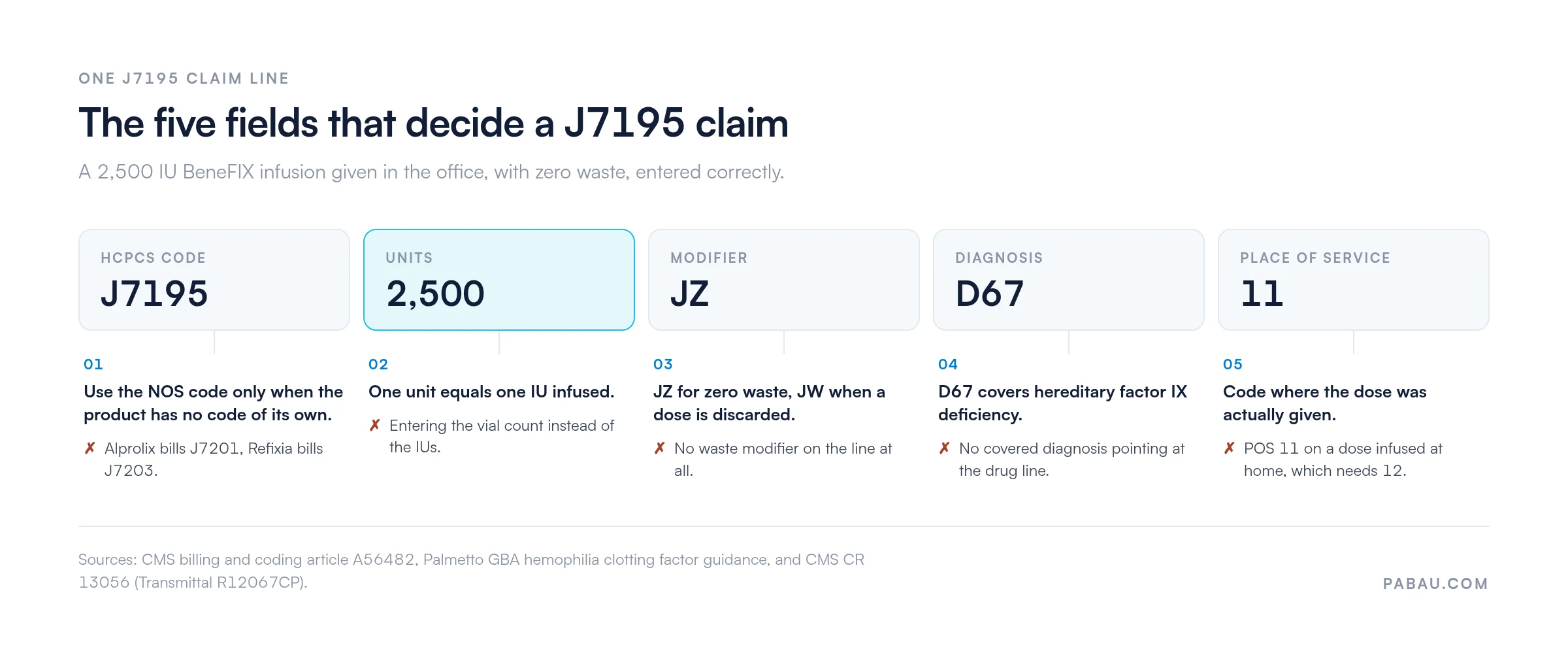
Each unit on the claim equals exactly one IU of recombinant factor IX administered. Palmetto GBA’s 2025 hemophilia clotting factor billing guidance confirms that one-to-one relationship. A patient who receives 2,500 IU in a single infusion session needs 2,500 in the units field.
Vial count is where this usually goes wrong. How many vials were opened has no bearing on the claim, so document and bill only the IUs actually infused. The five steps below are the order to work in.
Medicare Part B covers factor IX under J7195 across several care settings, and each has its own place of service (POS) code.
The POS code on the claim has to match the location where the drug was administered or dispensed. A home infusion submitted on an office POS is a clean denial.
CMS required one of two waste modifiers on every drug claim through Change Request 13056, issued as Transmittal R12067CP.
JZ reporting was voluntary from January 1, 2023, then mandatory from July 1, 2023. MACs started editing and denying lines that carry neither modifier on October 2, 2023.
So the choice on a J7195 line is binary. Append JW when part of a vial is discarded, and JZ when the full dose reaches the patient.
Re-read the current transmittals when the claim year turns, because modifier policy gets revisited annually.
Document the wasted IUs in the clinical record before you append JW. The wasted amount has to be noted separately from the amount administered. Auditors look for that note whenever JW appears on a J7195 claim. If nothing was discarded, use JZ and record zero waste in the chart.
D67, hereditary factor IX deficiency, is the primary diagnosis on almost every J7195 claim. It’s the ICD-10 code for hemophilia B, also known as Christmas disease.
CMS billing and coding article A56482 lists the diagnoses that have to accompany the drug line. A claim without one of them denies for medical necessity.
Secondary and acquired clotting conditions fall to the D68 series instead. Where the documentation describes a different factor deficiency, work from the ICD-10-CM codes for coagulation defects rather than defaulting to D67.
Confirming the pairing before treatment also saves a post-service denial on a claim worth thousands.
Thin documentation is the second most common reason J7195 claims fail, right behind unit errors. CMS and MAC guidance both expect the medical record to support every element on the line.
A useful test: an auditor should be able to rebuild the claim from the chart alone.
Factor IX products draw attention in RAC audits because of what one claim is worth. Keeping the record complete as you go is far cheaper than reconstructing it two years later.
CMS prices J7195 using Average Sales Price (ASP) methodology, and Medicare Part B pays ASP plus 6%. The ASP files are refreshed every quarter, so no article can quote a rate that stays true.
Pull the current figure from the CMS Physician Fee Schedule lookup tool and the quarterly ASP drug pricing files.
Coverage itself is not uniform either. Part B covers outpatient administration subject to medical necessity and to the Local Coverage Determination (LCD) in your MAC jurisdiction.
What Palmetto GBA approves can differ from what Noridian asks for, so read your own MAC’s LCD before treating a Medicare beneficiary.
For a practice carrying several hemophilia patients, the quarterly reset is an operational job rather than a finance footnote. One price change across a handful of patients is enough to move the month’s revenue.
Put a reminder against each ASP update and re-check the rate before the next batch of claims goes out.
Medicare Part B does cover home infusion of factor IX, but only for beneficiaries who meet the criteria. Noridian MAC guidance approves it where the patient cannot be treated in an outpatient setting.
The eligibility documentation belongs in the record before the first home claim goes out, not after it denies.
Several HCPCS codes cover factor IX products, and picking the wrong one is a frequent error as long-acting products pick up dedicated codes. The annual CMS HCPCS release files and the AAPC’s HCPCS code lookup are what to verify a product-to-code assignment against.
Treat the table below as a starting point, then confirm it with your MAC.
The NOS versus product-specific split affects payment as well as acceptance. CMS prices each J-code separately under ASP.
Billing J7195 for a product that has its own code can underpay you, or trip a claim edit. Check the descriptor before the first claim on any product you have not billed before.
The five errors below account for most J7195 failures across MAC jurisdictions. They come from published Palmetto GBA and Noridian guidance, plus CMS billing article A56482.
Catching them at the front end is far cheaper than denial management on a high-dollar drug claim after the payer has already said no.
A claim scrubber catches most of these, and a two-minute read of the line catches the rest. Work down the same list in the same order every time, and the errors stop being random.
For a practice treating the same hemophilia patients month after month, that list belongs in the workflow rather than in one biller’s head. The moment it lives only in someone’s memory, it walks out the door with them.
Building the J7195 line by hand is still the norm. Someone reads the administration record, types the IU count into the billing system, remembers the waste modifier, then looks up the diagnosis in another window.
That’s four chances to mistype a claim worth thousands of dollars.
Practice management software like Pabau closes that loop by keeping the record and the claim in one system. Pabau’s claims management software pre-fills the claim form from the client record, so the drug line and the diagnosis you documented are the ones submitted.
HCPCS and ICD-10-CM lookup libraries sit behind a search icon in the form itself, refreshed with each official release.
It also holds the claim until the required fields are complete. A line missing an authorization code or a membership number never reaches the payer.
On the US pipeline, eligibility checks, claim status tracking and remittance posting run in the same place. You can see what happened to a factor IX claim without logging into a separate clearinghouse portal.

Pabau’s claims management software pre-fills the claim from the client record and holds each line until its required fields are complete. That means fewer reworked claims and faster reimbursement on specialty drug billing.

J7195 rewards a boring, repeatable process. Every field on the line has an obvious source. The unit count comes from the administration record, and the modifier comes from what happened to the vial.
The diagnosis comes from the chart, and the POS from where the patient sat. None of it calls for judgment, which is exactly why these denials are so preventable.
The one item worth revisiting every year is the product-to-code mapping. Codes move, and a product that belonged on J7195 last year may carry its own code this year. Diary the annual HCPCS release and re-check every factor IX product you bill against it.
If your errors come from re-typing numbers between the chart and the claim, that’s a workflow problem with a workflow fix. Book a demo to see how Pabau builds a drug claim straight from the treatment record.

Want the claim to pass payer edits first time? Clean claim submission sets out the data elements a claim needs to clear without manual review.
Not sure what the charge document has to show? Superbill walks through the fields behind a claim and who fills each one in.
Checking coverage before a high-cost infusion? Insurance eligibility verification covers what to confirm before the patient is in the chair.
Worried about an audit on high-value drug claims? Medical billing compliance explains the standards Medicare and commercial payers audit against.
New to the billing cycle end to end? What is medical billing follows a claim from patient intake through to reimbursement.
Yes. The drug and the work of giving it are separate lines on the same claim. J7195 carries the product and the IUs infused, and the infusion or injection administration code carries the labor. Bill both, each with the units its own descriptor calls for, and make sure the administration code matches the route documented in the record.
Traditional Medicare Part B does not require prior authorization for J7195. Many Medicare Advantage plans, commercial plans and state Medicaid programs do, and some route factor IX through a pharmacy benefit instead. Confirm the requirement plan by plan before the first infusion, then store the authorization number where the biller can find it.
Whoever bought and supplied the product bills for it. Under buy-and-bill, the practice purchases the factor IX and bills J7195 alongside the administration. When a specialty pharmacy ships the product under the patient’s benefit, that pharmacy bills the drug and the practice bills only the administration. Billing the drug twice is a recoupment risk.
Sort the denial type before you draft an appeal. A wrong unit count, a missing modifier or an absent NDC is correctable, so resubmit it as a corrected claim. A medical necessity denial goes to redetermination, the first Medicare appeal level, with the physician order, the administration record and the waste documentation attached.