HCPCS code J7311: Retisert implant units and billing guide
HCPCS code J7311 covers one implant, Retisert HCPCS code J7311 is the Level II c...

Last Updated: Nov 10, 2026
HCPCS code J7186 reports an injection of antihemophilic factor VIII/von Willebrand factor complex (human), billed per factor VIII IU. It's a plasma-derived concentrate, and Alphanate from Grifols is the product billed under it.
It treats hemophilia A and, for surgery or invasive procedures, von Willebrand disease. Recombinant factor VIII, Humate-P and Wilate all have their own codes. Clean claims rest on three checks: the right code for the product, the matching NDC and the actual IU infused.
Let Pabau's smart automation suggest the right codes, reduce claim denials, and keep your practice compliant—effortlessly.
Automate repetitive tasks and focus on what matters most—your patients.
Reduce coding errors and ensure compliance with the latest regulations.
Clean claims, fewer denials, and faster reimbursements.
Powerful insights and reporting to help your practice thrive.
HIPAA compliant SOC 2 certified GDPR-compliant Trusted by 4,000+ clinics worldwide

J7186 reports the plasma-derived factor VIII/von Willebrand factor complex (human), billed per factor VIII IU, and Alphanate is the product it describes.
It is not a recombinant factor VIII code, so Advate, Kogenate FS, Recombinate, Nuwiq, Jivi and Esperoct all bill under other codes.
Supporting diagnoses are hemophilia A (D66) and von Willebrand disease, which now needs a specific D68.0- subcode.
Bill one unit per factor VIII IU actually infused, using the potency printed on each vial rather than the nominal vial size.
Most clean J7186 claims come down to three checks: the right code for the product, the matching NDC and the actual IU infused.
HCPCS code J7186 describes an injection of antihemophilic factor VIII/von Willebrand factor complex (human), billed per factor VIII IU.
It’s a plasma-derived concentrate that carries both clotting proteins, factor VIII (FVIII) and von Willebrand factor (VWF). Alphanate from Grifols is the product billed under it, for hemophilia A and for procedures in von Willebrand disease.
The unit is counted in factor VIII international units, even when the product is given for von Willebrand disease. That detail sets it apart from J7187 and J7183, which count VWF units instead.
J7186 is a product-specific code in practice. Alphanate is the FVIII/VWF complex (human) that payer policies and the CMS NDC-HCPCS crosswalk map to it. Every other factor VIII or VWF product has a code of its own.
Product portfolios and code assignments change, so check the NDC against the current CMS crosswalk before you bill. If the vial in hand turns out to be recombinant, our J7192 page explains how those products bill.
Hemophilia A is an inherited deficiency of factor VIII, coded as D66 (hereditary factor VIII deficiency). Alphanate is labeled to prevent and control bleeding in these patients, including around surgery.
Von Willebrand disease (VWD) is the most common inherited bleeding disorder. Low or faulty VWF impairs platelet adhesion and also shortens the life of factor VIII in circulation. Alphanate is labeled for surgery and invasive procedures in VWD patients when desmopressin (DDAVP) is ineffective or contraindicated.
One label limit matters for coding review. Alphanate is not indicated for patients with severe (type 3) VWD who are undergoing major surgery. A claim pairing J7186 with type 3 VWD and a major surgical procedure deserves a second look before it goes out.
Documentation should show the treatment reason (prophylaxis, a bleeding episode or a procedure), the weight-based dose and the factor VIII IU infused. Hemophilia treatment centers (HTCs) often coordinate this care and may hold their own payer arrangements.
Hemophilia A is reported with D66. Von Willebrand disease needs the subtype the chart supports, because D68.0 has been a category heading rather than a billable code since October 1, 2022.
D68.311 (acquired hemophilia) and D68.312 (antiphospholipid antibody with hemorrhagic disorder) don’t support J7186. Acquired inhibitors call for other treatments, so leave those codes off a J7186 claim.
Bill one unit of J7186 for each factor VIII IU infused. Alphanate vials are labeled with their actual FVIII potency, which varies around the nominal size, so add up the IU printed on each vial used.
For example, two vials labeled 1,032 IU and 1,018 IU, both fully infused, give 2,050 units on the claim line. Billing 2,000 because the vials are sold as 1,000 IU each understates the dose.
The administration goes on its own claim line. When your staff give the injection, that is usually 96374 for an IV push. Check the payer’s rules for home infusion before you add one.
Every Part B drug claim line needs the 11-digit NDC of the product given. Alphanate carries the Grifols labeler code 68516, with a separate NDC for each potency range.
Grifols has changed Alphanate presentations over the years, and older NDCs drop out of the crosswalk. Read the NDC from the carton in hand rather than a saved list.
Medicare Part B pays J7186 at 106% of the average sales price (ASP+6%). CMS updates the payment limit quarterly, and the rate in force on the date of service applies.
Clotting factors also earn a separate blood clotting factor furnishing fee, paid per IU on top of the drug payment. CMS publishes the fee each year, so check it alongside the quarterly ASP file.
Most commercial and Medicaid managed care plans require prior authorization for J7186. Policies such as Centene’s factor VIII/VWF complex policy group it with Humate-P and Wilate.
Original Medicare doesn’t generally require prior authorization for Part B clotting factors. Still, check your Medicare Administrative Contractor’s local policies, and expect Medicare Advantage plans to set their own rules.
Authorization requests usually need the confirmed diagnosis with factor VIII or VWF lab results and the treatment plan. For VWD, plans often ask for evidence that desmopressin is ineffective or contraindicated. Our walkthrough of the prior authorization process covers how a request moves from submission to decision.
Factor VIII and VWF products split across several codes, and three questions settle which one applies. Is the factor recombinant, does the product carry a VWF claim, and which complex is it? The diagram walks through them in order.
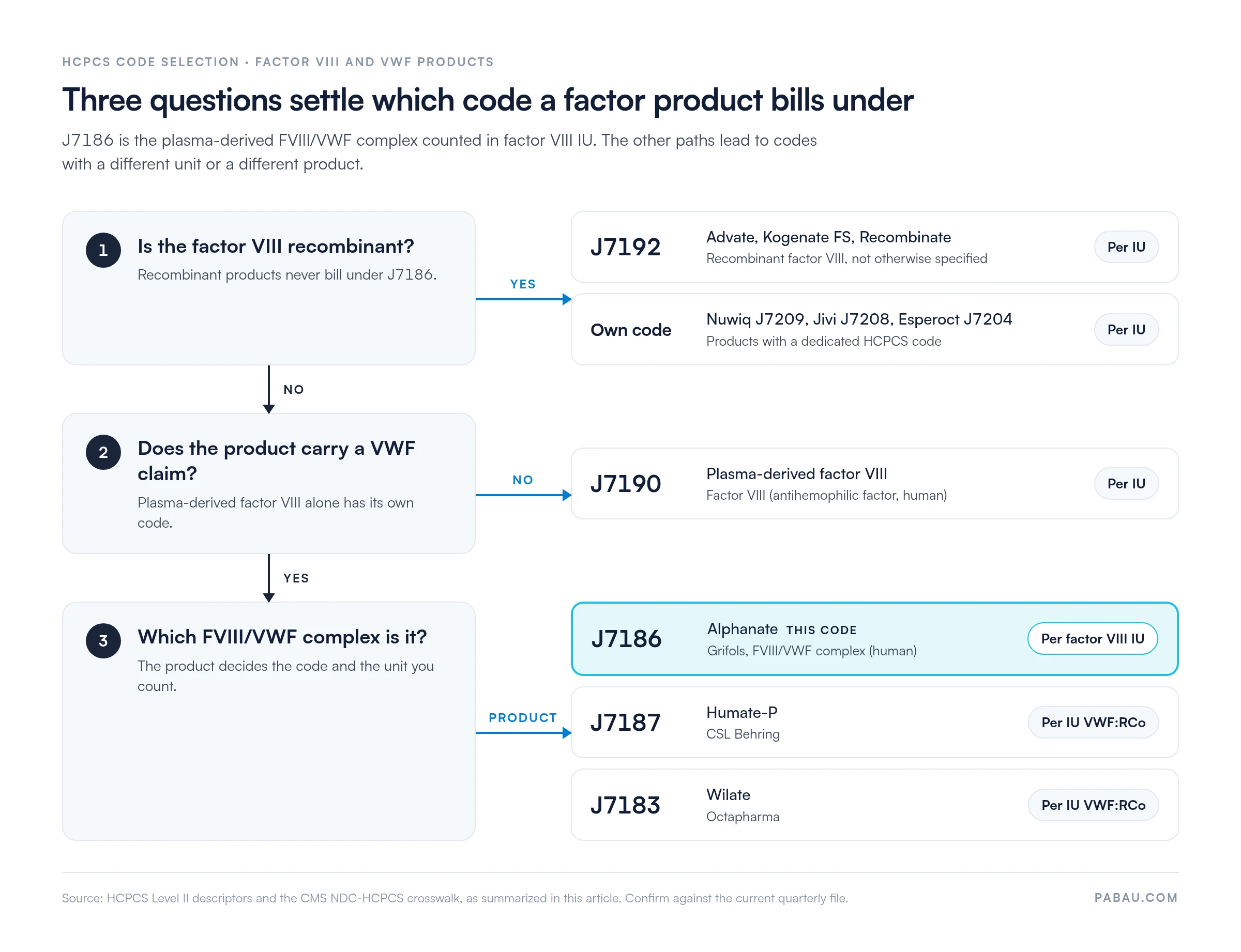
The unit column is where most errors hide. Moving a patient from Humate-P to Alphanate changes both the code and the unit basis, so recalculate the units rather than copying them. The J7187 page shows how the VWF:RCo count works on the other side of that switch.
J7186 claims tend to come back for one of four reasons, and each has a straightforward fix. The denial codes reference covers the full CARC list.
Appeal deadlines vary by payer and plan type. Note each deadline in your billing workflow on the day the denial arrives.
Use this checklist before you submit. The medical billing fundamentals guide covers wider claim workflows.
Factor claims carry high values, so a returned claim ties up a lot of money. Many practices still key clotting factor claims by hand and chase remittances across separate portals.
Pabau, the practice management platform we build, keeps the order, the infusion record and the claim on one patient record. Its claims management software sends US claims through Claim.MD, covering CMS-1500/837P claims, eligibility checks and ERA remittances.
Eligibility checks before the visit flag coverage problems early. ERA remittances then post against the original claim, so you can see when a payment falls short of the expected rate.

Pabau supports US claims through Claim.MD, with CMS-1500/837P claims, eligibility checks and ERA remittances linked to the patient record.

Treat J7186 as the Alphanate code and the rest of the claim falls into place. The product sets the code, the vial labels set the units and the carton sets the NDC.
The cost is a little more recording at the infusion chair, with each vial’s potency and lot noted as it’s used. That record is what stops a 2,050-unit dose going out as 2,000, or a Humate-P switch landing on the wrong code.
Book a demo to see how Pabau keeps factor orders, infusion records and Claim.MD claims on one patient record.

Need to understand how clearinghouse claim submission works? Medical claims clearinghouse guide explains how electronic claims are validated and routed to payers.
Seeing recurring denial patterns across your drug claims? Denial management in healthcare covers root-cause analysis and appeal strategy for specialty drug J-codes.
Want to understand how ERA remittance data maps back to claims? Electronic remittance advice (ERA) explained covers 835 transaction reading and payment posting workflows.
Need a request form for factor concentrates? Medical prior authorization form gives you a template for the diagnosis, treatment plan and supporting evidence a plan asks for.
Part B. Medicare Part B covers clotting factors for people with hemophilia, including factor the patient infuses at home. Payment is ASP+6% plus the clotting factor furnishing fee per IU.
One unit per factor VIII IU infused. Add the potency printed on each vial, so vials labeled 1,032 IU and 1,018 IU give 2,050 units.
J7186 is Alphanate, counted per factor VIII IU. J7187 is Humate-P, counted per IU of VWF:RCo. Both are human FVIII/VWF complexes, but the units don’t convert.
No, it’s a plasma-derived complex. Recombinant products such as Advate, Kogenate FS and Recombinate bill under J7192, and Nuwiq, Jivi and Esperoct have their own codes.
D66 for hemophilia A, or a specific von Willebrand disease subcode such as D68.01 or D68.03. D68.0 by itself is no longer billable.
No. Acquired hemophilia (D68.311) is driven by inhibitors and treated with other products, so it doesn’t support a J7186 claim.