CPT code 93503: Swan-Ganz catheter billing and modifiers
CPT code 93503: Official descriptor and procedure overview In the AMA CPT code s...

Last Updated: Oct 23, 2026
J7187 is the HCPCS Level II code for injection, von willebrand factor complex (humate-p), per iu vwf:rco.
Unlike most drug codes, J7187 is measured in international units of ristocetin cofactor activity, written IU VWF:RCo. That figure gets converted before it reaches the claim. Divide the IU administered by 100, then round to the nearest whole number.
Let Pabau's smart automation suggest the right codes, reduce claim denials, and keep your practice compliant—effortlessly.
Automate repetitive tasks and focus on what matters most—your patients.
Reduce coding errors and ensure compliance with the latest regulations.
Clean claims, fewer denials, and faster reimbursements.
Powerful insights and reporting to help your practice thrive.
HIPAA compliant SOC 2 certified GDPR-compliant Trusted by 4,000+ clinics worldwide

HCPCS Code J7187 describes injection of von Willebrand factor complex (Humate-P) per IU VWF:RCo. It bills Humate-P infusions in physician offices and outpatient settings.
Quantity billed is not the raw IU count. Divide the IU VWF:RCo administered by 100 and round to the nearest whole number. A 1,500 IU dose is reported as 15 units.
Primary ICD-10-CM diagnoses accepted with J7187 include D68.0 (von Willebrand disease) and D66 (hereditary factor VIII deficiency).
Humate-P is supplied in single-dose containers, so the drug line needs a JZ modifier when nothing is discarded and JW when some is.
Practice management software like Pabau supports J7187 billing workflows, from drug inventory tracking through to claim submission.
HCPCS Code J7187 sits in the J-series of HCPCS Level II codes. CMS maintains that series for drugs and biologicals administered other than by the oral method. The complete official descriptor is:
Humate-P is a plasma-derived concentrate containing both von Willebrand factor and Factor VIII. It is indicated to treat and prevent bleeding in adults with VWD.
It also treats hemophilia A when recombinant products are not appropriate. J7187 applies specifically to Humate-P branded product. Other VWF or factor VIII products use separate J-codes.
Two meanings of the word “unit” collide on a J7187 claim. The descriptor is written per IU VWF:RCo, which suggests the claim carries the raw international unit count. Medicare converts the dose into billing units first.
The instruction is consistent across contractors. Palmetto GBA, First Coast in Jurisdiction N, and the underlying CMS hemophilia billing guidelines all give one formula. Divide the number of IU administered by 100, then round to the nearest whole number. That result is the quantity billed.
The rounding convention is spelled out rather than left to judgment:
One more limit catches high-dose infusions. Palmetto GBA allows a maximum of 700 units on a single detail line for J7187, which is 70,000 IU. Anything larger has to be split across detail lines.
The IU figure you feed into the formula must match the infusion record exactly. If the vial label states 1,000 IU VWF:RCo and only 750 IU were administered, convert the 750, not the 1,000.
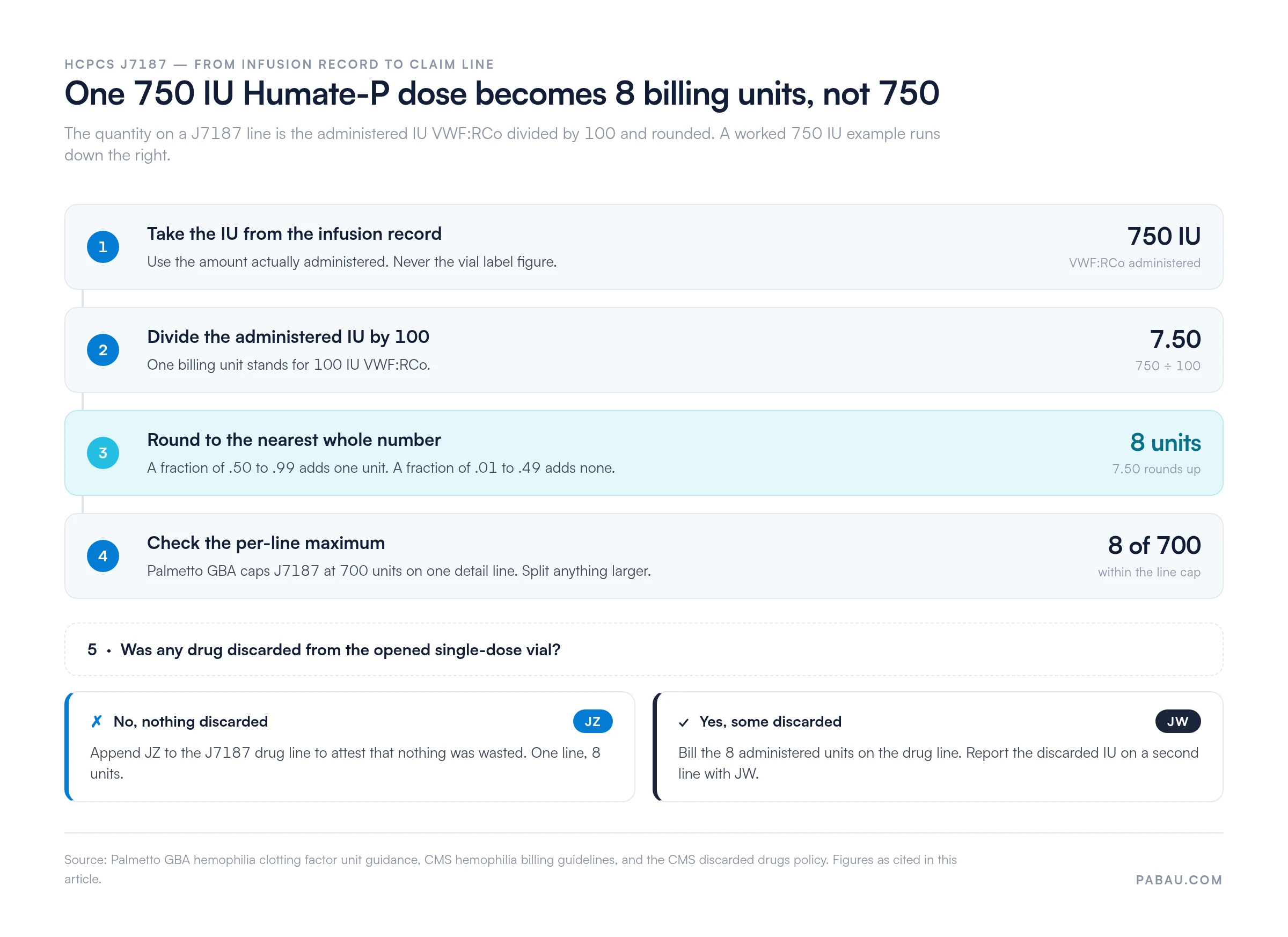
That gives 7.50, which rounds up to 8 billing units. The discarded remainder is reported on its own line rather than folded into that figure.
CMS lists Humate-P among the drugs supplied in single-dose containers, so the wastage modifiers apply. Report any discarded amount on a separate line with the JW modifier. When nothing is discarded, append JZ to the drug line to attest to it. Both requirements come from the CMS discarded drugs policy.
The diagram below traces one drug line end to end, from the infusion record through rounding to the wastage modifier.
Every J7187 claim needs a supporting ICD-10-CM diagnosis code that establishes medical necessity. The two primary diagnoses are stable in the 2026 code set, though coders should verify annually against the CMS ICD-10-CM update files.
Payer-specific policies may accept additional diagnosis codes, for example codes indicating hemorrhagic events or surgical prophylaxis.
Always confirm the accepted diagnosis list with your MAC’s Local Coverage Determination before submitting. An unsupported ICD-10 code on a J7187 claim is a common denial reason, and solid medical billing compliance processes prevent it.
Medicare Part B covers Humate-P under the buy-and-bill model for physician offices and outpatient hospital settings. Coverage is subject to medical necessity, so the clinical record must support both the diagnosis and the frequency of infusions.
Payment then moves through the same revenue cycle as any other Part B claim. Eligibility checks, unit accuracy, and denial follow-up all decide how fast the money lands.
Medicare reimburses J7187 under the Average Sales Price (ASP) plus 6% methodology. CMS updates ASP pricing quarterly, so any per-unit dollar figure quoted in a third-party publication may already be out of date.
Always verify the current quarter’s ASP rate before you bill. Use the CMS Physician Fee Schedule lookup tool or the quarterly ASP drug pricing files on cms.gov.
What stays consistent is the arithmetic. Payment applies the ASP+6% formula to each unit reported. Because one billing unit stands for 100 IU, a single-unit slip moves the payment by 100 IU worth of product. On high-dose VWD infusions, those slips add up fast.
Medicare Administrative Contractors can impose coverage criteria beyond the national baseline. Palmetto GBA, for example, publishes dated unit submission guidance for hemophilia clotting factor J-codes, most recently updated in January 2026.
Other MACs such as Novitas and CGS may set different documentation requirements or prior authorization thresholds. Check your own MAC’s LCD before assuming the national rules apply uniformly.
Before you trust any J7187 unit calculation, confirm two numbers with your own MAC: the divisor and the per-line maximum. Palmetto GBA divides administered IU by 100 and caps J7187 at 700 units on one detail line. Contractors republish that unit guidance every quarter, so bookmark the page and re-read it each January alongside the annual HCPCS and ASP updates.
Physician offices and outpatient hospital departments billing J7187 buy Humate-P directly from a specialty distributor. They administer it to the patient, then bill the payer for the drug plus the administration service.
Effective drug inventory management is essential here, because NDC tracking errors during buy-and-bill are a primary denial driver.
Incomplete documentation is the second most common reason J7187 claims are denied or flagged for audit. Digital intake forms and structured treatment records cut the work of assembling all of it at claim time. Here is the full checklist:

A well-constructed superbill that captures these elements at the point of care saves significant rework later. Build the checklist into the infusion workflow instead of reassembling it when the claim is due.
Palmetto GBA’s 2026 hemophilia factor guidance names a consistent set of errors across J7187 claims. Each one is preventable with the right workflow controls, and strong denial management starts by catching them before submission.
HCPCS Code J7187 is specific to Humate-P. Other von Willebrand and factor VIII products carry their own J-codes. The plasma-derived and recombinant families do not overlap.
Selecting the wrong code is a non-billable service error. Use this reference table to keep J7187 apart from the codes closest to it.
Billing J7183 when Humate-P was administered will not always trigger an immediate technical denial. It is still inaccurate coding, and it invites post-payment recoupment once an auditor compares the product to the billed code. Match the J-code to the product dispensed every time.
The unit definitions above are descriptor language. Every code in this table sits on the same hemophilia factor list, so the divide-by-100 quantity rule holds when you switch codes.
Outside that list the descriptor sets the unit, and the divisor changes with it. 150 units of hyaluronidase counts up to 150 units of hyaluronidase as a single billing unit. Codes are also retired and crosswalked, as J3487 was, so re-read the descriptors each January.
Infusion practices billing J7187 run a documentation-heavy workflow. Lot numbers, NDC codes, exact IU counts, lab values, and physician orders all have to reach the claim intact. In many practices that means a scheduler, a paper infusion log, and a separate billing tool.
Practice management software like Pabau keeps those fields in one client record instead. Practices running an EMR built for infusion capture infusion detail in structured templates rather than free-text notes. Drug, dose, lot, NDC, route, and duration each get their own field, so unit extraction reads a number instead of a sentence.
Pabau’s claims management software then carries that record into the claim, and our Claim.MD integration submits it electronically. Nobody retypes the administered units, which is where the hundredfold errors start.
The same setup serves practices well beyond hematology. IV therapy practices and functional medicine practices buy and bill drugs on the same terms, and they need the same lot-level trail.
Specific Pabau capabilities relevant to J7187 billing workflows:
Run a quarterly internal audit of your J7187 claims. Pull a sample of 20, divide the IU in each infusion record by 100, and compare the result to the units billed. Discrepancies between the two are the most common trigger for MAC-initiated focused reviews. Catching them internally first lets you correct the pattern before it becomes an external audit finding.

Pabau helps infusion practices capture exact treatment documentation, track drug inventory by NDC and lot number, and submit cleaner claims with fewer denials. See how it works for hemophilia and specialty drug billing.

Two habits keep J7187 claims clean. Convert every dose from the infusion record rather than the vial label, and get your own MAC’s divisor and per-line maximum in writing.
Practices that build the conversion into the documentation template stop re-checking arithmetic at claim time. The check happens once, at the point of care, while the IU figure is still in front of the person who measured it.
The trade-off is worth naming. Structured infusion fields take a little longer to fill in than a free-text note. They are also what stands up when an auditor asks for the lot number two years later. Book a demo to see how Pabau links infusion records to the claim for VWD and hemophilia A programs.

Coding a sacroiliac joint sprain? ICD-10 code S33.6 guide covers the 7th character extension that keeps this sprain claim from bouncing.
Documenting a late renal artery complication? ICD-10 Code S35.492S guide covers billing this sequela code for a healed left renal artery injury.
Billing another injectable drug code? J3470 walks through unit conversion and documentation for hyaluronidase injections.
Chasing a J-code that no longer pays? J3487 shows how a deleted code is crosswalked to its replacement without losing the claim.
Billing supplies alongside drugs? A4618 sets out how supply codes are documented and reported for 2026.
HCPCS Code J7187 is used to bill for Humate-P infusions, a plasma-derived von Willebrand factor and Factor VIII concentrate. It applies when Humate-P is administered to treat or prevent bleeding in von Willebrand disease (D68.0) or hemophilia A (D66). The setting is a physician office or outpatient hospital department billing under the buy-and-bill model.
Divide the IU VWF:RCo administered by 100 and round to the nearest whole number. A 1,500 IU dose is billed as 15 units. A 750 IU dose gives 7.50, which rounds up to 8. Fractions of .50 to .99 add one unit, and fractions of .01 to .49 add none. Palmetto GBA also caps J7187 at 700 units on a single detail line.
The primary ICD-10-CM codes accepted with J7187 are D68.0 (von Willebrand disease) and D66 (hereditary factor VIII deficiency, hemophilia A). Additional codes covering hemorrhagic events or surgical prophylaxis may be accepted by specific MACs or commercial payers. Confirm the covered diagnosis list in your MAC’s Local Coverage Determination before submitting.
Medicare reimburses J7187 under the ASP+6% methodology, with the rate calculated per billing unit, where one unit represents 100 IU VWF:RCo. Because CMS updates ASP pricing quarterly, no fixed per-unit dollar figure remains current for the full year. Verify the current quarter’s rate directly in the CMS quarterly ASP drug pricing files or the Physician Fee Schedule lookup tool at cms.gov.
Yes. CMS lists Humate-P among the drugs supplied in single-dose containers, so every J7187 drug line carries one of the two modifiers. Append JZ when nothing was discarded. When drug was discarded, bill the administered amount without a modifier, then report the discarded amount on a second line with JW.
Required documentation includes the infusion record showing exact IU VWF:RCo administered, the 11-digit NDC for the vial used, and the lot number. You also need a supporting physician order, ICD-10-CM diagnosis codes establishing medical necessity, and laboratory values (VWF:RCo activity or FVIII assay) supporting the indication. Most MACs also require a medical necessity letter for ongoing factor replacement therapy.
Both codes describe plasma-derived von Willebrand factor and Factor VIII concentrates measured in IU VWF:RCo. J7187 is specific to the Humate-P brand, and J7183 is specific to Wilate. Billing one when the other was administered is inaccurate code assignment, even when the claim pays. It can trigger post-payment audit recoupment without any immediate claim rejection.