CCSD code 20210: Pure tone audiogram billing guide
CCSD code 20210 is the UK private billing code for a pure tone audiogram by air ...

Last Updated: Nov 16, 2026
J7185 is the HCPCS Level II code for injection, factor VIII (antihemophilic factor, recombinant) (Xyntha), per IU. It describes one product, Xyntha, the recombinant factor VIII that Pfizer makes for people with hemophilia A.
Most billing errors on this code come from three places. Coders bill another factor VIII product under J7185, or they miscount units against the infusion record. Others leave off the NDC that payers require on Part B drug claims. This guide covers code selection, units, documentation and denial prevention for J7185.
Let Pabau's smart automation suggest the right codes, reduce claim denials, and keep your practice compliant—effortlessly.
Automate repetitive tasks and focus on what matters most—your patients.
Reduce coding errors and ensure compliance with the latest regulations.
Clean claims, fewer denials, and faster reimbursements.
Powerful insights and reporting to help your practice thrive.
HIPAA compliant SOC 2 certified GDPR-compliant Trusted by 4,000+ clinics worldwide

J7185 is a brand-specific code for Xyntha, Pfizer’s recombinant factor VIII, billed per IU administered.
Plasma-derived factor VIII goes on J7190, and other recombinant factor VIII products go on their own codes or J7192.
Units billed equal the IUs administered, and the claim carries the 11-digit Xyntha NDC plus a JW or JZ modifier.
Report D66 for hereditary factor VIII deficiency; acquired hemophilia (D68.311) and von Willebrand disease do not fit Xyntha.
HCPCS Code J7185 is the HCPCS Level II code for Xyntha, Pfizer’s recombinant factor VIII, billed per international unit (IU).
CMS’s October 2026 NDC-HCPCS crosswalk maps every Xyntha NDC, labeler code 58394, to J7185 at one IU per billing unit. The code sits in the clotting factors range, J7177-J7214.
Level II is the system that CMS maintains for drugs, biologicals and supplies that CPT does not describe. Its official descriptor reads “Injection, factor VIII (antihemophilic factor, recombinant) (XYNTHA), per IU.”
Two words in that descriptor do the work. “Recombinant” means the factor VIII is made in cell culture rather than purified from donated plasma. “XYNTHA” names the one product the code describes: Xyntha, the recombinant factor VIII that Pfizer markets through its Wyeth BioPharma division. Any other factor VIII product belongs on a different code.
Xyntha treats hemophilia A, recorded in ICD-10-CM as D66, hereditary factor VIII deficiency. Hematology practices, hemophilia treatment centers and specialty pharmacies that bill Part B will see the code. The most common error is billing J7185 for a factor VIII product that is not Xyntha.
The scope of J7185 is one product. If the vial or prefilled syringe in the infusion record is not Xyntha, the code is wrong.
Covered: Xyntha recombinant factor VIII, billed per IU administered, in any of its labeled strengths and kit presentations.
Not covered under J7185:
Charts often say “factor VIII” or “rFVIII” without naming the brand. Before assigning J7185, confirm the product name and NDC on the dispensing record or vial label. A Xyntha NDC starts with the labeler code 58394, which is a quick check against the pharmacy record. If the label shows human plasma-derived factor VIII instead, the line belongs on J7190.
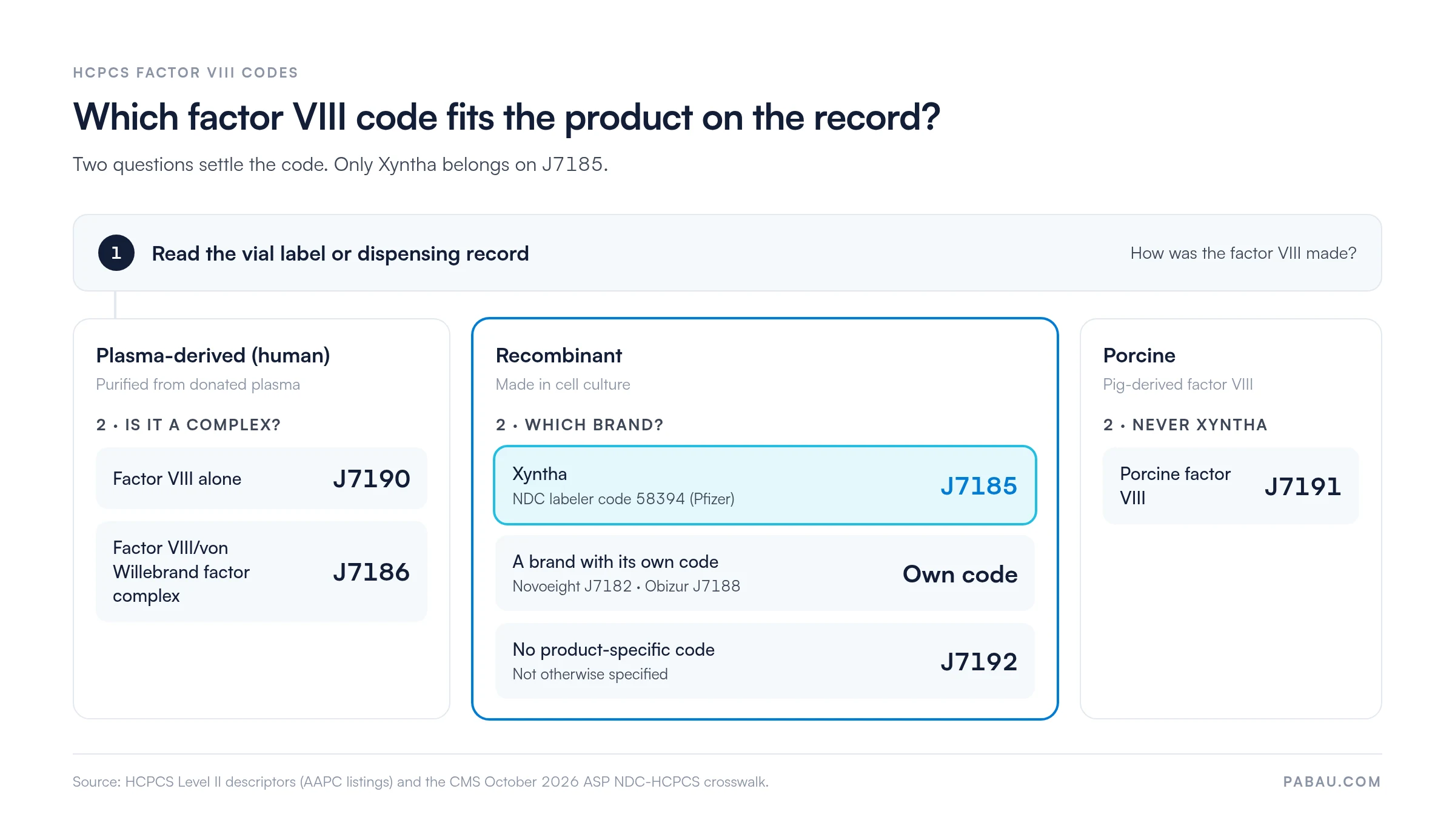
The factor VIII codes split on two questions. Is the product plasma-derived or recombinant, and does the recombinant product have its own code? J7185 answers both: recombinant, and Xyntha only. The descriptors below are taken from the AAPC HCPCS listings.
When the chart does not name the product, query the prescribing clinician or the dispensing pharmacy before coding. Defaulting to J7192 when the brand is Xyntha is as much a coding error as putting another brand on J7185. Two questions about the product settle the code, as the decision path below shows.
Medicare Part B pays for J7185 under the Average Sales Price (ASP) method, at ASP plus 6%. Medicare also pays a separate clotting factor furnishing fee per IU, which CMS updates each year. CMS publishes the ASP payment limits every quarter, so a figure written into a billing policy goes stale quickly. Pull the current limit from the CMS ASP pricing files each quarter.
Report the 11-digit NDC of the Xyntha package on the claim. It goes in loop 2410 of the 837P, or the shaded area of box 24 on the CMS-1500. The label prints a 10-digit NDC, so pad the middle segment with a leading zero. For example, 58394-012-01 becomes 58394-0012-01 on the claim. Payers check the NDC against the NDC-to-HCPCS crosswalk, so the NDC of a different factor VIII product on a J7185 line will not match.
Units billed equal IUs administered. The descriptor says “per IU,” so each international unit of Xyntha is one billable unit on the claim line. There is no rounding to a vial size. If the infusion record documents 2,000 IU administered, 2,000 units go in the quantity field.
Worked example:
CMS requires the JW or JZ modifier on Part B claims for drugs from single-dose containers. The CMS JW and JZ modifier FAQ lets practices report JZ from January 1, 2023. It became required no later than July 1, 2023. Since October 1, 2023, claims that leave the modifiers off may be returned as unprocessable. Check your MAC’s current guidance before you rely on a default.
The chart must support both the diagnosis and the specific product given. A missing element below is enough for an audit to deny the claim. Good medical billing compliance means recording these at the time of service, not rebuilding them after a denial.
Before submission, check that the IU count in the infusion record matches the units on the claim line. A mismatch between the two numbers often triggers a post-payment review, even when the claim pays the first time.
Traditional Medicare Part B does not use prior authorization for J7185, but Medicare Advantage plans often do. Most commercial payers and Medicaid plans manage factor VIII through prior authorization or a preferred-product list. Check the plan’s policy at the start of each treatment course, as requirements change with plan year renewals.
Checking coverage before the infusion matters as much as the authorization. Thorough insurance eligibility verification confirms active coverage, the benefit that pays for injectables, and whether the plan prefers a different factor VIII brand.
Typical prior authorization criteria for commercial plans include:
Read the payer’s clotting factor policy before the first J7185 claim. Many plans name preferred factor VIII products, documentation rules and dosing limits. A claim that pays can still be recouped in a post-payment review if the chart does not meet those criteria.
The place of service code tells the payer where Xyntha was given and which payment system applies.
Medicare Part B covers clotting factors that people with hemophilia give themselves at home, which is unusual for a Part B drug. The separate home infusion therapy benefit pays for professional services, not for the factor itself. Confirm the coverage pathway and contractor with the payer before billing POS 12.
J7185 claims fail for predictable reasons. Fixing the root cause of each one stops the same denial from coming back. Systematic denial management also protects revenue on high-cost biologics that pay first and are recouped later. The codes below are the X12 claim adjustment reason codes (CARC) and remark codes (RARC) whose wording matches each problem. The code a payer returns can differ.
Reviewing each J7185 claim against common medical billing denial codes before submission catches most of these early. A short checklist covering brand, NDC, units, modifier and authorization prevents most avoidable denials.
Xyntha is indicated for hemophilia A, so the diagnosis on a J7185 claim should be D66. Most other bleeding disorder codes either describe a condition Xyntha does not treat or point to a different factor product. Congenital factor XIII deficiency (D68.2) is one example, and its Corifact infusions bill under J7180.
Confirm the factor deficiency in the patient’s hematology records before assigning codes, especially for new patients. An unspecified coagulation defect code in place of D66 invites a medical necessity denial.
J7185 is a drug code only. It covers the Xyntha itself, not the act of giving it. When a practice administers the dose, the administration takes a separate CPT code on the same claim. Billing one without the other leaves an incomplete claim that payers may partly deny.
IV infusion administration codes come from the 96365-96368 range. Xyntha is often given as a slow IV injection over several minutes, which CPT 96374 (IV push) describes. The AMA’s CPT code set defines these codes and their reporting rules. Check that no bundling edit applies between J7185 and your administration code, as policies vary by contractor.
Modifiers on the J7185 drug line (JW, JZ) are separate from any modifiers on the administration code. Linking each drug record to its administration code in your revenue cycle management workflow stops one half of the pair from going out alone.
Most J7185 errors start before the claim is built. The brand, NDC and IU count sit in a pharmacy record, a paper flowsheet or an infusion note. Someone then retypes them into the billing system.
In Pabau, the practice management and billing platform we build, staff record each Xyntha administration in the patient’s file. The claim is then prepared from that same record, with the brand, NDC and IU count already on it. Pabau’s claims software for US practices sends CMS-1500 and 837P claims through Claim.MD, with eligibility checks and ERA remittances in the same connection.
The result is fewer retyped fields between the infusion and the claim. Your team still confirms the brand, NDC and units, but from one record rather than three.

Record each Xyntha administration in Pabau and prepare the claim from that record. US practices send CMS-1500 and 837P claims through Claim.MD.

Every J7185 claim depends on the product in the vial. Settle the brand and NDC first, and the units, modifiers and diagnosis follow from the infusion record.
That check costs a few seconds per claim. Skipping it risks a recoupment months later, because a wrong factor VIII code often pays first and is taken back in a post-payment review. Book a demo to see how Pabau keeps drug administration records and claims in one place for your practice.

Billing a plasma-derived complex instead? HCPCS code J7186 covers Alphanate units, NDC reporting and how the complex differs from factor VIII alone.
Treating von Willebrand disease? HCPCS code J7187 explains Humate-P billing, units and Medicare coverage.
Need a clean claim submission workflow? Clean claim submission best practices covers the pre-submission checklist that reduces first-pass denials across drug codes.
Building a denial prevention program? Denial management in healthcare shows how to track, appeal and prevent denials on high-cost biologics.
HCPCS Code J7185 covers Xyntha, Pfizer’s recombinant factor VIII, billed per international unit (IU) administered. Its official descriptor is “Injection, factor VIII (antihemophilic factor, recombinant) (XYNTHA), per IU.” It is a brand-specific code, so other factor VIII products do not belong on it.
J7185 is for Xyntha only. J7190 is for plasma-derived (human) factor VIII. J7192 is for recombinant factor VIII that has no brand-specific code. Check the brand and NDC on the dispensing record to choose between them.
Units billed equal the IUs administered, taken from the infusion record. If 2,000 IU were given, bill 2,000 units. Append JZ when no drug from a single-dose vial was discarded, or report discarded IUs on a separate line with JW.
Yes. Medicare Part B covers J7185, including factor that patients with hemophilia give themselves at home. Payment is based on ASP plus 6%, and CMS updates the limits every quarter. Medicare also pays a separate clotting factor furnishing fee. Check the current CMS ASP pricing file rather than a fixed figure.
D66, hereditary factor VIII deficiency (hemophilia A), is the diagnosis that supports Xyntha. D68.311 is acquired hemophilia, a different condition that is usually treated with other products. Xyntha is not indicated for von Willebrand disease.
Traditional Medicare Part B does not use prior authorization for J7185, but many Medicare Advantage, Medicaid and commercial plans do. Some plans also prefer a specific factor VIII brand. Check the plan’s policy before the first infusion of each treatment course.