HCPCS code J7040: Normal saline 500 mL billing guide
HCPCS code J7040 bills normal saline in 500 mL units HCPCS code J7040 is the CMS...

Last Updated: Nov 10, 2026
J7190 is the HCPCS Level II code for Factor VIII (antihemophilic factor, human), billed per international unit. It covers human plasma-derived concentrates such as Hemofil M and Koate, used mainly for hemophilia A.
Each IU administered is one billing unit, so a 1,050 IU dose bills as 1,050 units. Recombinant Factor VIII bills under J7192 or its own code, and porcine-sequence Obizur under J7188.
Let Pabau's smart automation suggest the right codes, reduce claim denials, and keep your practice compliant—effortlessly.
Automate repetitive tasks and focus on what matters most—your patients.
Reduce coding errors and ensure compliance with the latest regulations.
Clean claims, fewer denials, and faster reimbursements.
Powerful insights and reporting to help your practice thrive.
HIPAA compliant SOC 2 certified GDPR-compliant Trusted by 4,000+ clinics worldwide

J7190 covers human plasma-derived Factor VIII only, so recombinant, porcine-sequence and FVIII/VWF complex products bill under other codes.
One IU administered is one billing unit, so a 1,050 IU dose goes on the claim as 1,050 units.
Medicare Part B pays ASP+6% per IU, updated quarterly, before the 2% sequestration reduction and patient coinsurance.
Claims for single-dose or single-use J7190 products need the JW or JZ modifier, required on Medicare claims since July 1, 2023.
State Medicaid programs and many commercial payers require the 11-digit NDC, and a wrong or stale NDC is a common technical denial.
HCPCS code J7190 describes “Factor VIII (antihemophilic factor, human), per IU.” It’s the Level II J-code the Centers for Medicare and Medicaid Services assigns to plasma-derived Factor VIII concentrates. Each international unit you administer is one billing unit.
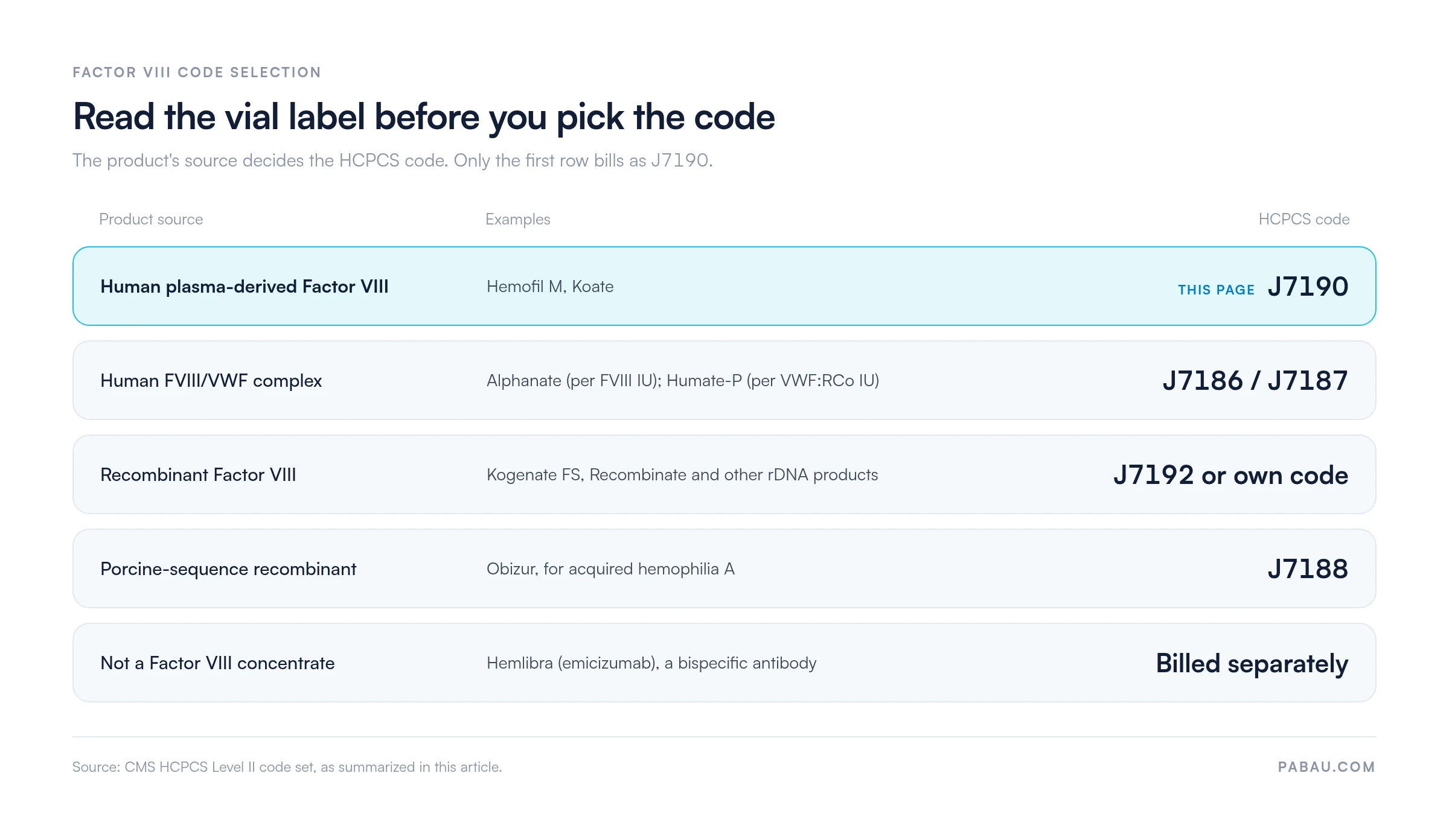
The word that does the work is “human.” Recombinant Factor VIII, porcine-sequence Factor VIII and FVIII/VWF complexes all bill under other codes. Pick the wrong family and the claim fails before anyone reads the dose.
J7190 applies to human plasma-derived Factor VIII concentrates given in a clinic, a hospital outpatient department or at home. Hemofil M and Koate are the usual examples. FVIII/VWF complexes such as Alphanate and Humate-P look similar on the shelf, but they bill under J7186 and J7187.
Most miscoding happens on the exclusion side. None of these belong under J7190:
The quickest check is the product source printed on the vial label, and the chart below maps each source to its code.
J7190 is billed per IU of Factor VIII administered. The units on the claim equal the total IUs given in the session, not the number of vials opened.
The prescriber usually sets the dose with the standard weight-based formula for hemophilia A:
Target IU = Body weight (kg) x Desired factor rise (%) x 0.5
The formula sets the order, but the administration record sets the claim. If the record shows 2,500 IU given, you bill 2,500 units of J7190.
Vials rarely match a dose exactly, so the provider rounds up to the nearest available vial. The amount given goes on the claim. Any product left in an opened vial is wastage, reported with the JW modifier covered below.
Record the patient’s current body weight in every infusion note, not just at baseline. Auditors compare the billed IU count with a weight-based dose. A billed dose you can’t reconcile with a recorded weight is an easy audit flag on clotting factor claims.
J7188 is the code for Obizur, a recombinant Factor VIII built on the porcine sequence and billed per IU. It treats acquired hemophilia A, where the patient’s own antibodies attack human Factor VIII. J7191 is the older porcine Factor VIII code, used for Hyate:C, and Obizur doesn’t bill under it.
Medicare Part B pays J7190 at ASP+6% per IU under the buy-and-bill model, per the Medicare Claims Processing Manual (Pub. 100-04, Chapter 17). CMS updates the Average Sales Price every quarter. Across a full prophylaxis course, a small per-IU change adds up to a material difference.
Medicare also adds a clotting factor furnishing fee per IU, which CMS updates each calendar year. Two adjustments then bring the final payment below the published rate:
Pull the current payment limit from the CMS ASP pricing files before you quote a rate. Medicare Advantage plans set their own payment methods and aren’t bound to the Part B rate.
State Medicaid programs and many commercial payers require the 11-digit NDC of the product administered alongside J7190. Medicare Part B generally does not. Where a payer requires it, a claim without a valid NDC fails technical edits before medical review.
On a CMS-1500 paper claim, the NDC goes in the shaded area of box 24 with the N4 qualifier. On an 837P electronic claim, it goes in loop 2410. Use the 5-4-2 format (manufacturer-product-package) and keep the leading zeros.
Three NDC mistakes cause most technical denials on J7190 claims:
CMS made the JZ modifier mandatory on Medicare claims for drugs from single-dose containers on July 1, 2023 (CMS CR 13056, MM13056).
The rule applies when the product is supplied in a single-dose container or single-use package. Claims for single-dose or single-use J7190 products must carry JW or JZ, or Medicare edits can return them.
The place of service (POS) code on a J7190 claim sets the payment rate and the billing route. CMS checks the billed POS against the type of provider on the claim, so a mismatch is an easy audit find.
Home self-infusion is the setting that trips teams up. Under Medicare Part B, J7190 for home use is billed by the supplier or provider furnishing the factor. That may be a specialty pharmacy, a hemophilia treatment center or the ordering physician, depending on the arrangement.
Medicaid rules vary by state, and some states route home infusion through managed care plans with their own prior authorization.
Medicare Part B fee-for-service doesn’t currently require prior authorization for J7190. Medicare Advantage plans commonly do, and most commercial plans and Medicaid programs want it before the first dispensing.
A J7190 prior authorization request usually needs:
A missing authorization is among the costliest J7190 denials, because the fix often means a retrospective appeal. Confirm whether the authorization covers refills as well as the first supply, and put the PA number on every claim. Solid denial management workflows catch a lapsed authorization before the claim goes out.
The diagnosis on a J7190 claim has to match both the patient’s condition and the product’s labeled indication. For most claims that means D66, hereditary Factor VIII deficiency. A code the product isn’t approved for triggers a medical necessity denial, even when the HCPCS code and units are right.
Von Willebrand disease claims usually involve a complex product rather than J7190. Those products bill under J7186 or J7187, so check the code before you pair a vWD diagnosis with J7190.
Here’s how one illustrative claim moves. A 70 kg adult with severe hemophilia A is on prophylaxis with Koate. The order targets a 30% rise, so the formula gives 1,050 IU.
Most problems show up between steps 3 and 4. When the infusion note and the charge disagree on IUs, the claim either underbills or fails an audit later.
J7190 claims get denied for predictable, fixable reasons. Clotting factor billing has been an Office of Inspector General (OIG) Work Plan target, so payers run tight edits. The table maps each denial to its cause and the fix.
Reading medical billing denial codes alongside the CARC codes on your remittances shows the patterns behind repeat denials. When the same code recurs across several J7190 claims in a month, fix the process rather than appealing claim by claim.
An audit of a J7190 claim asks the record to support the product, the dose and the diagnosis billed. Hemophilia treatment centers (HTCs) are the main billers of this code. MAC Local Coverage Determinations commonly expect these elements:
The medical billing workflow for clotting factor differs from most Part B drugs because the dose changes with weight and bleed history. Static order sets that don’t reflect the IUs actually given leave billed units you can’t reconcile with the chart.
Build a J7190 charge capture template that links the administered IU field straight to the billed unit count. When staff enter the dose, the unit field fills itself. That one link prevents the most common unit-mismatch error on clotting factor claims.
J7190 is the same code whether the infusion is prophylactic or treats an acute bleed. The code follows the product, and the units follow the dose given. Treatment intent still matters in three places:
Billing clotting factor by hand means copying IUs from the infusion note, keying the NDC into the claim and checking each remittance by eye. Every hand-off is a place where a unit count or an NDC drifts.
Pabau, the practice management platform we build, keeps the infusion note, the charge and the claim on one patient record. Its denial-tracking claims software supports electronic 837P claims through Claim.MD. It also posts electronic remittance advice back into the workflow.
So when a J7190 line comes back denied, your billing team sees the reason against the original claim. You correct it from the record instead of rebuilding it from paper.

Pabau supports electronic 837P claims through Claim.MD and posts ERA remittances back into your workflow. See how it handles high-value drug claims like J7190.

J7190 rewards one habit above the rest. Confirm the product source on the vial before you pick the code. A recombinant, porcine-sequence or complex product billed as J7190 fails however clean the rest of the claim is.
After that, the IU count and the NDC carry the claim. Tie the billed units to the administration record, and keep the NDC tied to the vial you opened. Then most denials become rare process fixes instead of weekly appeals.
Book a demo to see how Pabau links each infusion record to its claim and remittance, so clotting factor billing stops depending on re-keyed numbers.

Need a full picture of how clearinghouse billing works? Medical claims clearinghouse guide explains how payers, clearinghouses, and providers exchange claim data electronically.
Getting recurring claim rejections? Clean claim submission checklist covers the formatting and data requirements that prevent technical rejections before a claim reaches payer adjudication.
Dealing with payer denials after submission? How Claim.MD works with Pabau outlines how automated denial identification and ERA posting reduce the time between denial and correction.
In an office or hospital outpatient setting, a Factor VIII push usually bills as CPT 96374. An infusion running longer than 15 minutes bills as 96365 instead. Home self-infusion carries no administration code.
Yes. Part B covers clotting factors that hemophilia patients self-administer at home. The patient still owes the 20% coinsurance after the Part B deductible.
Hospitals usually report J7190 under revenue code 0636, drugs requiring detailed coding. The HCPCS code and units sit on the same UB-04 line.
It’s a per-IU amount Medicare adds to the drug payment for clotting factor. It covers the cost of storing, delivering and managing the product. CMS updates it each calendar year.