HCPCS code J3471: Hyaluronidase ovine injection billing guide
HCPCS code J3471: Descriptor, code type, and quick-reference data HCPCS code J34...

Last Updated: Oct 14, 2026
J7192 is the HCPCS Level II code for factor viii (antihemophilic factor, recombinant) per i.u., not otherwise specified.
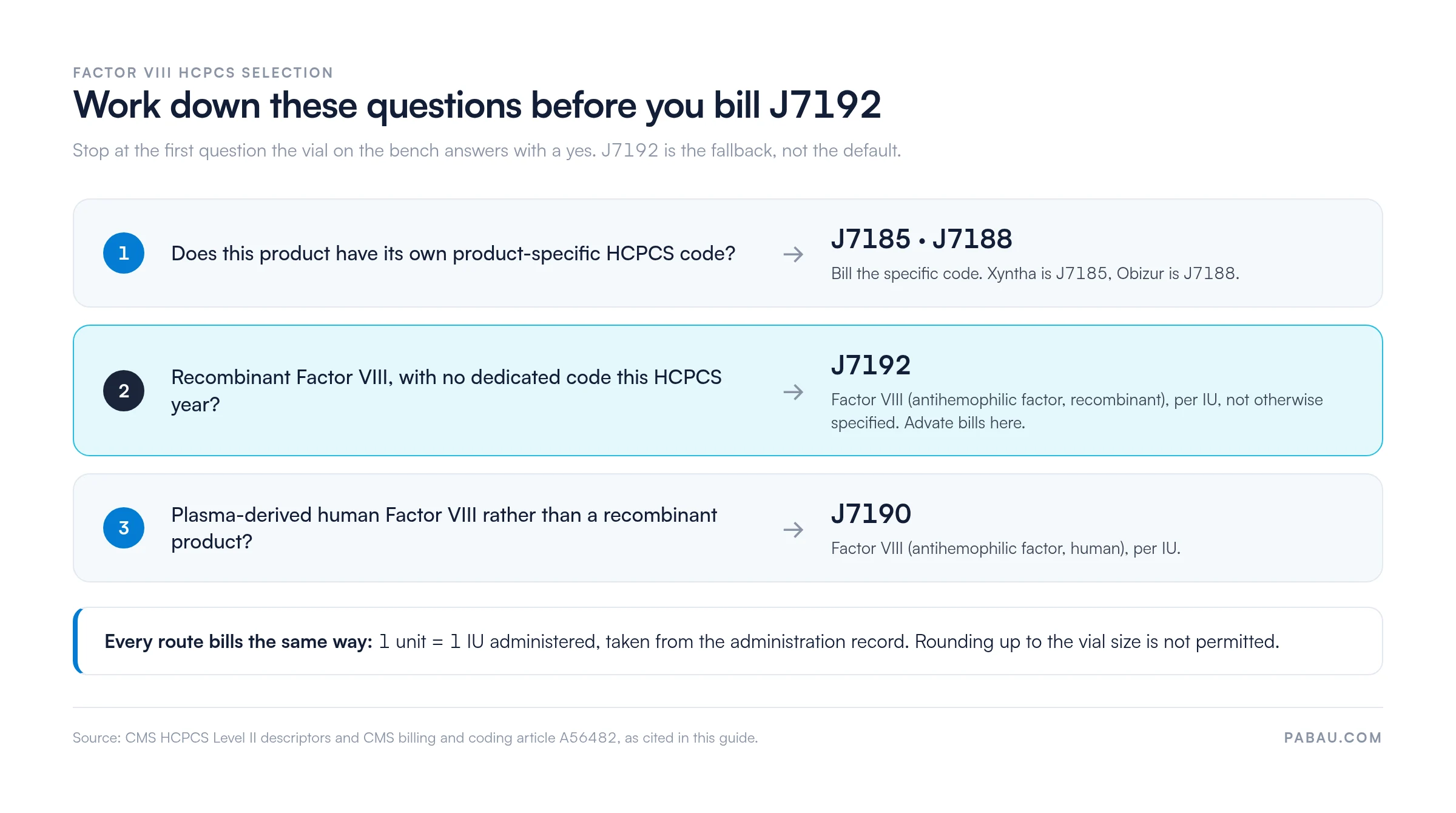
The "not otherwise specified" (NOS) qualifier separates J7192 from product-specific Factor VIII codes. When a branded product has its own dedicated HCPCS code, that code takes priority. J7192 is the fallback for recombinant Factor VIII products with no dedicated code in the current annual HCPCS release.
Let Pabau's smart automation suggest the right codes, reduce claim denials, and keep your practice compliant—effortlessly.
Automate repetitive tasks and focus on what matters most—your patients.
Reduce coding errors and ensure compliance with the latest regulations.
Clean claims, fewer denials, and faster reimbursements.
Powerful insights and reporting to help your practice thrive.
HIPAA compliant SOC 2 certified GDPR-compliant Trusted by 4,000+ clinics worldwide

HCPCS code J7192 covers recombinant Factor VIII products billed per International Unit when no product-specific J-code applies. Advate (octocog alfa) is the usual example.
Each billed unit equals exactly one IU administered. Rounding is not permitted, and a misreported IU figure is the most-cited audit trigger for Factor VIII claims.
Medicare Part B covers J7192 under CMS billing and coding article A56482. ICD-10 codes in the D66, D67 and D68 series support medical necessity.
Practice management software like Pabau ties J-code selection to the NDC and IU fields in one workflow, which cuts transcription errors in infusion billing.
J7192 covers recombinant Factor VIII products that do not have a dedicated HCPCS code. Advate (octocog alfa), made by Takeda, is the product most often billed this way, because no product-specific J-code exists for it.
Other recombinant Factor VIII products map to J7192 in some HCPCS years and not in others. Verify each product against the current annual CMS release files before the claim goes out.
Check whether a more specific code exists before you reach for J7192. Xyntha (moroctocog alfa, J7185) and Obizur (susoctocog alfa, J7188) both carry their own dedicated codes. Billing J7192 for a product that has a specific code invites denials and post-payment audits.
The AAPC HCPCS code lookup and the annual CMS HCPCS release both confirm current assignments. Three questions settle the choice for any Factor VIII product on the bench.
Medicare Part B covers HCPCS code J7192 for eligible hemophilia patients under CMS billing and coding article A56482. Coverage applies when a patient requires Factor VIII recombinant products and cannot self-administer, or when the caregiver is unable to administer the factor.
Verify MAC-specific coverage criteria before billing. Medicare Administrative Contractors such as Palmetto GBA and Noridian publish jurisdiction-specific guidance that supplements the national CMS article.
Self-administration changes the coverage answer. If a patient or a trained family member can infuse at home, Part B coverage may not apply. Document the patient’s ability to self-administer, or the reason they cannot, at every relevant encounter. Noridian’s guidance addresses home infusion and its place-of-service implications.
Every J7192 claim needs a supported ICD-10-CM diagnosis code to establish medical necessity. The primary covered diagnoses are hereditary coagulation disorders in the D66 to D68 range. Individual MACs may add codes or restrict the list, so read the current MAC billing and coding article alongside the national one.
These diagnoses sit inside the wider ICD-10-CM code set, where the D66 to D68 block holds the hereditary coagulation defects. The CDC ICD-10-CM coding tool carries the official definitions and tabular listings.
Report the exact number of International Units (IU) given to the patient. One billed unit equals one IU. Palmetto GBA’s hemophilia clotting factor guidance states that rounding is not permitted. A patient who received 1,247 IU is billed as 1,247 units.
Work the calculation in this order:
Worked example: A patient with hereditary Factor VIII deficiency (D66) receives one vial of Advate labeled at 1,500 IU. The full vial is administered, so the claim shows J7192 with 1,500 units. Where 800 IU is drawn from a 1,000 IU vial, bill 800 units. Document the 200 IU of waste in the clinical record.
The drug and its administration bill on separate claim lines. Where the factor runs as a therapeutic infusion of up to one hour, the administration is reported with CPT code 96365.
Medicare Part B pays J7192 at Average Sales Price (ASP) plus 6%. That is the standard model for separately payable Part B drugs given under physician administration. ASP rates change quarterly, so a dollar figure printed here would be stale within months.
Pull the current rate from the CMS Physician Fee Schedule lookup. The quarterly CMS ASP Drug Pricing files carry the same figures by date of service.
Several adjustments sit between ASP plus 6% and the amount that reaches the bank. Budget neutrality, geographic practice cost indices (GPCIs), and sequestration each move the final figure. Commercial payers set their own rates by contract, outside the Medicare ASP methodology.
Place of service (POS) affects how Medicare reimburses J7192 and what the claim has to document. Infusion centers, physician offices, and hospital outpatient departments each select a POS code on every encounter. The wrong code triggers payment adjustments or an outright rejection.
Palmetto GBA and Noridian both name incomplete records as the leading cause of hemophilia factor billing recoveries. A claim usually fails on a missing NDC, an unsigned order, or an IU figure nobody wrote down at the chair. Paper logs and disconnected systems make those fields easy to lose, so capture each one while the infusion is running.
Run a pre-claim documentation check for any new patient, and again after a break in treatment. Confirm the record carries the current diagnosis, a signed physician order, the vial NDC and lot number, the exact IU administered, and any waste notation. Five minutes of chart review at submission catches the missing fields that turn into five-figure audit recoveries.
J7192 sits in a family of Factor VIII and hemophilia-related J-codes. Knowing when each one applies prevents the most common mistake in this category. That mistake is reaching for the NOS code while a product-specific code exists.
J7192 denials cluster around three causes. Billers miscalculate the units, reach for the NOS code while a specific one exists, or submit without the documentation the payer expects. Each cause has its own fix, and the table below pairs them up.
Billing J7192 depends on a chain that runs from the infusion chair to the claim file. The vial NDC is captured at administration, and the exact IU has to reach the billing system. The diagnosis has to match the current MAC-approved list. Each handoff is a chance to lose a field.
Practice management software like Pabau closes those handoffs. Pabau’s software for infusion billing ties J-code selection to the NDC and IU fields inside one encounter record. The biller reads what the nurse recorded, rather than re-keying it from a paper log.
Digital clinical forms can make lot number, NDC, and IU administered mandatory before an encounter closes. The record then meets the documentation standard MAC auditors ask for, without a chart chase two weeks after the infusion.

Pabau connects clinical documentation, drug lot tracking, and claim submission in one platform. Your billing team spends less time chasing NDCs and more time on care.

J7192 is a narrow code with an exacting standard. It is correct only when no product-specific recombinant Factor VIII code exists, and every unit must equal one IU administered.
Verify the product-to-code mapping once a year, when the HCPCS release changes. Capture the NDC and the exact IU while the infusion is running, and point each claim at a supported diagnosis. Those three habits cover the audit patterns that MAC guidance flags for this code.
Pabau captures those fields at the point of care, so the record is audit-ready before the claim is generated. Book a demo to see how J-code documentation and claim submission work for an infusion practice.

Keeping an infusion practice audit-ready? Medical billing compliance for healthcare practices sets out the documentation and audit standards that apply across specialty drug billing.
Billing factor infusions outside the office? CPT code 99601 home infusion billing guide covers how a home infusion visit is reported and what has to support it.
Reporting drug units and NDCs on another J-code? HCPCS code J0694 billing guide works through unit calculation, NDC formatting, and the denials that follow when the two disagree.
HCPCS code J7192 is the billing code for Factor VIII (antihemophilic factor, recombinant), per IU, not otherwise specified. It is used for recombinant Factor VIII products that have no dedicated HCPCS code of their own. Advate (octocog alfa) is the product most often billed this way. Medicare Part B covers it for eligible hemophilia A patients who need physician or caregiver administration.
Advate (octocog alfa) is the primary product billed under J7192, because it has no product-specific HCPCS code. Other recombinant Factor VIII products without a dedicated J-code also map to J7192. Products with their own codes, such as Xyntha (J7185) and Obizur (J7188), must be billed with those codes instead.
One billed unit equals one IU of Factor VIII administered. Read the exact IU from the administered vial label, then work out the precise IU given from the volume used. Enter that number in the units field on the claim. Rounding to the nearest hundred or to the full vial size is not permitted under MAC billing guidance from Palmetto GBA and Noridian.
Yes, Medicare Part B covers J7192 under CMS billing and coding article A56482 for eligible patients with a confirmed hemophilia or coagulation disorder diagnosis. Coverage criteria include medical necessity documentation and, in certain scenarios, a requirement that the patient or caregiver cannot self-administer. MAC-specific guidance may add requirements depending on jurisdiction.
Medicare reimburses J7192 at ASP plus 6%, the standard Part B rate for separately payable drugs. ASP-based rates change quarterly, so current dollar amounts have to be checked for the specific date of service. The CMS ASP Drug Pricing files and the CMS Physician Fee Schedule lookup both carry them. Sequestration adjustments apply and reduce the net payment below the stated ASP plus 6% figure.
J7185 is the product-specific code for Xyntha (moroctocog alfa). J7192 is the “not otherwise specified” fallback, used when no product-specific code applies. Always bill J7185 when Xyntha is the administered product. Using J7192 for a product that has its own dedicated code is a coding error that can result in denials or audit findings.
The record needs the hemophilia or coagulation disorder diagnosis with its ICD-10-CM code, plus a physician order for the specific product. It also needs the vial’s NDC and lot number, the exact IU administered, and the date and time of administration. Where coverage depends on it, document the patient’s inability to self-administer. MAC guidance from Palmetto GBA and Noridian carries the documentation checklists for their jurisdictions.