CCSD code 20210: Pure tone audiogram billing guide
CCSD code 20210 is the UK private billing code for a pure tone audiogram by air ...

Last Updated: Nov 16, 2026
J7180 is the HCPCS Level II code for injection, factor XIII (antihemophilic factor, human), 1 IU. It bills Corifact, a plasma-derived factor XIII concentrate, at one unit per international unit infused.
The code pairs with ICD-10-CM D68.2 for congenital factor XIII deficiency. Hemophilia A infusions never belong here. Plasma-derived factor VIII bills under J7190, and recombinant factor XIII under J7181.
Let Pabau's smart automation suggest the right codes, reduce claim denials, and keep your practice compliant—effortlessly.
Automate repetitive tasks and focus on what matters most—your patients.
Reduce coding errors and ensure compliance with the latest regulations.
Clean claims, fewer denials, and faster reimbursements.
Powerful insights and reporting to help your practice thrive.
HIPAA compliant SOC 2 certified GDPR-compliant Trusted by 4,000+ clinics worldwide

HCPCS code J7180 bills Corifact, a plasma-derived factor XIII concentrate, at one unit per international unit infused.
J7180 pairs with ICD-10-CM D68.2 for congenital factor XIII deficiency, never with D66 for hemophilia A.
Plasma-derived factor VIII bills under J7190, and recombinant factor XIII (Tretten) bills under J7181.
Bill units from the potency printed on each vial label, not from the weight-based target dose.
Payers such as Cigna require prior authorization and a hematologist prescriber, with doses capped per 28 days.
HCPCS code J7180 is the Level II code for injection, factor XIII (antihemophilic factor, human), 1 IU. CMS publishes it in its quarterly HCPCS code files, and the current AAPC listing places it in the clotting factors range, J7177–J7214. The one product it describes is Corifact, a plasma-derived factor XIII concentrate from CSL Behring.
Corifact treats congenital factor XIII deficiency, a rare inherited bleeding disorder. Its FDA label covers routine prophylaxis and peri-operative management of surgical bleeding, in adults and children.
The CMS HCPCS file is updated every quarter. Confirm the descriptor against the current release before you submit a claim.
J7180 covers a single product type, human plasma-derived factor XIII concentrate. Factor XIII, also called fibrin stabilizing factor, cross-links fibrin so that a clot holds. A different factor, or a recombinant product, needs a different code.
Covered by J7180:
Not covered by J7180:
Check the package insert before you code. A plasma-derived factor XIII concentrate goes to J7180, and a recombinant one goes to J7181.
One billed unit of J7180 equals one international unit (IU) of factor XIII. Bill the IU infused, as printed on the vial labels, never the number of vials.
Corifact comes in a single-dose vial holding 1,000–1,600 IU. The label states the exact potency on each vial and carton, so two vials rarely carry the same figure.
Worked example: A 70 kg patient prescribed 40 IU/kg has a target dose of 2,800 IU. The claim still carries the IU printed on the vials infused, which can land slightly above or below that target.
Corifact is packaged as a single-dose vial. Medicare applies its JW and JZ discarded-drug modifier rules to single-dose containers, so check your MAC’s current guidance before you bill an unused amount.
Factor XIII and factor VIII codes sit a few numbers apart, which is how J7180 ends up on hemophilia A claims. The three codes below split by factor and by source.
Two more factor VIII codes sit close by. J7185 covers Xyntha, and J7186 covers factor VIII/von Willebrand factor complex. The chart below places all five side by side.
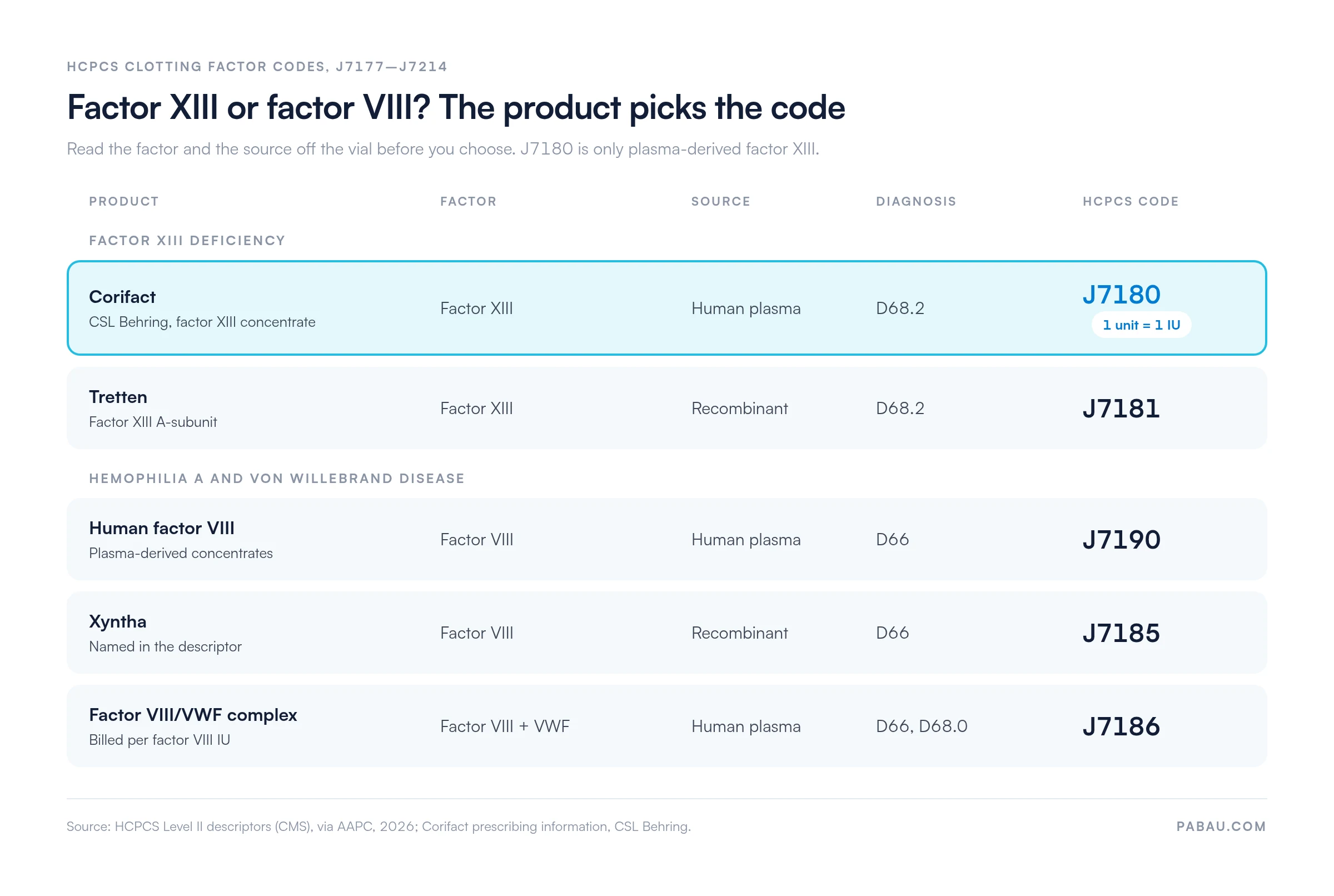
If the chart says hemophilia A, J7180 is the wrong code whatever the claim history shows. Re-read the order and the vial, then rebill under the factor VIII code that matches the product, such as J7190 for plasma-derived factor VIII.
Corifact and Tretten treat the same deficiency but bill under different codes. When a patient switches products, change the code from the first infusion of the new product and note the switch in the record.
D68.2, hereditary deficiency of other clotting factors, is the diagnosis for J7180. Its inclusion terms list deficiency of factor XIII (fibrin stabilizing), and payers check that pairing at adjudication.
List D68.2 first on every J7180 line. For a peri-operative dose, add the reason for surgery as a secondary diagnosis if your payer asks for it.
Most commercial plans require prior authorization for Corifact. Cigna’s Corifact coverage policy (IP0552), for example, approves it for one year when a hematologist prescribes it or is consulted.
That policy allows up to 160 IU/kg by IV infusion, no more often than once every 28 days. Doses above that go to case-by-case review by a clinician.
Typical prior authorization checklist:
Corifact’s label adjusts the dose in 5 IU/kg steps to keep trough factor XIII activity between 5% and 20%. A new dose can exceed an approval written for the old one, so recheck the authorized quantity whenever the order changes.
Medicare Part B covers clotting factors under a dedicated benefit for hemophilia patients, Section 1861(s)(2)(I) of the Social Security Act. Ask your MAC whether it applies to factor XIII deficiency, and confirm before the first claim.
Part B pays clotting factors at average sales price (ASP) plus 6%, plus a separate clotting factor furnishing fee. CMS posts current rates in its quarterly ASP pricing files, so look up J7180 each quarter rather than reusing an old figure.
Medicaid coverage varies by state. Many state programs manage Corifact through a pharmacy prior authorization policy, so check the state’s criteria and fee schedule before the first dispense.
Bill the factor from the entity that supplied it. A practice that bills POS 11 for a dose the patient infused at home invites an audit finding.
A J7180 claim holds up when the chart shows the deficiency, the order, the vials and the infusion. Record each item at the time of service, not afterwards.
For home infusion, keep the patient or caregiver training record and the dispensing log. Together they show the dose was supplied and self-administered as billed. For how these records fit the wider claim cycle, see our overview of medical billing.
Before you send a J7180 batch, match three things. Check the NDC against the vial dispensed, the units against the IU on the vial labels, and the diagnosis against D68.2.
Most J7180 denials trace back to the code, the units or the paperwork. The table maps each pattern to the X12 claim adjustment reason code (CARC) or remark code (RARC) that usually appears on the remittance. Our guide to denial codes explains the most common CARC codes and how to fix each one.
Medicare allows 120 days from receipt of the initial determination to request a redetermination. Commercial plans set their own windows, so log each denial with its date and reason code.
A denial management workflow that groups J7180 denials by reason code shows whether the cause is coding or paperwork. Our guide to the clean claim submission process covers the checks that stop them before submission.
Factor XIII billing spreads across an authorization letter, a dispensing log and a claim form. Kept in separate places, the units, lot numbers and approval dates drift apart.
Pabau, the practice management platform we build, holds them on the patient’s case. The prior authorization code, its dates and approved sessions sit on the case, and Pabau warns your team when one is missing.
Stock in Pabau carries a batch number and an expiry date, and the lot is recorded against the patient and the appointment. US claims go out through Claim.MD as CMS-1500 or 837P claims, with eligibility checks and ERA remittances. With claims management on the same record, a short payment on a factor claim shows up next to the infusion it paid for.

Pabau tracks prior authorization codes and dates on the case, records lot numbers against each infusion, and sends US claims through Claim.MD. Your team sees a missing authorization before the claim goes out.

J7180 is a narrow code, covering one factor, one source and one product. A hemophilia A diagnosis on a J7180 line is a coding error. Move that claim to the factor VIII code that matches the vial.
For Corifact claims, the work sits in the units and the authorization. Bill the potency printed on the vials, keep the lot numbers, and recheck the approved quantity whenever the dose changes. Book a demo to see how Pabau keeps factor XIII authorizations, lots and claims on one patient record.

Need a system for working factor claim denials? Denial management in healthcare covers how to track and appeal denials by reason code across drug billing.
Billing a factor dose outside the clearinghouse? Superbill best practices shows how to list codes, units and diagnoses so a payer can process the claim.
Billing plasma-derived factor VIII instead? HCPCS code J7190 covers the code that hemophilia A infusions of human factor VIII belong under.
HCPCS code J7180 covers injection of factor XIII (antihemophilic factor, human), billed per 1 IU. The product it describes is Corifact, a plasma-derived factor XIII concentrate for congenital factor XIII deficiency. It does not cover factor VIII or recombinant factor XIII.
Bill one unit per IU infused, using the potency printed on each vial label. If two vials labeled 1,300 IU and 1,450 IU are infused, bill 2,750 units. Never bill the vial count.
J7180 is plasma-derived factor XIII (Corifact), and J7181 is recombinant factor XIII A-subunit (Tretten). J7190 is plasma-derived factor VIII for hemophilia A. Match the code to the factor and the source on the vial.
Most commercial plans require it. Cigna, for example, approves Corifact for one year when a hematologist prescribes or is consulted. Its cap is 160 IU/kg, no more often than every 28 days. Check each plan’s policy before the first dose.
ICD-10-CM D68.2, hereditary deficiency of other clotting factors, which includes factor XIII deficiency. Do not pair J7180 with D66 for hemophilia A, which belongs with factor VIII codes such as J7190.
Corifact’s label starts routine prophylaxis at 40 IU per kg every 28 days. The dose then moves in 5 IU/kg steps to keep trough factor XIII activity between 5% and 20%.