CPT Code 62284: Injection procedure for myelography
CPT Code 62284: official descriptor and procedure overview The American Medical ...

Last Updated: Oct 19, 2026
J3385 is the HCPCS Level II code for injection, velaglucerase alfa, 100 units.
VPRIV is dosed by body weight, so the arithmetic changes with every patient and rarely lands on a whole number. Get it wrong and you either underbill, or you repay the difference later on a drug that costs thousands per infusion.
Here is how the code works, how the units are counted, and what payers want before they pay.
Let Pabau's smart automation suggest the right codes, reduce claim denials, and keep your practice compliant—effortlessly.
Automate repetitive tasks and focus on what matters most—your patients.
Reduce coding errors and ensure compliance with the latest regulations.
Clean claims, fewer denials, and faster reimbursements.
Powerful insights and reporting to help your practice thrive.
HIPAA compliant SOC 2 certified GDPR-compliant Trusted by 4,000+ clinics worldwide

HCPCS code J3385 covers injection of velaglucerase alfa (VPRIV), 100 units, for Gaucher disease type 1.
One billing unit equals 100 units of drug, so a 3,150-unit infusion bills as 32 units.
Medicare pays J3385 under Part B at ASP plus 6%, and CMS refreshes that rate every quarter.
Since July 1, 2023, J3385 claims carry JZ when no drug is discarded, or JW when some is.
Pabau pre-fills the claim from the client record and checks the required fields before submission.
J3385 describes a single product: injection of velaglucerase alfa, 100 units. The Centers for Medicare and Medicaid Services (CMS) maintains it as a Level II code. It sits in the J-series, which covers drugs given by a route other than oral.
The code took effect on January 1, 2011, and has stayed active without a change action since.
No other drug belongs on this line. If the bag does not hold velaglucerase alfa, J3385 is the wrong code.
Velaglucerase alfa, sold as VPRIV, is a recombinant enzyme replacement therapy. The U.S. Food and Drug Administration (FDA) approved it for Gaucher disease type 1, a rare lysosomal storage disorder.
Patients with the condition do not make enough glucocerebrosidase, so fatty substances collect in the liver, spleen, and bone marrow. VPRIV supplies the missing enzyme and reduces that build-up.
Takeda Pharmaceuticals makes the drug. It goes in as an intravenous infusion, usually in a physician office or a hospital outpatient department.
Dosing runs from roughly 15 to 60 units per kilogram of body weight, every two weeks. That wide, weight-based range is exactly why the unit math needs care.
E75.22, Gaucher disease, is the ICD-10-CM code payers expect on a J3385 claim. It has to sit on the claim, and the evidence behind it has to sit in the record.
Only FDA-approved indications belong in the diagnosis field. Off-label billing carries compliance risk, and Medicare and commercial plans rarely pay it.
Coverage still varies by region. Check the Local Coverage Determination (LCD) for your Medicare Administrative Contractor (MAC) before you submit, because enzyme replacement policies differ by contractor.
When the documentation points somewhere other than Gaucher disease, work from a full ICD-10-CM code reference rather than guessing at a substitute.
One unit of J3385 equals 100 units of velaglucerase alfa. Divide the total administered dose by 100, round up, and that number goes on the claim line. Miscount it and a reviewer usually finds the difference before you do.
Run the same three steps for every infusion. Check the ordered dose against the current prescribing information first, since the prescriber may adjust it based on how the patient responds.
Worked example: a 70 kg patient receives VPRIV at 45 units/kg. Total administered = 70 x 45 = 3,150 units. Billing units = 3,150 divided by 100 = 31.5, rounded up to 32. The claim goes out as J3385 x 32 units. The flow below runs that example end to end.
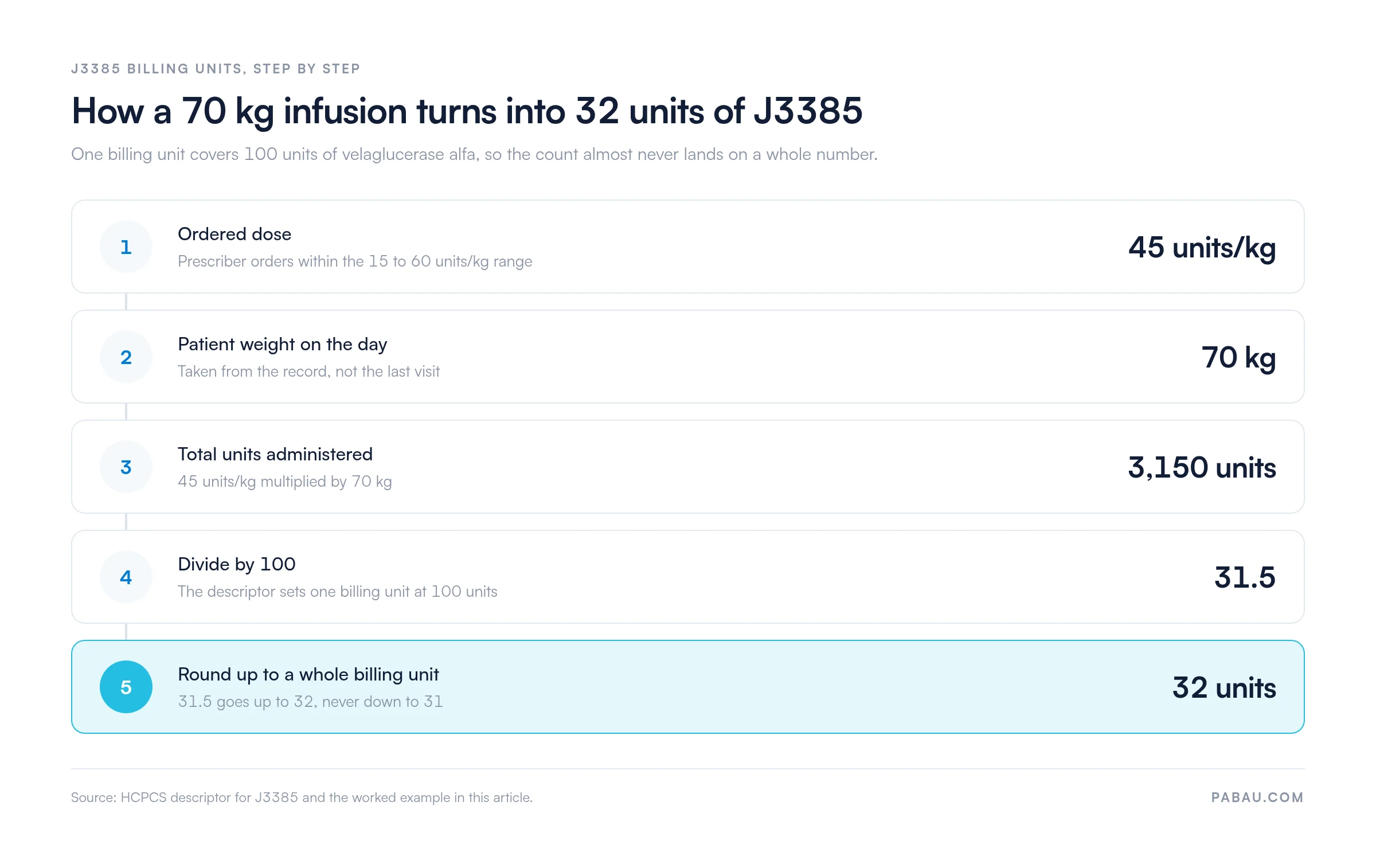
Three common weight and dose combinations show how fast the count climbs.
Medicare pays J3385 under Part B at Average Sales Price (ASP) plus 6%. That method applies to drugs a provider administers in a physician office or a hospital outpatient department.
CMS refreshes ASP every quarter, so the rate changes four times a year. Pull the current quarter’s figure from CMS’s fee schedule lookup before you quote anyone a number.
Payment lands per billing unit, not per infusion. The 3,150-unit example above bills 32 units, so the practice is paid 32 times the ASP plus 6% rate for that quarter.
One unit matters more on this line than on almost any other. At this price per unit, a single miscount moves hundreds of dollars in either direction. A unit check belongs in the pre-submission routine.
Two acquisition models exist, and the payer usually picks for you. Under buy-and-bill, the practice purchases VPRIV, holds it, administers it, and bills J3385. Under specialty pharmacy, the drug ships to the infusion site, the pharmacy bills the payer, and the practice bills only the administration.
The choice changes cash flow, margin, and inventory risk. Buy-and-bill for provider-administered drugs also draws oversight from the Office of Inspector General (OIG) and has to satisfy the Anti-Kickback Statute.
Run any acquisition arrangement past compliance counsel, then record why you chose that model.
The same acquisition decision applies to other infusion drugs, such as tocilizumab billed under J3262.
Check the payer contract before you assume buy-and-bill applies. Many commercial plans now require specialty pharmacy dispensing for high-cost enzyme replacement therapies. Confirm the acquisition model during benefit verification, before anyone orders VPRIV.
Yes, most commercial payers require prior authorization (PA) before VPRIV goes in. Medicare fee-for-service does not apply PA to Part B drugs the same way, though Medicare Advantage plans set their own rules. Sort out which applies at intake, before the first infusion reaches the schedule.
Requirements differ by plan, so ask the payer directly. Most PA packets ask for the following:
PA denials usually come down to thin clinical documentation rather than the therapy itself. Keep a VPRIV-specific checklist inside the intake workflow, and the packet goes out complete the first time.
Two wastage modifiers do most of the work on a J3385 claim. Since July 1, 2023, CMS has required one of them on every Part B claim for a single-dose container drug. VPRIV is one of those drugs.
They are mutually exclusive, so the claim carries one or the other. When the full amount reaches the patient, a single line goes out with JZ. If part of the vial is discarded, the administered units go on one line. The discarded units go on a second line with JW.
Two points trip billers up here. GY does not create an Advance Beneficiary Notice (ABN) requirement. A statutory exclusion already makes the patient liable, and the ABN belongs with GA instead.
JA and JB also have no place on J3385. Those two separate intravenous from subcutaneous routes on codes that cover both, and VPRIV is intravenous only.
Beyond that, check the plan’s own rules. Some payers ask for a drug source modifier that separates buy-and-bill supply from specialty pharmacy supply. CMS keeps the discarded-drug rules with the rest of its Part B drug payment policy.
Three codes sit close enough to cause trouble. Each covers a different product, and none of them substitutes for another. The full J-series list lives in the CMS HCPCS overview, which is the source to check a crosswalk against.
Patients do switch therapies. When a patient moves from velaglucerase alfa to imiglucerase, the claim moves to J1786, which carries its own unit definition. A switch to taliglucerase alfa (Elelyso) is billed under HCPCS code J3060, where one unit covers 10 drug units.
Resist the pull of J3490. An unclassified line where a specific code exists is a coding error. It also slows payment while a reviewer works out what you gave.
Confirm the code in AAPC’s HCPCS lookup before you default to the unclassified option.
Denial risk on this code runs above average, and the reasons repeat. High unit cost, weight-based dosing, and near-universal prior authorization all pull in the same direction. Audit your workflow against the six below.
Most of that is catchable at the desk, in the minute before the claim goes out. Run these five in order:
A workflow built for cleaner claims management keeps the code, the diagnosis, and the required claim fields in one record. That turns the check into a few seconds instead of a hunt through three systems.
Billing J3385 usually means working across three places at once. The dose lives in the clinical note, and the code lives in a lookup tool or someone’s head. Then the claim gets rekeyed into a clearinghouse portal. Each hop is a chance to drop a unit or a diagnosis.
Practice management software like Pabau removes the rekeying. The service charted in the client record carries its HCPCS code onto the CMS-1500 charge line. ICD-10 slots seed from the recorded problem list.
Built-in HCPCS and ICD-10-CM libraries cover more than 20,000 codes, refreshed with each official release. A coder can search without leaving the claim.
Pabau then confirms the claim’s required fields are complete before the send button unlocks. In the US, claims go out through Claim.MD.
That brings real-time eligibility checks, claim status tracking, and electronic remittance posting into the same record. The biller who counted the units sees the payment land against them.
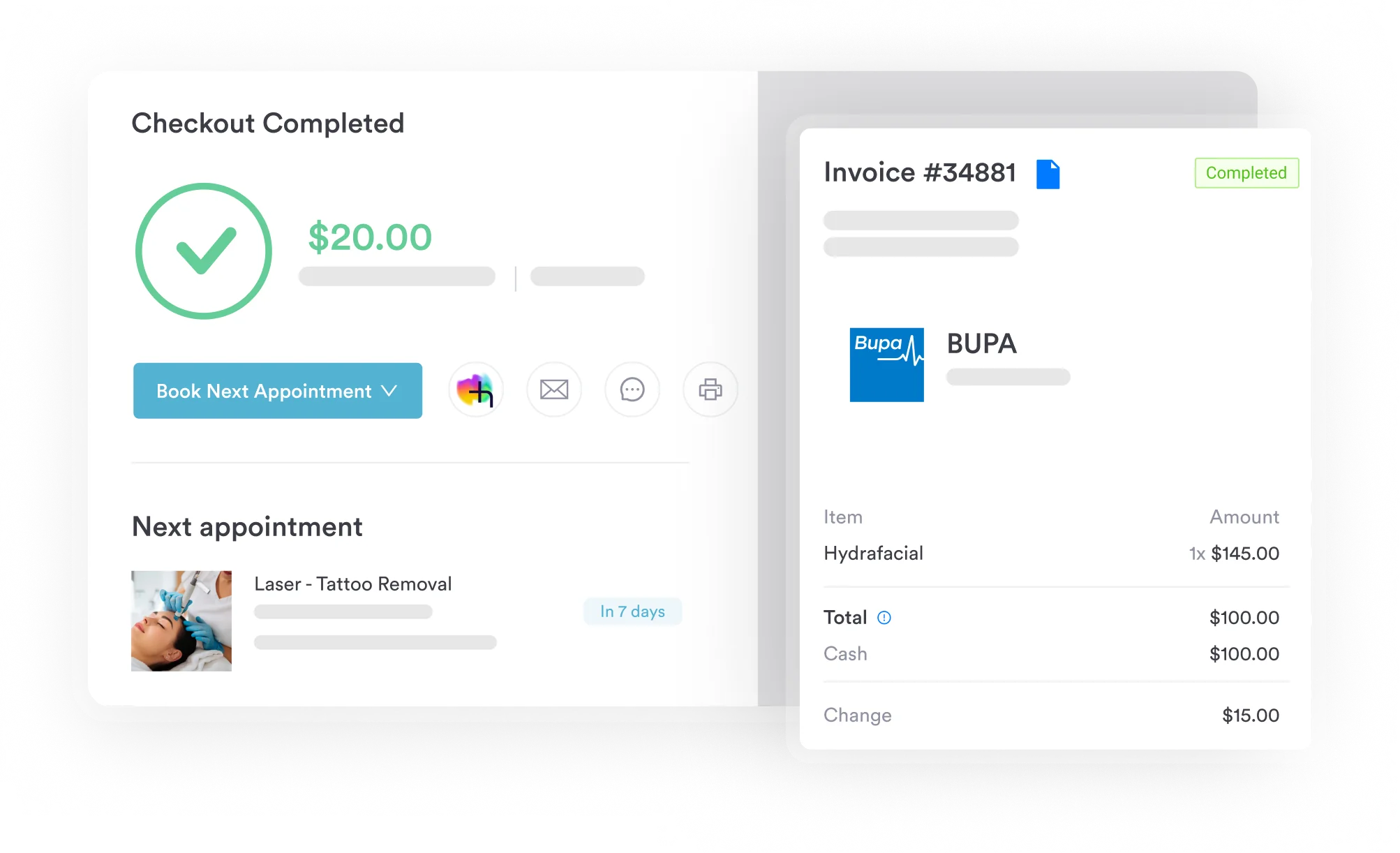

Pabau pre-fills the claim from the charted service, searches HCPCS and ICD-10-CM libraries in place, and checks required fields before submission. US claims go out through Claim.MD with eligibility checks and remittance posting.

J3385 rewards practices that treat arithmetic as part of clinical documentation. The dose, the weight, and any discarded amount all belong in the note. A claim is only as good as what the note says, and the rest is transcription.
There is a trade-off worth remembering here, speed against certainty. A biller can push this claim out in two minutes. One wrong unit then costs far more than the two-minute check would have.
So start with one change. Make the unit count a named step in your pre-submission routine, owned by a person rather than by whoever is closest. Book a demo to see how Pabau pulls the code, the diagnosis, and the claim fields into one record.

Need a billing compliance framework for your practice? Medical billing compliance guidance covers the documentation and workflow requirements that protect practices from OIG scrutiny.
Want to understand how remittances map back to your J-code claims? Electronic remittance advice explained breaks down how 835 files report a payer’s decision on each billing unit.
Looking for a denial process built for specialty drugs? Denial management in healthcare outlines an appeals workflow that recovers revenue on complex J-code denials.
Want fewer rejections on the first pass? What makes a clean claim sets out the fields payers check before a claim is accepted for adjudication.
Checking benefits before a high-cost infusion? Insurance eligibility verification shows how to confirm coverage and prior authorization rules at intake.
Yes. J3385 pays for the drug only. The infusion is billed with its own CPT code, usually 96365 for the first hour and 96366 for each additional hour. Both lines go on the same claim, and the infusion start and stop times belong in the note.
Often, yes. Many commercial plans and most state Medicaid programs want the 11-digit National Drug Code on the same line as J3385. Add the unit qualifier and the quantity too. Medicare requirements vary by contractor, so check your MAC’s claim completion guidance before you leave the field blank.
It follows where the infusion happened. Use POS 11 for a physician office, POS 22 for an on-campus hospital outpatient department, and POS 19 for an off-campus one. The setting also affects who bills the drug, so confirm it before the claim is built.
An auditor reconciles the claim against the note. Keep the prescriber’s order with the dose in units/kg, the weight used, and the total units administered. Note any amount discarded and the reason for it. A missing weight is enough to lose an appeal.