CPT Code 69610: Tympanic membrane patch repair (myringoplasty)
CPT code 69610: official descriptor and procedure overview CPT code 69610 descri...

Last Updated: Oct 19, 2026
22022 is the CCSD code for recording and reporting on EMG and nerve conduction studies for carpal tunnel syndrome or peripheral neuropathy. A carpal tunnel study qualifies only when both upper limbs are tested.
The fee covers two components. A consultant performs the study, then signs a separate written interpretation of it. UK private insurers reject the claim when the record carries only one of the two.
Let Pabau's smart automation suggest the right codes, reduce claim denials, and keep your practice compliant—effortlessly.
Automate repetitive tasks and focus on what matters most—your patients.
Reduce coding errors and ensure compliance with the latest regulations.
Clean claims, fewer denials, and faster reimbursements.
Powerful insights and reporting to help your practice thrive.
HIPAA compliant SOC 2 certified GDPR-compliant Trusted by 4,000+ clinics worldwide

CCSD code 22022 covers EMG and nerve conduction studies for carpal tunnel syndrome in both arms, or for peripheral neuropathy.
The bilateral upper limb limit applies to carpal tunnel studies only, so a neuropathy workup can cover any limbs.
The fee pays for the recording and the signed written report, so a record with only one of them is incomplete.
22023, 22024 and 22025 cover other EMG indications, and picking the neighbor by number is the most common coding slip.
UK private insurers such as Bupa, AXA Health, Aviva and Vitality pay the code, and claims usually go through Healthcode.
CCSD code 22022 pays for recording and reporting on EMG and nerve conduction studies for one of two indications. The first is carpal tunnel syndrome (CTS), studied in both upper limbs. The second is peripheral neuropathy.
The Clinical Coding and Schedule Development Group (CCSD) maintains the code as part of the UK private healthcare schedule. Bupa, AXA Health, Aviva, Vitality and other private medical insurers bill against that schedule.
22022 sits in chapter 3 of the schedule, under neurophysiological procedures at section 3.9. It carries a Minor complexity rating, which is what most insurer fee schedules key their rate to.
Two components sit inside the code. The consultant records the needle EMG and the nerve conduction study, then signs a written interpretation of the findings. Document one without the other and the claim is incomplete.
The two indications call for different protocols, and the report has to show which one was run. A consultant neurologist or clinical neurophysiologist usually performs both.
The phrase “Bilateral upper limb only” in the descriptor attaches to the CTS indication. It does not limit the peripheral neuropathy indication, which can cover one limb or all four.
Bill 22022 once per session. The code already covers both arms in a CTS study, so a second line for the other side reads as a duplicate claim.
Every 22022 claim needs a supporting ICD-10 diagnosis code that matches the indication in the report. UK insurers use the WHO ICD-10 classification, not the US ICD-10-CM version. The codes below are the ones most often paired with 22022.
Approved diagnosis lists vary by payer, so check the insurer’s own list if you bill a code outside this table. The WHO ICD-10 browser confirms the wording of each code.
When one referral asks for a CTS screen and a neuropathy workup, confirm with the consultant which indication is primary. A G56.0 claim on a report that also covers sural nerve studies invites a query about why the legs were tested.
Section 3.9 holds four EMG and nerve conduction codes with near-identical wording. Only the indication after the semicolon separates them, so the decision path below starts from the referral question rather than the code number.
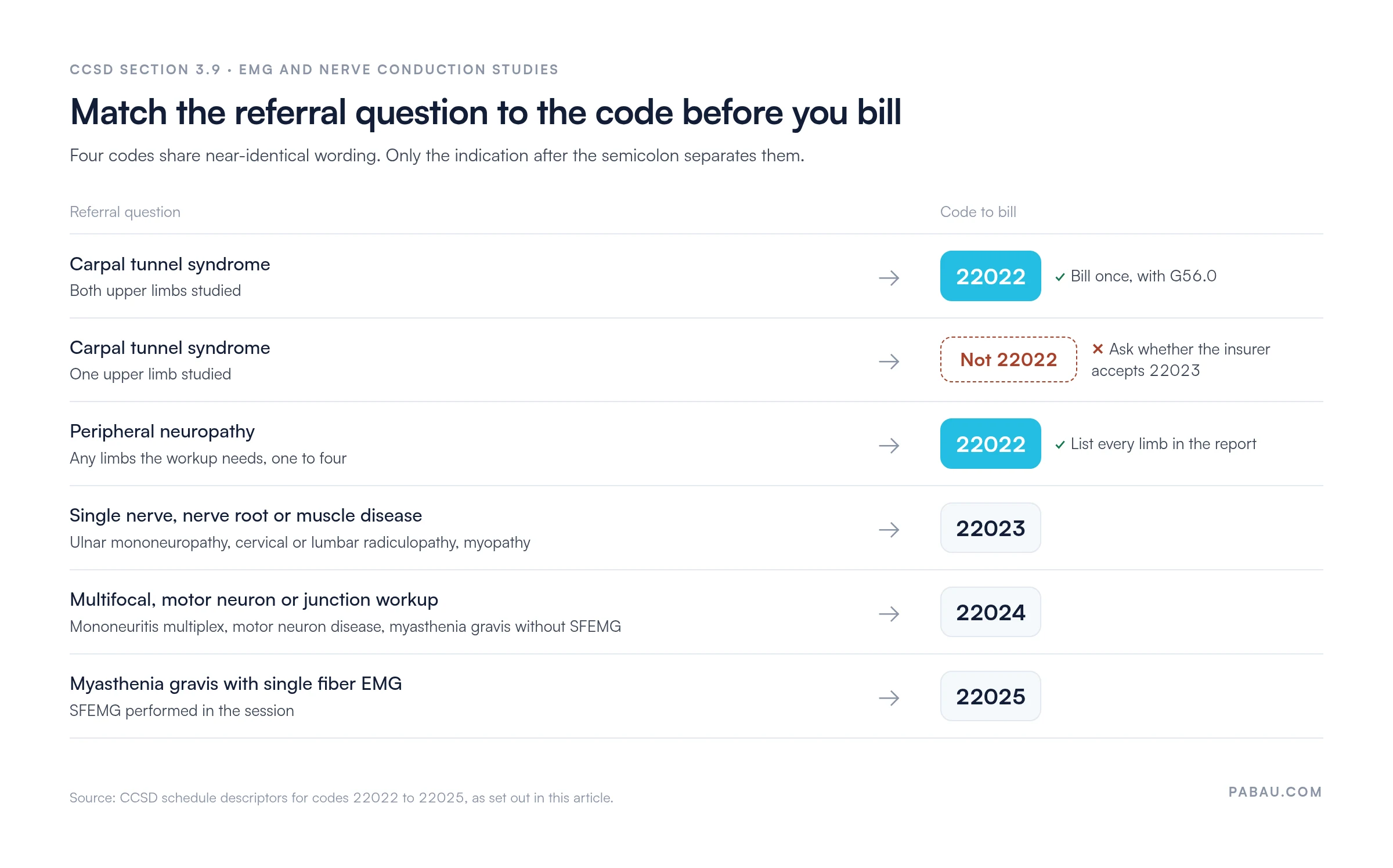
Numeric proximity is a trap in this part of the schedule. A myasthenia gravis workup without SFEMG belongs on 22024, even though its opening wording matches 22022. 22021, one digit away from 22022, is anorectal physiology, which belongs to a different specialty.
If you bill across several investigations, the CCSD codes index is the quicker way to check a neighboring descriptor before you submit. Codes and descriptors are revised periodically, so treat a locally saved copy of the schedule as a draft.
The consultant who performs and reports the study bills 22022, and the insurer has to recognize that consultant for the procedure. In practice, that means a consultant neurologist or clinical neurophysiologist on the GMC specialist register.
Insurers recognize practitioners procedure by procedure, not only by specialty. Confirm the billing consultant appears on the insurer’s list for 22022 before the appointment is booked.
A clinical physiologist may run the recording under supervision in some departments. The claim still goes out under the recognized consultant, and delegation rules differ by payer, so confirm yours before splitting the work.
Every step below maps to a denial reason that shows up on this code, so the sequence doubles as a pre-submission checklist.
Dedicated claims management software keeps coverage, authorization and report status on one patient record, which cuts rejections on this code. Spreadsheets tend to hold the authorization number in one place and the report status somewhere else.
Bupa asks for pre-authorization on specialist diagnostics under most plans, while AXA Health, Aviva and Vitality set the rule policy by policy. Rules can also change between policy years, so confirm with the payer using the sources below.
Submit without the authorization the policy required and most insurers will not pay retrospectively. Treat pre-authorization as a booking task rather than a test-day one.
Rejections on this code repeat a short list of patterns. Each has a fix that belongs in the workflow rather than in an appeal letter.
Pull your last 10 claims for this code and check three details on each. Does a CTS report cover both arms? Is there a signed interpretation? Does the diagnosis match the nerves tested?
The report has to stand alone as a record of what was done, what was found and what it means. A reviewer should see both halves of the code satisfied without requesting a second document.
Most failure points on this code are administrative, and they are spread across the diary, the clinical record and the invoice. The authorization number lives in an inbox, and the report sits in a shared drive.
Pabau keeps all three on the same patient record. The authorization reference is stored against the appointment, and the report template holds required fields, so an unsigned study stays flagged.
Claims then go out through the Healthcode integration with the code, the diagnosis and the reference already attached. For a neurophysiology practice, that means fewer invoices held back for a missing signature.

Pabau stores the authorization reference against the appointment, flags a report that has not been signed, and links the diagnosis code in the billing record. Your team submits once and chases less.

22022 is two codes in one descriptor, and the report decides which half applies. A CTS claim lives or dies on both arms being studied. A neuropathy claim needs a diagnosis that matches the nerves tested.
Settle the indication, the authorization and the consultant’s recognition while the appointment is being booked. None of those can be repaired after submission.
Book a demo to see how Pabau keeps authorization, reports and coding on one record for a private neurophysiology practice.

Investigating myasthenia gravis with single fiber EMG? CCSD code 22025 is the code that applies when SFEMG is part of the session.
Working up motor neuron disease or mononeuritis multiplex? CCSD code 22024 covers those EMG indications.
Billing other section 3.9 neurophysiology tests? CCSD code 22028 covers the inpatient sleep study, which sits in the same part of the schedule.
Billing more of the CCSD schedule than this one code? Bupa CCSD codes explains how the schedule maps onto Bupa’s own code list.
It covers recording and reporting on EMG and nerve conduction studies for two indications. One is carpal tunnel syndrome studied in both upper limbs, and the other is peripheral neuropathy. The fee includes the signed written report.
Carpal tunnel studies must be bilateral, covering both upper limbs, while peripheral neuropathy studies can cover one limb or several. A one-sided carpal tunnel study does not qualify for 22022.
Bupa applies pre-authorization to specialist diagnostics on most plans. AXA Health, Aviva and Vitality set the rule policy by policy, so confirm with the payer before the test date.
The usual causes are a one-sided CTS study, a missing authorization number, or a report with no signed interpretation. A diagnosis that does not match the nerves tested, or an unrecognized consultant, also leads to rejection.
No. CCSD codes exist for UK private medical insurance billing. NHS activity is coded with OPCS-4 for procedures and ICD-10 for diagnoses, so 22022 never appears on an NHS record.
No. 22022 covers the needle EMG, the nerve conduction study and the written report in one fee. Adding a separate line for one component reads as a duplicate claim.