CPT Code 69610: Tympanic membrane patch repair (myringoplasty)
CPT code 69610: official descriptor and procedure overview CPT code 69610 descri...

Last Updated: Oct 19, 2026
A7352 is the CCSD code for image-guided local anaesthetic blockade of named major nerve or plexus. It covers a single-shot injection of local anaesthetic around a named major nerve or plexus, placed under ultrasound, fluoroscopic or CT guidance.
Image guidance is built into the descriptor, so the note must record it. The same block without guidance is A7350, and a continuous catheter block is A7302. A7352 sits in chapter 3 of the CCSD schedule, under other nerve blocks, at minor complexity.
Let Pabau's smart automation suggest the right codes, reduce claim denials, and keep your practice compliant—effortlessly.
Automate repetitive tasks and focus on what matters most—your patients.
Reduce coding errors and ensure compliance with the latest regulations.
Clean claims, fewer denials, and faster reimbursements.
Powerful insights and reporting to help your practice thrive.
HIPAA compliant SOC 2 certified GDPR-compliant Trusted by 4,000+ clinics worldwide

CCSD code A7352 covers image-guided local anaesthetic blockade of a named major nerve or plexus. Image guidance is part of the code, so the note must show it was used.
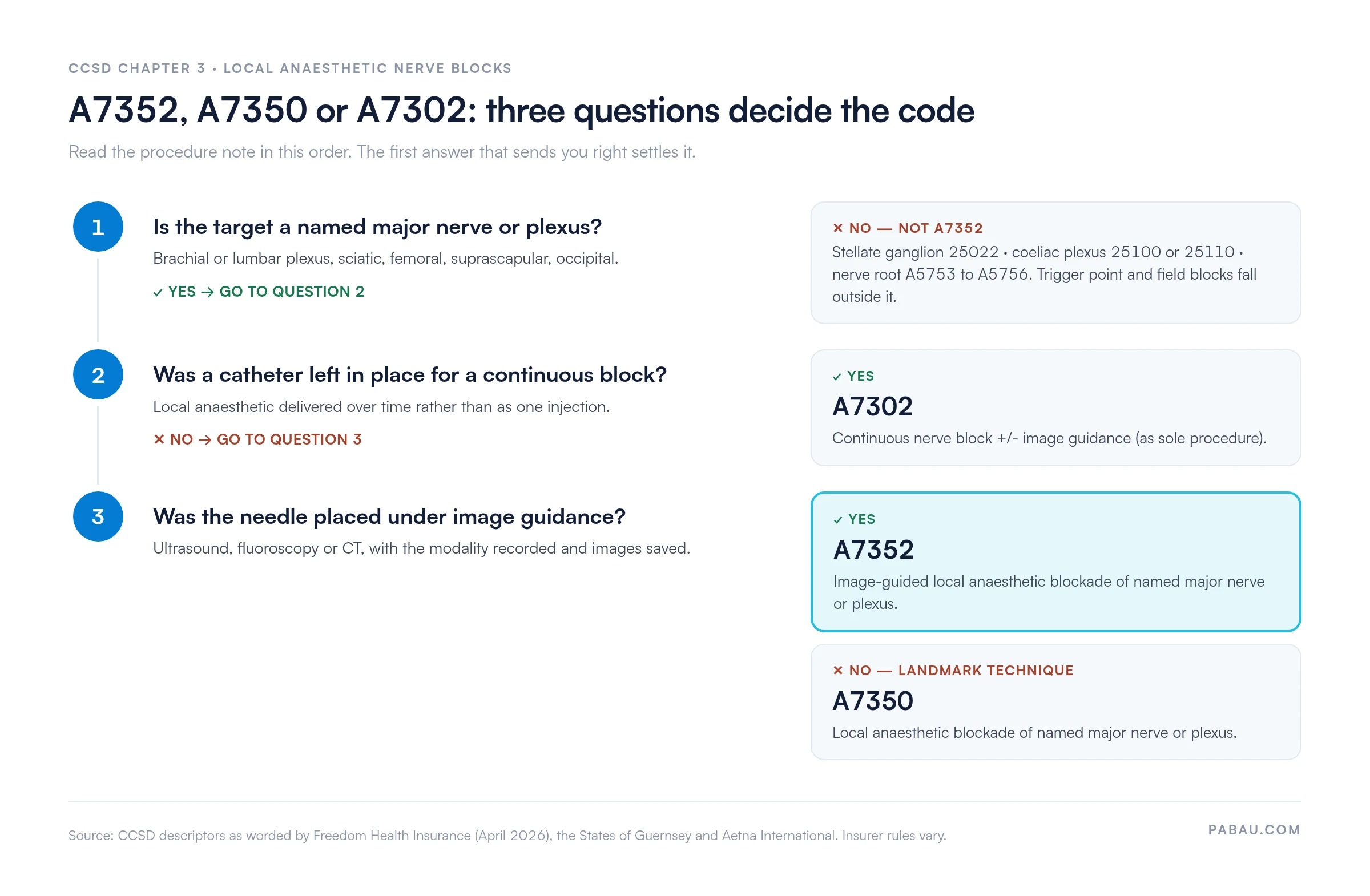
The same block without image guidance is A7350. A continuous block through an indwelling catheter is A7302, which is the code that carries the “as sole procedure” qualifier.
The named nerve or plexus must be identified in the operative note. A claim that cites “peripheral nerve” without naming it invites a query from the insurer.
Stellate ganglion and coeliac plexus blocks have their own CCSD codes (25022, 25100 and 25110), so they do not belong under A7352.
Practice management software like Pabau supports CCSD code lookup, pre-authorization tracking and claim submission for UK private practices.
CCSD code A7352 is the procedure code for image-guided local anaesthetic blockade of a named major nerve or plexus. It sits in Chapter 3 of the CCSD schedule (“Spine, spinal cord and peripheral nerves”), under subsection 3.7, other nerve blocks, at minor complexity.
The code applies when a consultant anaesthetist or pain specialist injects local anaesthetic around a named nerve or plexus under ultrasound, fluoroscopic or CT guidance. The injection interrupts sensory, motor or autonomic transmission, either to confirm a diagnosis or to relieve pain.
Intent separates A7352 from A7300. The local anaesthetic block is temporary, while A7300 covers a permanent lesion of a named peripheral nerve made by radiofrequency, cryoprobe or phenol.
Image guidance is written into the descriptor itself: Image-guided local anaesthetic blockade of named major nerve or plexus. Freedom Health Insurance (April 2026), the States of Guernsey surgical fee schedules and Aetna International all word A7352 this way. A block placed by landmark technique alone belongs under A7350 instead.
A7352 is used mainly in interventional pain management, for diagnostic and therapeutic blocks. Consultants moving from NHS work into private practice should note that NHS procedures are coded with OPCS-4. Those coding habits do not carry across to CCSD.
“Named major” is the operative qualifier. The nerve or plexus must be anatomically specific and documented by its proper name in the procedure note. The same naming rule governs CCSD code A6180, which covers surgical excision of a lesion from a major nerve rather than a block. The following targets fit A7352 when the block is image-guided:
Some schedules name occipital, suprascapular, intercostal and trigeminal branch blocks inside the A7350 descriptor. When one of these is image-guided and documented as such, check which of the two codes the insurer expects.
Several blocks that look similar carry codes of their own. Stellate ganglion blocks use 25022 (local anaesthetic), and coeliac plexus blocks use 25100 (diagnostic) or 25110 (therapeutic). Nerve root blocks sit in the A5753 to A5756 range. Trigger point injections and field blocks target muscle or tissue rather than a named nerve, so they fall outside A7352.
Most A7352 coding errors involve its two nearest neighbors in Chapter 3. All three cover local anaesthetic blocks of major nerves. Two facts decide between them: how the needle was placed, and how long the block runs.
A practical rule follows, set out as three questions in the diagram below. First confirm the target is a named major nerve or plexus. Then check whether a catheter was left in place, and finally look for image guidance and saved images.
When a block forms part of the anaesthetic for surgery, many insurers pay it within the anaesthetist’s fee for that operation. Check the payer’s rules before adding A7352 to a surgical episode.
Because image guidance is inherent to A7352, the guidance record is the evidence the insurer checks. A claim coded A7352 with no record of imaging reads as an unguided block, which invites a query or a request to recode.
None of the schedules above lists a separate guidance code alongside A7352. Treat the imaging as included in the code, and add a guidance line only where the insurer’s own schedule allows one.
Selecting the correct code means knowing A7352’s neighbors. The table below lists the related codes billers most often confuse with it, taken from the Freedom Health Insurance, Guernsey and Aetna International schedules. Other procedures in the schedule are covered in our CCSD billing guides.
Paravertebral blocks sit outside A7352 as well, in the paraspinal injections section of Chapter 3. One placed at up to two levels under X-ray control is billed as 25011. A medial branch block under X-ray control sits in the same section, carried on older schedules as CCSD code A5750. Bupa’s February 2026 schedule no longer lists it.
Descriptors and code sets differ between insurers and schedule editions, so check each payer’s current list before billing.
Before submitting an A7352 claim, confirm the code is live and worded the same way in the insurer’s current schedule. Freedom Health Insurance’s April 2026 Chapter 3 schedule, for example, lists A7352 and A7302 but not A7350.
Documentation quality is what separates a clean A7352 claim from a denial. UK private insurers expect the operative note to contain each of the items below. Digital clinical forms built for nerve block procedures cut omissions and speed up insurer review.
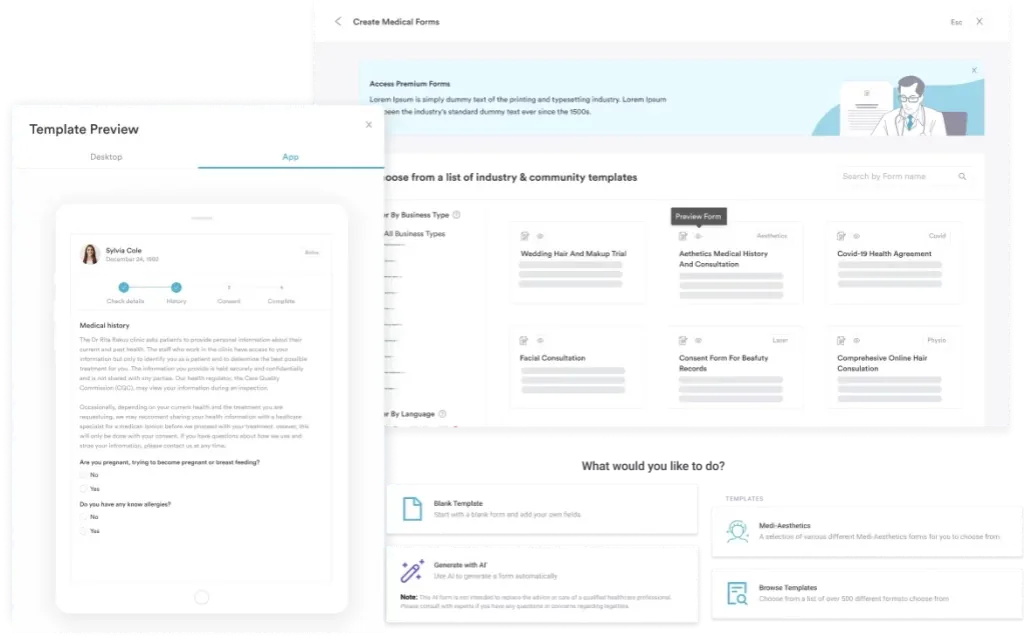
Standardized procedure note templates, pre-populated with these fields, reduce retrospective insurer queries. One shared template also holds every clinician in the practice to the same documentation standard.
Pre-authorization rules for A7352 vary between UK private insurers. The table below summarizes the position of four major payers, but policies change between contract cycles. Verify the current position with each insurer, and check the Bupa fee schedule for reimbursement ranges.
Tracking pre-authorization by hand adds administrative risk for practices managing several funding sources. Practice software with built-in pre-authorization workflows makes it less likely that a claim goes ahead without approval. A missing approval is one of the most preventable denial causes.
Most A7352 denials trace back to the note or to code selection, which makes them predictable. Auditing claims before submission catches them while they are still cheap to fix.
When a claim is denied, request the reason code from the insurer in writing before resubmitting. That code tells you whether to add documentation, correct the code or appeal. Claims management software that logs denial codes and tracks resubmissions stops denied claims from aging out unresolved.
Run a monthly audit of the A7352 claims submitted in the previous 30 days. Flag any note that does not name the nerve or plexus, confirm image guidance, or record pre-authorization. Catching these patterns early prevents repeat denials and shows where billing staff need training.
A7352 and US CPT nerve block codes cover similar clinical territory but follow different bundling and reimbursement logic. CCSD and CPT are separate code systems, so no CCSD code is a direct billing equivalent of a CPT code. Practices with international billing may still find this crosswalk useful.
The overlap is partial. Several CPT codes include imaging guidance when performed, much as A7352 does, while CPT 64450 still allows a separate ultrasound code. Applying one system’s bundling logic to the other produces incorrect claims in both.
An A7352 claim depends on several steps staying consistent: code selection, pre-authorization, a structured note, image evidence and diagnosis pairing. Manual workflows struggle to hold all of them steady at volume.
Practice management software like Pabau supports CCSD billing for UK private practices across each of those steps. Billing staff can select A7352 from the CCSD code list without switching between payer portals.
Nerve block note templates can be built to capture the named nerve, laterality, imaging modality, agent, volume and indication. The pre-authorization reference sits on the same record as the booked procedure.
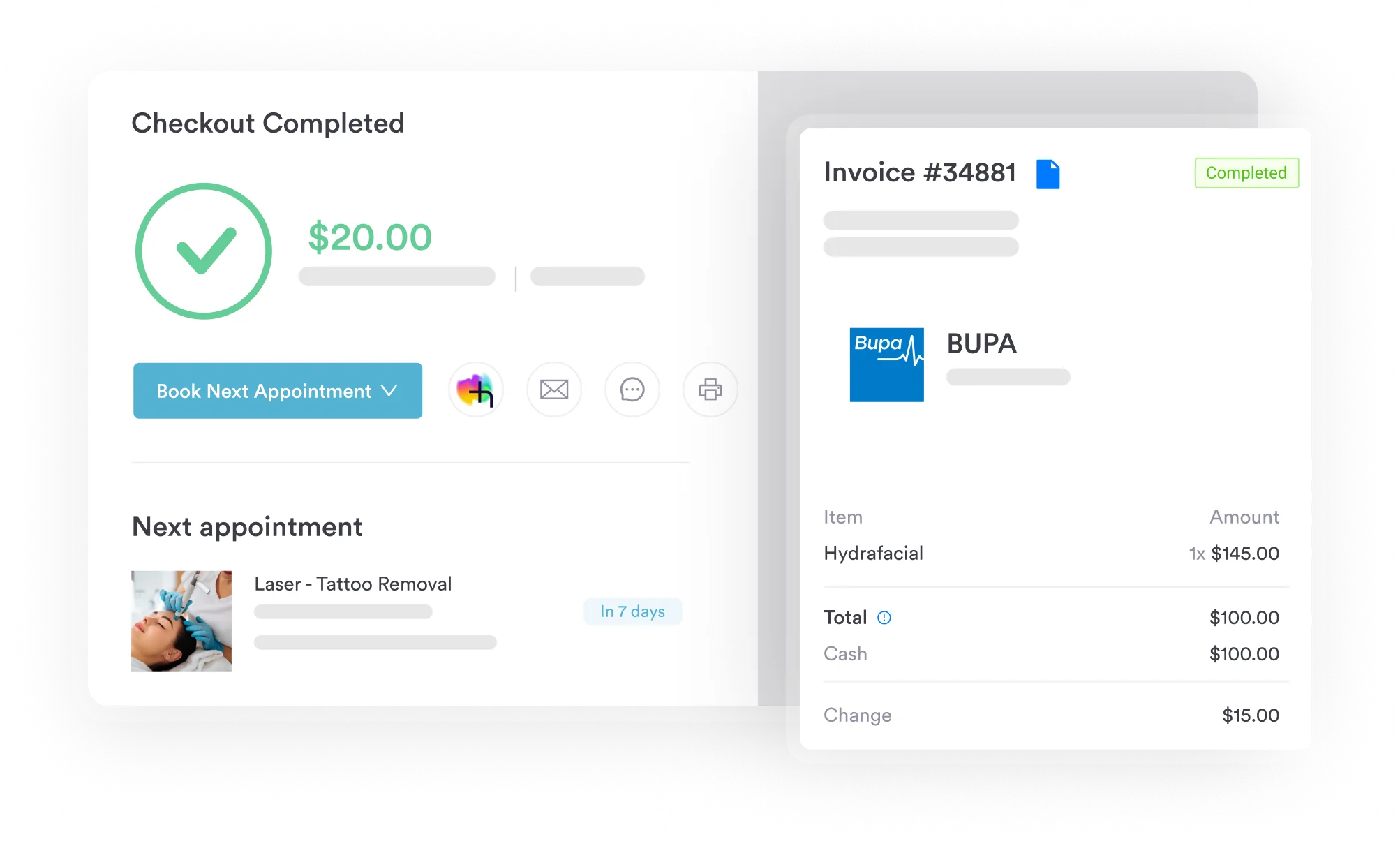
Claims are raised and tracked from that record too. A denied A7352 claim stays next to its note and pre-authorization reference, so the fix starts with the evidence already in hand.

Pabau connects nerve block documentation, CCSD code selection and insurer submission for UK private practices, so fewer A7352 claims come back queried.

A7352 claims stand or fall on one fact the descriptor makes central: the block was image-guided, and the note proves it.
Build the imaging modality and saved-image confirmation into your nerve block template, next to the named nerve and laterality. The trade-off is a minute more per note against a queried claim that has to be recoded and resubmitted.
Book a demo to see how Pabau keeps nerve block notes, pre-authorization references and CCSD claims together for pain management practices.

Need a reference for Bupa CCSD procedure codes? Pabau’s Bupa CCSD codes guide covers the procedure code structure Bupa uses for UK private healthcare billing.
Coding a paravertebral block? CCSD code 25010 covers paravertebral block billing, another Chapter 3 procedure that sits outside A7352.
Billing a brachial plexus block in the US? CPT code 64415 explains the single-injection brachial plexus code that the A7352 crosswalk above points to.
Coding a femoral nerve block for a US payer? CPT code 64447 covers the femoral nerve block code and the documentation US payers expect with it.
Blocking a smaller peripheral nerve branch? CPT code 64450 explains the catch-all peripheral nerve code, which allows separate ultrasound billing.
CCSD code A7352 covers image-guided local anaesthetic blockade of a named major nerve or plexus. Guidance by ultrasound, fluoroscopy or CT is part of the code. The note must name the nerve or plexus and confirm that guidance was used.
Image guidance separates them. A7352 is the image-guided block of a named major nerve or plexus, and A7350 covers local anaesthetic blockade without image guidance. Some schedules word A7350 as blockade of a major nerve trunk instead.
Image guidance is included in A7352, because the descriptor defines the code as an image-guided block. Add a separate guidance line only where the insurer’s own schedule allows one. The “+/- image guidance (as sole procedure)” wording belongs to A7302, the continuous nerve block code.
Both Bupa and AXA Health typically require pre-authorization for interventional pain procedures including A7352. AXA Health uses its specialist procedure codes portal for authorization requests. Check Bupa’s requirements through the Bupa code search at the time of booking, because policies vary by policy type and change periodically.
Qualifying targets include the brachial and lumbar plexuses and the sciatic, femoral, suprascapular and occipital nerves, when blocked under image guidance. Stellate ganglion and coeliac plexus blocks have their own codes (25022, 25100 and 25110). Trigger points and field blocks do not qualify.
A7352 overlaps with CPT 64415 (brachial plexus), 64445 (sciatic), 64447 (femoral) and 64450 (other peripheral nerve), but they are not billing equivalents. Several of those CPT codes include imaging guidance when performed, while 64450 allows a separate ultrasound code.