CPT Code 62284: Injection procedure for myelography
CPT Code 62284: official descriptor and procedure overview The American Medical ...

Last Updated: Oct 19, 2026
J1786 is the HCPCS Level II code for injection, imiglucerase, 10 units.
Three fields decide whether the claim pays. Divide the prescribed dose by 10 to get the unit count, and report E75.22 as the diagnosis. Then pair the drug with the administration CPT code your MAC accepts. Medicare Part B then pays the Average Sales Price plus 6%, recalculated every quarter.
Let Pabau's smart automation suggest the right codes, reduce claim denials, and keep your practice compliant—effortlessly.
Automate repetitive tasks and focus on what matters most—your patients.
Reduce coding errors and ensure compliance with the latest regulations.
Clean claims, fewer denials, and faster reimbursements.
Powerful insights and reporting to help your practice thrive.
HIPAA compliant SOC 2 certified GDPR-compliant Trusted by 4,000+ clinics worldwide

HCPCS code J1786 describes injection, imiglucerase, 10 units. It bills Cerezyme enzyme replacement therapy for Gaucher disease Type 1 and the non-CNS manifestations of Type 3.
Each billed unit equals 10 units of imiglucerase. Divide the prescribed dose in units by 10 to get the J1786 unit count for the claim.
Medicare Part B reimburses J1786 at ASP+6%, recalculated quarterly. ICD-10 code E75.22 belongs on every claim to establish medical necessity.
Practice management software like Pabau automates unit calculations, NDC reporting, and eligibility checks, so infusion claims submit clean the first time.
HCPCS code J1786 is the Level II code assigned by CMS to describe injection, imiglucerase, 10 units. J-codes classify drugs given by a route other than oral. J1786 covers the intravenous infusion of imiglucerase, the recombinant glucocerebrosidase that Sanofi Genzyme sells under the brand name Cerezyme.
The code is active for the 2026 fiscal year with no descriptor changes from prior years. CMS maintains it in the HCPCS Level II J-code category and revises it through the annual HCPCS update cycle, not through the AMA CPT process.
CMS releases the annual HCPCS update file in the fourth quarter for the following calendar year, so a code’s status is worth rechecking each October. A descriptor holds steady when the clinical distinction behind it does not move. HCPCS code C1896 has carried the same long description across code cycles for that reason.
Gaucher disease is the most common lysosomal storage disorder. In Type 1, the non-neuronopathic form, a deficiency of glucocerebrosidase lets glucocerebroside build up in macrophages of the spleen, liver, and bone marrow. Imiglucerase is a recombinant form of that enzyme, given as long-term enzyme replacement therapy.
The FDA expanded the imiglucerase label in January 2026. It now covers Type 1 Gaucher disease and the non-CNS manifestations of Type 3. Type 2 and the neurologic features of Type 3 stay outside the approved indication. A J1786 claim tied to CNS involvement can still draw medical necessity scrutiny.
Dosing is weight-based and patient-specific. Labeling runs from 2.5 units per kilogram three times a week up to 60 units per kilogram once every two weeks.
Because the dose varies that widely, the units billed under J1786 differ from patient to patient and from infusion to infusion. Never apply a standard dose to J1786 billing without checking the prescribed dose in the clinical record.
One unit of J1786 represents 10 units of imiglucerase. To find the number of J1786 units to report, divide the prescribed dose in units of imiglucerase by 10. Round to the nearest whole number.
Verify the prescribed dose against the clinical documentation before submitting. Billing more units than the documented dose is an overcoding error, and billing fewer leaves reimbursement on the table. Cerezyme is expensive and the doses are large, so a one-unit discrepancy per claim adds up over a treatment course.
Every J1786 claim needs a supporting ICD-10-CM diagnosis code to establish medical necessity. Without a valid Gaucher disease diagnosis code, the claim denies. The primary code is E75.22, and a small set of related codes may apply depending on the clinical presentation documented.
E75.22 is the only ICD-10-CM code that maps directly to Gaucher disease, and Medicare and most commercial payers accept it with J1786. Some MAC Local Coverage Determinations list E75.22 as the sole covered diagnosis, so defaulting to it on every imiglucerase claim is the safest habit. Always confirm whether a payer’s coverage policy has expanded or restricted the list.
If the documentation names a different sphingolipidosis, our ICD-10-CM code reference covers the rest of the E75 family. Lysosomal acid lipase deficiency sits in the same family under E75.5, and its enzyme therapy, sebelipase alfa, bills under HCPCS code J2840.
J1786 covers the drug only. The administration service billed alongside it needs a separate CPT code. Most commercial and Medicare claims for imiglucerase infusion use the therapeutic drug infusion codes. The choice turns on infusion duration and on whether sequential infusions follow the initial dose.
Verify which administration code set your Medicare Administrative Contractor requires for imiglucerase specifically. Some MACs treat the infusion under the 96365 and 96366 series rather than 96413 and 96415. Submitting the wrong administration code alongside J1786 is a common source of claim edits. Check current AMA CPT guidance and your MAC’s coverage policy first.
Check your MAC’s Local Coverage Determination before choosing between CPT 96413 and 96365 for imiglucerase administration. Several MACs have issued separate guidance for enzyme replacement biologics. The wrong administration code can trigger a claim edit even when the drug code and the units are both correct.
Medicaid programs and many commercial payers require a National Drug Code at the line level on claims that include J1786. Medicare does not require NDC reporting on the CMS-1500, though individual MACs may request it for review. Always report the NDC from the vial actually administered, not a generic lookup value.
Cerezyme comes in a single strength of 400 units per vial from Sanofi Genzyme. NDC numbers can change with new manufacturing lots or packaging. The NDC below was current at the time of writing, so verify it against the Sanofi Genzyme package insert or FDA label before submitting claims.
Medicare Part B reimburses J1786 at the Average Sales Price plus 6%. CMS updates ASP pricing quarterly, so the allowable rate changes four times a year. Check the current CMS ASP Drug Pricing File before each quarter’s billing cycle. CMS’s Physician Fee Schedule lookup tool shows the current allowable by locality.
Imiglucerase is among the most expensive physician-administered drugs in the Part B portfolio. Because payment is set per 10 units, the unit count has to be exact to capture the full allowable. Underbilling by 10 units on a 400-unit dose costs 2.5% of the infusion, on what is usually a biweekly, lifelong schedule.
Between the quarterly ASP update lag and the buy-and-bill acquisition cost, cash flow on a Gaucher disease infusion program needs close attention. Expect a gap of weeks between paying for the drug and collecting the allowable on it.
Imiglucerase is almost always dispensed through the buy-and-bill model in office-based and infusion center settings. The provider purchases Cerezyme from Sanofi Genzyme or a specialty distributor, administers it, and then bills the payer using J1786. Under specialty pharmacy dispensing, by contrast, the pharmacy bills for the drug and the provider bills only the administration service.
Buy-and-bill creates working capital exposure, because the provider pays for the drug upfront and waits for reimbursement. A single Cerezyme vial costs thousands of dollars, so even a small Gaucher disease patient panel belongs in the practice’s cash flow planning.
Coverage under commercial insurance and state Medicaid programs varies materially from Medicare’s standardized ASP+6% approach. Most commercial payers cover J1786 where medical necessity is documented and prior authorization is in place. Reimbursement rates, quantity limits, and approved care settings still differ by plan.
Medicaid coverage is state-administered. Some state programs use a state-specific maximum allowable cost that sits below Medicare’s ASP+6%. Others run through managed Medicaid plans that apply their own prior authorization criteria. Never assume Medicaid approval or a specific rate without checking the applicable state fee schedule portal.
California’s Medi-Cal, for example, has issued HCPCS policy updates governing J-code infusion billing that differ from standard Medicare rules.
Commercial payers and Medicaid plans generally require prior authorization before the first imiglucerase infusion. Medicare does not require it for J1786, but the coverage criteria in the applicable LCD still have to be met and documented. For commercial patients, a missing authorization at the time of administration is the single largest cause of J1786 denials.
Most authorization requests for Cerezyme ask for documentation across several clinical areas. Organizing these in advance speeds approval and reduces the risk of a denied infusion session.
Sound denial management for J1786 starts with authorization tracking. When an authorization lapses, or the dose changes without re-authorization, the claim denies even though the underlying coverage exists. Build a renewal reminder into the workflow calendar, tied to each patient’s expiration date.
The place of service code on the J1786 claim decides whether Medicare and commercial payers apply the facility or non-facility rate. Imiglucerase is infused in several settings, and the code has to reflect where the service was rendered.
Two modifiers come up on J1786 claims. Modifier JW reports the discarded portion of a vial when the dose does not use all 400 units. Modifier JZ reports zero waste where payer rules call for it. Omitting JW when waste occurs can trigger an overpayment audit, and omitting JZ where it is required delays the claim.
J1786 claims are high-dollar and high-scrutiny. Errors compound quickly, because the drug is expensive, the doses are large, and the treatment is indefinite. Eight data elements decide the outcome of the drug line, and the ones below are where audits and denial patterns concentrate.
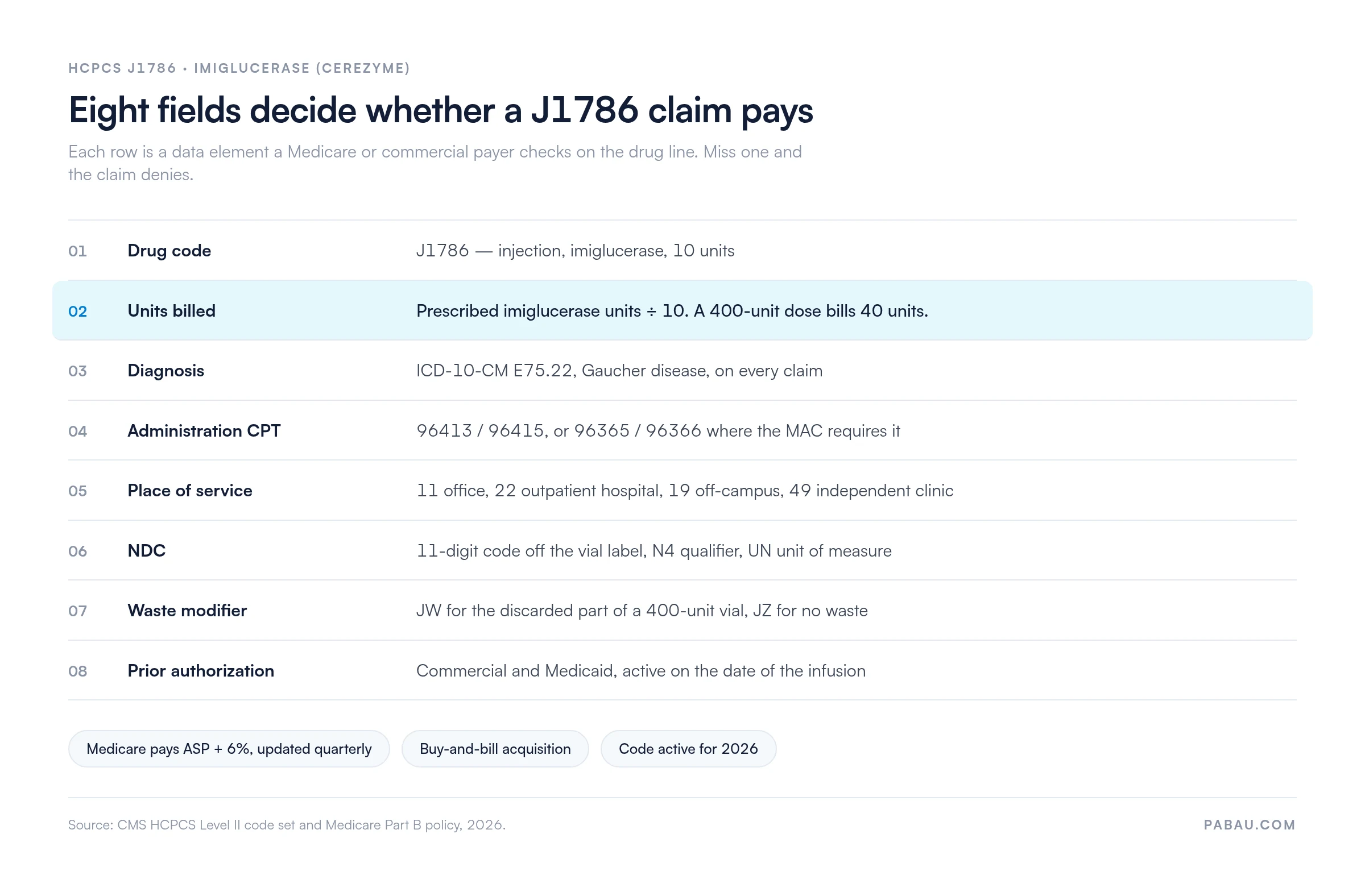
A pre-claim checklist covering units, NDC, ICD-10, authorization status, companion CPT, place of service, and the waste modifier removes most of these errors. Pabau’s claims management software builds those checks into the submission workflow, so no one verifies eight fields from memory on every infusion.
Run a quarterly J1786 audit. Pull every claim submitted with the code over the past 90 days and check the billed units against the administered dose in the clinical documentation. On a biweekly schedule across three or four patients, a small unit error turns into a material discrepancy within one quarter.
Most infusion practices assemble a J1786 claim from separate places. The dose sits in the clinical note, the vial’s NDC sits on a paper log, and the authorization expiry sits in a spreadsheet. A coder then reconciles all three before the claim goes out.
Practice management software like Pabau keeps those records in one patient file instead. The infusion note, the administered units, the NDC, and the authorization dates travel with the claim. The billing team submits from the record rather than retyping it.
The result is fewer unit mismatches, fewer lapsed authorizations, and a shorter path from infusion to payment. A claim that carries its own documentation clears the first submission more often, which matters most on a drug this expensive.

Pabau’s claims management tools help infusion practices track administered drug units and attach NDC data. J-code claims go out with the documentation payers need to pay them the first time.

Billing J1786 accurately takes more than knowing the code. The unit count, the NDC, the companion CPT code, the authorization status, and the waste modifier all have to be right on the same line. That holds on every infusion, not only the first.
The trade-off worth remembering is scale. One systematic error on a lifelong biweekly schedule costs far more than a single slip. The correction belongs in the workflow, not in a reviewer’s memory. Audit a quarter of J1786 claims against the clinical documentation and you will know which kind you have.
Book a demo to see how Pabau carries administered drug units and authorization dates through to the claim.

Need a framework for managing claim denials on specialty drugs? Denial management in healthcare covers the workflows and tracking that keep J-code rejections from aging into write-offs.
Want to see how revenue cycle management works for Part B drugs? Revenue cycle management fundamentals explains the billing cycle from drug acquisition through final payment.
Looking for guidance on clean claims for specialty infusions? What makes a clean claim outlines the documentation and data that reduce edit holds on high-dollar submissions.
HCPCS code J1786 is the billing code for injection, imiglucerase, 10 units. It claims reimbursement for Cerezyme enzyme replacement therapy in patients with confirmed Gaucher disease. Medicare Part B pays it as a physician-administered drug, and ICD-10 code E75.22 establishes medical necessity.
One J1786 billing unit represents 10 units of imiglucerase. Divide the total prescribed dose in units by 10 to get the number to report. A 400-unit dose bills as 40 units of J1786.
ICD-10-CM code E75.22, Gaucher disease, is the primary diagnosis code required on J1786 claims. Most Medicare LCDs and commercial policies list E75.22 as the only accepted diagnosis for imiglucerase. A claim without a supported diagnosis code denies regardless of the rest of the documentation.
Commercial payers and Medicaid plans usually require prior authorization before the first imiglucerase infusion. Medicare Part B does not, though its Local Coverage Determination criteria still have to be met and documented. Commercial requests ask for a confirmed diagnosis, a weight-based dose calculation, and evidence of symptomatic disease. Authorizations run 6 to 12 months and need renewing before they lapse.
Yes. The provider buys Cerezyme directly, administers it, and bills the payer using HCPCS code J1786 for the drug. A companion CPT code covers the infusion service. Medicare reimburses the drug at ASP+6%, updated quarterly.
Cerezyme comes in 400-unit vials from Sanofi Genzyme. Report the NDC printed on the vial used for that infusion, since lot-specific numbers change. Medicaid and many commercial payers require line-level NDC reporting with the N4 qualifier. Verify the current number against the package insert before submitting.