CCSD code H4430: Examination of rectum under anaesthetic
CCSD code H4430 pays for the examination alone CCSD code H4430 is the UK private...

Last Updated: Oct 20, 2026
90686 is the CPT code for influenza virus vaccine, quadrivalent (IIV4), split virus, preservative free, 0.5 mL dosage, for intramuscular use.
It reports the vaccine product only, so the injection is billed separately with an administration code such as 90471. A common denial trigger is billing a trivalent or preservative-containing neighbor code, and an NDC check before submission catches it.
Let Pabau's smart automation suggest the right codes, reduce claim denials, and keep your practice compliant—effortlessly.
Automate repetitive tasks and focus on what matters most—your patients.
Reduce coding errors and ensure compliance with the latest regulations.
Clean claims, fewer denials, and faster reimbursements.
Powerful insights and reporting to help your practice thrive.
HIPAA compliant SOC 2 certified GDPR-compliant Trusted by 4,000+ clinics worldwide

CPT Code 90686 reports the quadrivalent, split-virus, preservative-free 0.5 mL flu vaccine product, and it never covers the injection itself.
Report CPT 90471 for the administration on the same claim, because a 90686 line without it is the leading cause of underpayment.
Pair 90686 with ICD-10 Z23, and expect Medicare Part B to cover the annual flu vaccine with no deductible or copay.
Practice management software like Pabau tracks vaccine codes, modifier rules, and payer requirements, so errors get caught before the claim goes out.
CPT Code 90686 is the code for the quadrivalent, preservative-free influenza vaccine given as a 0.5 mL intramuscular dose.
It sits in the Medicine section of the AMA’s CPT code set, under Vaccines, Toxoids (90476-90759). The official long descriptor reads: “Influenza virus vaccine, quadrivalent (IIV4), split virus, preservative free, 0.5 mL dosage, for intramuscular use.”
Treat 90686 strictly as a vaccine supply code. It reports the product, and the injection is billed separately. The Immunization Administration range (90460-90474) holds those administration codes, such as 90471 and 90472.
Most influenza coding errors happen inside the 906xx vaccine family. The codes differ on four variables: valency (trivalent or quadrivalent), preservative status, dose and age, and formulation. Get any one wrong and you’ve billed the wrong code. Most payers deny a trivalent-quadrivalent mismatch without further explanation.
The 90686 vs. 90658 distinction causes the most coder confusion. 90658 is trivalent, so it targets three influenza strains. CPT Code 90686 is quadrivalent and targets four. Bill 90658 for a quadrivalent product and the code no longer matches the vaccine given. Payers cross-reference the NDC (National Drug Code) on the claim against the CPT code. A quadrivalent NDC paired with a trivalent CPT code is an automatic denial.
90686 and 90685 are both quadrivalent and preservative-free, so the dose is what separates them. 90685 is the 0.25 mL pediatric dose for children aged 6-35 months, while 90686 is the 0.5 mL dose. Billing one for the other misrepresents the product in a documentation audit. The three checks below put these distinctions in the order a coder meets them at the vial.
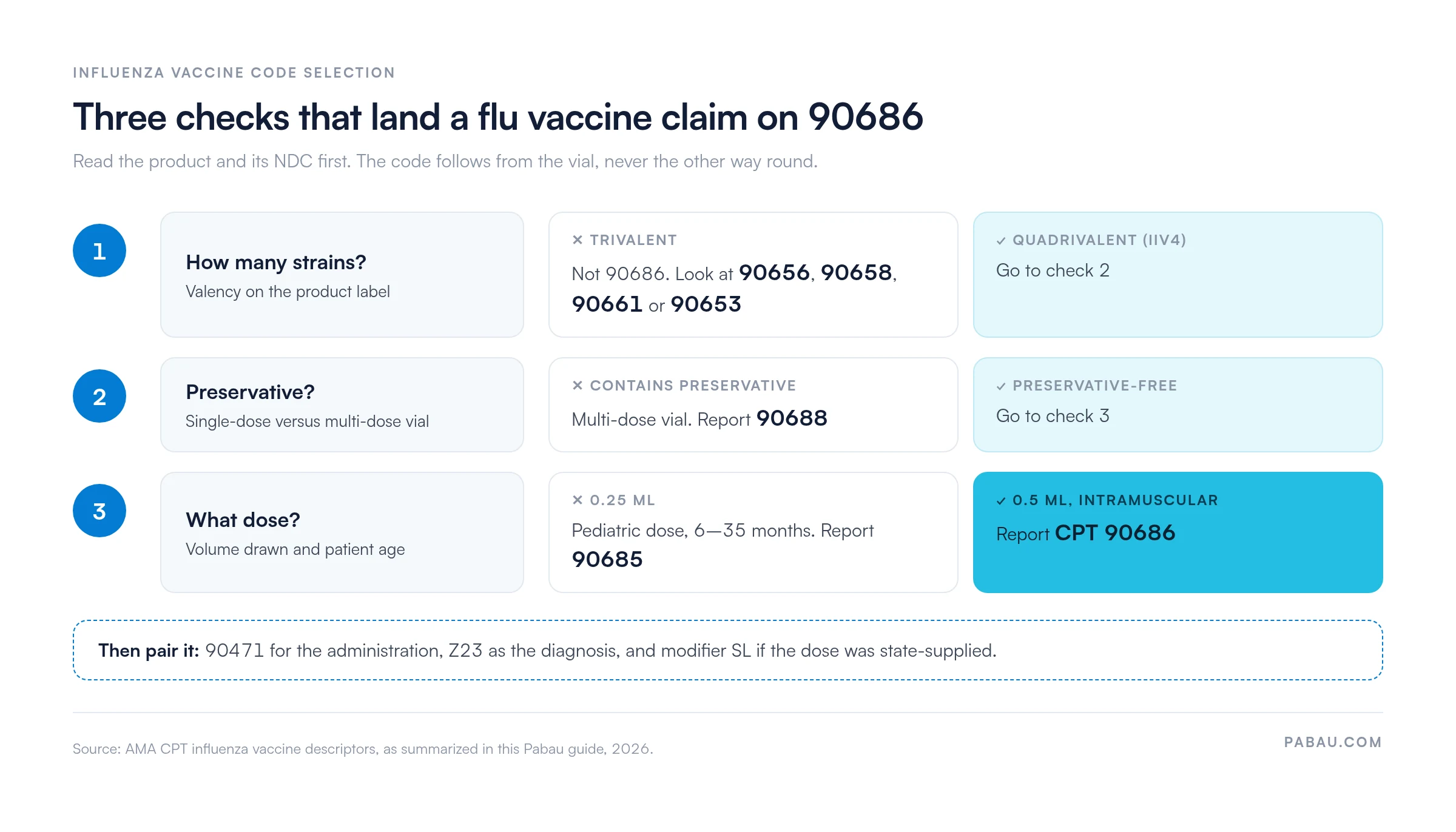
CPT Code 90686 is a supply code only, so every immunization claim needs a paired administration code. Report CPT 90471 for the first vaccine given during an encounter. If the patient gets a second vaccine at the same visit, report CPT 90472 for each additional one.
A COVID-19 dose at the same visit is the exception. Report CPT 90480 for it, never 90472. The flu shot still takes 90471, even when the COVID-19 dose came first.
Leaving out 90471 is the most common reason a 90686 claim is underpaid rather than denied outright. The payer may reimburse only the component it can match. If neither code is correct, it pays nothing.
ICD-10 code Z23 (Encounter for immunization) is the standard diagnosis code for routine vaccination encounters. CMS and AMA guidance consistently identify Z23 as the primary diagnosis when no underlying illness prompted the visit. Sometimes a patient also presents with an active condition. Coders may then list Z23 alongside the condition code, and Z23 stays on the claim to show the vaccination was a separate preventive service.
Vaccine Information Statement (VIS) delivery must be documented too. The CDC requires practitioners to give patients the current VIS before each vaccination. The lot number, VIS publication date, and VIS delivery date should all appear in the clinical record.
Missing or incomplete documentation is the second most common reason influenza vaccine claims are denied or pulled for audit. A structured checklist removes the guesswork and protects the practice during payer reviews.
Practices that run faster, cleaner claims management can build this checklist into the immunization workflow as required fields. That way a biller can’t submit the claim before the record is complete.
Run a quarterly audit of your influenza vaccine claims. Pull every 90686 submission and check it against the NDC on the matching vaccine lot record. An NDC-CPT mismatch is invisible at submission but surfaces immediately in a payer audit or RAC review.
Most routine 90686 claims go out without modifiers. Two situations need one, and using the wrong modifier or omitting a required one generates a denial.
Modifier SL is the most misused modifier in vaccine billing. Practices in the Vaccines for Children (VFC) program, or receiving state-supplied flu vaccine, get the product at no cost. Billing 90686 without SL in that situation is a compliance risk. The practice would be claiming payment for a product it received free of charge.
Adding SL tells the payer the vaccine was state-supplied, and the administration fee (90471) stays billable at the standard rate. Review this supply-versus-administration split once a year as a compliance checkpoint.
Modifier 25 applies only when a clinician provides a distinct evaluation and management service on the same day. Documenting “reviewed immunization history” is not a separately identifiable E/M service. The note must show a problem-focused or more extensive assessment unrelated to the immunization.
Medicare Part B covers CPT Code 90686 as a preventive benefit. Unlike most Part B services, the annual flu vaccine carries no patient deductible and no copay. Medicare pays 100% of the Medicare-allowable amount. The practice must enroll as a Medicare provider and accept assignment on flu vaccine claims to be paid directly.
The reimbursement amount changes each year, so don’t rely on a fixed dollar figure from a billing resource. CMS updates rates in the annual Medicare Physician Fee Schedule and publishes them ahead of each flu season. The CMS Physician Fee Schedule lookup tool lets you search 90686 by MAC jurisdiction for the current-year allowable in your area.
For benchmarking across payers, the FastRVU 2026 RVU lookup tool lists the work, practice expense, and malpractice RVUs for 90686 by year. Those values help you estimate allowables before negotiating a fee schedule with commercial payers.
Most payers don’t require prior authorization for the annual flu vaccine. As a preventive benefit, CPT Code 90686 usually falls within automatically approved services under Medicare and most commercial plans. Still, verify with each payer annually. Coverage conditions can include age minimums, frequency limits (typically once per plan year), and provider type restrictions.
Tracking each payer’s preventive-vaccine rules by hand gets unwieldy once a practice bills more than a few plans. Flag payer-specific rules when the vaccine visit is scheduled, rather than discovering a coverage condition at claim submission.
Denials on 90686 cluster around a predictable set of errors. Most are preventable while the claim is being prepared, so they never need a post-denial appeal. The table below lists the errors payers flag most often on immunization claims.
Review the denial codes after each remittance cycle, especially the CARC (Claim Adjustment Reason Code) on each denial. It names the rule that was broken, which makes a targeted correction far faster than a general appeal.
Set up a pre-submission rule in your billing workflow that flags any 90686 claim missing a paired 90471 before it reaches the clearinghouse. This single check catches the most common underpayment scenario without requiring a coder to manually review every immunization claim.
Without a system, a biller checks each 90686 claim by hand. They match the NDC to the code, add 90471 and Z23, and remember modifier SL for state stock. Miss one step during flu season and the denial arrives weeks later.
Pabau keeps the vaccine record, the billing codes, and the payer rules in one system. The biller works from the same note the clinician signed, with the lot number and NDC already on it. Modifier and payer requirements sit alongside the claim, so the checks happen before submission.
Pabau also integrates with Claim.MD, a clearinghouse connected to thousands of US payers. Claims go out from the platform, and payment status and electronic remittance advice (ERA) come back into it. Your team sees which 90686 claims were paid and which were denied, without logging into a separate portal.

Pabau tracks vaccine billing codes, modifier rules, and payer requirements in one place. Your 90686 claims go out clean the first time.

Flu season packs most of a year’s vaccine billing into a few busy months. The checks around 90686 have to run on autopilot during that rush. Start at the vial: a quadrivalent, preservative-free, 0.5 mL NDC means 90686, with 90471 and Z23 on the same claim.
The trade-off worth remembering is modifier SL. Leaving it off state-supplied stock is a compliance problem, which is worse than a simple denial. Treat VFC doses as their own workflow.
Book a demo to see how Pabau keeps vaccine codes, modifiers, and payer rules in step, so your 90686 claims go out clean.

Billing the injection alongside the vaccine? CPT code 90471: Immunization administration billing guide covers the administration code every 90686 claim needs.
Giving the flu shot to a Medicare patient? HCPCS Code G0008: Influenza vaccine administration billing guide explains the Medicare administration code for influenza vaccines.
Stocking the trivalent preservative-free vaccine? CPT Code 90656: Influenza vaccine billing guide walks through the trivalent neighbor of 90686.
Using a cell-culture flu vaccine? CPT Code 90661: Cell-culture influenza vaccine billing guide covers the ccIIV3 code and how it differs from high-dose products.
Want to understand the full claims submission process? Our Claim.MD clearinghouse guide explains how electronic claims move from the practice to the payer and back.
CPT Code 90686 covers the quadrivalent inactivated influenza vaccine (IIV4), split virus and preservative-free. It is a 0.5 mL intramuscular dose for patients aged 3 and older. It covers the vaccine product only, so bill the administration separately with CPT 90471.
CPT 90686 is quadrivalent (four influenza strains) and preservative-free, while CPT 90658 is trivalent (three strains) and may contain a preservative. Billing 90658 for a quadrivalent product is a coding error. Payers check the NDC on the claim against the CPT code and deny a mismatch.
ICD-10 code Z23 (Encounter for immunization) is the standard diagnosis code paired with CPT Code 90686 for routine vaccination visits. If the patient also has an active condition that day, list Z23 alongside the condition code. Z23 stays on the claim to show the vaccination was a separate preventive service.
Yes, Medicare Part B covers CPT Code 90686 as an annual preventive benefit with no patient deductible or copay. The practice must be enrolled as a Medicare provider and accept assignment on flu vaccine claims. Rates change each year, so check the CMS Physician Fee Schedule lookup tool for your MAC jurisdiction.
Modifier SL is required when the flu vaccine was state-supplied through the VFC program or state health department stock. It reduces the vaccine supply payment to $0, while the administration fee (90471) stays billable. Modifier 25 applies when a separately identifiable, documented E/M service happens on the same day.
The most common reasons are billing the trivalent code (90658) for a quadrivalent vaccine and omitting the administration code 90471. Using a condition code instead of Z23 also triggers denials. So do a second claim in the same plan year, a patient under 3, and a missing modifier SL on state-supplied vaccine.
No. CPT Code 90686 is indicated for patients aged 3 years and older, and claims for younger patients will be denied. The 0.25 mL pediatric dose for children aged 6-35 months is reported with CPT 90685.