CCSD code H4430: Examination of rectum under anaesthetic
CCSD code H4430 pays for the examination alone CCSD code H4430 is the UK private...

Last Updated: Oct 20, 2026
J2212 is the HCPCS Level II code for injection, methylnaltrexone, 0.1 mg.
Units are only the first of four checks a payer runs. The line also needs the right wastage modifier, the NDC from the container you opened, and a diagnosis tying the constipation to opioid therapy.
Here's how each piece works, and what to confirm before the claim leaves your office.
Let Pabau's smart automation suggest the right codes, reduce claim denials, and keep your practice compliant—effortlessly.
Automate repetitive tasks and focus on what matters most—your patients.
Reduce coding errors and ensure compliance with the latest regulations.
Clean claims, fewer denials, and faster reimbursements.
Powerful insights and reporting to help your practice thrive.
HIPAA compliant SOC 2 certified GDPR-compliant Trusted by 4,000+ clinics worldwide

HCPCS code J2212 covers an injection of methylnaltrexone bromide, sold as Relistor, and one unit equals 0.1 mg.
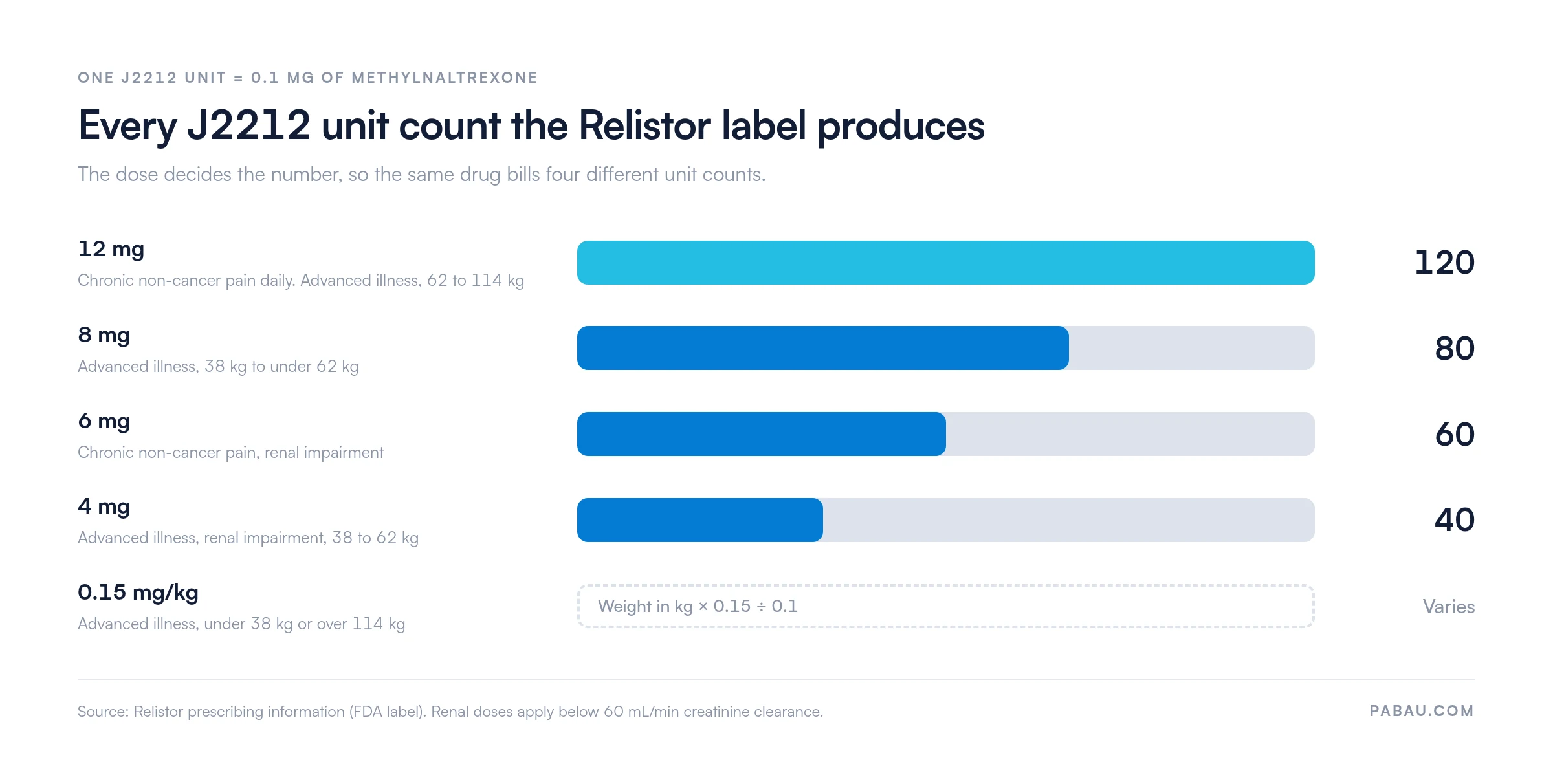
Divide the milligrams given by 0.1 to get the units, so a 12 mg dose bills as 120 units.
CMS requires either modifier JW or modifier JZ on a J2212 line, and reporting has been mandatory since July 1, 2023.
Both modifiers appear on one claim only when a single-dose container is split between drug given and drug discarded.
Medicaid needs the 11-digit NDC from the container you opened, and the diagnosis has to link the constipation to opioid therapy.
J2212 pays for the methylnaltrexone itself. The injection service bills separately on its own line, usually as CPT 96372. Treating the two as one charge is a quick way to lose money on a visit you already delivered.
The code is a Level II drug code maintained by the Centers for Medicare and Medicaid Services (CMS). It describes a single 0.1 mg increment of methylnaltrexone bromide, marketed as Relistor by Salix Pharmaceuticals.
J-codes cover drugs a patient cannot take on their own at home. Most of them run through buy-and-bill. The practice purchases the vial, a provider administers it in the office, and the practice bills the payer for the product.
Methylnaltrexone works in the gut rather than the brain. It blocks opioid receptors in the bowel without crossing the blood-brain barrier, so constipation eases while pain control stays intact.
Payers treat it as a targeted therapy, which is why the diagnosis on the claim has to prove the constipation came from opioids.
Medicare Part B pays J2212 at the average sales price plus 6 percent. The current payment limit sits in the quarterly ASP drug pricing files, alongside the CMS Physician Fee Schedule. Manufacturers report sales data every quarter, so the dollar amount resets in January, April, July, and October.
Geography moves it again. The Medicare locality payment percentage adjusts the national figure for where the service was delivered.
Two practices can submit identical claims and be paid different amounts. Check the quarterly file and your own locality before quoting a figure to a patient.
Open the CMS ASP drug pricing files at the start of every quarter. Set a calendar reminder for the second week of January, April, July, and October. That is usually early enough to catch the update before claims go out on a stale rate.
Units on a J2212 line equal the milligrams administered divided by 0.1. Nothing else feeds the calculation. Vial size is irrelevant, so 12 mg is 120 units whether it came from a vial or a prefilled syringe.
Which dose the patient receives depends on the indication, and the Relistor prescribing information carries two separate regimens.
The weight bands below belong to the advanced-illness regimen. Two of them are fixed doses. The other two are calculated from body weight, so the unit count changes from patient to patient.
Renal function changes the number again. Below a creatinine clearance of 60 mL per minute, the chronic non-cancer pain dose drops to 6 mg daily, which is 60 units. Advanced-illness doses halve too, so an 8 mg patient becomes a 4 mg patient at 40 units.
Rounding is where the calculated doses go wrong. Work from the dose recorded in the treatment note rather than the vial label, and carry the decimal through before you round the unit count.
A J2212 line carries one wastage modifier, never two. JZ attests that no drug from the single-dose container was discarded. JW reports the discarded amount, on a line of its own. Relistor ships in single-dose vials and prefilled syringes, so the CMS discarded drug policy applies to it.
The dates matter if you are cleaning up older claims. CMS allowed voluntary JZ reporting from January 1, 2023. Reporting became mandatory on July 1, 2023, and contractors began editing claims for correct use on October 1, 2023.
Here is what that looks like on paper. A full 12 mg dose with nothing discarded is a single line reading J2212, 120 units, modifier JZ. One line, one modifier, done.
Now split the container. Give 10 mg from a 12 mg single-dose vial and the claim needs two lines. The first reports 100 administered units with no wastage modifier. The second reports the 20 discarded units with JW. Both amounts have to appear in the patient’s record.
Every state Medicaid program wants the National Drug Code (NDC) on claims for physician-administered drugs, and plenty of commercial payers ask for it too. The NDC is an 11-digit number in 5-4-2 format identifying the product, the package size, and the labeler.
It has to match the container you opened. A 12 mg single-dose vial and a 12 mg prefilled syringe carry different NDCs. The number describes the stock on your shelf, not the drug in general. Read it off the carton at the point of administration.
Numbers also change when a manufacturer updates packaging. Check the current one against the label or the FDA National Drug Code Directory, because a stale NDC on a Medicaid claim rejects automatically. A crosswalk built once and never revisited is the usual culprit.
A J2212 claim needs at least one ICD-10-CM code establishing medical necessity, and K59.03 is the one payers expect. Automated necessity edits look for a diagnosis that names the cause, so unspecified constipation rarely clears them on its own.
Pair K59.03 with Z79.891 for a patient on long-term opioid therapy, or with Z51.5 when the visit is palliative. Descriptors change every October 1, so confirm the wording in the current ICD-10-CM code set before it goes on a claim.
Medicare Part B pays for methylnaltrexone when a qualified provider gives it by subcutaneous injection in a clinical setting. Coverage rests on the incident-to rules and the Part B drug benefit for physician-administered drugs.
Relistor tablets sit outside that benefit. Oral formulations a patient can take at home fall under the CMS self-administered drug exclusion, and Part D pharmacy benefits pay for them instead. Route of administration is the single detail separating the two, and billing J2212 for a tablet is an improper claim.
Medicare fee-for-service does not routinely require prior authorization for J2212. Medicare Advantage plans and commercial payers often do, and the rule varies plan by plan. Verify it during eligibility, not after the drug is in the patient.
Most commercial payers also want step therapy on record. In practice that means the patient tried conventional laxatives first, such as polyethylene glycol, lactulose, or bisacodyl, and got no relief from them.
Document each failed trial with the drug name, the dose, how long the patient took it, and the response. That record supports the authorization request. It is also the same evidence a post-payment audit will ask for a year later.
Denials on this code cluster around a short, predictable list. Working backwards from the remittance and matching each rejection to the relevant denial codes shows which of the six is firing in your practice.
Two or three of these usually account for most of the rework. Fix the workflow producing them and the denial rate falls without anyone chasing claims one at a time.
J2212 rarely appears alone. The administration service, the diagnosis, and the occasional unlisted-drug code all sit near it. Knowing which is which prevents both unbundling and duplicate billing.
CPT 96372 causes the most argument of the four. Some payers reimburse the administration separately, and others fold it into the drug payment. Read the policy before you add the line, because appealing a bundled service after the fact rarely works.
Most J2212 denials are preventable in the 30 seconds before submission. Here is the short version of what a biller should confirm on the line.
Working that list is also the quickest route to the clean claim requirements a payer applies before a claim ever reaches an adjudicator.
In most practices the drug administration lives in one system and the claim lives in another. Someone reads the note, retypes the dose, works out the units, and keys the NDC into a billing screen. Every hop is a chance to drop a decimal.
Practice management software like Pabau closes that hop. The treatment note, the product used, the diagnosis, and the invoice sit in one client record. From there, claims management without retyping builds the claim from what the clinician documented. Claims then go to the payer electronically, and remittances land against the same record.
It does not make the coding decisions for you. Pabau will not pick your modifiers or maintain an NDC crosswalk, and no software replaces a biller who knows the discarded drug policy. What it removes is the retyping between the clinical record and the claim, which is where units and NDCs usually break.

Pabau keeps the drug administered, the diagnosis, and the invoice in one client record, then submits the claim electronically. Your billers work from what the clinician documented instead of retyping it into a second system.

J2212 is not a difficult code, but it is an unforgiving one. The 0.1 mg unit, the wastage modifier, and the NDC all fail quietly. The claim comes back weeks later with a reason code that never says which of the three broke.
Practices that stop losing money here do three small things. They calculate units from the documented dose. They decide the modifier at the point of administration, not at submission. And they read the NDC off the container instead of a saved crosswalk.
Get those three right and the rest of the claim tends to look after itself. Book a demo to see how Pabau carries a drug administration straight through to a submitted claim.

Need the wider picture before you fix one code? What is medical billing walks through how a drug claim moves from the encounter to the payment.
Struggling to read the remittance after a J-code batch? Electronic remittance advice explains how to read an ERA file and trace each reason code back to its cause.
Want a process for the denials you already have? Denial management in healthcare sets out how to triage, appeal, and stop repeat denials at the source.
Catching authorization problems too late? Insurance eligibility verification covers what to check before the visit, including prior authorization rules.
Worried about how a J-code claim looks in an audit? Medical billing compliance outlines the documentation standards behind physician-administered drug claims.
It depends on the indication. For opioid-induced constipation with chronic non-cancer pain, the label supports one 12 mg injection daily. For advanced illness, dosing runs every other day as needed, with no more than one dose in any 24-hour period. Frequency edits are common, so record the date and time of every dose.
In the shaded area of item 24, directly above the J2212 line. Enter the N4 qualifier, then the 11-digit NDC with no spaces or hyphens, then the unit of measure and the quantity given. Injectables normally use ML. Facility claims on the UB-04 report the drug under revenue code 0636 instead.
The dose in milligrams, the route, the injection site, the date and time, the NDC and lot number from the container, and any discarded amount. Auditors compare the units billed against that record. A note that records only the drug name will not support 120 units.
Appeal with the clinical record rather than resubmitting a corrected claim. Attach the opioid regimen, the failed laxative trials with dates, and the note showing the dose given. Most necessity denials trace back to a diagnosis that never names opioids, so check the codes on the line first.