CCSD code H4430: Examination of rectum under anaesthetic
CCSD code H4430 pays for the examination alone CCSD code H4430 is the UK private...

Last Updated: Oct 20, 2026
J1930 is the HCPCS Level II code for injection, lanreotide, 1 mg.
For physician-administered drugs, the per-unit descriptor drives the claim. J1930 covers one milligram, so every claim must reflect the exact number of milligrams administered.
The code sits in HCPCS Level II, which the Centers for Medicare and Medicaid Services (CMS) maintains. Its effective date is January 1, 2009. It covers only the brand-name Ipsen product, and Cipla's generic lanreotide bills under a separate code, J1932, covered in the related codes section below.
Let Pabau's smart automation suggest the right codes, reduce claim denials, and keep your practice compliant—effortlessly.
Automate repetitive tasks and focus on what matters most—your patients.
Reduce coding errors and ensure compliance with the latest regulations.
Clean claims, fewer denials, and faster reimbursements.
Powerful insights and reporting to help your practice thrive.
HIPAA compliant SOC 2 certified GDPR-compliant Trusted by 4,000+ clinics worldwide

HCPCS code J1930 describes injection, lanreotide, 1 mg, the brand-name Somatuline Depot from Ipsen, billed under Medicare Part B.
Billing units match the dose exactly, so a 60 mg dose is 60 units and a 120 mg dose is 120 units.
Medicare pays J1930 at ASP plus 6%, and the rate changes every quarter, so check the current CMS figure before projecting revenue.
Most Medicare Advantage, Medicaid, and commercial payers require prior authorization, and Cipla’s generic lanreotide bills under J1932 instead.
Practice management software like Pabau automates HCPCS lookup, unit calculation, and prior authorization tracking to cut denials on drug codes.
Lanreotide acetate mimics somatostatin, a hormone that inhibits growth hormone secretion and suppresses the release of certain peptides from the gastrointestinal tract. Somatuline Depot comes as a pre-filled, ready-to-inject syringe in three strengths of 60 mg, 90 mg, and 120 mg. It is usually given once every four weeks, though the interval may be adjusted to clinical response.
Somatuline Depot carries three FDA-approved indications. The first is acromegaly, in patients who have failed or are not candidates for surgery or radiation. The second is gastroenteropancreatic neuroendocrine tumors (GEP-NETs), where it improves progression-free survival. The third is carcinoid syndrome, where the label covers reducing the use of short-acting somatostatin analogs.
CMS and most commercial payers require a documented covered diagnosis for J1930 claims. All three FDA-approved indications qualify. They are acromegaly, GEP-NETs, and carcinoid syndrome. A claim submitted without a supporting ICD-10-CM code that matches payer policy is among the most common denials on this code.
For acromegaly claims, most payers require documentation that the patient failed or was not a candidate for surgery or radiation therapy. For GEP-NETs, payers typically require pathology confirming neuroendocrine origin and evidence of unresectable or metastatic disease. For carcinoid syndrome, document the symptom burden and the short-acting somatostatin analog use the therapy is meant to reduce.
Most payers, including Medicare, require the National Drug Code (NDC) to appear on J1930 claims. The NDC identifies the product, manufacturer, and package size administered. Omitting the NDC, or using one that does not map to J1930, is a common rejection trigger. The NCI SEER CanMED HCPCS database maintains the official NDC-to-HCPCS crosswalk for lanreotide.
When reporting the NDC on a claim, use the 11-digit format with qualifier N4 in the appropriate loop of the 837P electronic claim. Report the unit of measure qualifier as ML and the quantity as administered. Verify the NDC for current product lots against the NCI SEER crosswalk or the payer’s formulary list, since NDCs change when manufacturers update packaging.
J1930 billing is straightforward once the one-to-one relationship between milligrams and units is clear. The descriptor specifies 1 mg per unit, so units billed equal milligrams administered. A practice giving the 120 mg dose bills 120 units on the claim line.
This is where many denials originate. Billers unfamiliar with the code sometimes bill 1 unit per vial regardless of dose, which under-reports the service and under-reimburses the practice.
J1930 is billed through the buy-and-bill model. The practice purchases the drug, administers it, and then submits a claim for reimbursement.
The claim goes out on the 837P electronic claim format, or on the CMS-1500 paper form. It carries J1930 on the procedure line, the NDC in the drug field, and the supporting ICD-10-CM diagnosis.
Place of service affects reimbursement. The common settings for lanreotide are office (POS 11), outpatient hospital (POS 22), and off-campus outpatient hospital (POS 19).
Medicare pays a lower rate for the same J-code from a facility setting than from a non-facility office, because facility overhead is reimbursed separately. Confirm the place of service before submission to avoid both denials and mispayment.
Recording the administration date, the dose in milligrams, the lot number, and the NDC in the patient record supports the claim if it is audited.
Medicare Part B reimburses J1930 at average sales price plus 6% (ASP+6%). CMS calculates the ASP from manufacturer-reported sales data and updates it every quarter. The dollar amount per unit therefore moves throughout the year.
Always verify the current quarter’s ASP rate through the CMS Physician Fee Schedule lookup tool before projecting reimbursement for a patient encounter.
At the 120 mg dose, the difference between a high-ASP quarter and a low-ASP quarter can run to several hundred dollars per claim. For oncology and endocrinology practices giving Somatuline Depot regularly, tracking quarterly ASP changes is a routine revenue cycle task.
After adjudication, the electronic remittance advice (ERA/835) from the payer shows the allowed amount applied to each J1930 line.
J1930 falls under Medicare Part B rather than Part D, because it is administered in a clinical setting. Patient cost-sharing is 20% after the deductible, applied to the ASP+6% amount. Secondary insurance or a Medigap plan may cover that share, depending on the patient’s coverage.
Run a quarterly ASP check every January, April, July, and October, when CMS updates its drug pricing files. Flag any J1930 claim pending submission around a quarter boundary and confirm the new rate before transmitting. On a 120-unit claim, a few cents per unit adds up quickly across a patient panel.
Traditional Medicare (Parts A and B) does not generally require prior authorization for J1930. Local Coverage Determinations may still impose documentation requirements that work much the same way. Medicare Advantage plans, Medicaid managed care, and commercial insurers typically require prior authorization before the drug is given.
Administering the drug without an approved PA and then submitting the claim almost always produces a denial that is hard to overturn after the fact.
Confirm PA status as part of the eligibility check before each administration cycle. For J1930, PA requests typically require:
When a PA is denied, the appeal should cite the FDA-approved indication, the patient’s clinical documentation, and current guidance from the relevant professional society.
Practices that track PA denials by payer recover more of these claims than practices that appeal case by case. Retain the PA approval record alongside the claim documentation for the same encounter, so an audit can reconstruct both in one pull.
Several HCPCS codes appear alongside J1930 in oncology and endocrinology billing. Choosing the wrong one is a common and easily avoided error on lanreotide claims. Use the AAPC HCPCS code reference to verify the code for each product and manufacturer before submission.
Our HCPCS code library covers the other J-codes an oncology billing team handles in the same encounter.
J1930 and J1932 are not interchangeable. Billing J1930 when Cipla’s generic lanreotide was administered is an incorrect code submission.
Payers cross-reference the NDC on the claim against the HCPCS code. An Ipsen NDC billed with J1932, or a Cipla NDC billed with J1930, triggers an edit. Always confirm the manufacturer before selecting the code.
J1930 claims fail more often than most Part B drug codes because four fields have to line up at once. Those are the code, the units, the NDC, and an approved prior authorization. Missing any one of them triggers a denial.
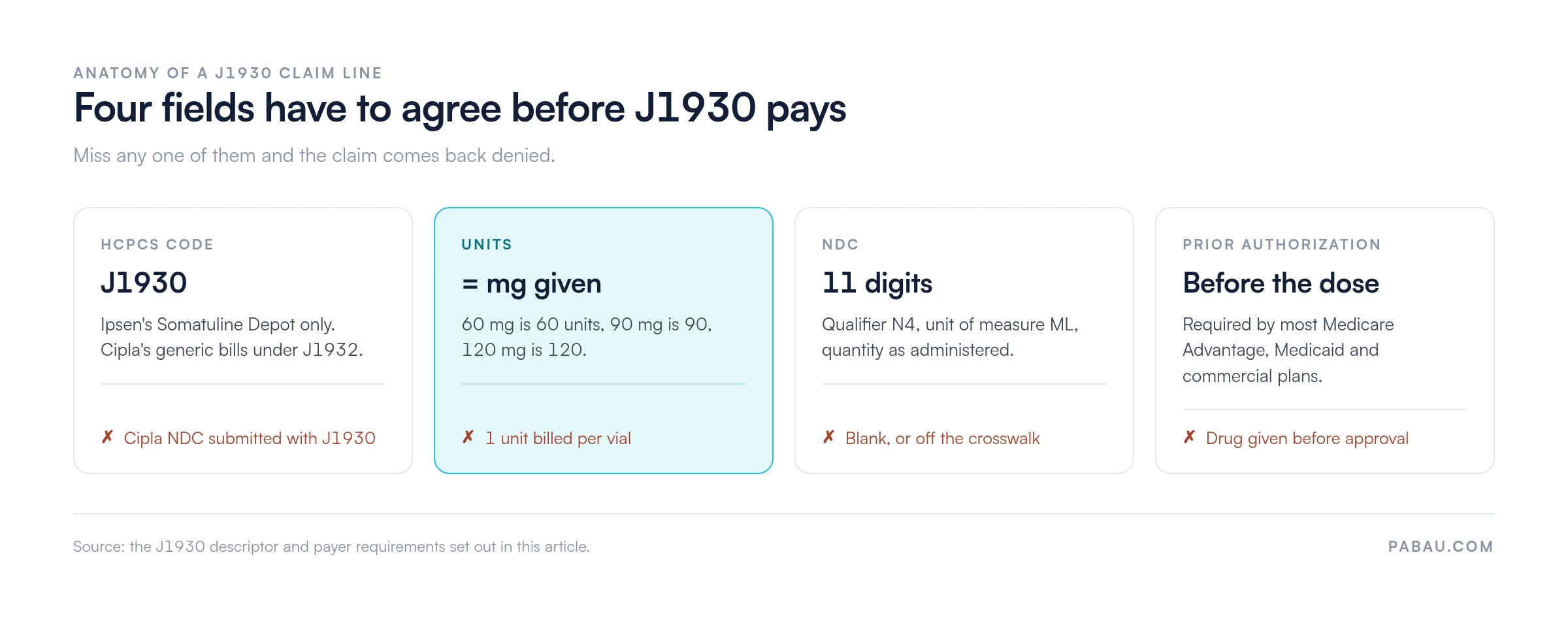
A pre-submission checklist that validates these six points against each J1930 claim sharply reduces first-pass denial rates. On a drug this expensive, that checklist protects more revenue per hour than any appeals process.
Build a J1930-specific scrub rule in your billing system. Have it flag any claim where the unit count does not match the documented dose in milligrams. Have it flag a blank NDC field, and any patient with no PA approval recorded for the active payer. Caught at the scrubbing stage, those three fields stop most first-pass J1930 denials.
Manual J1930 billing across a panel of acromegaly and GEP-NET patients creates compounding administrative risk. Each quarterly ASP update, each prior authorization renewal, and each new lot number is a change somebody has to catch by hand.
Practice management software like Pabau removes most of that manual tracking. Its connected claims management software pulls HCPCS lookup, unit calculation, and prior authorization status into a single workflow.
When a clinician records the administered dose in the patient record, that number carries into the claim. The billing team generates the line with the correct unit count instead of retyping it.
Prior authorization status sits on the patient record before the administration is scheduled, so nobody administers a dose without an active approval. After submission, remittance data reconciles against the expected ASP+6% amount and flags discrepancies for review.

Pabau connects HCPCS lookup, unit calculation, and prior authorization tracking in one platform. Your team spends less time on manual entry and more on patient care.

J1930 is simple in concept and demanding in practice. The per-milligram unit logic, the NDC crosswalk, the quarterly ASP change, and the prior authorization cycle all have to be right on every claim.
One missed field means a denied claim and delayed payment on an expensive drug. Practices that build the check into the workflow stop paying for it later in appeals.
Book a demo to see how Pabau keeps unit counts, NDC data, and prior authorization status together on J-code claims.

Need a framework for managing drug claim denials? Denial management in healthcare covers how to build a systematic appeals process for high-value Part B drug claims.
Want to reduce errors before claims leave the practice? Clean claim submission best practices outlines the pre-submission validation steps that reduce first-pass denial rates.
Need to confirm coverage before the dose? Insurance eligibility verification explains the checks that catch a lapsed policy or a missing prior authorization.
Reconciling what the payer actually allowed? Electronic remittance advice walks through reading the 835 file line by line.
Looking to streamline your revenue cycle beyond individual codes? Revenue cycle management explained breaks down how integrated billing workflows reduce administrative overhead.
HCPCS code J1930 is the billing code for injection, lanreotide, 1 mg, the brand-name drug Somatuline Depot from Ipsen. Practices use it to bill Medicare Part B and commercial payers for physician-administered lanreotide injections. The approved indications are acromegaly, gastroenteropancreatic neuroendocrine tumors (GEP-NETs), and carcinoid syndrome.
Bill 120 units for a 120 mg dose. J1930 is a per-1-mg code, so units billed must equal milligrams administered. That makes 60 mg 60 units and 90 mg 90 units. Billing 1 unit per vial regardless of dose is the most common error on this code.
Yes, prior authorization is required by most Medicare Advantage plans, Medicaid managed care, and commercial payers. Traditional Medicare (Parts A and B) generally does not require PA for J1930, but Local Coverage Determinations may impose documentation requirements. Always verify PA requirements with the specific payer before administering the drug.
Medicare reimburses J1930 at average sales price plus 6% (ASP+6%). The dollar amount per unit changes quarterly as CMS updates ASP data from manufacturer-reported sales figures. Always verify the current quarter’s rate using the CMS Physician Fee Schedule lookup tool before projecting reimbursement.
J1930 is for brand-name Somatuline Depot from Ipsen, while J1932 is for Cipla’s generic lanreotide. The two codes are not interchangeable. The NDC on the claim must match the manufacturer that corresponds to the code used. Billing J1930 with a Cipla NDC, or J1932 with an Ipsen NDC, triggers a code-NDC mismatch denial.
Medicare covers J1930 under Part B rather than Part D, because a healthcare professional administers lanreotide in a clinical setting. Drugs the patient takes at home fall under Part D instead. Cost-sharing is 20% of the allowed amount after the Part B deductible.
The main supporting ICD-10-CM codes are E22.0 for acromegaly, C25.4 for pancreatic GEP-NETs, and C7A.01x for carcinoid tumors of the small intestine. E34.0 covers carcinoid syndrome, which is also an FDA-approved indication for Somatuline Depot. Verify the covered diagnosis list against the payer’s own policy before submitting.