CPT Code 62284: Injection procedure for myelography
CPT Code 62284: official descriptor and procedure overview The American Medical ...

Last Updated: Oct 19, 2026
J1620 is the HCPCS Level II code for injection, gonadorelin hydrochloride, per 100 mcg. CMS deleted it effective December 31, 2025, so it is not billable for 2026 dates of service.
No replacement code has been named. For 2026 services, follow the CMS unclassified-drug route (J3490 with the NDC) and the payer's own policy. Claims for earlier dates of service still bill J1620 at one unit per 100 mcg.
Let Pabau's smart automation suggest the right codes, reduce claim denials, and keep your practice compliant—effortlessly.
Automate repetitive tasks and focus on what matters most—your patients.
Reduce coding errors and ensure compliance with the latest regulations.
Clean claims, fewer denials, and faster reimbursements.
Powerful insights and reporting to help your practice thrive.
HIPAA compliant SOC 2 certified GDPR-compliant Trusted by 4,000+ clinics worldwide

HCPCS code J1620 (injection, gonadorelin hydrochloride, per 100 mcg) was deleted effective December 31, 2025, and is not billable for 2026 dates of service.
CMS has named no replacement code. For 2026 services, follow the CMS unclassified-drug route (J3490 with the NDC) and the payer’s own policy.
For dates of service on or before December 31, 2025, J1620 bills one unit per 100 mcg, with the NDC reported under qualifier N4.
Pabau, our practice management platform, validates claims before submission and tracks each one from pending to paid, so denials surface early.
HCPCS code J1620 is the deleted Level II code for an injection of gonadorelin hydrochloride, per 100 micrograms. CMS deleted it effective December 31, 2025, so it is not billable for 2026 dates of service.
The official descriptor is: Injection, gonadorelin hydrochloride, per 100 mcg. J1620 entered HCPCS on January 1, 1982, and covered a drug that cannot be self-administered. That placed it under Medicare Part B rather than Part D. The Centers for Medicare and Medicaid Services (CMS) HCPCS program maintains the J-series codes.
J1620 sat in the J-code range for drugs given other than by mouth. Other codes in that range have their own pages in our HCPCS reference for coders.
No, J1620 is not active. The CMS October 2026 alpha-numeric HCPCS file lists it with action code D (deleted) and a termination date of December 31, 2025. The deletion took effect on January 1, 2026.
AAPC and Find-A-Code show the same deletion. Your Medicare Administrative Contractor (MAC) rejects J1620 on a 2026 date of service with an “invalid code for date of service” edit. Commercial payers that follow the CMS HCPCS master file reject it the same way.
The date of service decides which rule applies, not the date you submit the claim. A late claim for a December 2025 injection still bills J1620. A January 2026 injection does not, and the diagram below shows where each one goes.
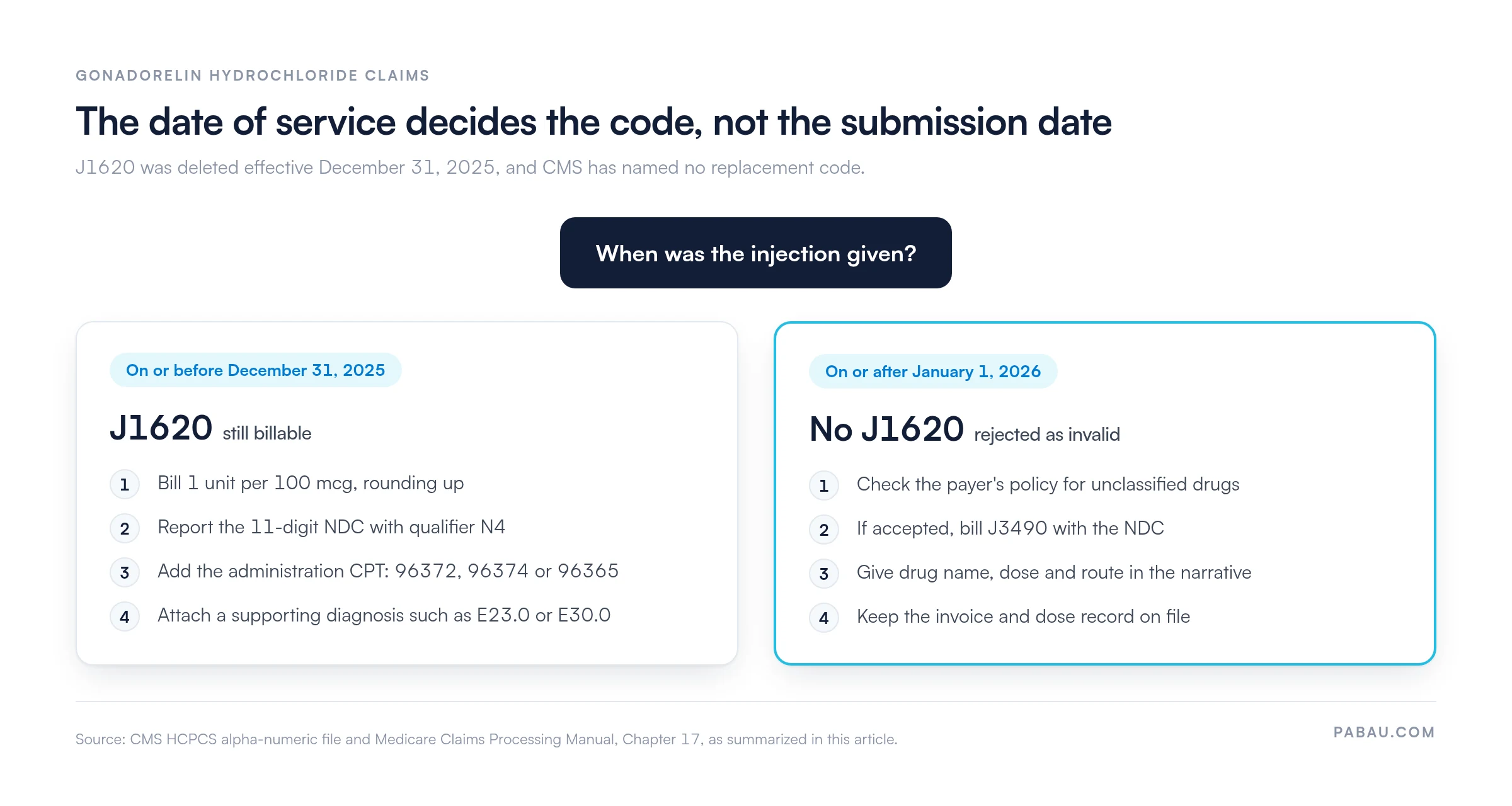
Search your charge master and EHR billing tables for J1620 and retire it for 2026 dates of service. A deleted code left active keeps generating denials until someone notices the pattern.
CMS has not named a replacement code for J1620, and no source we checked names one. Do not bill a code someone suggests in a forum without checking it against the payer.
For drugs with no specific HCPCS code, CMS guidance points to the unclassified-drug route. The Medicare Claims Processing Manual, Chapter 17 covers billing an unclassified drug under J3490 with the NDC. CMS does not designate J3490 as the official successor to J1620, so treat it as a route to confirm rather than a crosswalk.
Gonadorelin hydrochloride is a synthetic form of gonadotropin-releasing hormone (GnRH), also called luteinizing hormone-releasing hormone (LHRH). It stimulates the pituitary gland to release luteinizing hormone (LH) and follicle-stimulating hormone (FSH).
Its documented clinical uses include:
Factrel, given subcutaneously or by IV, is the gonadorelin hydrochloride product that J1620 described. Lutrepulse was a separate gonadorelin acetate product given by pulsatile infusion pump, and J1620 did not describe it. Some formulations have been commercially discontinued, so confirm availability with the prescribing provider.
Fertility practices often document gonadorelin alongside ovulation-stimulating protocols in the treatment-cycle record. That record supports the diagnosis code on the claim.
Gonadorelin is a Part B drug because it is physician-administered by injection. Part D covers self-administered drugs only, so an injected drug billed to Part D is rejected at adjudication.
The steps below apply only to dates of service on or before December 31, 2025. Use them to work open claims, corrected claims and appeals. If your team is new to drug claims, start with how medical billing works for physician-administered injectables.
J1620 is billed per 100 mcg administered. Divide the total dose given by 100 to get your unit count. Round up to the nearest whole unit if the dose is not a clean multiple of 100.
Medicaid requires NDC reporting on physician-administered drug claims, and Medicare contractors often require it for unclassified drugs. A missing or invalid NDC is one of the most common denial triggers for drug J-codes. The NDC goes in the claim’s drug identification segment in this format:
Use the NDC from the vial or syringe administered, not a generic NDC. If several vials were opened to reach the dose, report the NDC of each vial used and record the lot numbers in the clinical record.
The drug code and an administration CPT code must both appear on the same claim. Subcutaneous gonadorelin usually pairs with 96372, and the route decides the rest:
Every drug claim needs a diagnosis code that establishes medical necessity. Codes used with gonadorelin include E23.0 (hypopituitarism, including hypogonadotropic hypogonadism), E30.0 (delayed puberty) and N97.0-N97.9 (female infertility by cause). The diagnosis must be documented in the clinical note for the date of service.
Document the exact dose in micrograms in the nursing or physician note, not just the number of vials used. Payers audit the units billed against the dose in the record, and a note without a microgram figure cannot support them.
CMS paid physician-administered Part B drugs under the Average Sales Price (ASP) method, generally at ASP plus 6%. ASP rates change quarterly, so the amount for a J1620 claim depends on the quarter of its date of service. This page does not quote a dollar rate for that reason.
For a 2025 or earlier date of service, check the CMS quarterly ASP pricing file for that quarter. Your MAC’s drug fee schedule carries the same rates. The CMS Physician Fee Schedule lookup tool also returns HCPCS status by year. The AAPC HCPCS code database and PGM Billing’s HCPCS lookup help with descriptor checks.
Hospital outpatient departments bill under the Outpatient Prospective Payment System (OPPS) and may be paid a different rate. Check with your MAC if your facility is not a standard outpatient department or physician office.
Traditional Medicare generally does not require prior authorization for Part B drug injections. Coverage still depends on medical necessity. The drug must match a covered diagnosis under any applicable National Coverage Determination (NCD) or Local Coverage Determination (LCD).
Commercial payers and Medicaid plans often require prior authorization (PA) where Medicare does not. Rules vary by payer and MAC jurisdiction, and they apply whether the claim uses J1620 or an unclassified code. Verify with each plan before the drug is given.
When prior authorization is granted, record the PA number in Box 23 of the CMS-1500 and in the patient’s chart. A claim submitted without an issued PA number denies on the “authorization required” edit.
Gonadorelin is one drug in a larger class of GnRH-related drugs, and several of them have their own J-codes. The drug on the claim must match the drug in the clinical record and its approved indication for the billed diagnosis.
The most damaging mix-up is between J1620 and the leuprolide codes. Gonadorelin stimulates the pituitary, while leuprolide suppresses it with continuous use. J9217 and J9218 are billed for advanced prostate cancer, so a fertility workup patient should never carry either code.
Good denial management in healthcare for drug J-codes starts with knowing which edits fire. The table below maps six common J1620 denial triggers to their fixes.
A clean claim for a drug code starts with documentation that supports every field on the 837P or CMS-1500. Use this checklist for J1620 claims through 2025 and for unclassified-drug claims from 2026.
Before any gonadorelin claim leaves the practice, check two fields. Confirm the NDC matches the vial in the administration record, and confirm the code matches the date of service.
A deleted J-code tends to surface as a run of denials weeks after January, once remittances come back. By then, billing staff are reworking claims instead of preventing them.
Pabau, the practice management platform we build, includes claims management software that validates each claim before it goes out. Claims are submitted electronically through clearinghouses on the CMS-1500, and each one is tracked from pending to paid. Electronic remittance advice (ERA) shows which claims came back denied and why.
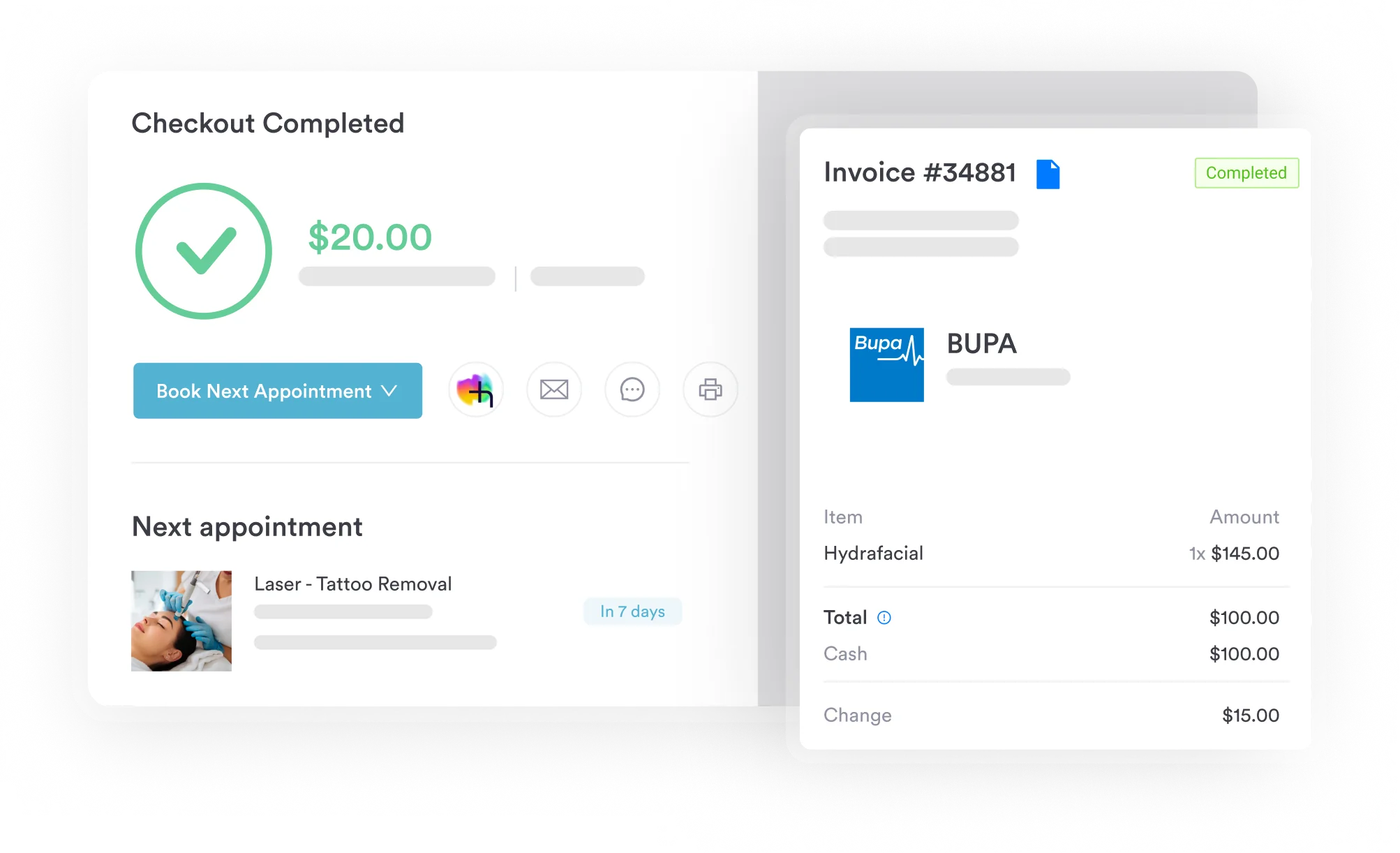
Prior authorization codes are managed on the claim, so the number is on hand when a commercial payer asks for it. When a wave of “invalid code” denials lands, the pending-to-paid view makes the pattern visible within days.

Pabau’s claims management validates claims before submission, sends them electronically through clearinghouses, and tracks each one from pending to paid. Your practice sees denials early and reworks fewer claims.

J1620 is gone for 2026 dates of service, and no replacement code is coming to make the switch automatic. Retire the code in your charge master now, then confirm each payer’s route for unclassified drugs before the next gonadorelin injection.
Keep the J1620 billing rules on file rather than deleting them. Claims, corrections and appeals for 2025 services still need them, and the date of service decides which rule applies. Book a demo to see how Pabau helps your practice catch code-change denials before they reach your receivables.

Billing a 2026 gonadorelin injection? HCPCS code J3490 explains how unclassified drugs are billed with the NDC, dose and drug name.
Need a reference on IVF procedure codes? IVF CPT codes reference covers the CPT codes paired with reproductive endocrinology billing, including which codes pair with drug J-code submissions.
Billing a GnRH agonist instead? HCPCS code J1950 covers leuprolide acetate, the GnRH drug most often confused with gonadorelin on a claim.
Tracking down why claims keep getting denied? Denial management in healthcare walks through the denial workflow from CARC code identification through corrected-claim submission and appeal.
J1620 is no longer active. CMS deleted it effective December 31, 2025, and the CMS HCPCS file gives it action code D, for deleted. It is not billable for 2026 dates of service. Claims for earlier dates of service still use it.
CMS has not named a replacement code. For drugs with no specific code, CMS guidance describes billing J3490 (unclassified drugs) with the NDC, drug name and dose. Confirm the route in each payer’s policy first, because CMS does not designate J3490 as J1620’s official successor.
HCPCS code J1620 covered an injection of gonadorelin hydrochloride, a synthetic form of gonadotropin-releasing hormone, billed per 100 micrograms. It applied when the drug was physician-administered and billed under Medicare Part B or a comparable payer benefit. It never covered other GnRH-class drugs such as leuprolide, which has its own J-codes.
For dates of service through December 31, 2025, bill one unit per 100 micrograms administered. Divide the dose in mcg by 100, so 200 mcg equals 2 units. Round up when the dose is not a clean multiple of 100, and document the exact dose.
Yes, in most cases. Medicaid requires NDC reporting on physician-administered drug claims, and many Medicare and commercial payers expect it. Report the 11-digit NDC in 5-4-2 format with qualifier N4, the unit qualifier (UN, ML or GR) and the quantity administered. The same NDC rules apply to unclassified-drug claims from 2026.
Traditional Medicare generally does not require prior authorization for Part B drug injections, but medical necessity must be documented. Medicare Advantage plans, Medicaid and commercial insurers often do require it. Check each payer’s policy before the drug is given, and record the PA number on the claim.
It depends on the route. CPT 96372 covers subcutaneous or intramuscular injection, the most common route for gonadorelin. CPT 96374 applies to an IV push and CPT 96365 to an IV infusion. The drug code and the administration CPT must appear on the same claim.