

CPT code 48152: Whipple procedure without pancreatojejunostomy
CPT code 48152: Official description and procedure overview CPT code 48152 descr...

Last Updated: Nov 13, 2026
J2780 is the HCPCS Level II code for injection, ranitidine hydrochloride, 25 mg. CMS deleted it effective July 1, 2024, with no crosswalk code, so June 30, 2024 is the last valid date of service.
One unit equals 25 mg, so a 50 mg dose bills as 2 units with the NDC and an administration code. Ranitidine left the US market after the FDA's April 2020 withdrawal request over NDMA contamination.
Let Pabau's smart automation suggest the right codes, reduce claim denials, and keep your practice compliant—effortlessly.
Automate repetitive tasks and focus on what matters most—your patients.
Reduce coding errors and ensure compliance with the latest regulations.
Clean claims, fewer denials, and faster reimbursements.
Powerful insights and reporting to help your practice thrive.
HIPAA compliant SOC 2 certified GDPR-compliant Trusted by 4,000+ clinics worldwide

HCPCS code J2780 covers injection, ranitidine hydrochloride, 25 mg, so each 25 mg administered is one billing unit.
CMS deleted J2780 effective July 1, 2024, with no crosswalk code, so it is invalid for any later date of service.
Modifiers JW and JZ apply to Medicare Part B claims for single-dose-container drugs, and a line missing the right one can be denied.
The NDC goes on the claim line in the 11-digit 5-4-2 format with the N4 qualifier, which Medicaid requires and many commercial payers expect.
Pabau’s claims management tools send CMS-1500 and 837P claims and warn staff when a prior authorization is missing.
HCPCS Code J2780 is the Level II code for injection, ranitidine hydrochloride, 25 mg. CMS deleted it for dates of service on or after July 1, 2024. The CGS Medicare July 2024 HCPCS update lists its discontinue date as June 30, 2024, with no crosswalk code. The code captures only the drug cost, so a separate CPT administration code always goes on the same claim.
J2780 sat in the J-code range of the HCPCS Level II set. That range is what CMS maintains for drugs administered by injection or infusion rather than taken by the patient at home. Its neighbors are easiest to compare in a searchable HCPCS code library.
Medicare allows 12 months from the date of service to file a claim. That window closed on June 30, 2025 for the last valid J2780 date of service. The code now matters mainly for appeals, reopenings, audits and corrected claims, plus Medicaid or commercial plans with their own filing limits.
Ranitidine’s brand name, Zantac, still appears in older clinical records and payer policies, so billers searching for the “Zantac injection code” are looking for J2780. The drug left the US market after the FDA’s April 2020 market withdrawal request over NDMA contamination. The timeline below shows how the date of service decides which code an H2-blocker injection claim takes.
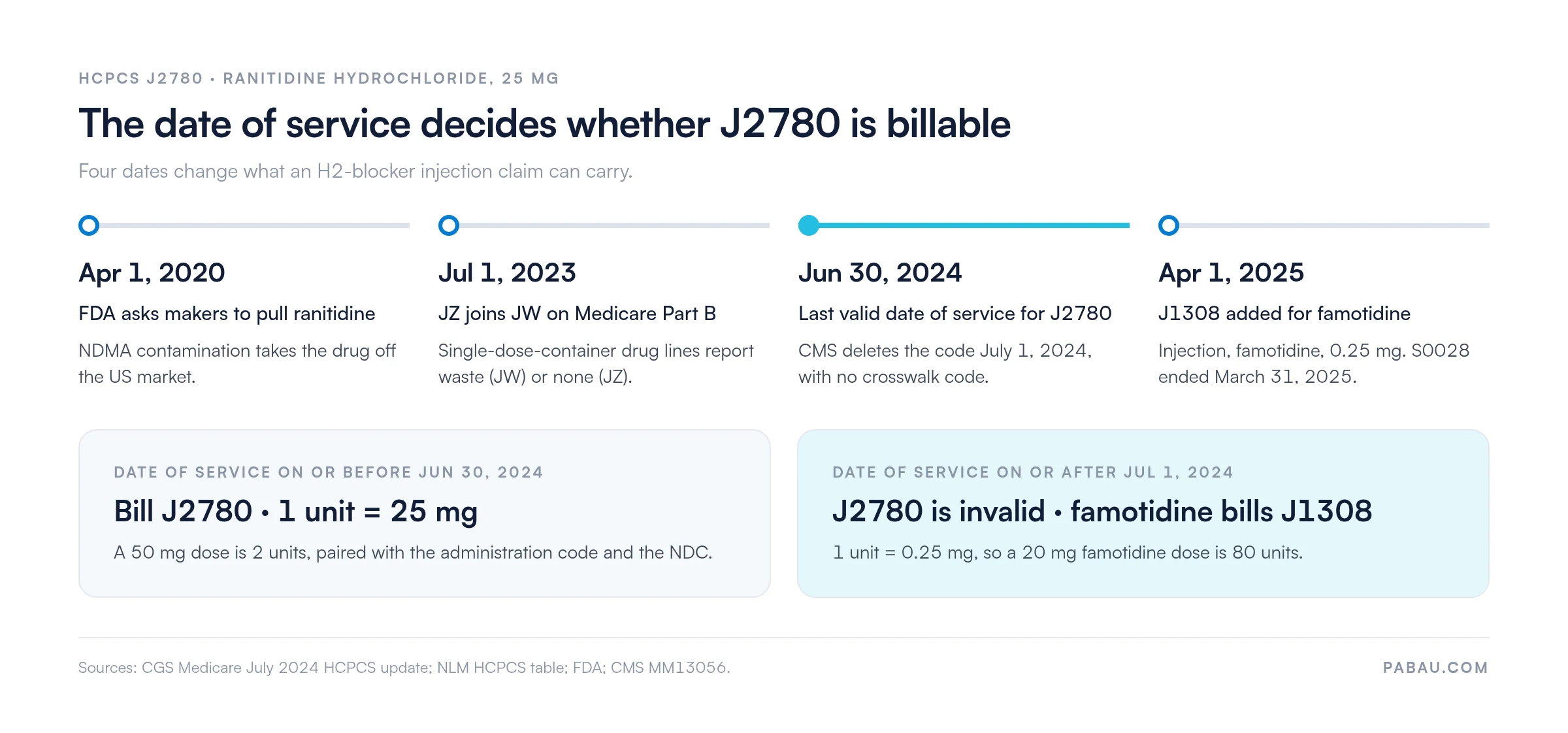
Units for J2780 equal the dose administered divided by 25 mg, the quantity in the official CMS descriptor. A 50 mg dose is 2 units, and a 75 mg dose is 3 units. A wrong unit multiplier is one of the most common reasons drug claims exceed the medically unlikely edit (MUE) limit and are denied.
CMS publishes MUE values quarterly. Check J2780 against the MUE file in effect on the date of service, not the current one.
Modifiers JW and JZ apply to Medicare Part B claims for single-dose-container drugs, which covers a J2780 line drawn from a single-dose vial. JW has been required since January 1, 2017. The JZ requirement began January 1, 2023, with enforcement from July 1, 2023, under CMS MLN Matters MM13056. A line without the right modifier can be denied, and a multiple-dose vial takes neither.
Commercial payers and Medicare Advantage plans may apply their own wastage policies. Confirm modifier requirements in each plan’s provider manual before submission.
Audit J-code drug claims monthly to confirm that each Medicare Part B line from a single-dose vial carries JW or JZ. Build the modifier prompt into charge entry, so coders choose it at the point of coding.
Most payers require the National Drug Code (NDC) on the same claim line as J2780. Medicaid programs are required by law to collect NDC data, and many commercial payers and Medicare Advantage plans ask for it too. A J2780 line without the NDC typically returns a CO-16 denial, with a remark code naming the missing information.
Scan the vial barcode at the point of administration and capture the NDC in your EHR at the time of service. An NDC rebuilt later from a purchase order is how a catalog number ends up on the claim in place of the package actually given.
J2780 covers the drug cost only, so a separate CPT administration code goes on the same claim for the clinician’s work. A subcutaneous or intramuscular injection takes 96372, while an IV push takes 96374. Without the administration code, the claim pays nothing for the professional service.
In a facility setting such as a hospital outpatient department (POS 22), the administration code may be bundled into the facility’s APC payment. The professional then cannot bill it separately. Confirm bundling rules with the facility’s compliance team before including 96372 on the professional claim.
An unsupported diagnosis is among the top denial triggers for J2780 claims. The diagnosis code must reflect a clinical indication for which injectable ranitidine was medically necessary. Payers may check it against any Local Coverage Determination (LCD) or National Coverage Determination (NCD) for H2 antagonist drugs. Verify the LCDs in force on the date of service through your Medicare Administrative Contractor (MAC).
These diagnosis codes are clinically appropriate based on ranitidine’s pharmacological indications. Confirm coverage against any applicable LCD or payer-specific coverage policy, as LCDs for H2 antagonists vary by MAC jurisdiction.
Under Medicare Part B, physician-administered drugs are paid at average sales price plus 6% (ASP+6%). CMS publishes those payment limits quarterly, so a J2780 line is paid at the rate for its date-of-service quarter. Ranitidine left the market in 2020, so check whether that quarter’s file lists a J2780 payment limit at all before appealing an underpayment.
Pull the rate from the CMS ASP pricing files for the quarter that matches the date of service. Never apply a later quarter’s rate to an older claim, since payers audit payment against the rate in effect on the date of service. The patient’s Part B coinsurance is typically 20% of the allowed amount after the deductible is met.
Medicaid rates are set by each state and can differ from the Medicare ASP+6% method. Check the state fee schedule for the date of service. A steady revenue cycle management routine keeps those payer-by-payer rate changes visible.
Traditional Medicare did not routinely require prior authorization for J2780 as a Part B drug, but Medicare Advantage plans commonly did. Commercial payers varied, and many required a PA when injectable ranitidine was ordered over an oral or over-the-counter H2 blocker. On an appeal, pull the PA rules that applied in that plan year.
A PA request for J2780 typically required the following documentation:
Keep the PA reference number in the billing record. A missing authorization number is a denial reason of its own, separate from any clinical or coding problem on the claim.
J2780 denials follow predictable patterns. Most trace back to one of eight root causes, each with a corrective action and a Claim Adjustment Reason Code (CARC) on the remittance.
Running each J2780 claim through these eight checks before submission is the core of a denial management workflow. Software built for error-free claims management can run part of that review before the claim leaves the practice.
Documentation must exist in the medical record before the claim is submitted, not after. Post-payment audits of injectable drug claims check whether the chart supports the drug name, dose, route, and medical necessity for that date.
Post-payment audits and OIG reviews of physician-administered drug billing start with the documentation. A superbill that captures the NDC, dose and modifier at the point of service puts those details on the claim without rekeying.
The place of service (POS) code determines whether J2780 and its administration code are billed separately or bundled, and it affects the Medicare payment rate. A POS that does not match the site of service invites a CO-5 denial.
Several codes appear alongside J2780 in HCPCS searches. Picking the wrong one returns a CO-16 or CO-181 denial, or a payment the payer later recoups.
When a drug has no specific code, J3490 carries the claim, with the drug name, dose and NDC in the claim’s narrative field. Use the PGM Billing HCPCS lookup tool to check a descriptor and unit quantity before each annual charge master review. For crosswalk data, the AAPC HCPCS code range search is a standard reference for coding teams.
Many practices assemble a drug claim from three sources. The order sits in the chart, the vial in the treatment room and the codes in a billing spreadsheet. Each handoff is a chance for the NDC, the unit count or the modifier to drop off the claim.
Pabau, the practice management platform we build, keeps those details in one patient record. The vial’s batch number and expiry are logged against the patient and the appointment. US claims go out as CMS-1500 or 837P claims through Claim.MD, with eligibility checks before the visit and ERA remittances posted after it.
Prior authorizations sit on the patient’s case with their auth code, dates and sessions, and staff see a warning when one is missing. Claims are then built from the documentation captured at the visit, so billers stop rebuilding them from memory days later.

Pabau records the batch, dose and prior authorization against each patient visit, then sends CMS-1500 claims through Claim.MD. Your team spends less time reworking denied injectable drug claims.

Treat J2780 as a closed code. For a date of service on or before June 30, 2024, bill one unit per 25 mg. Send it with the NDC, the administration code and the right wastage modifier. For any later date the code is invalid, and the drug actually given decides the claim.
Most J2780 work left today is appeals, audits and corrected claims. In each one, the chart has to prove the dose, route and medical necessity on its own. Book a demo to see how Pabau keeps drug documentation and claims in one place for your billing team.

Need a foundation in medical billing terminology? Medical billing fundamentals covers the end-to-end billing cycle, from charge capture through payment posting.
Struggling with claim denials across your drug codes? CARC denial codes in medical billing breaks down the most common adjustment reason codes and how to respond to each one.
Want to reduce claim errors at submission? Submitting a clean claim outlines the data elements every claim needs to avoid edits before it reaches the payer.
HCPCS Code J2780 represents injection, ranitidine hydrochloride, 25 mg, an H2 receptor antagonist that reduces stomach acid. Ranitidine was sold as Zantac. The FDA requested its US market withdrawal in April 2020 over NDMA contamination, and CMS deleted J2780 effective July 1, 2024.
No. CMS deleted J2780 effective July 1, 2024, with no crosswalk code, so June 30, 2024 is the last valid date of service. A claim line for a later date returns a CO-181 denial.
One unit of J2780 equals 25 mg, so divide the dose by 25 mg and round up to the next whole unit. A 50 mg dose is 2 units. Billing the wrong unit count is a primary cause of MUE-related denials.
JW and JZ are required on Medicare Part B claims for single-dose-container drugs, which includes a J2780 line from a single-dose vial. Use JW when part of the vial was discarded and JZ when none was. The JZ requirement began January 1, 2023, with enforcement from July 1, 2023. A line missing the right modifier can be denied.
Traditional Medicare Part B did not typically require prior authorization for J2780, but Medicare Advantage plans and many commercial insurers did. On an appeal, check the payer’s rules for that plan year. PA documentation generally included a physician order, the clinical indication and evidence supporting the injectable route over oral administration.
Eight problems cause most J2780 denials. Three are code-level: a date of service after the deletion (CO-181), units over the MUE (CO-151) and a missing JW or JZ modifier (CO-4). Three come from claim data: a missing NDC (CO-16), an unsupported diagnosis (CO-11 or CO-50) and a POS mismatch (CO-5). The last two are a missing prior authorization (CO-15) and facility bundling edits (CO-97).
Append Modifier JW to the J2780 claim line when any portion of the drawn drug is discarded rather than administered. Document the total vial contents, the dose given to the patient, and the quantity wasted in the administration note. If the entire vial contents are administered with no discarded drug, use Modifier JZ instead. On a Medicare Part B line from a single-dose vial, one of the two must appear.



