CPT Code 62284: Injection procedure for myelography
CPT Code 62284: official descriptor and procedure overview The American Medical ...

Last Updated: Oct 19, 2026
J1440 is the HCPCS Level II code for fecal microbiota, live - jslm, 1 ml, the product Ferring sells as Rebyota. It took effect on July 1, 2023, and bills per 1 mL, so the single 150 mL rectal dose is reported as 150 units.
Rebyota prevents recurrent Clostridioides difficile infection in adults after antibiotic treatment. The claim pairs J1440 with CPT 0780T for the rectal instillation, and usually with ICD-10-CM code A04.71.
Let Pabau's smart automation suggest the right codes, reduce claim denials, and keep your practice compliant—effortlessly.
Automate repetitive tasks and focus on what matters most—your patients.
Reduce coding errors and ensure compliance with the latest regulations.
Clean claims, fewer denials, and faster reimbursements.
Powerful insights and reporting to help your practice thrive.
HIPAA compliant SOC 2 certified GDPR-compliant Trusted by 4,000+ clinics worldwide

HCPCS code J1440 bills Rebyota (fecal microbiota, live – jslm) per 1 mL, so one 150 mL dose is reported as 150 units.
Bill J1440 on the same claim as CPT 0780T, the rectal instillation code, or some Medicare contractors reject the claim.
Pair it with A04.71 for recurrent C. difficile enterocolitis, and document the antibiotic end date, since the dose falls 24 to 72 hours later.
J1440 has not described filgrastim since 2014, so a claim built on the old Neupogen code needs J1442 or a biosimilar code instead.
Pabau, our practice management and billing platform, keeps the treatment note and the claim on one patient record. That makes the claim easy to check against the chart.
HCPCS code J1440 is the Level II code for fecal microbiota, live – jslm, 1 ml, the product Ferring sells as Rebyota. CMS created it in its first-quarter 2023 drug coding cycle, effective July 1, 2023. Like other drugs given by a route other than mouth, it sits in the J range of our HCPCS code library.
Rebyota is a live biotherapeutic given once, rectally, to adults who have just finished antibiotics for recurrent Clostridioides difficile infection (CDI). It is given after the infection has been treated, to prevent the next recurrence. Because the code counts milliliters, the single 150 mL dose is billed as 150 units.
The CMS decision is recorded in its HCPCS Level II coding updates. Ferring had asked for a code describing the whole 150 mL instillation. CMS chose a 1 mL unit instead, which is why the unit count matters so much on these claims.
Until the end of 2013, J1440 described filgrastim 300 mcg (Neupogen), and J1441 described the 480 mcg dose. CMS deleted both codes on January 1, 2014, and later reused J1440 for Rebyota.
Filgrastim (excluding biosimilars) is now billed with J1442, per 1 mcg. Biosimilars use their own codes, such as Q5101, Q5110 and Q5148, and tbo-filgrastim (Granix) uses J1447. A charge master or cheat sheet that still maps J1440 to filgrastim will send a neutropenia claim out under a C. difficile product code.
The FDA approved Rebyota on November 30, 2022. It is indicated to prevent recurrence of CDI in people aged 18 and older, following antibiotic treatment for recurrent CDI.
The label sets out three facts that coders need from the chart:
Payer criteria build on the label. Aetna’s fecal bacteriotherapy policy, for example, asks for the following:
Other commercial and Medicare Advantage plans publish similar criteria, usually behind prior authorization. Check each plan’s policy before the patient is scheduled.
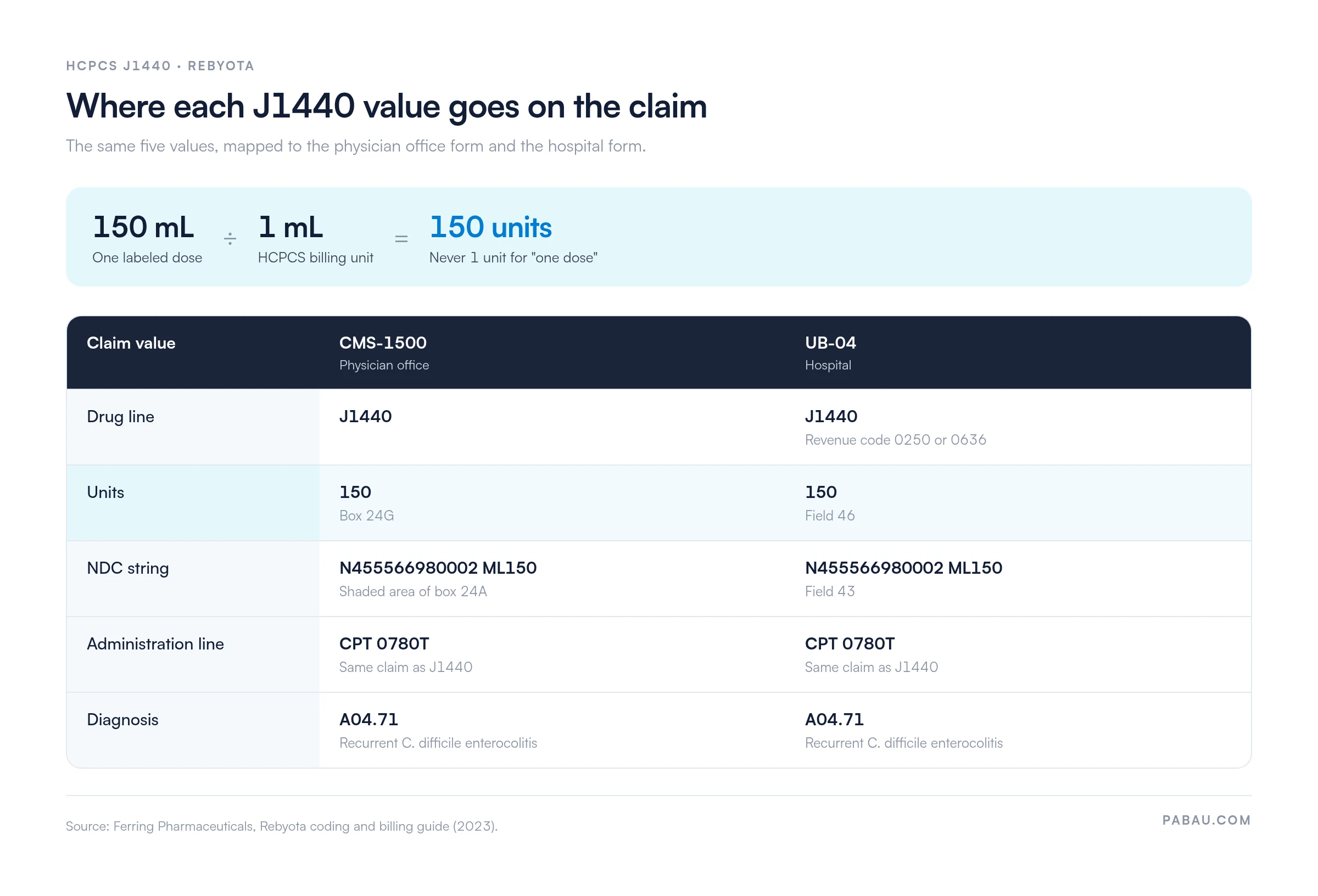
Unit errors are the costliest mistake on a J1440 claim, because a one-unit line pays for 1 mL of a 150 mL product. Ferring’s Rebyota coding and billing guide shows the claim lines below.
The 1 mL unit also limits the line. A single date of service should never show more than 150 units, because no labeled regimen goes beyond one 150 mL dose. The diagram below maps each value to its field on both claim forms.
In Pabau’s claims management software, the claim sits on the same patient record as the treatment note. Your biller can compare the J1440 units and the 0780T line with the chart before the claim goes out.
J1440 pays for the product only. The instillation is billed separately, and the code depends on the payer and the setting.
Bill J1440 and 0780T on the same claim. First Coast Service Options, a Medicare administrative contractor, warns that it rejects J1440 claims without 0780T. The rule applies to dates of service from July 1, 2023.
G0455 and CPT 44705 describe preparing a donor specimen, which a practice does for conventional fecal microbiota transplantation. Rebyota arrives as a finished product, so there is no specimen preparation to report.
Rebyota needs fewer modifiers than most J-code drugs, but two common habits cause trouble.
JW and JZ guidance for J1440 has varied between sources, so check the contractor’s JW/JZ list before the first claim. A filgrastim-era template that appends JB to every J1440 line should be retired.
Medical necessity for J1440 rests on documented recurrent CDI. Ferring lists two diagnosis codes in its billing guide.
Code A04.71 whenever the notes show a prior episode. A04.72 invites a request for records, because the policy question is whether the patient has had a recurrence. Neutropenia codes such as D70.1 belong to filgrastim claims and have no place on a J1440 claim.
Medicare Part B covers Rebyota as a drug that a clinician administers in a covered setting. Understanding medical billing fundamentals for Part B drugs helps before the first J1440 claim.
In the physician office, Medicare Part B pays J1440 at the average sales price (ASP) plus 6%. CMS sets that payment limit per 1 mL unit in its quarterly ASP pricing files.
To estimate the drug payment for one dose, multiply the current per-unit payment limit by 150. Patients on traditional Medicare usually owe 20% coinsurance on that amount.
ASP moves every quarter, so never hard-code a dollar figure in the fee schedule. Update the J1440 charge when CMS publishes each new file.
Most J1440 denials trace back to a handful of claim-build errors. Structured denial management workflows catch them before they turn into write-offs.
Payers review J1440 claims against the label and their own criteria, so the record has to show both. Sound medical billing compliance means keeping these items together on the patient record.
A well-built superbill that captures the NDC, 150 units and 0780T at the point of care keeps the claim in step with the chart. The antibiotic end time and the administration time are the two entries an auditor will compare first.
Build J1440 and 0780T as a linked pair in your charge master, with 150 units preset on J1440. Then run a monthly report for any J1440 line with fewer than 150 units or no 0780T on the same claim.
Most J1440 errors start when the drug line is typed into the claim separately from the chart. Units get entered as 1, the NDC is missing, or 0780T is left off.
In Pabau, the treatment note and the claim share one patient record. Your biller builds the J1440 line with the Rebyota administration note on the same screen, instead of working from a separate spreadsheet. Prior authorization letters and stool results can be kept on that record too, ready for an appeal.
The outcome is a claim that is easier to check against the chart before it leaves, with fewer corrected claims to work afterward.

Pabau keeps the treatment note and the claim on one patient record, so your team can check Rebyota claims against the chart before submission.

J1440 now means one product, Rebyota, and one claim shape. That shape is 150 units of J1440, the 0780T instillation on the same claim, and A04.71 backed by the antibiotic timeline.
If your charge master still links J1440 to filgrastim, fix that first. It is the error most likely to send a whole claim to the wrong product.
Lock the pairing and the unit count into your templates, and the remaining work is documentation. Book a demo to see how Pabau keeps the treatment note and the J1440 claim on one patient record.

Need to understand how claim edits work? What makes a clean claim walks through the pre-submission checks that prevent automatic denials on drug claims.
Working a high volume of J-code denials? Denial management in healthcare covers appeal workflows and root-cause tracking strategies.
Building out a compliant drug-billing workflow? Medical billing compliance outlines the documentation and audit-readiness standards that protect J-code claims.
Still holding older Rebyota claims? HCPCS code J3490 explains how the unclassified drug code is billed and documented.
HCPCS code J1440 covers fecal microbiota, live – jslm, sold as Rebyota by Ferring, billed per 1 mL. It took effect on July 1, 2023. Rebyota is used to prevent recurrent C. difficile infection in adults after antibiotic treatment.
Bill 150 units. Each unit is 1 mL, and the single labeled dose is 150 mL. Report the NDC as N455566980002 ML150 alongside the J1440 line.
Use CPT 0780T, instillation of fecal microbiota suspension via rectal enema into the lower GI tract. Some Medicare contractors reject J1440 when 0780T is not on the same claim. A few commercial payers still accept G0455, though Ferring expects it to be phased out.
No. CMS deleted the filgrastim codes J1440 and J1441 on January 1, 2014. Filgrastim (excluding biosimilars) is now J1442, per 1 mcg. Biosimilars use codes such as Q5101, Q5110 and Q5148, and tbo-filgrastim uses J1447.
Use A04.71, enterocolitis due to Clostridium difficile, recurrent. Ferring notes that most payers also accept A04.72, not specified as recurrent. A04.71 matches the recurrence-prevention indication more closely.
JA and JB describe intravenous and subcutaneous routes, so they never fit a rectal product. Ferring’s sample claim forms show JZ, meaning no drug was discarded. Confirm your contractor’s current JZ instructions, because guidance has varied.
Yes, when a clinician administers it in a covered setting such as a physician office or hospital outpatient department. In the office, Medicare pays ASP plus 6% per unit. Medicare Advantage plans commonly require prior authorization first.