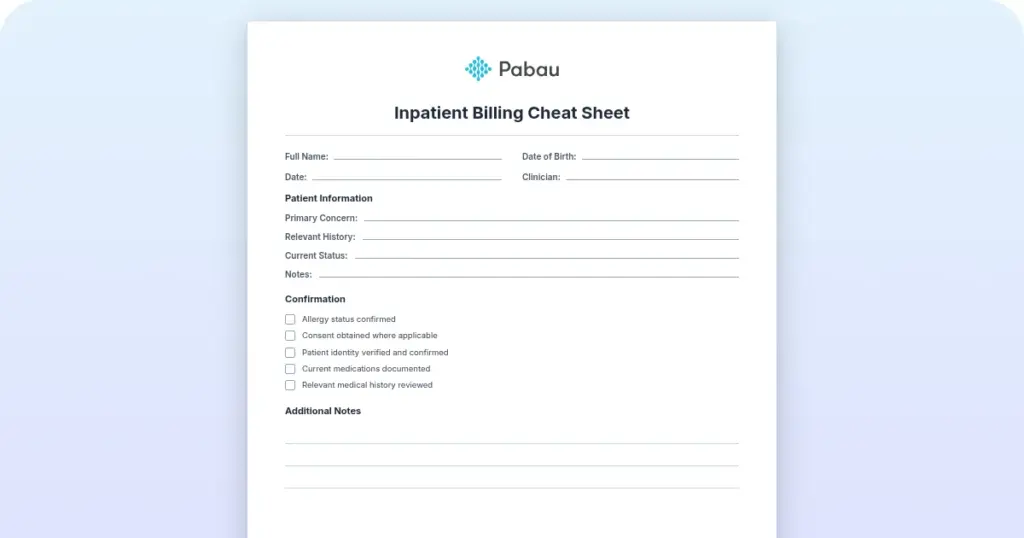
Inpatient billing cheat sheet
An inpatient billing cheat sheet is a quick reference for the codes and claim ru...

Last Updated: Oct 19, 2026
J0690 is the HCPCS Level II code for injection, cefazolin sodium, 500 mg.
The Centers for Medicare and Medicaid Services (CMS) maintains HCPCS Code J0690 under HCPCS Level II, the section of the Healthcare Common Procedure Coding System that covers drugs, supplies, and other items not captured by CPT codes.
Cefazolin is one of the most widely used perioperative antibiotics in the United States, which makes J0690 a high-frequency J-code in surgical practices, outpatient infusion centers, and hospital-based outpatient departments. Providers give it intravenously or intramuscularly to treat or prevent bacterial infections.
Let Pabau's smart automation suggest the right codes, reduce claim denials, and keep your practice compliant—effortlessly.
Automate repetitive tasks and focus on what matters most—your patients.
Reduce coding errors and ensure compliance with the latest regulations.
Clean claims, fewer denials, and faster reimbursements.
Powerful insights and reporting to help your practice thrive.
HIPAA compliant SOC 2 certified GDPR-compliant Trusted by 4,000+ clinics worldwide

HCPCS Code J0690 represents each 500 mg of cefazolin sodium administered by injection, billed per 500 mg unit administered.
A 1g dose requires 2 units; a 2g dose requires 4 units. Billing fewer units than administered is one of the most common claim errors.
JW and JZ modifiers are mandatory for Medicare Part B when single-dose vials are used. Omitting them triggers automated denial.
J0690 and J0689 are NOT interchangeable. J0689 is the Baxter-brand formulation CMS explicitly states is not therapeutically equivalent to J0690.
One unit of J0690 equals 500 mg of cefazolin sodium. Practices must bill the number of units that reflects the total dose actually administered, not the vial size purchased.
The most common unit-count error is billing 1 unit for a 1 g dose. Because the standard surgical prophylaxis dose is typically 1-2 g, practices routinely leave revenue on the table by billing half the units administered. Checking the medication administration record (MAR) against the billed units before submission catches this error before it reaches the claim.
When a vial contains more drug than the patient received, the leftover amount counts as drug wastage, so practices must handle it under the JW/JZ modifier rules covered in the next section. Billing for the full vial when staff used only part of it is a compliance violation, not just a coding error.
Run a monthly audit comparing your MAR doses against J0690 units billed. For surgical practices, flag every J0690 claim where units equal 1 and the indicated procedure would typically require a 1 g or 2 g dose. A single discovered pattern can recover thousands of dollars in underbilled claims annually.
Medicare Part B reimburses J0690 under the buy-and-bill drug administration model at Average Sales Price plus 6% (ASP+6%). CMS updates the ASP every quarter, so practices should verify the current rate using the CMS Physician Fee Schedule lookup tool before relying on any published figure.
However, commercial payers calculate reimbursement differently. Many use Wholesale Acquisition Cost (WAC) or Average Wholesale Price (AWP)-based formulas. Because these rates vary by payer contract, practices should never assume they match Medicare’s ASP+6% methodology.
Practices must bill drug administration separately from the drug itself. CPT code 96365 covers IV infusion. Code 96375 is an add-on code for each additional sequential IV push of a new substance, so it only applies alongside a primary code like 96374, never on its own.
Billing J0690 without a primary administration code is one of the top reasons for technical denials on drug claims. Practices managing IV therapy billing workflows should therefore verify that their claim templates bundle the correct administration code with every J-code drug claim.
CMS made JW and JZ modifier reporting mandatory for single-dose vial (SDV) drugs, including J0690. The CMS JW/JZ Modifier Policy document explicitly lists J0690 as a code subject to these requirements. As a result, failing to append the correct modifier triggers an automated denial under Medicare.
When a single-dose vial of cefazolin contains more drug than the patient requires, the unused portion counts as wastage. The JW modifier then flags that wastage on a separate line of the claim. Together, the administered-amount line and the wastage-amount line must equal the full vial quantity. Other single-dose-vial injectables.
When staff administer the entire contents of a single-dose vial with no wastage, they must append the JZ modifier to the J0690 claim line. This certifies to the payer that no drug went to waste. Before CMS mandated JZ, a claim with no wastage modifier left this unclear. Now, JZ removes that uncertainty and prevents audit exposure.
The JW/JZ requirement does not apply to multi-dose vials. For practices using IV therapy administration protocols, documenting vial type and confirming SDV vs. MDV status at the point of care is the cleanest way to ensure modifier selection is accurate before the claim is built.

Pabau’s claims management tools help infusion and surgical practices track drug administration, units, and modifier requirements in one place. See how it works.

CMS created J0689 specifically for cefazolin sodium manufactured by Baxter. According to the CMS JW/JZ Modifier Policy document, J0689 is explicitly not therapeutically equivalent to J0690. Because these codes aren’t interchangeable, billing J0690 when the Baxter formulation was given (or the reverse) counts as a coding error.
The correct code depends on which formulation the practice actually administered. This information comes from the purchase invoice and the NDC number on the vial. Practices that track drug inventory with lot and NDC data can check the administered product against the correct J-code at the time of claim generation, which removes this category of error.
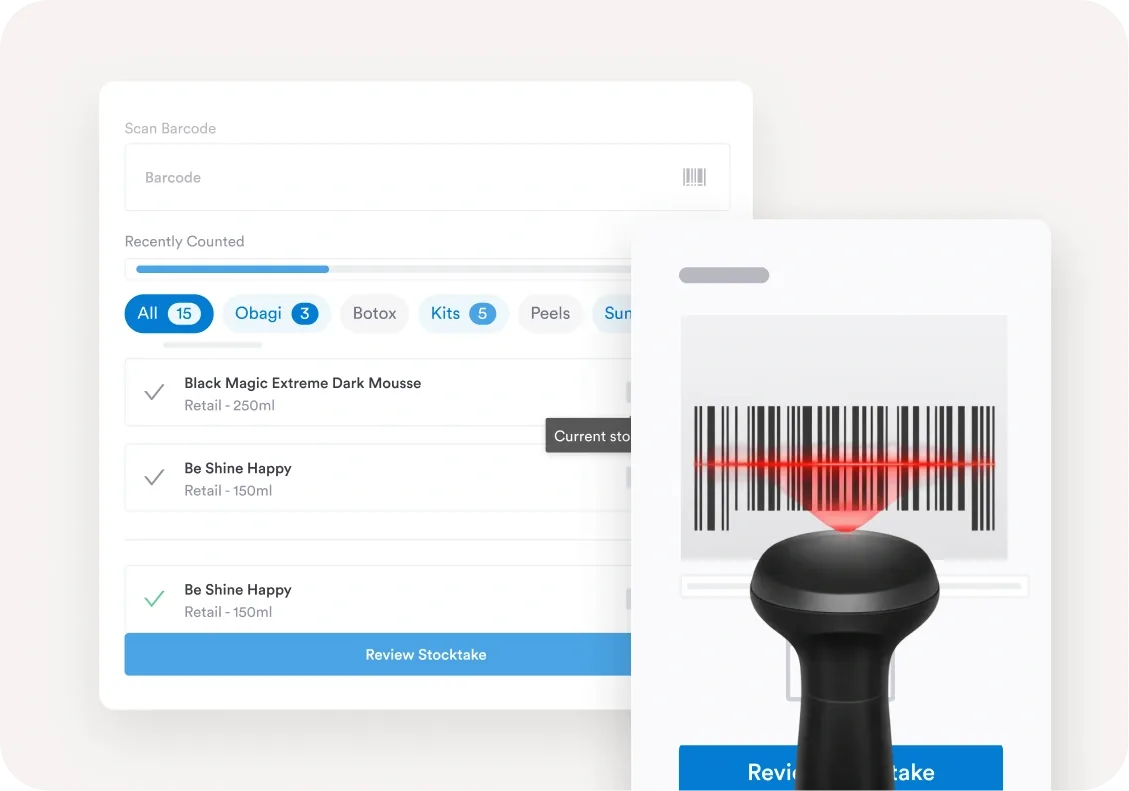
National Drug Codes (NDCs) identify the specific product, manufacturer, and packaging for a drug. HCPCS Code J0690 maps to a large number of NDC codes because multiple manufacturers produce cefazolin in several vial sizes. Some payers, particularly Medicaid programs, require NDC reporting on all drug claims in addition to the HCPCS code.
When NDC reporting is required, the claim must include the 11-digit NDC number (in 5-4-2 format), the correct NDC unit of measure, and the quantity dispensed in NDC units. Cefazolin ships as a lyophilized powder that practices reconstitute before administration, so it renders as UN (unit) on the claim, not ML. The ML unit applies to drugs supplied as ready-mixed liquids, which cefazolin is not. Getting the NDC format wrong is a common technical denial reason on Medicaid drug claims.
Practices seeing high Medicaid denial rates on J0690 should audit NDC format compliance first. Often, a missing leading zero in the manufacturer segment or an incorrect unit of measure causes a large share of NDC-related rejections. Good clinical documentation practices that capture the administered NDC at the point of care resolve this at the source.
Set up a reference sheet at the point of administration listing the NDC numbers for each cefazolin product your practice purchases, the corresponding J-code (J0690 or J0689), and the required billing format. Laminate it and keep it with the drug supply. This single step prevents the most common NDC-related denial category for injectable antibiotics.
Medical necessity is the foundation of every payable J0690 claim. Payers require documentation that the drug was medically necessary for a covered indication, actually administered, and appropriately dosed. So, these elements must appear in the patient record before the practice submits the claim, not reconstructed after a denial.
Pre-authorization requirements for J0690 vary by payer and clinical setting. Medicare generally does not require prior authorization for Part B drug claims, but commercial payers and Medicaid managed care plans often do for outpatient infusion settings.
Checking authorization requirements per payer policy before scheduling cefazolin administration prevents the most expensive category of denial: non-covered services. Practices with structured digital documentation workflows capture these elements consistently at the point of care rather than chasing records at billing time.
Understanding why J0690 claims deny is more useful than knowing how to submit a perfect claim. In practice, most denials fall into the same four patterns, on repeat.
For practices running high volumes of J0690 claims, a pre-submission claim scrubbing rule that checks for modifier presence, unit calculation, and paired administration CPT codes catches most of these errors before they reach the payer. As a result.
J0690 does not exist in isolation. Every cefazolin claim involves at least one additional code and often requires knowledge of adjacent codes in the antibiotic and drug administration category. Cephapirin sodium, another first-generation cephalosporin, was billed under HCPCS code J0710, but that code is deleted and current claims go to J3490.
Coding teams managing broad antibiotic formularies benefit from a structured reference that maps each cephalosporin J-code to its administration CPT pair. The same paired-code logic applies well beyond cefazolin, too. Ceftaroline fosamil (Teflaro), a fifth-generation cephalosporin billed under HCPCS code J0712, also bills alongside its infusion administration code.
The PGM Billing HCPCS lookup tool provides free access to CMS-sourced HCPCS data for checking code descriptions and verifying adjacent codes.
Cefazolin is one of the most frequently administered injectable antibiotics in outpatient and surgical settings, which makes clean J0690 billing essential to practice revenue. The most preventable errors, wrong unit counts, missing JW/JZ modifiers, and J0690/J0689 code confusion, all trace back to a mismatch between what happens at the point of administration and what gets captured at billing time. The right practice management software closes that mismatch by connecting clinical documentation directly to the billing workflow. A service billed to Australian Medicare needs the matching schedule item and the documentation the descriptor asks for.
Pabau’s claims management software helps practices handling injectable drug billing maintain accurate records from administration through claim submission, reducing the rework that denied J0690 claims create. To see how it fits your workflow, book a demo with the team.

Coding ear discharge in both ears? ICD-10 code H92.13 covers the billable code for otorrhea affecting both ears at once.
Billing a hypertension diagnosis without a cause? ICD-10 code I10 covers the primary hypertension code used when no underlying cause is documented.
Billing an implant or device code instead? HCPCS code A4262 covers the temporary, absorbable lacrimal duct implant, with the same unit and documentation logic applied to a different device category.
HCPCS Code J0690 is the billing code for injection, cefazolin sodium, 500 mg, used to report each 500 mg of cefazolin administered by IV or IM injection to a patient. It covers the drug cost component of cefazolin administration and must be paired with an appropriate administration CPT code (such as 96365 for IV infusion) on the same claim.
Bill 2 units of J0690 for a 1g (1,000 mg) dose. Each unit represents 500 mg, so divide the total dose in milligrams by 500 to get the correct unit count. A 2g dose requires 4 units; a 3g dose requires 6 units.
J0689 is specifically for cefazolin sodium manufactured by Baxter, while J0690 covers all other cefazolin formulations. CMS explicitly states these codes are not therapeutically equivalent and not interchangeable. The correct code depends on which manufacturer’s product was actually administered, identifiable from the NDC on the vial label.
Yes, when J0690 is dispensed from a single-dose vial under Medicare Part B. The JZ modifier certifies that the full vial was administered with no wastage. The JW modifier flags any drug discarded from the vial on a separate claim line. CMS lists J0690 explicitly in its JW/JZ Modifier Policy as subject to these requirements. Omitting both modifiers on an SDV claim results in automatic denial.
Yes, J0690 is covered under Medicare Part B as a drug administered by injection in a provider setting. Reimbursement follows the ASP+6% methodology, updated quarterly by CMS. The drug administration CPT code (96365 for infusion, or 96374 for IV push) must also be billed on the same claim for the drug charge to be processed correctly.
Multiple NDC codes map to J0690 because cefazolin is produced by several manufacturers in various vial sizes. The specific NDC depends on the product purchased. Practices should verify the NDC from the physical vial label, confirm it maps to J0690 (not J0689 for Baxter products), and report it in 11-digit format (5-4-2) when payer policy requires NDC on the claim.