CPT Code 62284: Injection procedure for myelography
CPT Code 62284: official descriptor and procedure overview The American Medical ...

Last Updated: Oct 19, 2026
A4262 is the HCPCS Level II code for temporary, absorbable lacrimal duct implant, each.
Let Pabau's smart automation suggest the right codes, reduce claim denials, and keep your practice compliant—effortlessly.
Automate repetitive tasks and focus on what matters most—your patients.
Reduce coding errors and ensure compliance with the latest regulations.
Clean claims, fewer denials, and faster reimbursements.
Powerful insights and reporting to help your practice thrive.
HIPAA compliant SOC 2 certified GDPR-compliant Trusted by 4,000+ clinics worldwide

HCPCS Code A4262 describes a temporary, absorbable lacrimal duct implant (collagen punctal plug), billed per implant unit
A4262 covers absorbable/collagen implants only; companion code A4263 covers permanent, non-dissolvable silicone plugs
Special coverage instructions apply; Medicare reimbursement is determined by your DME MAC jurisdiction and requires documented medical necessity
Pabau’s claims management software helps ophthalmic and ambulatory practices track A4262 submissions, modifiers, and denial patterns in one place
HCPCS Code A4262 captures a supply that most dry eye patients never see but frequently depend on: a temporary, absorbable lacrimal duct implant inserted into the punctum to slow tear drainage and relieve ocular surface dryness. Claims billed without the right supporting documentation are among the most common denial triggers in ophthalmic DME billing. A4262 is no exception, however. Specifically, this reference covers the code definition, clinical context, coverage rules, documentation requirements, and the A4262 vs A4263 distinction that trips up even experienced coders. Documentation that arrives after the claim raises audit risk even when the coding was correct.
CMS maintains the official descriptor under the Healthcare Common Procedure Coding System (HCPCS), and it reads: Temporary, absorbable lacrimal duct implant, each. Notably, the unit of service is per implant, so bilateral placement at a single encounter is billed as two units of A4262. Notably, the code falls within the A4200-A4999 supply code range, grouped under Other Supplies Including Diabetes Supplies and Contraceptives.
Specifically, absorbable punctal plugs are made from collagen or similar biodegradable materials. As a result, they dissolve over days to weeks, making them suitable for trial assessments before permanent occlusion, post-surgical dry eye management, or short-term symptomatic relief. The temporary nature is the defining clinical characteristic that separates A4262 from A4263. In contrast, A4263 covers non-dissolvable implants.
CPT Code 68761 (closure of lacrimal punctum by plug, each) describes the procedure of inserting the plug. HCPCS A4262, however, reports the supply separately. In the physician office setting, whether both can be billed together depends on NCCI (National Correct Coding Initiative) edit rules and your payer’s bundling policy. Therefore, check your DME MAC’s local coverage guidance before submitting both on the same claim.
For ophthalmic practices managing multiple procedure types.
Selecting between these two codes is a clinical documentation decision, not a coder judgment call. Specifically, the implant type placed determines the code, and the medical record must clearly state which material was used.
The clinical workflow usually runs in sequence. First, insert a temporary A4262 plug to assess patient response, then graduate to a permanent A4263 implant if the patient tolerates occlusion and reports symptomatic improvement. In that case, billing both codes for the same punctum on the same date requires clear documentation. This should show two distinct implants were placed — for example, upper and lower puncta.
For related coding context on other ophthalmic supply codes.
HCPCS Code A4262 coverage varies across payers, and the coverage instructions attached to this code require active attention. CMS flags the code with a “special coverage instructions apply” designation. This means reimbursement under Medicare Part B follows local coverage determinations (LCDs) set by each DME MAC jurisdiction rather than a single national policy.
In total, four DME MAC jurisdictions administer Medicare Part B coverage for supply codes like A4262. Jurisdiction A and Jurisdiction D are administered by Noridian; Jurisdiction B and Jurisdiction C are administered by CGS. The CGS DME MAC Jurisdiction C Supplier Manual confirms A4262 appears on the active HCPCS fee schedule for covered supply items. Before submitting, therefore, verify that your practice’s geographic location falls under the correct jurisdiction and review that jurisdiction’s LCD for lacrimal punctal plugs.
For this reason, use the CMS Physician Fee Schedule lookup tool to confirm current allowed amounts for A4262 by Medicare locality. Fee schedule figures change each year, so always verify against the current year’s data before quoting payment amounts to patients or building them into revenue projections.
Commercial payers set their own quantity limits and coverage rules separately from Medicare. United Healthcare (UHC), for example, assigns a quantity limit of 2 units to A4262 per the UHC HCPCS policy list, reflecting the bilateral anatomy of the lacrimal system. Exceeding a payer’s quantity limit without prior approval is a common denial reason.
Additionally, each state determines its own Medicaid coverage. CMS policy confirms that Medicaid programs define their own coverage levels and are not required to follow Medicare rules for supply codes. Instead, check your state Medicaid fee schedule directly before assuming coverage mirrors Medicare.
Practices seeing high volumes of ophthalmic DME claims benefit from a consistent tracking approach.
Run a quarterly audit of your A4262 claims against your DME MAC jurisdiction’s active LCD. Coverage policies for supply codes update independently of the annual HCPCS revision cycle, and an outdated policy assumption can trigger backdated repayment requests.
An inventory management tool flags when supply usage and supply billing drift apart.
Overall, medical necessity documentation is the most common failure point for A4262 claims. Payers require evidence that the implant was clinically indicated, appropriately selected over other treatments, and placed by a qualified provider. The medical record must support all three.
Practices using electronic client records with set clinical note templates can capture these documentation elements consistently at the point of care, making audit defence straightforward. For coding workflow support across multiple specialties.
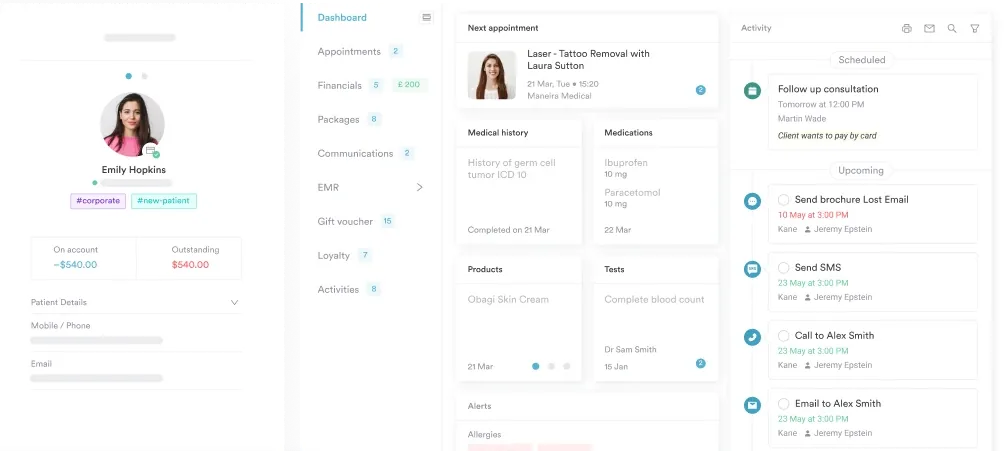

Pabau helps ophthalmic and ambulatory care practices manage A4262 documentation, track claim submissions, and catch coding errors before they reach the payer. See how it works for your billing workflow.

In practice, getting A4262 paid requires more than correct code selection. In addition, the claim needs the right modifiers, an accurate place of service, and a sequenced diagnosis that directly supports medical necessity. Here is how a clean A4262 claim is structured.
For reference on how similar supply code workflows are managed across specialties, the intraparenchymal hemorrhage ICD-10 coding guide and autism ICD-10 code reference show paired diagnosis-to-procedure documentation strategies relevant across claim types.
Generally, denials for A4262 cluster around three patterns: medical necessity (documentation insufficient to establish dry eye severity), quantity limit exceeded (bilateral units submitted without authorization), and code mismatch (A4263 placed but A4262 billed, or vice versa). In each case, a different appeal strategy is needed.
For medical necessity denials, attach the treating clinician’s note showing clear dry eye findings (Schirmer test results, corneal staining scores) alongside the A4262 claim on appeal. Quantity denials require the bilateral placement note documenting each punctum treated. When appealing a code mismatch denial, review the operative or procedure note against the product’s manufacturer documentation and recode if necessary before resubmitting.
Use the PGM Billing HCPCS lookup tool to verify current code properties and any active billing notes for A4262 before preparing an appeal.
Flag every A4262 denial by denial reason code and track them monthly. If medical necessity denials exceed 15% of submissions, the issue is documentation at the point of care, not coding. Bring the pattern to the clinician’s attention with a specific documentation checklist rather than a general reminder.
Understanding where A4262 sits within the wider coding landscape helps practices build complete, accurate claims and avoid under-coding or over-coding related services.
For additional crosswalk guidance, the AAPC Codify HCPCS lookup provides crosswalk data linking A4262 to related CPT, ICD-10, and NCCI edit information in one search. Practices managing electronic health records and billing workflows in a single system reduce the data entry errors that arise when coders work from separate reference tools. Pabau’s integrated client record keeps clinical documentation and billing data linked within one platform, so the diagnosis documented during the encounter automatically carries through to the claim.
HCPCS Code A4262 is a straightforward supply code that becomes complicated in practice by the clinical specificity payers demand. The absorbable/permanent distinction, bilateral unit counting, DME MAC jurisdiction rules, and NCCI bundling considerations all create denial risk when not managed systematically.
Pabau’s claims management software helps ophthalmic and ambulatory practices build documentation workflows that capture the laterality, implant type, and diagnosis specificity A4262 claims require. To see how it fits your billing operations, book a demo with the Pabau team.

Still billing IMRT delivery with G6015? IMRT delivery billing guide explains why G6015 was deleted in 2026 and the setting and companion-code errors that cause denials.
Billing a positive depression screening result? Positive depression screen billing guide covers G8431 and the charting gap, an undocumented follow-up plan, that causes most denials.
Documenting a negative depression screening result? Negative depression screening guide covers G8510, the Measure 134 code for a negative screen, and how it differs from G8431.
HCPCS Code A4262 is used to bill for a temporary, absorbable lacrimal duct implant (collagen punctal plug) inserted to slow tear drainage in patients with dry eye disease or related lacrimal conditions. It is billed per implant, so bilateral placement generates two units.
A4262 covers temporary, absorbable implants (typically collagen) that dissolve over days to weeks. A4263 covers permanent, long-term, non-dissolvable implants (typically silicone) that remain in place until physically removed. The choice between codes is driven by the implant material documented in the clinical note, not by the coder’s preference.
Medicare Part B coverage for HCPCS Code A4262 is subject to special coverage instructions and varies by DME MAC jurisdiction. Coverage is not guaranteed nationally; each jurisdiction publishes local coverage determinations (LCDs) that define medical necessity criteria. Verify with your specific DME MAC (Noridian for Jurisdictions A and D; CGS for Jurisdictions B and C) before submitting.
The most commonly paired ICD-10 codes are H04.121 (dry eye syndrome, right lacrimal gland), H04.122 (left), H04.123 (bilateral), and H04.119 (unspecified). Select the code that matches the clinical documentation, including laterality, to avoid medical necessity denials.
Whether A4262 (the supply) and CPT 68761 (the insertion procedure) can be billed on the same claim depends on NCCI edit rules and your specific payer’s bundling policy. Some payers bundle the supply cost into the procedure payment; others allow separate billing. Verify through your DME MAC’s coverage guidance and NCCI edits before submitting both codes together.